TL;DR
Choosing between outsourced vs in-house SOP consulting affects your compliance readiness, operational accuracy, and long-term costs more than most organizations realize. Your internal SOP team brings institutional knowledge and faster iteration on routine updates. External SOP consulting delivers specialized expertise, unbiased gap analysis, and scalable capacity when your processes are complex or your team is stretched. A hybrid model works best for most growing organizations. Read this guide to compare both options across cost, risk, scalability, and performance metrics, so you can make the right call for your business.
Outsourced vs In-House SOP Consulting Guide
You wouldn’t hire a plumber to wire your electrical panel. The same logic applies to SOP consulting. Yet many organizations assign SOP development to whoever happens to be available, with little thought about whether that person, or team, is the right fit for the job.
Here’s the thing: the quality of your standard operating procedures directly shapes how your operations run, how audits go, and how quickly your team can scale. Choosing between outsourced vs in-house SOP consulting isn’t just a budget conversation. It’s a strategic decision that affects compliance, consistency, and long-term efficiency.
This guide breaks down both options with real cost data, decision criteria, hybrid models, and performance metrics. Whether you handle SOP services with an internal team or hire an outside SOP consultant, you’ll walk away knowing exactly which approach fits your situation.
Outsourced vs In-House SOP Consulting: Key Differences
At its core, the difference comes down to who owns the work, who does it, and who’s accountable when something goes wrong.
An internal SOP team is built from your own staff. They know your culture, your tools, and your workflows. An external SOP consulting firm brings specialized process knowledge, regulatory experience, and fresh eyes, but they need time to learn your business before they can contribute meaningfully.
The outsourced vs in-house SOP consulting debate often gets reduced to cost. That’s a mistake. Cost is one factor, but expertise gaps, scalability, and compliance exposure carry equal weight.
Here’s the quick version before we go deep:
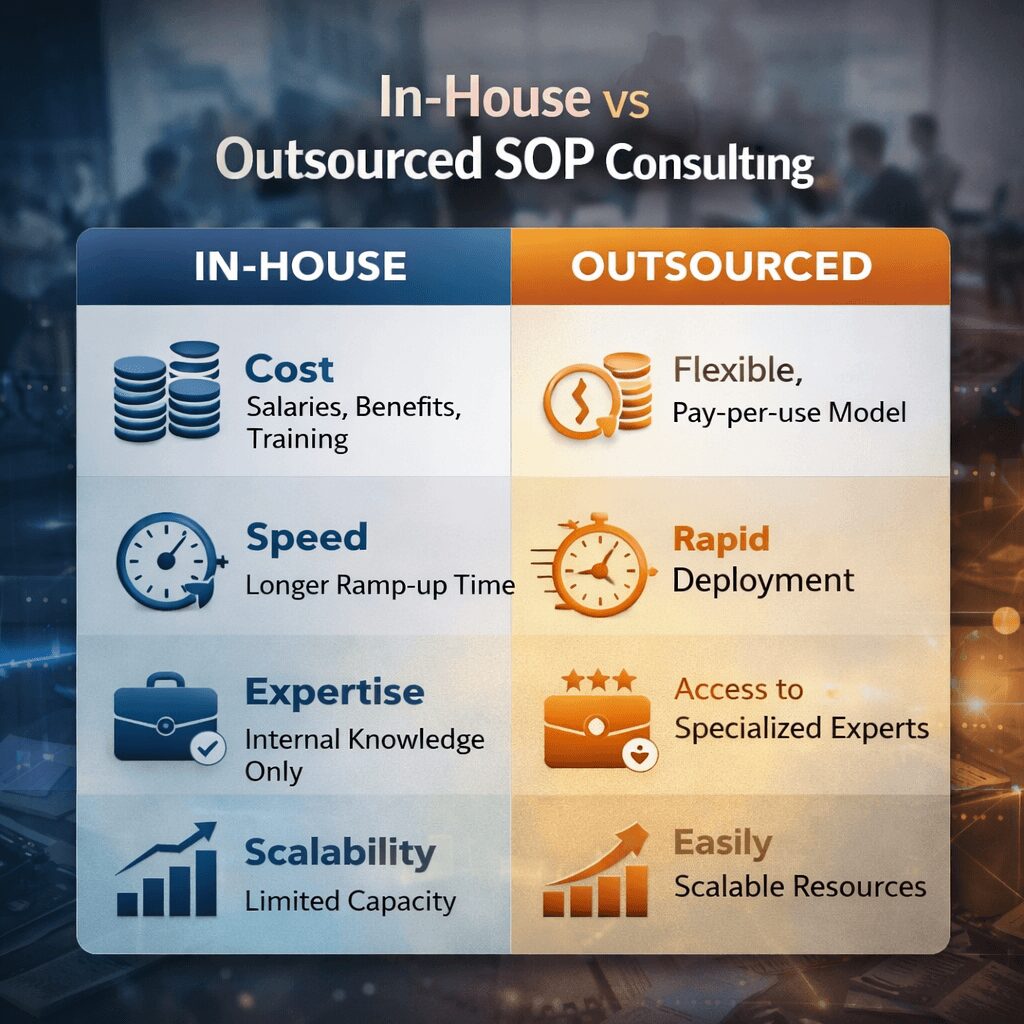
| Factor | In-House | Outsourced |
| Objectivity | Lower (familiarity bias) | Higher (independent view) |
| Domain knowledge | Deep internal context | Broad industry expertise |
| Cost structure | Fixed (salaries + overhead) | Variable (project-based) |
| Scalability | Limited by headcount | Scales with scope |
| Compliance coverage | Depends on team skills | Often wider and more current |
| Turnaround speed | Usually faster for minor changes | Faster for large-scale builds |
What Is In-House SOP Consulting?
In-house SOP consulting means your internal team, whether dedicated SOP writers, process managers, or subject matter experts, takes ownership of creating, reviewing, and maintaining your standard operating procedures.
This model works best when your processes are well-documented, your team has SOP experience, and your regulatory environment is stable. Your internal team understands the nuances of your operations that no outsider can replicate quickly.
That said, the internal SOP team model carries real risks when staff turnover is high, expertise is narrow, or your documentation needs to scale fast.
What Is Outsourced SOP Consulting?
External SOP consulting means engaging a specialized firm or independent consultant to develop, audit, or revise your SOPs. These professionals bring cross-industry experience, often having worked across multiple regulatory frameworks and business types.
External SOP consulting is particularly useful when you’re entering new markets, dealing with novel processes, preparing for a compliance audit, or simply don’t have internal bandwidth to handle the workload.
You can learn more about what this covers through dedicated sop consulting services that address everything from process design to final documentation handover.
What Does an SOP Consultant Actually Do?
People search for “SOP consultant” and “SOP services” without a clear picture of the work involved. So here’s the plain version.
An SOP consultant maps your real workflows, interviews the people who run them, finds the gaps between what’s documented and what actually happens, and writes procedures that hold up under audit. Good ones bring templates, a review methodology, and regulatory knowledge your team may not carry in-house.
The engagement usually runs in four stages: discovery interviews, workflow mapping, drafting and review, then handoff with a maintenance plan. That last stage matters most. A consultant who writes procedures and vanishes leaves you worse off than before. Ask any SOP consultant how they handle knowledge transfer before you sign anything.
SOP Consulting vs SOP Review vs SOP Development
These three terms get used as if they’re the same thing. They aren’t, and picking the wrong one wastes budget.
| Service | What it covers | When you need it |
| SOP consulting | Full advisory: strategy, which procedures to build, how to structure the whole system | You don’t know where to start or what you’re missing |
| SOP development | Writing the procedures from scratch, mapping workflows into documents | You know what you need but lack the people or time to write it |
| SOP review | Auditing existing procedures for gaps, compliance, and consistency | You already have SOPs but aren’t sure they hold up |
Most organizations need more than one. A common path: consulting to set direction, development to build the library, then a recurring SOP review process to keep it current. Getting the sequence right is half the value.
Pros and Cons of In-House SOP Consulting
Advantages of Internal SOP Teams
Your internal team already knows how things work. That institutional knowledge is irreplaceable and often the deciding factor in SOP accuracy.
Here’s what an internal SOP team does well:
- Faster turnaround because no onboarding is needed
- Stronger alignment with company culture and terminology
- Lower per-project cost for routine updates
- Easier communication and real-time feedback loops
- Greater accountability since the team lives with the output
For organizations in stable regulated environments, internal teams can maintain a consistent SOPs review cycle without the overhead of repeated vendor engagements.
Limitations of In-House Consulting
The risks of in-house SOP only become visible over time, often during an audit or a process failure.
Common limitations include:
- Skill gaps: Most internal teams don’t specialize in SOP writing
- Objectivity gaps: Familiarity with a process can create blind spots
- Bandwidth limits: SOP work competes with day-to-day responsibilities
- Scalability challenges: Hiring delays slow SOP development during growth phases
- Outdated content: SOPs can drift from current regulations without a formal review cycle
These aren’t minor inconveniences. In regulated industries, a non-compliant SOP can trigger inspection findings, liability exposure, or operational shutdowns.
There’s a name for the objectivity problem too. Audit literature calls it familiarity bias, and it’s a documented risk in quality management. When you’re too close to a process, the broken parts stop looking broken. Your team stops seeing the step everyone skips because everyone has always skipped it.
Prima Consulting
Not sure whether your team can spot its own SOP blind spots? Our advisory team offers a free initial consultation.
No obligation · Responds within 1 business day · GCC, Europe & APAC
Pros and Cons of Outsourced SOP Consulting
Benefits of External SOP Experts
External SOP consulting firms see patterns across industries that your internal team can’t. That breadth of experience translates directly into better process design and fewer compliance blind spots.
The benefits of SOP consulting through an external provider include:
- Access to specialists with cross-industry regulatory knowledge
- Unbiased gap identification that internal teams often miss
- Faster ramp-up for novel processes or new geographic locations
- Scalable capacity that adjusts to your project volume
- Structured handoff documentation for knowledge transfer
According to the Wipfli 2024 Outsourcing Trends Report, 93% of organizations that outsourced business functions reported satisfaction with the experience. That’s not a small number.
Risks of Outsourcing SOP Development
Outsourcing isn’t without risk. The biggest challenge is that external consultants don’t know your business from day one.
Key risks to plan for:
- Information sharing friction: Consultants need full access to process details, which requires a solid NDA and structured onboarding
- Longer review cycles: Complex processes mean more back-and-forth before sign-off
- Cultural misalignment: A consultant unfamiliar with your team’s language can produce technically correct but practically confusing SOPs
- Post-project accountability gaps: Once the engagement ends, ownership reverts to your team
Selecting the right SOP consulting firm matters more than many realize. Vetting for regulatory fit, industry experience, and communication style reduces most of these risks significantly.
One reality check worth keeping in mind: cost savings don’t always land the way people expect. ISG Market Lens data from March 2024 found only 38% of enterprises rated their outsourcing cost savings as very good or excellent, even though cost reduction is usually the top reason they outsourced in the first place. So go in with clear expectations. Outsourcing buys you expertise and speed first. Savings come second, and only when the engagement is scoped well.
Cost Comparison: In-House vs Outsourced SOP Consulting
Short-Term vs Long-Term Cost Impact
Short-term, in-house looks cheaper. You’re paying existing salaries, not consultant fees. But the full picture changes when you factor in the actual hours spent and what those hours cost.
A mid-level internal SOP writer spending 20 hours per week on documentation represents a significant resource allocation, often pulling attention from core responsibilities. External SOP consulting has a higher sticker price but often delivers faster turnaround and lower error rates, which reduces rework costs.
Long-term, organizations that invest in structured external SOP consulting during growth phases often find it more cost-effective than building an in-house capability from scratch.
What the Numbers Actually Look Like
Vague cost talk helps nobody. So here are real figures. Boutique consulting firms typically charge between $20,000 and $40,000 for SMB-level SOP documentation projects. Individual consultants run $75 to $200 per hour.
On the in-house side, the cost hides inside salaries. If a mid-level operations manager earning $80,000 a year spends 30% of their time on SOP writing for three months, that’s roughly $6,000 in diverted labor. And that figure ignores the productivity you lose everywhere else while your people write procedures instead of doing their jobs.
The ROI case for outsourcing is stronger than most in-house advocates admit. HR outsourcing data compiled in 2025 put average ROI at 191% for large businesses, 175% for mid-sized organizations, and 150% for small businesses. Those aren’t rounding-error returns.
Hidden Costs to Consider
Most cost comparisons miss the hidden expenses on both sides.
For internal SOP teams:
- Training costs for non-specialist writers
- Management time spent reviewing and correcting output
- Compliance penalties from outdated or non-compliant SOPs
- Productivity loss when core staff are pulled into documentation work
For outsourced SOP consulting:
- Onboarding time and knowledge transfer sessions
- Revision cycles if initial drafts miss internal context
- Contract management overhead
The honest answer is that neither model is universally cheaper. The right choice depends on your process complexity, timeline, and internal capacity.
What Bad SOPs Actually Cost
Here’s the number that should end the “in-house is cheaper” argument for anyone in a regulated or systems-heavy business. When The Hershey Company rolled out a new ERP system internally in 1999 without proper process documentation and training, it lost $112 million in revenue in a single quarter. Critical data and process gaps sat at the center of that failure.
That’s the tail risk nobody prices in. A cheap internal SOP project that skips expert input can cost multiples of what a consultant would have charged, all in one bad quarter. Research on DIY software implementations found a 33% failure rate, usually tied to weak process documentation and training. The pattern repeats across SOP work.
Time: Which Option Actually Moves Faster?
Time is the resource you can’t buy back. For most businesses, it’s the real deciding factor, not cost.
Build SOPs internally and the timeline bends to your team’s availability. For a company with 10 to 20 core processes, an internal team doing this part-time often needs four to eight months to produce usable documents. Then add review, revision, formatting, and approvals, and it stretches further.
A dedicated external team working full-time can often finish the same scope in four to eight weeks. Experienced consultants bring templates, interview frameworks, and structured workflows that erase the learning curve.
But speed cuts both ways. Rush SOPs without real stakeholder input and you get documents that look sharp and describe a process nobody actually follows. The best outsourced engagements always build in structured interviews with your frontline staff. Skip that, and fast just means fast to useless.
When Should You Choose In-House SOP Consulting?
In-house SOP consulting makes the most sense when your team already has the expertise, your processes are stable, and you’re doing ongoing maintenance rather than building from scratch.
Choose an internal SOP team when:
- Your team includes experienced SOP writers or process analysts
- You’re updating existing procedures rather than creating new ones
- Your regulatory environment is well-established and familiar to your staff
- You have a formal SOPs review cycle already in place
- Your SOP volume is manageable within current bandwidth
- Your SOPs contain highly sensitive IP that you’d rather not expose to a third party
In short, if your internal team has the skill and the time, keeping SOP development in-house gives you more control and faster iteration.
When Is Outsourced SOP Consulting the Better Option?
There are specific situations where external SOP consulting clearly delivers better results than keeping everything internal.
Consider hiring SOP consultants when:
- You’re building an SOP library from scratch and lack internal expertise
- You’re preparing for a regulatory audit or inspection
- Your organization is entering a new market or launching a new product line
- You need to complete a large documentation project within a tight deadline
- Your internal reviews consistently flag compliance gaps
- You want an unbiased perspective on current process documentation
Many organizations also turn to external SOP consulting after a failed audit. At that point, speed and accuracy matter more than cost, and a specialist firm can often deliver both.

Quality, Compliance, and IP Risk
Why Consistency Breaks Down In-House
One of the biggest risks of in-house-only SOP work is inconsistency. When different departments write and review their own procedures without a central standard, you end up with SOPs that conflict, use different terminology, and apply different approval thresholds.
An external SOP consultant brings one standardized methodology. Every procedure gets measured against the same criteria. That consistency is exactly what an auditor wants to see, and exactly what’s hardest to produce when six people in six departments each do it their own way.
Protecting Your Data and IP When You Outsource
This is the concern that keeps some teams internal, and it’s a fair one. Your SOPs hold proprietary workflows, financial controls, and operational detail you’d never want a competitor to see.
If you outsource, you need airtight NDAs, clear data-handling terms, and a vendor with a documented security track record. Ask the hard questions before you sign. How do you store and delete client SOP data? What happens if there’s a breach? Who owns the documents once the work is done? These aren’t optional. A firm that can’t answer them cleanly isn’t ready to hold your process data.
Can You Combine In-House and Outsourced SOP Consulting?
Hybrid SOP Consulting Model Explained
Yes, and for many organizations, this is the most practical approach. The hybrid SOP consulting model pairs your internal team with external specialists on a project or function basis.
Here’s how it typically works:
- Your internal team handles day-to-day SOP maintenance and updates
- External consultants step in for new process development, compliance audits, or specialization gaps
- Knowledge transfer sessions bring internal staff up to speed after each external engagement
This setup gives you the cost advantage of internal maintenance with the expertise advantage of specialized consulting when it matters most.
Integrating consultants with your team works best when roles are clearly defined from the start. Who owns the final document? Who approves changes? Getting those answers in writing before the engagement begins prevents most friction.
Split Authoring and Reviewing
One split that works especially well: keep authoring internal, bring review external. Writing SOPs and reviewing them are two different disciplines, and they don’t have to belong to the same team.
Many organizations write procedures in-house, where the process knowledge lives, then hand them to an outside reviewer to stress-test before rollout. Authorship stays close to the work. A fresh, objective lens checks the final product. You can read more on how the SOP review process works when it’s structured this way. It’s a clean way to get objectivity without giving up ownership.
Free Consultation
Want a hybrid model mapped to your team?
Prima’s advisors work with organisations across the GCC, Europe, and Asia-Pacific. First conversation is always free, no pitch, just expertise.
How to Choose the Right SOP Consulting Approach
Key Decision Factors and Checklist
Use this checklist to work through the decision:
- Do you have internal staff with SOP writing experience? (Yes = in-house; No = consider external)
- Is your SOP need ongoing or project-based? (Ongoing = in-house; Project = external)
- Do you have an upcoming audit or compliance deadline? (Yes = external SOP consulting)
- Are you entering a new industry or geography? (Yes = external SOP consulting)
- Is your documentation volume manageable within current bandwidth? (Yes = in-house)
- Do your current SOPs have known compliance gaps? (Yes = external review or hybrid)
Prima’s SOP consulting team runs this assessment for organizations that want the gap mapped before they commit to a model. The benefits of sop consulting go beyond just documentation quality. They include faster compliance readiness and cleaner audit trails.
Questions to Ask Before You Hire a Consultant
Not all SOP consulting firms are equal, and the sales deck won’t tell you which is which. Go deeper. Ask any firm you’re considering:
- What industries have you written SOPs in, and what were the outcomes?
- How do you handle knowledge transfer after the work is done?
- Can you show examples of findings and how they were resolved?
- How do you protect client IP during and after the engagement?
- What’s your process for handling compliance gaps you find?
The answers tell you far more than any proposal document. A firm that dodges the IP and knowledge-transfer questions is telling you something. Listen to it.
How to Measure SOP Consulting Success (KPIs)
Performance Metrics for In-House Teams
Without the right KPIs, you won’t know if your internal SOP team is performing well until something goes wrong.
Track these metrics for internal teams:
- SOP review cycle completion rate: Are scheduled reviews actually happening?
- Time to publish: How long does it take from draft to approved SOP?
- Audit finding rate: How many compliance findings trace back to SOP issues?
- Version control accuracy: Are outdated versions being replaced consistently?
- Staff onboarding time: Are new employees getting up to speed faster with updated SOPs?
Performance Metrics for Outsourced Consultants
Service-level expectations for SOP consultants should be defined in the contract before work begins.
Key metrics to track:
- Deliverable quality: How many rounds of revision are needed per SOP?
- Timeline adherence: Are project milestones being hit on schedule?
- Regulatory alignment: Do finished SOPs pass your internal compliance review?
- Knowledge transfer effectiveness: Can your internal team maintain the SOPs post-engagement?
- Consulting ROI: What’s the measurable cost reduction or compliance improvement post-engagement?
The Deloitte 2024 Global Outsourcing Survey found that 83% of executives are using or planning AI-powered outsourcing, with 67% already applying it to operations and process work. That shift is changing how SOP consulting engagements are scoped and delivered.
If you want the four numbers that matter most, track these across any model: time to first draft, adoption rate, error frequency after implementation, and compliance audit results. Those four tell you more than any framework will.
Explore our advisory services
Common Mistakes in SOP Consulting Decisions
Planning an SOP consulting engagement without addressing these pitfalls leads to avoidable failures.
Watch out for:
- Choosing based on cost alone: The cheapest option often becomes the most expensive one after rework and compliance fixes
- No defined scope: Starting without a clear list of which SOPs need to be created or updated leads to scope creep
- Skipping the NDA and information-sharing process: Consultants can’t write accurate SOPs without access to real process data
- No internal champion: External SOP consulting projects fail when no one internally owns the relationship
- Ignoring change management: New SOPs need staff buy-in to be followed, not just written and filed
- No post-engagement plan: When the consultants leave, who maintains the SOPs? That question needs an answer before the project starts
A formal SOPs Review before launching any consulting engagement helps you understand what you already have, what needs updating, and where the real gaps are.
FAQs: Outsourced vs In-House SOP Consulting
Which is more cost-effective for SOP development?
It depends on your scale and timeline. For routine updates to existing procedures, internal teams are generally more cost-effective. For building a new SOP library, preparing for audits, or tackling regulatory-heavy documentation, external SOP consulting typically delivers better ROI due to speed and specialization.
How do you ensure quality in outsourced SOP consulting?
Start with a detailed scope of work and clear service-level expectations for SOP consultants. Require draft reviews at multiple stages, not just a final submission. Include a structured handoff process so your internal team can maintain the documents post-engagement. Selecting a firm with direct experience in your regulatory environment also reduces quality risk significantly.
Do I need an SOP consultant or an internal team?
Hire an SOP consultant when you’re building from scratch, facing an audit, entering a new market, or your internal reviews keep missing gaps. Keep it internal when your processes are stable, your team has SOP writing skill and spare bandwidth, and your documentation is highly sensitive. If your answers split both ways, a hybrid model fits: internal maintenance, external expertise for the hard parts.
What does SOP consulting cost per project?
Individual SOP consultants typically charge $75 to $200 per hour. Boutique firms price SMB documentation projects between $20,000 and $40,000, depending on how many processes and how much complexity. In-house looks cheaper but hides cost in staff time: a manager spending 30% of three months on SOP work is roughly $5,000 to $10,000 in diverted labor before productivity loss.
Is in-house SOP consulting scalable?
It can be, but scaling internal SOP capacity requires dedicated hiring, training, and process infrastructure. Most small to mid-size organizations find that business process outsourcing for SOP development is more scalable during growth phases. Once internal volume and expertise reach a sustainable level, transitioning to a hybrid model makes sense.
How long does it take to create SOPs?
For a mid-sized organization, internal SOP creation usually takes four to eight months when handled part-time by existing staff. A dedicated external team working full-time on the same scope can often deliver within four to eight weeks. Complexity, stakeholder availability, and review cycles affect the timeline on both sides.
How much does SOP consulting cost?
In-house costs hide inside staff time. A manager spending 30% of their time on documentation for three months represents roughly $5,000 to $10,000 in diverted labor, before productivity loss elsewhere. External consultants typically charge $75 to $200 per hour, while boutique firms price SMB projects between $20,000 and $40,000. Your real comparison depends on your team’s fully loaded hourly rate and how long internal work actually takes.
Relevance of IAS 19 Valuation in SOP Consulting Decisions
You might wonder what IAS 19 has to do with SOP consulting. More than you’d expect.
IAS 19 governs the accounting treatment of employee benefits, including post-employment benefit obligations. When organizations use actuarial assumptions to calculate these liabilities, the underlying data and processes need to be documented with the same rigor as any other regulated procedure.
For businesses with defined benefit plans, outsourced vs in-house SOP consulting decisions can directly affect the quality of the process documentation that supports IAS 19 valuations. Poorly maintained SOPs around benefit plan administration, data collection, and reporting create audit risk and valuation inaccuracy.
A SOP strategy firm with experience across finance and actuarial services can document these processes in a way that satisfies both operational and regulatory requirements. That’s particularly relevant for organizations in insurance, financial services, and pension administration.
Making the Right Call on Outsourced vs In-House SOP Consulting
The outsourced vs in-house SOP consulting decision isn’t one-size-fits-all. Internal teams work well when expertise and bandwidth align with the workload. External SOP consulting delivers the most value when complexity, compliance pressure, or scale exceeds what your team can handle internally.
The hybrid model offers the best of both in most growing organizations, pairing your institutional knowledge with specialist capability.
Start with a clear picture of what you have. Then decide what you need. If the gap between those two points is larger than your team can close alone, working with a qualified SOP strategy firm is the right move.
Prima’s SOP consulting team helps organizations across industries design, document, and maintain SOPs that hold up under regulatory scrutiny. Connect with our team to find the right approach for your business.
Who we are
50+ years of combined IFRS, risk, and actuarial expertise
Prima Consulting serves banks, insurers, and corporates across Saudi Arabia, UAE, Pakistan, Ireland, and Europe, delivering IFRS advisory, ECL modelling, risk management, and audit support.