









































IAS 19 Actuarial Valuation Software Built for EOSB and Gratuity

Prima's IAS 19 actuarial valuation software takes your team from spreadsheet-and-wait to signed, audit-ready EOSB reports produced in-house, in minutes.

Prima Consulting built this tool from its own IAS 19 engagements across Saudi Arabia, the UAE, and Pakistan.

The people who run valuations for clients are the people who designed the software.

Why Finance Teams Need IAS 19 Actuarial Valuation Software

IAS 19 actuarial valuation software is a tool that calculates a company’s defined benefit obligation for employee end-of-service benefits, applies the Projected Unit Credit method, and produces a signed, disclosure-ready report without an external actuary running each cycle by hand.
Most teams still run EOSB the slow way. A fragile spreadsheet, one person who understands it, and a wait for an outside actuary every close.
  • Our EOSB file lives in one workbook only one person can open safely
  • We wait weeks for the consultant, and the audit clock is already running
  • Every assumption change means another invoice and another round trip
  • Sensitive salary and demographic data leaves the building to reach the actuary
  • When the auditor pushes back, we cannot reproduce last year’s numbers from memory
  • A single formula slip in the workbook can quietly move the whole liability
See the software run on a sample of your own workforce
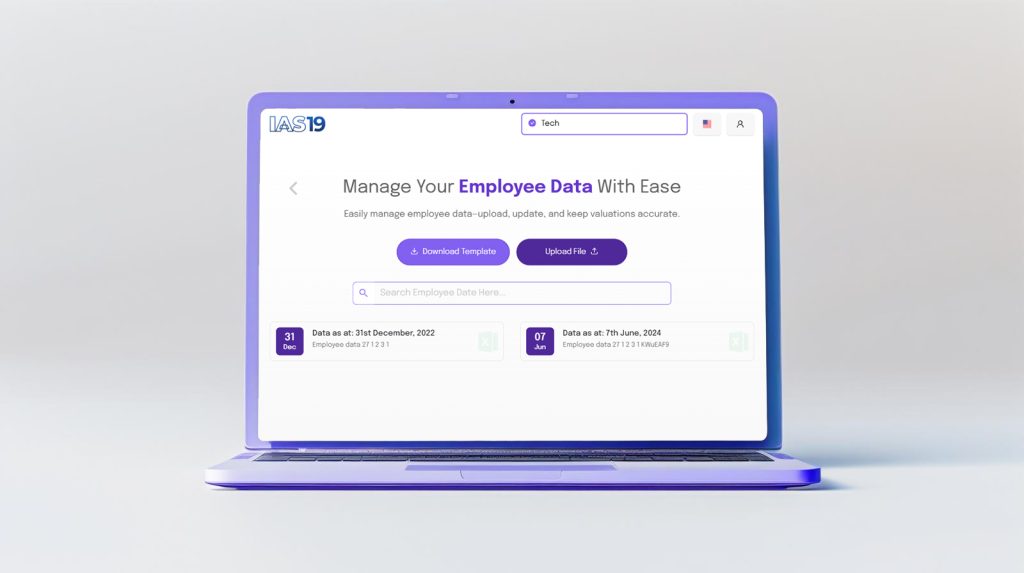
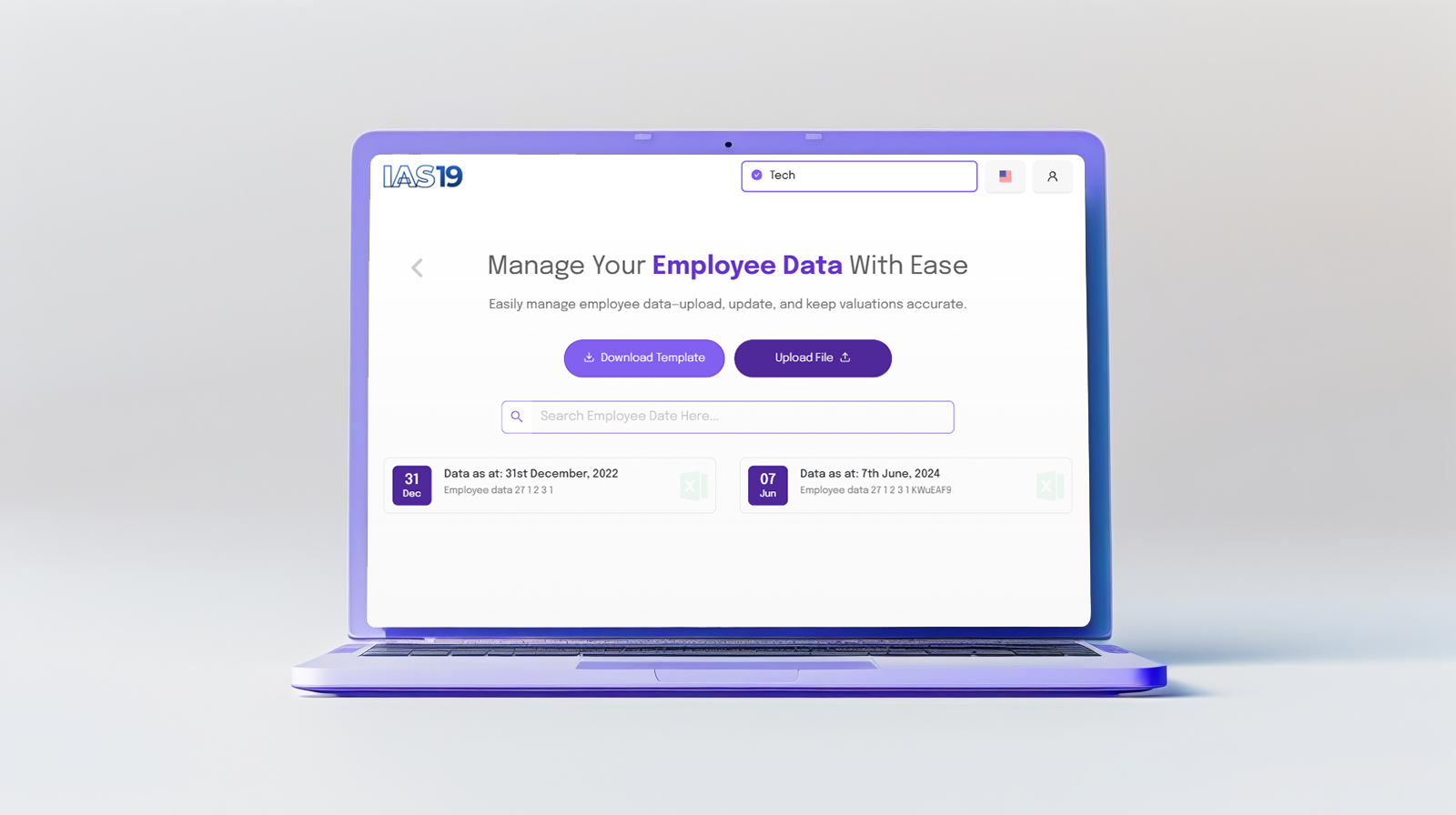
Employee Data management screen in the IAS 19 valuation tool, with options to Download Template and Upload File.

The IAS 19 Software That Replaces the EOSB Spreadsheet and the Wait

Delta is an end-to-end IFRS 17 platform that automates cashflow generation, IBNR reserve calculation, risk adjustment, and discounting on the actuarial side, then carries those results straight into accounting entries, general ledger exports, and statutory reports, without a manual handoff between the two.

Prima’s software moves the whole EOSB valuation inside your own systems. You upload data, the tool proposes assumptions from your workforce profile, and it returns a signed report on the same visit.

  • Upload your census, get a full defined benefit obligation calculated on the Projected Unit Credit method.
  • The assumptions engine reads your demographic profile and suggests discount, salary growth, and withdrawal rates you can then edit.
  • A signed valuation report generates instantly, with every figure traceable back to its input.
  • Re-run the whole valuation as many times as you want at no extra cost when an assumption changes.
  • Confidential employee data never leaves your control or reaches a third-party consultant.
  • Outputs map to IAS 19 and to AASB 119, FAS 87, Ind AS 19, HKAS 19, and ASPE 3642 where you report under those.

The EOSB Problems Prima's Software Solves

"Our valuation lives in one fragile spreadsheet."

What teams need Teams need the EOSB model to sit in a controlled system, not a workbook that breaks when a column moves.

How Prima's software solves it The software holds the calculation engine centrally, so the model is the same every cycle and never depends on one person's file.

  • No more rebuilding the model each year from last year's workbook
  • Every run uses the same audited PUC engine, so results are consistent
  • The valuation no longer depends on one person who knows the file
"We wait weeks for an outside actuary."

What teams need Teams need results on their own schedule, especially when the audit deadline is fixed and close.

How Prima's software solves it The tool runs the full valuation in-house and returns a signed report on the same session, so the wait disappears.

  • Signed EOSB reports produced in minutes during the close
  • No dependency on a consultant's queue at year end
  • Room to test numbers before the audit meeting, not after

"Every assumption change costs another invoice."

What teams need Teams need to flex discount rate, salary growth, and withdrawal without paying for each re-run.

How Prima's software solves it Unlimited re-runs are built in, so you adjust an assumption and regenerate the whole report at no extra cost.

  • Sensitivity checks run as often as the auditor asks
  • No per-run fee blocking a quick what-if
  • Assumption changes reflected in the report immediately

"Our employee data leaves the building."

What teams need Teams need to value benefits without emailing salaries and national IDs to an outside firm.

How Prima's software solves it The software keeps all employee data inside your controlled environment, with no hand-off to a third-party consultant.

  • Salary and demographic data stays under your access controls
  • One less data-sharing agreement to manage and defend
  • A cleaner story for your own privacy and PDPL obligations

"We cannot reproduce last year's numbers."

What teams need Teams need every prior figure to be traceable when the auditor reopens it twelve months later.

How Prima's software solves it Each valuation stores its inputs and assumptions with the output, so any past number can be reconstructed on demand.

  • Prior-year figures reproduced without guesswork
  • A documented trail from census row to reported liability
  • Faster answers when audit queries land

How to Run an IAS 19 EOSB Valuation in Prima's Software

The tool turns a valuation that used to span weeks into five guided steps. You move from raw census to signed report without leaving the platform, and each step hands you a concrete output before the next begins.

Step 1:
Upload Data
You load your employee census. Built-in checks flag schema problems, nulls, and date-logic errors before anything is calculated. OUTPUT: A validated census ready for valuation.
>>>
Step 2:
Set Assumptions
The assumptions engine reads your workforce profile and proposes discount, salary-growth, and withdrawal rates. You review and override any of them. OUTPUT: A locked assumption set with its basis recorded.
>>>
Step 3:
Run Valuation
The engine applies the Projected Unit Credit method to calculate the defined benefit obligation, service cost, and interest cost for each entity or unit. OUTPUT: Full IAS 19 results per reporting unit.
>>>
Step 4:
Review and Re-run
You test sensitivities by changing an assumption and regenerating. Re-runs are unlimited, so nothing blocks a quick what-if. OUTPUT: Sensitivity comparisons across scenarios.
>>>
Step 5:
Generate Report
The tool produces a signed, disclosure-ready report with the movement analysis, OCI split, and full assumption disclosures. OUTPUT: A signed EOSB actuarial valuation report.

Book a 15-Minute Demo

Step 1
Discovery & Process Mapping
Structured interviews with key staff capture how work is actually done. A process map identifies what needs to be documented and in what order.
Step 2
Gap Analysis & Prioritisation
For review engagements: existing documentation is assessed against current practice and compliance requirements. For creation engagements: scope is defined and prioritised by operational risk.
Step 3
SOP Drafting & Formatting
Procedures are written in plain operational language and formatted for daily use. Each document is structured with clear ownership, version control, and review dates.
Step 4
Review & Staff Validation
Draft procedures are reviewed by the staff who will use them. This step identifies anything that does not reflect operational reality before final approval.
Step 5
Handover, Training & Review Cycle Setup
Final documentation is handed over with an implementation guide, a training briefing for managers, and a scheduled review calendar so the documents stay current.

What Prima's IAS 19 Software Includes

Feature What It Means
Census Upload with Built-In Validation Schema, null, and date-logic checks catch data errors before they reach the calculation.
Demographic-Driven Assumptions Engine The tool suggests discount, salary-growth, and withdrawal rates from your own workforce, then lets you override each one.
Projected Unit Credit Calculation Engine The defined benefit obligation, current service cost, and interest cost follow the method IAS 19 requires for EOSB.
Multi-Standard Output The same run maps to IAS 19 and to AASB 119, FAS 87, Ind AS 19, HKAS 19, and ASPE 3642 when you report under those.
Signed, Disclosure-Ready Reports Reports arrive with the OCI split, movement analysis, and assumption disclosures your auditor expects.
Unlimited Re-Runs Adjust any assumption and regenerate the full valuation at no extra cost, as often as the audit needs.
Per-Entity and Per-Unit Valuation Run separate valuations for each reporting entity or business unit in one place.
In-House Data Handling Confidential employee data stays inside your environment and is never shared with an outside consultant.
Cloud Platform on Oracle Cloud The platform runs on Oracle Cloud Services and meets Saudi CITC and PDPL requirements, and works across the UAE, Pakistan, and other regions.
Actuary and Accountant Support A team of qualified actuaries and accountants backs the tool across the whole valuation and audit, not just a login.
Proof

Measured on Real EOSB Valuation Work

Process Results

  • The day of manual data checks that used to precede every cycle now runs automatically at upload
IAS 19
Projected Unit Credit method, one auditable source

Methodology and Standards

The software applies standard IAS 19 methodology, documented at every step and structured for external audit review. The defined benefit obligation, service cost and interest cost run through the Projected Unit Credit method, with the OCI split, movement analysis and full assumption disclosures generated from one valuation run and configured by Prima's practicing actuaries against each entity's jurisdiction.

Generated EOSB report page showing defined benefit obligation and OCI movement

Replace Your EOSB Spreadsheet: The Before and After

The shift from a manual EOSB workbook to software is easiest to see side by side.

The spreadsheet-based valuation The Prima IAS 19 software valuation
The model depends on one person who understands the workbookThe PUC calculation engine lives in the platform, documented and independent of any individual
You wait weeks for an outside actuary while the audit clock runsYour team runs the full valuation in-house and gets a signed report the same session
Every assumption change means another invoice and another round tripUnlimited re-runs, so an assumption change regenerates the whole report at no extra cost
Salary and demographic data leaves the building to reach the actuaryConfidential employee data stays inside your controlled environment, no third-party hand-off
A single formula slip can quietly move the whole reported liabilityAutomated validation flags schema, null and date-logic errors at upload
Last year's numbers cannot be reproduced when the auditor reopens themEach valuation stores its inputs and assumptions, so any prior figure reconstructs on demand
Regional labour-law nuance lost in generic global softwareBuilt for Saudi and Gulf labour law first, extended to Pakistan and other jurisdictions
The auditor pushes back and the working is not documentedSigned reports arrive with the OCI split, movement analysis and full assumption disclosures

An EOSB Practice That Built Its Own Engine

Actuaries sometimes say that software from a consulting firm is a side project bolted on as an afterthought. At Prima the relationship runs the other way: this is the tool our own actuaries use on IAS 19 engagements, so a neglected release would break our own work first. The people who built it value EOSB by hand every reporting season, which is why the calculation logic follows Gulf and Pakistan labour law in its detail, not a generic template. Support is part of the offer: our actuaries help with assumption reviews, disclosure questions and auditor conversations, not just login resets.

What Is Real Today

Today the software runs deterministic IAS 19 measurement on the Projected Unit Credit method with full actuarial control, and supports multiple scenarios against the same census, so testing an assumption change is a configuration step rather than a workbook rebuild. Where benefits accrue disproportionately in later years, the calculation attributes them on the straight-line basis IAS 19 requires. Stochastic modelling is not needed for standard EOSB obligations, and results export cleanly for any downstream work. The actuary always decides; the platform makes the math visible and repeatable.

Why Prima Built Its Own IAS 19 Software

This software started because Prima’s own actuarial and accounting teams were running IAS 19 valuations by hand for employers across the region and kept hitting the same limits every consultancy reaches eventually. A spreadsheet-based process does not scale past a handful of entities, and it does not produce the kind of audit trail regulators and Big 4 reviewers increasingly expect.

End-of-service liabilities moved from a footnote to a figure auditors test hard, and Gulf regulators now expect the Projected Unit Credit method, clear assumptions, and disclosures that hold up on review. Employee benefits software built for global markets rarely accounts for regional labour law. This tool was designed for Saudi and Gulf EOSB from day one, then extended to Pakistan and other jurisdictions, and it comes from an employee benefits consultancy: Prima’s own actuaries provide valuation and audit support whenever it is wanted, not just a login and a manual.

The software was built for Saudi Arabia, the UAE, and Pakistan first, not adapted from a platform designed for a different regulatory environment and localised afterward. That ordering matters when an auditor asks a question a globally generic tool was not built to answer. Prima’s relationship with clients continues after go-live. The software is the tool, and Prima’s actuarial and implementation teams remain the people behind it.

IAS 19 actuarial valuation software workspace featuring financial reports, actuarial charts, a calculator, documents, and a globe in a professional financial analysis setting.

Put IAS 19 Actuarial Valuation Software Behind Your Next Close

Prima's actuaries built this tool from their own EOSB engagements, so your team can run audit-ready valuations without waiting on anyone. The demo takes fifteen minutes, runs on sample data, and is led by an actuary.

No obligation attaches to any of the three options.

Part of the IFRS Tech suite: Delta (IFRS 17), Rust (IFRS 9 and ECL), Aegis (insurance reserving), and ROU 360 (IFRS 16).

Frequently Asked Questions

IAS 19 is a critical accounting standard that outlines the principles for recognizing and measuring employee benefits liabilities. It covers many benefits, including short-term employee benefits, post-employment benefits like pensions, and termination benefits. Understanding and applying IAS 19 correctly is essential for accurate financial reporting, particularly for organizations with significant employee costs.

An IAS 19 actuarial valuation is a specialized assessment of a company's financial obligations arising from employee benefits promises. It involves complex calculations to determine the present value of these liabilities based on various actuarial assumptions. This valuation is crucial for complying with IAS 19 requirements and clearly showing the company's financial position.

IAS 19 and AS 15 are accounting standards related to employee benefits but differ in their treatment of actuarial gains and losses. While AS 15 allows these gains and losses to be recognized in the profit and loss account, IAS 19 mandates that they be recognized in other comprehensive income (OCI). This distinction significantly impacts a company's financial statements and overall financial performance.

The withdrawal rate in IAS 19 refers to the estimated annual percentage of employees expected to leave the company before retirement. This rate is a crucial factor in calculating employee benefit obligations. It is essential to use accurate and up-to-date withdrawal rates to ensure the reliability of actuarial valuations and financial reporting.

In the context of IAS 19, plan assets represent the resources held by a pension plan or other employee benefit fund that are available to meet future benefit obligations. These assets can include investments, cash, and other financial instruments. Accurate valuation and management of plan assets are vital for effective employee benefits management and financial reporting.

The asset ceiling in IAS 19 represents the maximum amount that can be recognized as an asset related to a defined benefit plan. It is calculated as the present value of expected economic benefits available to the company from the plan. Understanding the asset ceiling is essential for determining the appropriate accounting treatment of plan assets and liabilities.

IAS 19 focuses on the employer's perspective in accounting for employee benefits, while IAS 26 deals with the financial reporting of retirement benefit plans. IAS 19 governs how companies recognize and measure employee benefit costs and liabilities in their financial statements, whereas IAS 26 guides retirement benefit plans on their financial reporting.

A settlement in IAS 19 occurs when a company transfers all or part of its obligations under a defined benefit plan to another party. This typically involves a lump sum payment or creating a separate entity to hold the plan's assets and liabilities. Settlements have significant implications for financial reporting and require careful accounting treatment.

The IAS 19 amendment, "Plan Amendments, Curtailments, and Settlements," introduced changes to the accounting treatment of modifications to employee benefit plans. It provides specific guidance on accounting for plan amendments, curtailments (reductions in benefits), and settlements, ensuring consistency and comparability in financial reporting.

A curtailment in IAS 19 refers to modifying a defined benefit plan that reduces the expected future benefits for current employees. This can occur due to changes in employment terms, plan closures, or other factors. Curtailments have financial implications for the company and require appropriate accounting treatment under IAS 19.

IAS 19 sets the framework for accounting and reporting employee benefits, influencing how employee benefits valuations in UAE are calculated and disclosed. Compliance with IAS 19 requires careful actuarial assessment of defined benefit plans and other post-employment benefits. Prima Consulting helps clients align their valuations with IAS 19 requirements to ensure transparency and accuracy. Find out more about our IAS 19-focused employee benefits valuations in UAE services.

It is a tool that calculates a company's EOSB and gratuity liability under IAS 19, applies the Projected Unit Credit method, and produces a signed, disclosure-ready report in-house. Prima's version suggests assumptions from your own workforce and lets your team run the whole valuation without an outside actuary.

It is the calculation of the present value of end-of-service benefits a company owes its employees. Under IAS 19 it uses the Projected Unit Credit method and a set of actuarial assumptions to produce the defined benefit obligation reported in the accounts.

It uses the Projected Unit Credit method, the approach IAS 19 requires for defined benefit obligations. Where benefits accrue disproportionately in later years, the calculation attributes them on the straight-line basis IAS 19 also requires.

The calculation engine sits centrally instead of in a workbook, so the model is identical every cycle and does not break when data moves. You upload the census and get a signed report, with no rebuild from last year's file.

Yes. The tool is built for finance and HR teams, not only actuaries, with guided steps and suggested assumptions. Prima's actuaries stay available for the technical calls and the audit.

Every figure traces back to its input, and reports carry the movement analysis, OCI split, and assumption disclosures auditors ask for. That makes Big 4 review faster because the working is already documented.

Yes. You can run separate valuations for each entity or business unit and keep them in one place.

The same run maps to AASB 119, FAS 87, Ind AS 19, HKAS 19, and ASPE 3642, so groups reporting under more than one standard are covered.

Yes. The engine suggests discount, salary-growth, and withdrawal rates, and you can override any of them. Re-runs are unlimited, so testing costs nothing.

Yes. It runs on Oracle Cloud Services and is built to meet Saudi CITC and PDPL rules, and works across the UAE, Pakistan, and other regions.

It is the same engine Prima's actuaries use on live client valuations. It was built for real EOSB work, not as a marketing add-on, and it ships with actuarial support.

Beyond consultant fees, the real cost is audit delay and the risk of a spreadsheet error moving the reported liability. In-house software removes both the wait and the single point of failure.

The tool runs deterministic PUC valuations, which is what IAS 19 EOSB reporting requires. Stochastic modelling is not needed for standard EOSB obligations.

Yes. Gratuity and end-of-service benefits are both handled as defined benefit obligations under IAS 19.

An actuary runs a full valuation cycle on sample data with you, answers technical questions, and shows the signed report output. There is no obligation to buy.

Prima Consulting

Actuarial Advisory With Its Own Technology

Contact Us

Ready to elevate your business with Prima Consulting? Fill out the form below to discuss your needs with our experts and discover how we can help you achieve your business goals.

Your benefits:
What happens next?
1

We Schedule a call at your convenience 

2

We do a discovery and consulting meeting 

3

We prepare a proposal 

Schedule a Free Consultation