
SOP review services assess your existing standard operating procedures, find the gaps, outdated steps, and compliance risks, then give you a prioritized plan to fix them. Prima Consulting delivers audit-ready SOP documentation for businesses across KSA, the UAE, and the wider Middle East.
Industries served: Hospitality – Franchise Networks – Retail – Corporate Operations – F&B – Logistics




























Most businesses have some version of documented procedures. The problem is not that SOPs do not exist, it is that most are outdated, ignored, or written for compliance rather than day-to-day use. When staff leaves, when you open a new location, or when an auditor arrives, those gaps become expensive.
Across Germany, Pakistan, KSA, UAE, and the broader Middle East, businesses are growing faster than their internal systems. Franchise groups, hospitality chains, and corporate operations are all discovering the same thing: growth without documentation is growth that depends on people, not process.
SOP review services and standard operating procedure consulting bridge that gap. They take what your best people do instinctively and turn it into a repeatable, trainable system – one that holds up when those people change roles, get promoted, or leave.

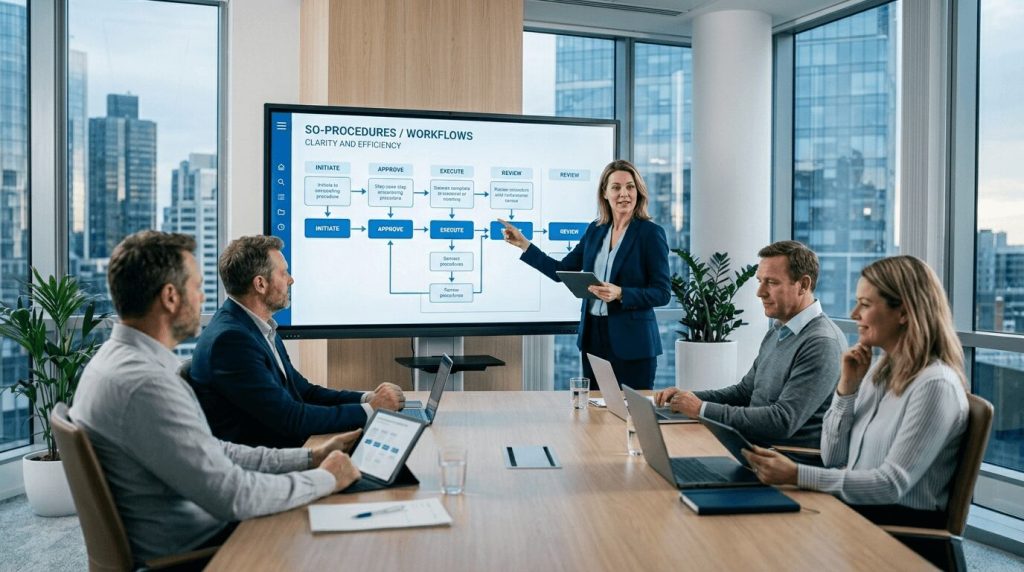
When every decision escalates to one person, growth stalls. Owners and senior managers become the operating system. Holidays, illness, or promotion of a key person exposes the fragility underneath. What teams need: A documented decision framework that transfers knowledge out of individual heads and into a referenceable system. How SOP consulting solves it: Discovery sessions capture how your best people make decisions. Those decisions become written procedures. The business gains independence from any individual. - Reduce escalations by documenting decision criteria - New managers become effective faster with a clear procedural reference - Leadership can delegate with confidence
This is the highest-urgency scenario. A specific trigger event - ISO certification, an investor doing due diligence, a franchise partner requiring documentation - creates a deadline. Improvisation at this point is not an option. What teams need: Audit-ready documentation produced by consultants who understand what auditors and investors look for. How SOP audit services solve it: Prima Consulting works to a deadline. The SOP audit process establishes what documentation exists, what is required, and what needs to be created or remediated before the review date. -SOP compliance consulting aligned to ISO, regulatory, and investor standards -Gap analysis identifies exactly what is missing before the audit does -Accelerated documentation delivery for time-sensitive engagements
The SOP graveyard is real. Documents printed, filed, and never referenced again. No review cycle, no ownership, no connection to how work actually happens. The business has SOPs on paper but runs on improvisation. What teams need: Procedures with an owner, a review date, and a format people can actually use during the working day. How SOP review services solve it: A structured audit of existing documentation identifies what is current, what is outdated, what contradicts itself, and what is simply missing. The output is a prioritised remediation plan. -SOP review identifies outdated, conflicting, or missing procedures -Each document gets an owner and a review cycle -Format redesign makes procedures accessible during daily work
New hires are trained by whoever is least busy. Tribal knowledge lives in people's heads and leaves when they do. Staff turnover becomes an operational emergency every time because the next person starts from zero. What teams need: A structured onboarding SOP that delivers consistent training regardless of who is available to deliver it. How SOP consulting solves it: Onboarding procedures are built as a structured document set - covering role expectations, task sequences, quality checks, and escalation paths. New staff reach competency in days, not weeks. -Reduce onboarding time from weeks to days with documented training paths -Consistent standards regardless of who delivers the induction -Lower cost-per-hire as competency time drops
A five-star experience today and a three-star experience tomorrow is the most common complaint in hospitality, retail, and franchise operations. Without documented standards, quality depends on who is working that shift. What teams need: Behavior-level SOPs that are written for the person doing the job define not just what to do, but how and to what standard. How SOP development services solve it: Procedures are written in plain operational language, validated with the frontline staff who use them, and structured for daily reference rather than annual review. -Consistent service delivery across all locations and shifts -Clear quality benchmarks that can be measured and managed -Brand standards protected at every customer touchpoint
Many operations managers know exactly what needs to be documented. They started three SOP documents and abandoned all of them. The day-to-day running of the business takes priority, and documentation stays permanently on the to-do list. What teams need: An external team that can extract the knowledge, structure the documentation, and deliver finished procedures without pulling internal staff off their primary responsibilities. -Knowledge extraction through structured interviews - not long internal workshops -Drafting, formatting, and review handled entirely by the consultancy -Internal team signs off on finished documents, not the draft process
| Feature | What It Means for Your Operations |
|---|---|
| Process discovery sessions | Your operational knowledge is extracted through structured interviews - no lengthy workshops that pull staff off the floor. This ensures accurate documentation based on real workflows, not assumptions. |
| Procedure drafting and formatting | Finished documents delivered in a format your team can use during the working day, not a format designed for a filing cabinet. |
| Staff validation review | Procedures are reviewed with the people who do the job before finalization so they reflect how work actually happens, not how it was assumed to happen. |
| Role-specific SOP sets | Each department receives documentation tailored to its specific tasks, escalation paths, and quality benchmarks. |
| Onboarding SOP package | A structured training document set that brings new hires to competency in days rather than weeks, regardless of who delivers the induction. |
| Review cycle and ownership setup | Each document is assigned an owner and a review date so the documentation stays current as the business evolves. |
| Feature | What It Means for Your Operations |
|---|---|
| Full SOP audit | A structured assessment of every existing procedure - identifying what is current, what is outdated, what contradicts itself, and what is missing entirely. |
| Gap analysis report | A prioritized list of documentation gaps, compliance risks, and remediation actions - delivered before an auditor finds them. |
| Compliance alignment check | Existing procedures reviewed against relevant standards: ISO requirements, regional regulatory frameworks, and sector-specific compliance rules. |
| Documentation remediation | Outdated or non-compliant procedures are rewritten, simplified, or restructured to meet current standards and operational reality. |
| SOP evaluation scoring | Each document receives a score across clarity, completeness, compliance alignment, and practical usability - giving management a clear picture. |
| Audit-ready deliverable package | A finalised documentation set formatted for submission to auditors, ISO bodies, investors, or franchise partners. |
The five-step process below applies to both SOP creation and SOP review engagement. Each step has a defined output, so you know at each stage what has been completed and what comes next.
| Step | Stage | Output |
|---|---|---|
| 1 | Discovery & Process Mapping | Structured interviews with key staff capture how work is actually done. A process map identifies what needs to be documented and in what order. |
| 2 | Gap Analysis & Prioritisation | For review engagements: existing documentation is assessed against current practice and compliance requirements. For creation engagements: scope is defined and prioritised by operational risk. |
| 3 | SOP Drafting & Formatting | Procedures are written in plain operational language and formatted for daily use. Each document is structured with clear ownership, version control, and review dates. |
| 4 | Review & Staff Validation | Draft procedures are reviewed by the staff who will use them. This step identifies anything that does not reflect operational reality before final approval. |
| 5 | Handover, Training & Review Cycle Setup | Final documentation is handed over with an implementation guide, a training briefing for managers, and a scheduled review calendar so the documents stay current. |
Finance, HR, procurement, and administrative procedures for mid-size to enterprise organizations.
Store operations, inventory management, customer service standards, staff performance frameworks.
Brand standards, franchise operations manuals, multi-location consistency documentation, partner onboarding packs.
Warehouse procedures, driver protocols, dispatch workflows, and safety compliance documentation.
Hotels, resorts, restaurants, catering operations. Front-of-house, back-of-house, and guest service standards.
Clinical and administrative SOPs aligned to CBAHI, JCI, and MOH requirements in KSA and UAE.
A hospitality group reduced new hire onboarding from 3 weeks to 6 days after completing a full departmental SOP development engagement with Prima Consulting.
Onboarding time reduced
Prima Consulting gave us something we had been putting off for years. Within eight weeks we had a full set of operational procedures for every department. Our next franchise partner signed the agreement because our documentation was ready." - Jabbar Rasheed, CFO
This is why there are several Benefits of SOP Consulting for different SMBs and Enterprises.
For instance, in the case of franchise operators, undocumented processes mean each location operates slightly differently. Brand consistency erodes. Customer complaints accumulate. The franchise value diminishes.
Likewise, for businesses preparing for ISO certification, investor review, or a new regulatory audit, the cost of undocumented procedures is a failed review, a delayed certification, and the reputational impact that follows
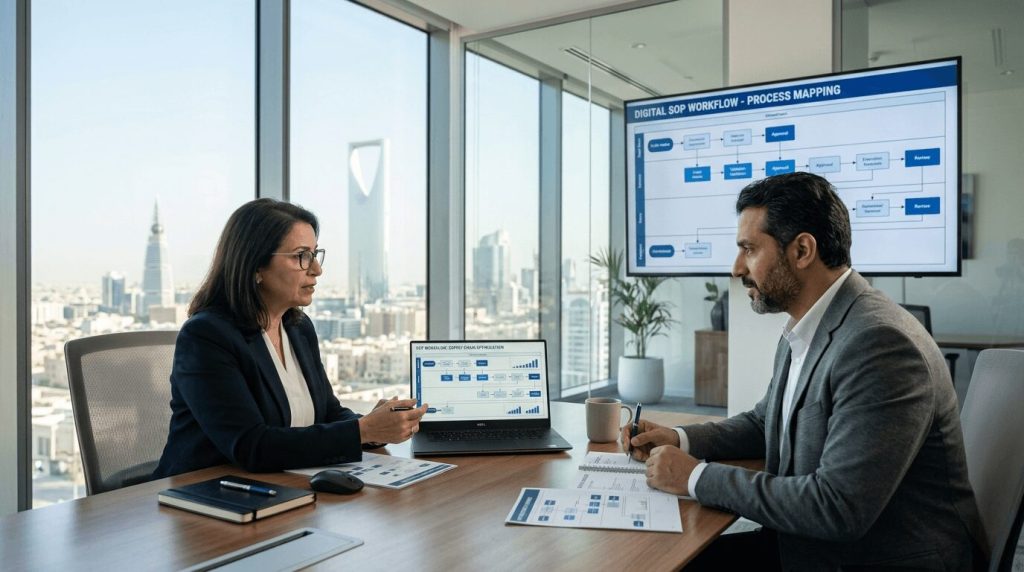
A free 30-minute SOP assessment call covers the current state of your documentation, the highest-priority gaps for your specific context, and a clear view of what a full engagement would involve. There is no obligation and no generic sales pitch. The call is designed to give you useful information whether or not you proceed to an engagement.
An SOP consultant works with a business to document how its operations work - capturing existing processes, identifying gaps and inconsistencies, and producing clear written procedures that staff can follow without supervision. For SOP review engagements, the consultant assesses existing documentation against current practice and compliance requirements and delivers a prioritised remediation plan.
Timelines depend on the scope and the number of departments involved. A focused engagement covering one department typically takes two to four weeks. A full operational documentation project for a mid-size business runs six to twelve weeks. For urgent audit or compliance deadlines, Prima Consulting can structure accelerated SOP development process engagements.
As a general standard, SOPs should be reviewed at least annually. Additionally, any significant change in process, personnel, regulation, or technology should trigger an immediate review of the relevant procedures. The review cycle is built into every SOP set Prima Consulting produces.
SOP creation builds documentation from scratch for departments or processes that currently have no written procedures. SOP review services assess documentation that already exists, identifying what is current, outdated, missing, or non-compliant. Many engagements involve both: a review of existing documentation followed by targeted creation work for identified gaps.
ISO standards require documented procedures for all processes that affect product or service quality and compliance. The specific documentation requirements vary by ISO standard (9001, 14001, 45001, etc.). Prima Consulting's SOP audit services include alignment review against the relevant ISO standard for your sector and certification target.
Yes. Prima Consulting serves clients across Saudi Arabia, the UAE, and the wider Middle East. The team has direct experience with the regulatory frameworks, compliance requirements, and operational contexts specific to the KSA and UAE markets. Engagements can be conducted in-person or remotely depending on project scope. We aso have offices and serve in Germany, Ireland, and Pakistan.
Engagements are scoped and priced based on the number of departments, the volume of procedures required, and whether the engagement involves creation, review, or both. A free assessment call is the starting point - this gives both parties the information needed to scope an engagement accurately. Book your free assessment call to get a clear picture.
Yes. SOPs are not only for large organisations. For a business with 10 to 50 employees, documented procedures are often the single most effective way to reduce owner dependency, accelerate onboarding, and prepare for growth. The scope is smaller, but the operational benefit is proportionally just as significant.
Yes. Most SOP review engagements start with existing documentation. The consultant assesses what is there, what is missing, what contradicts current practice, and what needs to be updated. The output is a gap analysis report and a prioritised plan - not a wholesale replacement of everything already in place.
Prima Consulting has developed SOPs for hospitality groups, franchise networks, retail chains, corporate operations, logistics businesses, and healthcare providers across KSA and UAE. Industry-specific knowledge matters because the procedures need to reflect how work actually happens in your sector, not a generic template.
High turnover hits restaurants hard when no one's written down how things actually run. Restaurant SOP consulting documents your service steps, kitchen workflows, and shift routines so new staff get up to speed faster. You spend less time retraining. You lose less in wasted food, missed steps, and inconsistent service. The documentation stays when your people don't.
Yes. Hospitality SOP services are built specifically for multi-property operations where brand consistency has to hold across every location, regardless of who's managing each one. Procedures are written at a level of detail that a general manager at a new property can follow from day one. Your brand standards stop living in the heads of a few senior people and start living in the documentation.
Good SOP writing services produce procedures in a format designed for the working day, not a filing cabinet. That means clear task sequences, named owners, version numbers, and a layout your team can scan in thirty seconds on a busy shift. Before finalising anything, the procedures are checked with the staff who'll use them. If it doesn't match how work actually happens, it gets rewritten until it does.
SOP consulting in Saudi Arabia maps your existing procedures against SFDA requirements, municipal operational standards, and sector-specific regulations before an inspection arrives. The consultant identifies which processes lack documentation, which procedures contradict current practice, and what needs to be in place for your business to pass review. You go into an inspection with a documented, auditable system rather than relying on staff memory.
Professional SOP review services in KSA are typically triggered by one of four situations. A key manager leaves and takes process knowledge with them. A franchise partner asks for operational documentation before signing. A regulatory body schedules an inspection. Or the business opens a new location and realises the existing procedures weren't written for replication. Any one of these makes a structured review the right first move.
A good SOP consulting firm doesn't ask your team to write documentation from scratch. It runs structured discovery sessions with the people doing the work, asks specific questions about each task, and turns those answers into written procedures. Your team's time on the floor stays protected. The consulting firm handles the drafting, structuring, and formatting. Your staff review finished procedures before sign-off.
SOP review and audit consulting produces a gap analysis report, a scored assessment of every procedure reviewed, and a prioritised remediation plan. Each document gets rated across clarity, completeness, compliance fit, and practical usability. You get a clear picture of what passes, what needs updating, and what's missing entirely. It's the kind of structured output you can act on immediately, not a general summary of findings.
Most businesses need SOP review and update services at least once a year. On top of that, any change in regulation, technology, staffing structure, or service model should trigger a targeted review of the affected procedures. Without a regular update cycle, documentation drifts out of sync with how work actually gets done. SOP review and update services keep that gap from opening up and becoming a compliance or operational problem.
An internal audit tells you what documents you have. SOP gap analysis services tell you what you're missing, what's outdated, and what creates compliance risk. The difference is the external standard. A consultant measures your documentation against regulatory requirements, operational best practice, and what an auditor would expect to see. Internal audits tend to find what's there. SOP gap analysis services find what isn't.
A single department typically takes two to four weeks with custom SOP development services. The timeline covers discovery sessions with your team, drafting, internal review, and final sign-off. Scope affects speed. A department with complex workflows or compliance requirements takes longer than a straightforward operational role. Custom SOP development services move faster when key staff are available for structured interviews in the first week.
Regulatory compliance SOP consulting covers the standards relevant to your sector and operating region. For businesses in KSA and UAE, that includes ISO 9001, ISO 45001, CBAHI, JCI, MOH requirements, and Vision 2030 operational frameworks. The consultant reviews your procedures against the specific standard you're working toward, not a generic checklist. You get documentation that holds up under the scrutiny of the body conducting your review.
Yes. An SOP compliance audit for Middle East operations is built to handle cross-border scope. KSA and UAE share some regulatory frameworks but differ across sector-specific requirements, licensing bodies, and operational mandates. A structured SOP compliance audit maps your documentation against the requirements of each country separately, then produces a combined gap report. You get one audit, one deliverable, and a clear remediation plan for both territories.
Without franchise SOP development, each new location builds its own version of your brand. Standards drift. Customer experience varies by site. Training becomes inconsistent because there's nothing consistent to train from. When a franchise partner does a site visit or an audit, the gaps become visible fast. Franchise SOP development puts a documented standard in place before the next location opens, not after the problems show up. You can learn how to standardize SOP processes and why they should be standardized across departments and franchises by clicking here.
SOP consulting cost is often compared against the wrong thing. The real comparison isn't the consulting fee against doing nothing. It's the consulting fee against the cost of a failed audit, a key person leaving with undocumented knowledge, or a new hire taking three weeks to reach basic competency. For most businesses, one of those events costs more than a full SOP consulting engagement. The assessment call is free and scoped to your situation.
SOP optimization consulting takes procedures you already have and makes them faster, clearer, and easier to follow. We review each SOP for bottlenecks, outdated steps, and duplication, then rewrite them for daily use. The goal is fewer errors, quicker training, and procedures your team actually reads.
SOP standardization consulting brings every location, shift, or department onto one consistent set of procedures. It matters most for franchises and multi-site operations where quality drifts by location. We build a single documented standard, a shared template, and a review cycle so every site runs the same way.
Process documentation maps how work flows across a business, the steps, handoffs, and systems involved. An SOP goes deeper: it tells one person exactly how to do a task to standard. You often need both. Prima Consulting's process documentation services and SOPs work together to make operations repeatable.
Ready to elevate your business with Prima Consulting? Fill out the form below to discuss your needs with our experts and discover how we can help you achieve your business goals.
We Schedule a call at your convenience
We do a discovery and consulting meeting
We prepare a proposal
Regulatory Compliance Notice
Our services are delivered in accordance with applicable laws and regulations in each jurisdiction.
Prima Consulting provides its services and engages in accordance with the local applicable laws, regulations, professional standards, and regulatory requirements of the jurisdiction in which each service is performed.
Thus, our services are delivered through the appropriate Prima network firm, office or, where required, an appropriately licensed or authorised professional partner. Where a service is not to be provided by one Prima Consulting entity, it may be provided through another Prima Consulting entity or an appropriately authorised third party or not at all for some services, subject to applicable laws and regulations and we ensure strict compliance in this regard.
Nothing on this website constitutes a representation that any particular Prima Consulting entity is licensed or authorised to provide every service in every jurisdiction. Regulatory permissions and service eligibility are assessed on a service-by-service and jurisdiction-by-jurisdiction basis. This is done to ensure compliance in the face of changing local and global trends in laws, regulations and standard best practices.
The user of this website by entering accepts that such services shall be sought and procured through official legal channels appropriate and allowed for such service. In case of any ambiguity in this regard, it is strongly advisable to seek help from professionals or our team.