From a fragile, single-person Excel model to an audited, repeatable IFRS 17 close, without handing your judgment calls to a black box.
Delta was built by actuaries who calculate IFRS 17 by hand for insurers across the region, then automated the parts of that work that don’t need a human doing it manually every quarter.








































IFRS 17 compliance software automates the cashflow projection, risk adjustment, and reporting mechanics that insurers previously calculated by hand, so finance and actuarial teams can close on schedule without depending on one person’s spreadsheet.
Most insurance finance teams didn’t choose to build IFRS 17 in Excel. It happened by accident, one reporting period at a time, until nobody could safely touch it anymore.
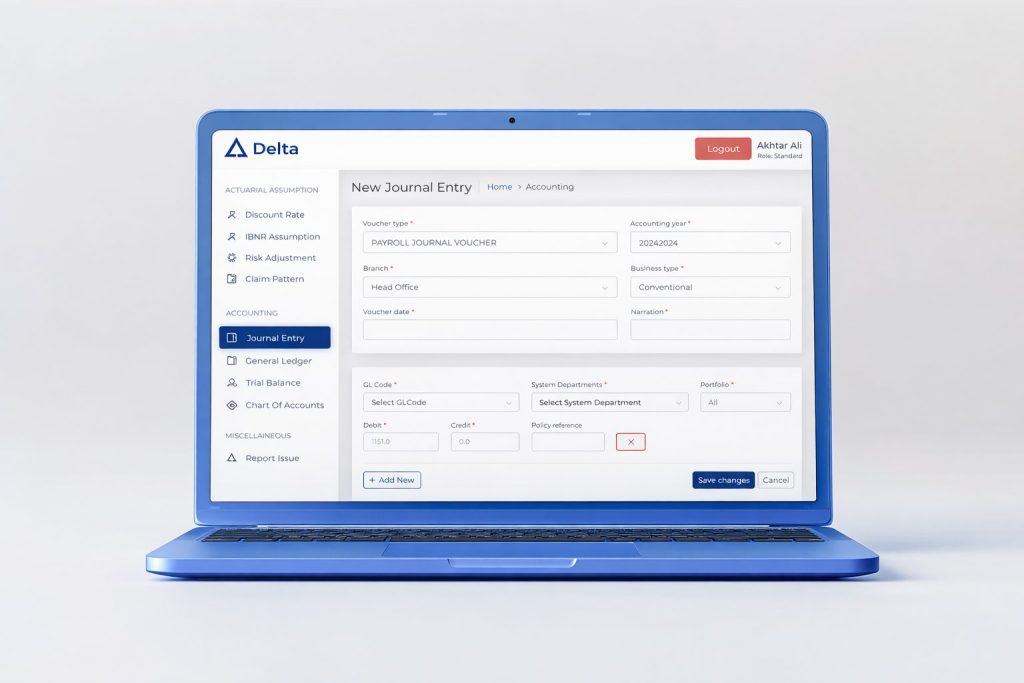

Delta is an end-to-end IFRS 17 platform that automates cashflow generation, IBNR reserve calculation, risk adjustment, and discounting on the actuarial side, then carries those results straight into accounting entries, general ledger exports, and statutory reports — without a manual handoff between the two.
Six failures that Excel-based IFRS 17 repeats every cycle, and how Delta closes each one.
What teams need: A repeatable calculation that survives staff turnover and returns the same answer from the same inputs.
How Delta solves it: The actuarial module runs the CSM calculation as a configured process, not a manual formula chain, with assumptions stored and versioned.
What teams need: A record of who changed what, and when, without building it by hand after the fact.
How Delta solves it: Every calculation and data change is logged automatically as part of normal use, not as a separate compliance task.
What teams need: To test a change in assumptions in minutes, not days.
How Delta solves it: The actuarial module runs multiple scenarios against the same base data without manual rework.
What teams need: One platform that handles both measurement models without forcing a choice.
How Delta solves it: The accounting module supports GMM and PAA natively, on the same underlying data.
What teams need: A number anyone can trace back to its source, not a black box only finance can open.
How Delta solves it: Cashflow, risk adjustment and discounting run from one traceable actuarial module straight into accounting entries.
What teams need: IFRS 17 reports on the finance calendar, not on the spreadsheet's readiness.
How Delta solves it: Reports are pre-configured to generate weekly, monthly or quarterly, automatically.
Delta implementations follow a five-step process built around your existing data and reporting calendar, not a fixed template that ignores how your team already works.
| Step 1: Data and Portfolio Assessment |
Prima's team reviews your current actuarial and accounting data, portfolio structure, and whether GMM, PAA, or both apply. | OUTPUT: A documented data-readiness assessment and a scoped implementation plan. |
| >>> | ||
| Step 2: Configuration |
Delta's chart of accounts, calculation methodology, and reporting templates are configured to match your portfolio and regulatory jurisdiction. | OUTPUT: A configured Delta environment specific to your entity. |
| >>> | ||
| Step 3: Data Migration and Validation |
Historical and current data is loaded into Delta and run through its automated validation checks. | OUTPUT: A validated dataset with error flags resolved before go-live. |
| >>> | ||
| Step 4: Parallel Run |
Delta runs alongside your existing process for at least one reporting cycle so results can be reconciled before full cutover. | OUTPUT: A reconciled comparison between Delta's output and your current process. |
| >>> | ||
| Step 5: Go-Live and Support Handoff |
Your team moves to Delta as the system of record, with Prima's support team available for the transition period. | OUTPUT: Delta live as system of record, with Prima support through cutover. |
| Feature | What It Means |
|---|---|
| Actuarial Module (Cashflow, IBNR, Risk Adjustment, Discounting) | Your future cashflow projections and reserve calculations come from one consistent, auditable source instead of a chain of linked spreadsheets. |
| Multi-Scenario Analysis | You can test a change in assumptions and see the financial impact in real time, without rebuilding your model. |
| GMM and PAA Accounting Support | You run both measurement models from one platform, so a mixed portfolio doesn't need two separate tools. |
| Flexible Chart of Accounts | Your accounting structure maps to how your entity actually reports, not a fixed template built for someone else's business. |
| Real-Time P&L and Balance Sheet Updates | You see the financial statement impact of a change as it happens, not after the next close. |
| General Ledger Export for Any Date | You can pull a complete GL view, including IFRS 17-specific ledgers, for any reporting period you're asked about. |
| Automated Data Validation and Error Detection | Errors get caught and flagged before they reach a report, with suggested corrections, instead of surfacing during an audit. |
| Single or Bulk File Upload | Your team uploads one file or many at once, with the same validation applied either way. |
| Role-Based Access Control | Each user sees only the functions and data relevant to their role, reducing accidental exposure. |
| End-to-End Encryption and Private Cloud Deployment | Data is encrypted in transit and at rest, hosted on AWS rather than local infrastructure your team has to maintain. |
| Full Audit Trail on Every Action | Every calculation, approval, and data change is logged automatically, with the user responsible attached to it. |
| API-Based ERP Integration | Delta connects to systems you already run, instead of requiring a separate manual export-import cycle. |
Global platforms are scoped for global carriers and few of them speak to SAMA, SECP or the UAE Insurance Authority. Delta was built by actuaries who work these jurisdictions by hand, with regional reporting in the core design.
Chart of accounts and statutory templates configured for Saudi Central Bank reporting, built by a team that works the standard in-market.
GMM and PAA measurement mapped to UAE reporting requirements, with the same auditable trail from actuarial input to disclosure.
IFRS 17 measurement configured for SECP-regulated insurers, with regional regulatory nuance handled in configuration, not bolted on.
Takaful portfolios configure alongside conventional lines, running the same GMM or PAA workflow and chart of accounts.
Composite insurers running both measurement models handle them on one platform, on the same underlying data, without two systems.
API-based integration connects Delta to the ERP you already run, so IFRS 17 output flows into your close rather than a manual export.
Delta applies IFRS 17 measurement under both the general measurement model and the premium allocation approach, with fulfilment cash flows, risk adjustment, discounting and CSM run from one auditable source. Outputs are structured for external audit, statutory return formats and management reporting, configured by Prima's practicing actuaries against each entity's regulatory jurisdiction.

The IFRS 17 transformation is easiest to see side by side.
| The Excel-based close | The Delta close |
|---|---|
| Model depends on one or two people who understand the spreadsheet | Calculation logic lives in the platform, documented and independent of any individual |
| Auditors ask for an audit trail the spreadsheet cannot produce | Every calculation, approval and data change logged automatically with the user attached |
| Re-running GMM or PAA after an assumption change means rebuilding half the workbook | Assumption change re-runs in a configuration step, both models from one platform |
| Data errors surface during audit, not before | Automated validation flags errors at upload with suggested corrections |
| P&L and balance sheet impact known only after the next close | Financial statement impact updates in real time as inputs change |
| General ledger assembled by hand for each reporting date | Full GL, including IFRS 17-specific ledgers, exports for any date |
| Regional regulatory nuance lost in generic global software | Chart of accounts and templates configured to your jurisdiction (SAMA, SECP, UAE IA) |
| Leadership cannot independently verify a spreadsheet number | Auditable source from data intake to disclosure, verifiable outside finance |
Actuaries sometimes say that software from consulting firms is a side business bolted on as an afterthought. At Prima the relationship runs the other way: Delta is the platform our own actuaries use on IFRS 17 engagements, so a neglected release would break our own work first. The people who built it work the standard by hand every quarter, which is why the calculation logic is regional in its detail, not generic. Implementation support is part of the offer: our actuaries help with measurement model questions, assumption reviews and regulator conversations, not just login resets.
Today, Delta runs deterministic IFRS 17 measurement under GMM and PAA with full actuarial control, and supports multiple scenarios against the same base data, so testing an assumption change is a configuration step rather than a workbook rebuild. Data moves through an API-based integration with the systems you already run, so results are not trapped in a closed file. For stochastic and bespoke analysis, outputs export cleanly for downstream work in R and Python. The actuary always decides; the platform makes the math visible and repeatable.
Delta started because Prima’s own actuarial and accounting teams were doing IFRS 17 calculations by hand for clients across the region and kept running into the same limits every consultancy hits eventually: a spreadsheet-based process doesn’t scale past one or two portfolios, and it doesn’t produce the kind of audit trail regulators increasingly expect.
IFRS 17 reserving pulled that number onto the financial close calendar, and SAMA turned it into a quarterly submission. Reserving software built for global carriers rarely accounts for either. Aegis was designed as reserving software for Saudi Arabia, the GCC and the Middle East from day one, then extended for European markets, and it comes from an insurance reserving consultancy: Prima’s own actuaries provide appointed actuary reserving support whenever it is wanted, not just a login and a manual.
Delta was built for Saudi Arabia, the UAE, and Pakistan first, not adapted from a platform designed for a different regulatory environment and localized afterward. That ordering matters when a regulator asks a question a globally generic tool wasn’t built to answer. Prima’s consulting relationship with clients continues after go-live — Delta is the software, and Prima’s actuarial and implementation teams remain the people behind it.

Delta exists because our own actuaries were tired of fragile spreadsheets, black-box numbers nobody outside finance could verify, and GMM and PAA calculations that had to be rebuilt by hand every time an assumption changed. The result is an IFRS 17 engine your team can run, your auditors can trace end to end, and your board can trust. The demo takes 15 minutes with an actuary, not a salesperson.
Delta is an end-to-end IFRS 17 platform that automates actuarial calculations, accounting entries, and statutory reporting for insurers. It covers cashflow projection, risk adjustment, and discounting on the actuarial side, then carries those results into GMM or PAA accounting entries and reports.
Delta's actuarial module calculates the CSM as part of its cashflow projection and risk adjustment process, using the assumptions your team configures and stores in the system. The calculation runs the same way every time the same inputs are used, and every run is logged.
Yes. Delta's accounting module supports both the General Measurement Model and the Premium Allocation Approach. PAA amortizes premium over time to the P&L; GMM uses a forward-looking method that factors in cash flow expectations, discount rates, and risk adjustments. A single portfolio can be assigned to whichever model applies.
No. Delta automates the calculation mechanics of IFRS 17 — the parts that don't require a person to do them manually each cycle. Your actuaries keep control of the assumptions, judgment calls, and sign-off. The goal is fewer hours spent rebuilding spreadsheets, not fewer actuaries on the team.
Yes. Delta is hosted on AWS, so there's no local hardware or client-side installation required. Access is through the platform itself, with role-based permissions controlling what each user can see and do.
Excel-based IFRS 17 processes tend to depend on one or two people who understand the full model, and they rarely produce a complete audit trail. Delta runs the same actuarial and accounting logic as a configured, repeatable process, with every calculation and data change logged automatically.
Delta uses end-to-end encryption, IP restriction, and role-based access control, with deployment on a private cloud. Every action in the system is captured in an audit trail.
Delta was built with Saudi Arabia, the UAE, and Pakistan as its primary markets, with regulatory nuance for each region built into the product rather than added afterward.
Yes. Delta's CSM and accounting logic can be adapted to Takaful-specific contract structures.
Timelines depend on portfolio size, data readiness, and whether you're running GMM, PAA, or both. Prima's team scopes a specific timeline during the data and portfolio assessment step of the implementation process, request a demo for an estimate against your own data.
Pricing depends on portfolio scope and implementation complexity. Book a consultation for a quote scoped to your entity rather than a generic list price that wouldn't reflect your actual setup.
Yes. Delta connects to existing ERP systems through API-based integration, so data coordination doesn't require a manual export-import process.
Yes. The accounting module supports both models on the same platform, so a mixed portfolio doesn't require separate systems or a manual reconciliation between them.
The actuarial module calculates risk adjustment as part of the same process that generates cashflow projections and discounting, using the assumptions your team configures.
Delta is pre-configured to generate IFRS 17 reports weekly, monthly, or quarterly, along with management reporting packs and full financial statements including non-IFRS 17 disclosures.
Yes. Delta can export the complete corporate ledger, including IFRS 17-specific general ledgers, for any reporting date.
Yes. Every calculation, approval, and data change is logged in a full audit trail, which is designed to support the documentation auditors typically request for IFRS 17 review.
Prima provides ongoing support during and after implementation.
Prima Consulting provides actuarial, risk and IFRS advisory to insurers and banks across the GCC, Asia and Europe, including IFRS 17 implementation, reserving, ECL modeling and employee benefits valuation. Delta productizes the IFRS 17 practice: the same general measurement model and premium allocation approach our actuaries apply on engagements, structured into software an insurer's own team can run and an auditor can independently verify.
Delta sits on IFRS Tech, Prima's technology arm, alongside the Rust IFRS 9 platform, the IAS 19 valuation system and the Aegis insurance reserving engine. Insurers building a full reporting stack can pair Delta's IFRS 17 measurement with Rust for IFRS 9 expected credit loss, and feed reserving output from Aegis straight into the same close.
Related Prima services and resources: IFRS 17 Advisory · Appointed Actuary Services · Reserving, Pricing and Insurance Analytics
Ready to elevate your business with Prima Consulting? Fill out the form below to discuss your needs with our experts and discover how we can help you achieve your business goals.
We Schedule a call at your convenience
We do a discovery and consulting meeting
We prepare a proposal
Regulatory Compliance Notice
Our services are delivered in accordance with applicable laws and regulations in each jurisdiction.
Prima Consulting provides its services and engages in accordance with the local applicable laws, regulations, professional standards, and regulatory requirements of the jurisdiction in which each service is performed.
Thus, our services are delivered through the appropriate Prima network firm, office or, where required, an appropriately licensed or authorised professional partner. Where a service is not to be provided by one Prima Consulting entity, it may be provided through another Prima Consulting entity or an appropriately authorised third party or not at all for some services, subject to applicable laws and regulations and we ensure strict compliance in this regard.
Nothing on this website constitutes a representation that any particular Prima Consulting entity is licensed or authorised to provide every service in every jurisdiction. Regulatory permissions and service eligibility are assessed on a service-by-service and jurisdiction-by-jurisdiction basis. This is done to ensure compliance in the face of changing local and global trends in laws, regulations and standard best practices.
The user of this website by entering accepts that such services shall be sought and procured through official legal channels appropriate and allowed for such service. In case of any ambiguity in this regard, it is strongly advisable to seek help from professionals or our team.