TL;DR
The benefits of SOP consulting go far beyond cleaner documentation. When you bring in an expert, your business gains a structured system that cuts errors, speeds up onboarding, reduces compliance risk, and builds processes that scale with growth. This article covers what SOP consultants actually do, the cost savings most businesses overlook, and a practical framework for measuring ROI before and after the engagement. Whether you’re scaling fast, preparing for an audit, or closing knowledge gaps, read on to find out if now is the right time to bring in outside expertise.
You’ve probably heard that SOPs keep businesses organized. That’s true, but it’s only half the story.
SOP consulting delivers benefits that go well beyond writing down how things get done. When you bring in an expert, you’re getting a strategic partner who can spot workflow gaps you’ve stopped noticing, build procedures that scale with your growth, and reduce the kind of operational risk that rarely shows up until it’s too late.
This article walks through what SOP consulting actually does for a business, the cost savings most companies don’t anticipate, and the concrete results you can expect when the work delivers.
Benefits of SOP Consulting for Business Efficiency and Compliance
Here’s the thing: most businesses already have some form of documentation. The problem is that those documents sit outdated, contradict each other, or lack the detail your teams need to act on them.
An SOP consulting expert doesn’t just rewrite your procedures. They audit your current state, identify what’s missing, and build a documentation system that tracks how your operations run today and where they’re headed.
That’s why the benefits of SOP consulting show up across every function, from finance and HR to operations and customer service.
According to ISO, ISO 9001 certification, which centers on documented SOPs and quality management systems, can lead to a 20% increase in productivity and a 50% reduction in errors. Those numbers aren’t coincidental. They’re what structured, well-maintained procedures produce.
Why Hire an SOP Consulting Expert in 2026
You might be wondering whether it’s worth bringing in outside help or whether your team can handle this internally. That’s a fair question.
In-house SOP development pulls core staff away from the work they were hired to do. It moves slower, carries internal blind spots, and often produces documentation that mirrors old habits rather than how work should actually run.
An SOP consultant brings a clean perspective. They’re trained to see bottlenecks, redundancies, and compliance gaps that internal teams normalize over time.
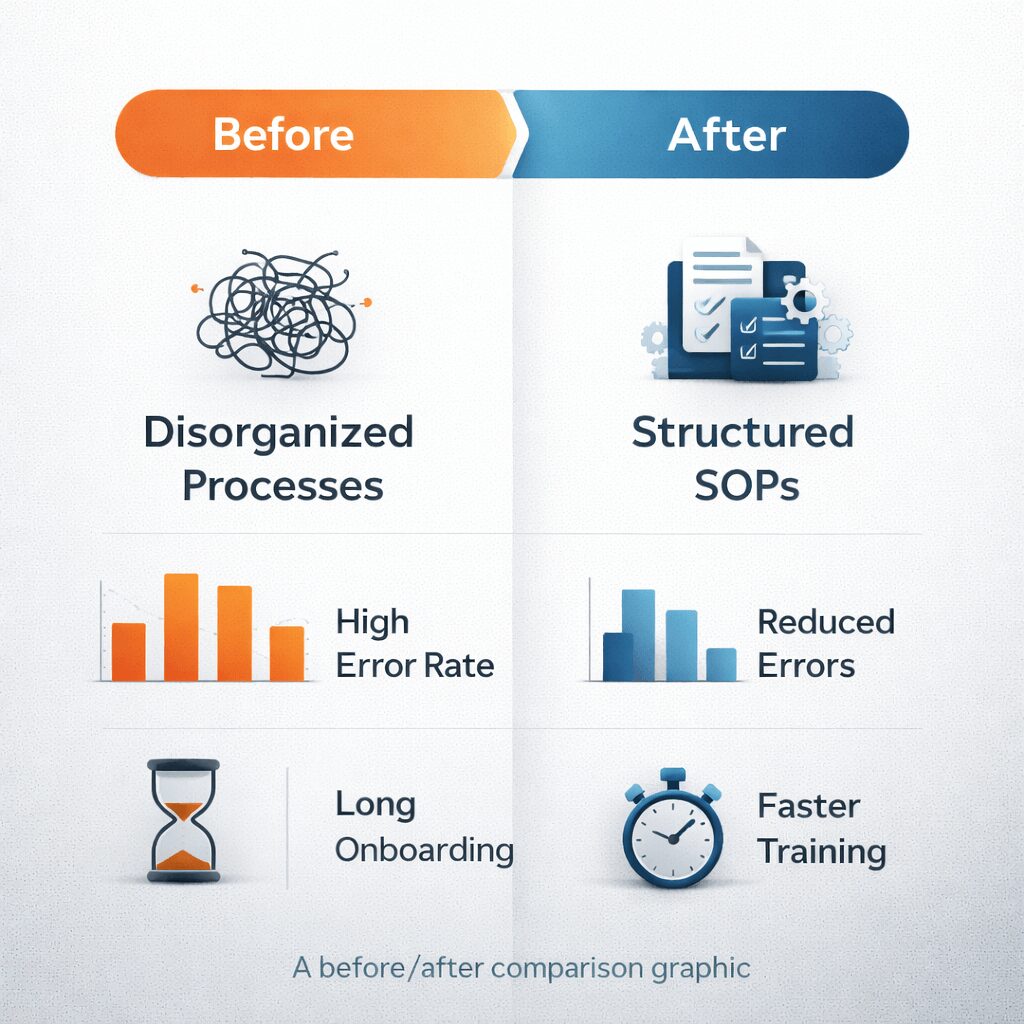
That said, the case for external support isn’t just about speed. It’s about quality. A 2023 manufacturing case study found that after teams implemented SOPs with expert guidance, defect rates dropped from 15% to 5%, on-time delivery climbed from 73% to 91%, new hire training time fell from four weeks to two, and production costs dropped from $1.5M to $1.2M.That’s not a marginal gain. Those are numbers that change how a business operates.
If your team is already stretched or your procedures haven’t been updated in over a year, it’s time to look at sop consulting services as an investment rather than an overhead cost.
How SOP Consultants Improve Efficiency and ROI
Let’s talk ROI, because that’s what leadership wants to see.
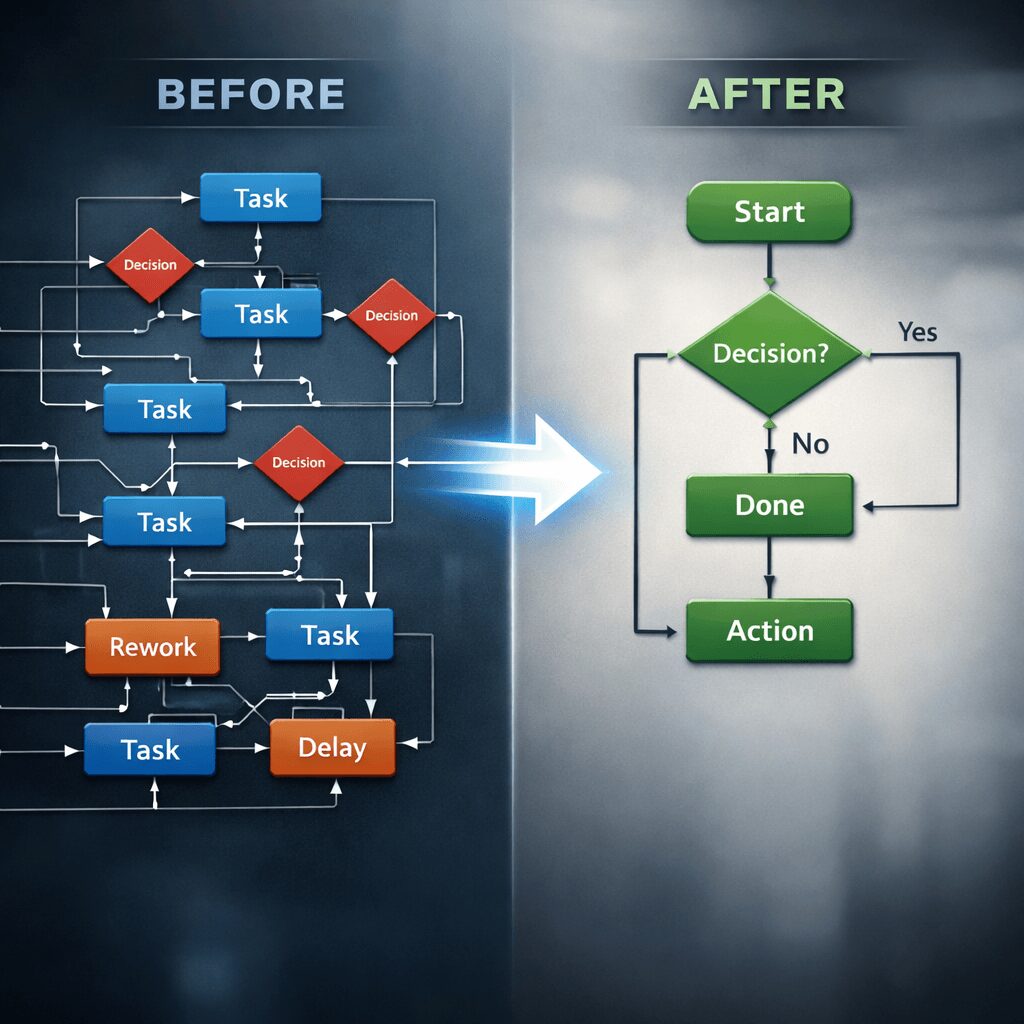
The efficiency gains from SOP consulting don’t arrive all at once. They build. In the first phase, you eliminate confusion and rework. Second, you reduce training time and onboarding costs. At last, third, your teams can actually scale without the process falling apart.
Think about it this way: every hour a manager spends answering the same question is an hour not spent on growth. Every error that reaches a client costs more than the rework required to fix it. And every new hire who spends three weeks shadowing a colleague because there’s no written process is a delay you could avoid.
Organizations with formalized, digital SOP systems scale new market operations approximately 40% faster than those relying on informal knowledge transfer, according to Insights Consultancy research. At the same time, structured SOPs have been linked to up to a 35% reduction in role-specific training time.
That’s the ROI case in a nutshell: fewer errors, faster ramp-up, and lower cost per process.
Cost Savings You Didn’t Expect from SOP Consulting
Most businesses focus on the obvious: cutting rework, reducing errors. But there are savings that don’t appear in the initial business case that are just as real.
Here are the ones that tend to surprise clients the most:
- Compliance fines avoided: In regulated industries, one audit finding tied to an outdated procedure can cost more than a full SOP consulting engagement.
- Reduced management load: When procedures are clear, middle managers spend less time answering questions and resolving inconsistencies.
- Faster scaling into new markets: A business with documented, standardized workflows can replicate its operations faster and with less risk of quality loss.
- Lower turnover costs: Clear role documentation and onboarding processes reduce early-stage attrition, which is expensive.
- Mergers and acquisitions readiness: SOPs give acquirers confidence and speed up integration timelines, directly affecting deal value.
The question isn’t whether these savings are real. The question is whether you have a way to track them before and after an engagement. That’s where a structured ROI framework matters.
A straightforward pre- and post-measurement approach works well: pick three to five KPIs per department (error rate, onboarding time, process cycle time, compliance rate, rework cost), measure them before the SOP project starts, and track them again at 30, 90, and 180 days post-implementation.
How SOP Experts Build Scalable Business Processes
Standardizing workflows for consistent outcomes
Scalable processes start with role-based design. Rather than writing SOPs for specific individuals, SOP consultants document procedures by function. This means a procedure written for a “Sales Manager” role works whether it’s filled by one person today or five people next year.
This approach also makes delegation easier. When responsibilities are tied to roles rather than names, the handoff between team members is clear and doesn’t require tribal knowledge to execute.
Reducing operational errors and compliance risks
Process governance isn’t just about documentation. It’s about building controls into your workflows so errors get caught before they reach the client, the regulator, or the audit.
Well-designed SOPs include decision trees, escalation paths, and built-in checkpoints. These aren’t bureaucratic extras. They’re the features that keep your operations clean under pressure.
At the same time, procedures that directly meet regulatory standards close the gap between how you work and what compliance requires. Consultants track regulatory changes in your industry and update documentation to stay current, so your team walks into every audit prepared.
A regular SOPs Review cycle keeps this current and gives your compliance function a reliable audit trail to work from.
Aligning SOPs with long-term business strategy
Here’s something most documentation conversations miss: SOPs aren’t just operational tools. They’re strategic infrastructure.
When your procedures are designed to support your three-year or five-year plan, rather than just describe what’s happening today, they become a foundation for growth. They tell new hires how the business plans to operate. They guide decisions at the department level without needing a senior leader in every room.
SOP consultants with strategic experience can map procedures to long-term business objectives, flagging where today’s workflows would break under growth, and redesigning them before that becomes a problem.
What Problems Can SOP Consultants Solve?
Inefficient processes and workflow bottlenecks
Every business has processes that work on paper but drag in practice. The issue is usually not that people are doing things wrong. It’s that the process itself was never designed for efficiency.
An SOP consultant looks at your actual workflows, not just your documented ones, and spots where steps pile up, where handoffs get dropped, and where work sits in a queue waiting for approvals that should clear automatically. The redesign targets those points specifically.
Lack of documentation and knowledge gaps
When key processes live in one person’s head, the business is exposed. If that person leaves, is sick, or gets promoted, the institutional knowledge leaves with them.
SOP consulting closes that gap. Every critical process gets documented, reviewed, and stored in a central location. That gives your team a reference point, your managers an accountability framework, and your business continuity plan an actual foundation.
Scaling challenges in growing organizations
This is where the outsourced vs in-house sop consulting question becomes most pressing. Growing businesses often find that their existing processes can’t carry the volume or complexity of where the business is headed.
Scalable SOPs break down multi-role responsibilities into discrete functions, stress-test processes against projected growth, and build in review triggers so procedures stay current as the business changes. Without this, you’re building headcount on a foundation that was designed for a smaller operation.
How Do SOP Consultants Save Time and Resources?
Faster process mapping and implementation
External consultants bring proven methodologies that most internal teams build from scratch. They know how to run stakeholder interviews, map process flows, and turn raw information into structured documentation quickly.
What might take an internal team six months to produce, a consultant with the right tools and experience can complete in six to eight weeks. That’s not a small difference when you’re trying to hit a growth target or pass an audit.
Eliminating redundant tasks and inefficiencies
Redundancy is expensive. When two departments follow different versions of the same process, or when a workflow requires five approvals that could be three, the business is paying in time and coordination every single day.
Process optimization is a core part of what SOP consultants do. They look for steps that don’t add value, decisions that can be delegated, and handoffs that can be automated. The result is leaner operations without losing the controls that matter.
Are SOP Consulting Services Worth the Investment?
Let’s be direct. SOP consulting is an upfront investment with a long tail of returns.
The case is strongest when:
- Your business is scaling and your current processes weren’t built for it
- You’re preparing for a compliance audit or regulatory review
- Onboarding is taking too long and quality is inconsistent
- You’ve experienced repeated errors or customer complaints tied to process failures
- You’re planning a merger, acquisition, or new market entry
In each of these scenarios, the cost of not having structured procedures is higher than the cost of the engagement. And when you track the before-and-after metrics, the ROI tends to be clear.
For businesses that are earlier in their growth or have tighter budgets, a phased approach works well: start with the two or three most critical processes, measure the impact, and expand from there.
When Should You Hire an SOP Consulting Expert?
You don’t have to wait for a crisis. The best time to bring in an SOP expert is before the problem is obvious.
That said, there are clear signals that now is the right time:
- Team size is growing faster than your documentation
- New hires are taking longer to reach full productivity
- Your compliance function is flagging process-related risks
- You’re getting inconsistent outputs from the same team
- You’re about to launch a new product, service, or location
- Leadership is too involved in day-to-day decisions that should be handled at lower levels
Each of these points is a sign that your processes are lagging behind your business. An SOP consulting expert can close that gap before it turns into a real operational problem.
Key Features to Look for in an SOP Consultant
Industry expertise and proven frameworks
The right consultant brings more than documentation skills. They bring industry knowledge that helps them read your regulatory environment, assess your operational risks, and benchmark your standards against what competitors are already meeting.
Look for consultants who have worked in your sector, who reference ISO, IFRS, or industry-specific compliance standards where relevant, and who use a structured framework rather than building processes from scratch each time.
Customization vs standardized approaches
Off-the-shelf SOP templates have their place. But they tend to miss the contextual nuances that make or break a procedure in practice.
A good SOP consultant combines a structured methodology with customization based on direct observation of your workflows, interviews with your staff, and an understanding of your specific risk profile. The output should look like your business, not a generic benchmark.
The right balance is a proven framework applied with enough flexibility to reflect how your teams actually operate.
How to Get Started with SOP Consulting Services
Getting started doesn’t require a full organizational overhaul. A practical first step looks like this:
- Run an SOP maturity audit. List your current procedures, when they were last reviewed, who owns them, and how well they’re actually being followed. Most businesses find gaps within the first hour of this exercise.
- Identify one critical process. Pick the workflow that, if it broke down, would have the highest impact on your operations, your clients, or your compliance status.
- Measure your current baseline. Before any changes are made, document your current KPIs: error rate, cycle time, onboarding time, rework frequency.
- Engage a consultant for a defined scope. You don’t have to start with everything. A fixed-scope engagement on one or two processes gives you a proof of concept with measurable outcomes.
- Track and expand. After 30 to 90 days, measure your KPIs again. Use the results to build the internal case for expanding the program.
Change management matters here too. Rolling out new procedures to a resistant team is one of the most common points of failure. A good SOP consulting engagement includes a plan for communicating changes, training affected staff, and getting buy-in from middle management before the new process goes live.
The Real Case for Investing in SOP Consulting
The benefits of SOP consulting don’t live in a single document or a one-time project. They show up in every process your team runs, every new hire you bring on, and every audit you walk into with confidence.
Operational improvement builds one procedure at a time. When your team designs those procedures well, reviews them regularly, and ties them to your broader strategy, they become one of the most cost-effective investments your business can make.
If you’re ready to stop patching processes and start building something that scales, Prima Consulting can help. Prima Consulting builds our sop consulting services around your operations, your growth targets, and your compliance requirements.