TL;DR
IAS 19 is the international accounting standard that sets out how employers record employee benefits. It covers four groups: short-term benefits, post-employment benefits, other long-term benefits, and termination benefits. Share-based payment is excluded and falls under IFRS 2 instead. IAS 19 has applied since 1999 and remains in effect in 2026.
What Is IAS 19?
IAS 19 is the International Accounting Standard that governs employee benefit accounting. It requires employers to record benefit expenses when employees earn them, not when they are paid. The standard covers four benefit categories and applies to all employers preparing IFRS financial statements.
Think of IAS 19 as the rulebook for recording everything from monthly salaries to pension obligations.
The four categories carry different rules. Short-term benefits like wages and bonuses get simple treatment. Post-employment benefits, especially defined benefit plans, need actuarial work.
What makes it hard is the actuarial side. Pension obligations pull in assumptions about future mortality, salary growth, and discount rates. A monthly salary doesn’t.
Amendments effective in 2024 and 2025 tightened disclosure rules. So transparency now carries more weight than it did a decade ago.
What Does IAS 19 Stand For?
IAS 19 stands for International Accounting Standard 19, titled “Employee Benefits.” The IAS prefix marks it as one of the standards issued before the IFRS naming series began. It sets the accounting for wages, pensions, other long-term benefits, and termination benefits.
The standard sits inside the wider body of IFRS. IASB maintains it today, even though the original “IAS” label predates the IFRS Foundation’s current naming.
You’ll see it written as “IAS 19” or “IAS19.” Both point to the same standard.
Is IAS 19 Still in Effect in 2026?
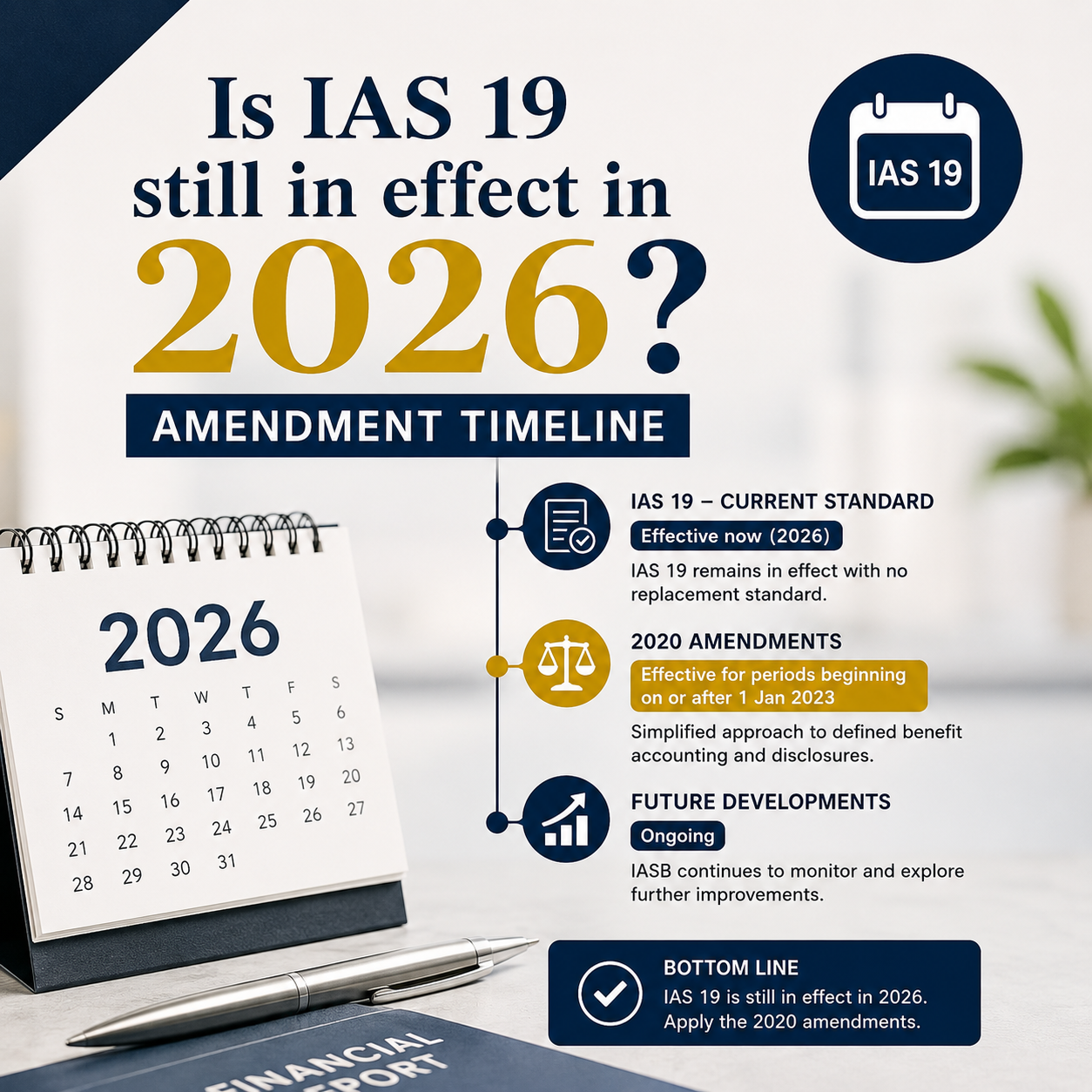
Yes. IAS 19 remains fully in effect in 2026 and is the current standard for employee benefit accounting under IFRS. IFRS 18, effective from January 2027, changes how profit or loss is presented but does not replace IAS 19 measurement.
No replacement standard is on the table. Defined benefit and termination benefit accounting still run on IAS 19 rules.
What is changing is presentation. IFRS 18 reshapes where benefit income and expense sit in the income statement, and our IFRS 18 financial statements guide covers that shift in detail.
When Was IAS 19 First Issued? A Short Amendment History
IAS 19 was first issued in 1998 and took effect in 1999. Major milestones are the 2011 revision that removed the corridor method, the 2018 amendment on plan changes, and IFRS 18 in 2024. Each step tightened transparency.
Here’s the lineage that most guides skip.
In 1998, companies could defer actuarial gains and losses using the “corridor” method. That option is gone now.
The 2011 revision killed the corridor. Remeasurements went straight to other comprehensive income, and the net interest approach replaced the old split between interest cost and expected return on assets. This reshaped how most balance sheets look today.
A 2018 amendment forced companies to use updated assumptions for the rest of the period once a plan amendment, curtailment, or settlement hits. Small change on paper. Big effect on the numbers.
Then IFRS 18 arrived in 2024, effective January 2027. It doesn’t rewrite IAS 19 measurement, but it changes how benefit costs present inside profit or loss.
Why Does IAS 19 Matter for Finance Teams?
IAS 19 matters because employee benefit obligations often run into millions and swing hard with assumptions. A 1% move in the discount rate can shift defined benefit liabilities by 10 to 15%. Getting it wrong hits compliance, investor confidence, and credit ratings.
The numbers are large. In Germany, 87.1% of the labour force takes part in statutory pension schemes.
Regional rules add friction. In Saudi Arabia and UAE, pension coverage reaches 51% in some regions, with contribution rates that differ across borders.
Two risks feed straight into your statements. Longevity risk means employees might outlive projections. Investment risk hits plan asset performance. For the wider cost picture, see our note on what drives the cost of employee benefits.
Also check out our blog: Why Employee Benefits Valuation Is More Critical Than You Think
What Is the Scope of IAS 19?
IAS 19 covers all employee benefits given in exchange for service or termination. It excludes share-based payment, which falls under IFRS 2, and it excludes reporting by the retirement benefit plan itself, which sits under IAS 26. Knowing the boundary stops you applying the wrong standard.
The standard runs on accrual-based recognition. You record benefit expenses when employees earn them, not when you pay them.
Market-based assumptions anchor every valuation. Discount rates track high-quality corporate bond yields, and salary growth should match realistic economic projections.
The projected unit credit method is the required valuation approach for defined benefit plans. It spreads benefit costs across an employee’s service life.
What Are the Four Categories of Employee Benefits?
The four IAS 19 categories are short-term benefits, post-employment benefits, other long-term benefits, and termination benefits. Classification depends on when benefits become payable and whether they need actuarial calculation.
Each category has its own treatment. Get the classification right and the accounting follows.
How Are Short-Term Employee Benefits Accounted For?
Short-term benefits include wages, salaries, bonuses, and social security contributions payable within 12 months. You record an expense when employees provide the service, with no discounting.
If you owe employees $50,000 in unpaid wages at year-end, you record a $50,000 liability. Simple.
Paid absences fall here when they accumulate but vest within 12 months. Vested carry-forward leave needs accrual. Non-vesting sick leave usually doesn’t until employees take it.
Profit-sharing counts as short-term when payment falls within 12 months. The test is a present obligation from past employee service.
What Are Post-Employment Benefits?
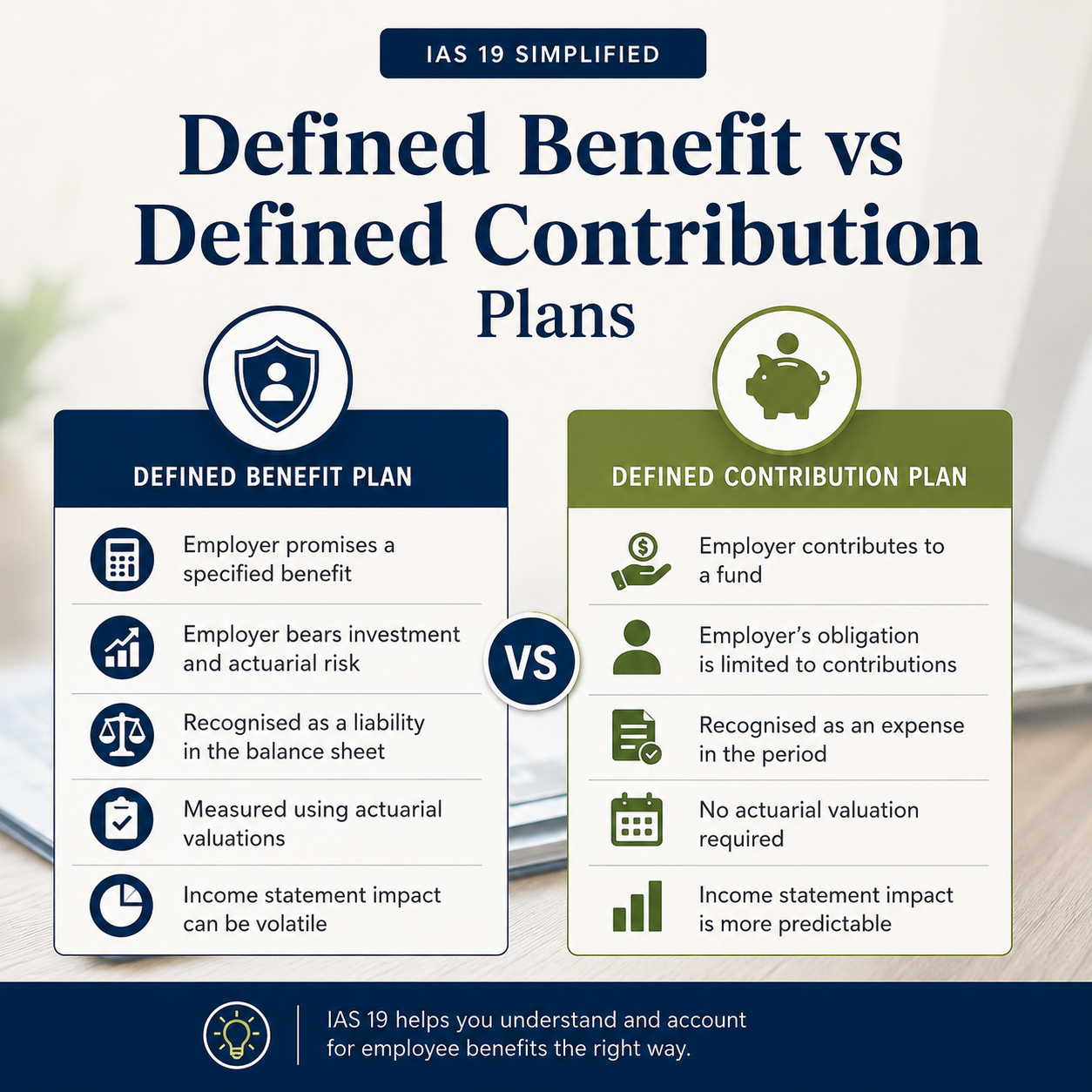
Post-employment benefits split into defined contribution and defined benefit plans. The split turns on who carries the risk: defined contribution pushes it to employees, defined benefit keeps it with the employer.
That single distinction drives two very different accounting approaches.
Geography adds complexity. Pakistani employers contribute 5% of minimum wage, while UAE employers may contribute up to 15% under some arrangements.
Read the legal structure carefully. Some plans look like defined contribution but expose you to defined benefit risk through minimum return guarantees.
How Do You Account for Defined Contribution Plans?
Under a defined contribution plan, your expense equals the contributions required for services rendered. Record contributions as an expense when employees provide service. No actuarial valuation is needed.
If employees earned $100,000 in wages and your plan requires 10% contributions, you record $10,000 in pension expense.
Unpaid contributions at reporting dates create liabilities. Owe $25,000 at December 31st, book a $25,000 liability.
Refer to our blog: What Affects the Cost of Your Employee Benefits Obligation?
Multi-employer plans often count as defined contribution for each participating employer. But withdrawal liabilities or guarantees can flip that.
How Do You Account for Defined Benefit Plans?
Defined benefit accounting measures the projected benefit obligation, adds service cost and interest cost through profit or loss, and routes remeasurements through other comprehensive income. Plan assets reduce the net obligation on the balance sheet.
The projected benefit obligation (PBO) is the present value of benefits your plan already owes. It moves as interest accrues and assumptions change.
Service cost is the extra benefit earned each year. Interest cost is the time value of money as you near payment. Together they build the annual expense.
Actuarial gains and losses show up when experience differs from assumptions. Remeasurements are recognised in the period they arise, through other comprehensive income, not profit or loss.
Can You Show a Worked IAS 19 Journal Entry?
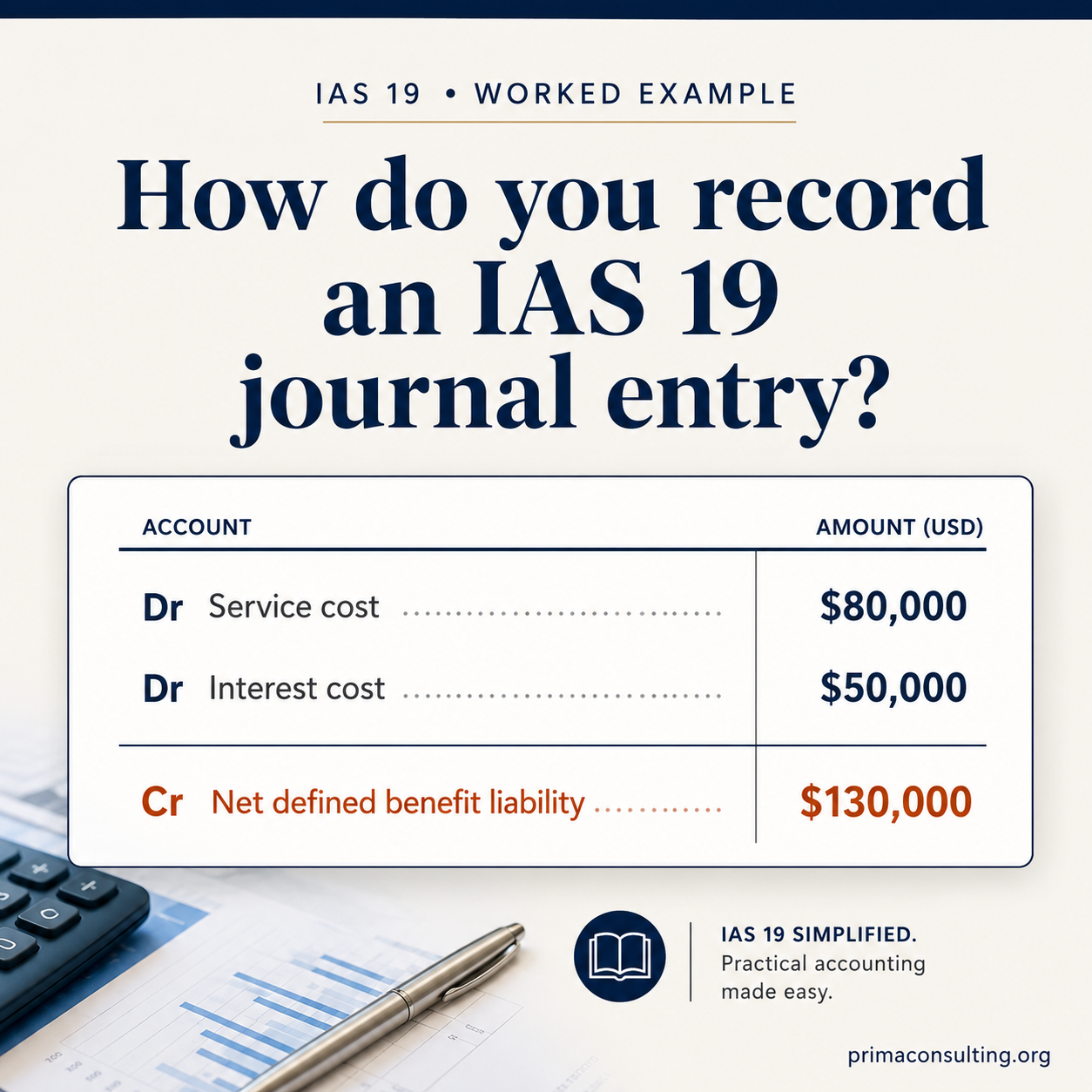
Yes. Take a plan with an opening PBO of $1,000,000, a 5% discount rate, and $80,000 current service cost. Interest cost is $50,000, so the total charge to profit or loss is $130,000. Closing PBO, after $60,000 benefits paid, is $1,070,000.
Interest cost is 5% of the opening $1,000,000, which is $50,000. Add $80,000 service cost. That’s $130,000 through profit or loss.
The expense-side journal entry looks like this:
Dr Employee benefit expense (service cost) $80,000
Dr Finance cost (interest on obligation) $50,000
Cr Net defined benefit liability $130,000
Closing PBO is $1,000,000 + $80,000 + $50,000 – $60,000 = $1,070,000. Benefits paid reduce the obligation but don’t hit expense.
For the full attribution method behind service cost, see our projected unit credit method guide.
Prima Consulting
Stuck on an IAS 19 defined benefit calculation? Our actuarial team offers a free first consultation.
No obligation · Responds within 1 business day · GCC, Europe & APAC
What Are Other Long-Term Employee Benefits?
Other long-term benefits include sabbaticals, long-service awards, and deferred compensation payable more than 12 months after service. They use a simpler version of defined benefit accounting, with lighter disclosure.
You still need actuarial valuation, but some detailed disclosure rules drop away.
Sabbatical leave is the clean example. Six months’ paid leave after ten years of service gets accrued over the service period using present value.
The difference from post-employment benefits is timing. These fall due while employees still work.
When Are Termination Benefits Recognized?
Termination benefits are recognized when the employer shows commitment through a detailed formal plan it cannot withdraw, or when employees accept a voluntary offer. Without demonstrable commitment, no liability exists.
The liability equals your best estimate of the cost to settle. Large redundancies need actuarial work to estimate take-up rates.
For more information, check out our blog: Prima’s End-to-End Actuarial Valuation Services for HR & Finance Teams
Watch the timing trap. Enhanced pension benefits offered to redundant employees might count as post-employment benefits instead, which changes the accounting.
How Does IAS 19 Differ From IFRS 2, IAS 26, and IFRS 17?
IAS 19 covers employee benefits from the employer’s side. IFRS 2 covers share-based payment, IAS 26 covers the retirement plan’s own reporting, and IFRS 17 can apply to insured benefit arrangements. The most common mix-up is treating share options under IAS 19 instead of IFRS 2.
| Standard | What it covers | Why it’s not IAS 19 |
|---|---|---|
| IFRS 2 | Share-based payment: options, shares, equity-settled awards | IAS 19 explicitly excludes share-based payment. |
| IAS 26 | Reporting by the retirement benefit plan itself | IAS 19 is the employer’s view, not the plan’s financial statements. |
| IFRS 17 | Insurance contracts, including some insured benefit arrangements | Benefits delivered through a qualifying insurance contract can fall under IFRS 17. |
If your package mixes cash pensions with equity awards, you’re applying two standards at once. That’s normal. Just keep the pension logic out of the option accounting.
What Are the Most Common IAS 19 Challenges?
The two biggest IAS 19 challenges are setting actuarial assumptions and staying compliant across jurisdictions. Discount rate and mortality choices swing the numbers, and pension rules differ by country. Both usually need specialist input.
The discount rate should track high quality corporate bonds, usually read as an AA rating. Pinning the right rate per country takes skill, which is why discount rate selection gets so much auditor attention.
Mortality brings its own headache. Recent rule changes cap mortality improvement rates at 0.78% for future years in some jurisdictions.
On the regional side, German statutory arrangements run on different lines from GCC systems. In Germany, pension replacement rates reach 54.7% counting voluntary schemes.
Teams that skip specialist review tend to get caught on exactly these points. Our roundup of common IAS 19 mistakes covers the recurring ones.
Who Prima works with
Across industries and geographies — delivering measurable outcomes
🏦
Banks & Financial Institutions
IFRS 9 ECL models, credit risk, impairment methodology, regulatory reporting
🛡️
Insurance & Takaful Companies
IFRS 17 implementation, actuarial modelling, GMM/VFA/PAA, CSM calculations
🏢
Corporates & Multinationals
IFRS 15, 16, IAS 36 compliance, financial statements, internal controls
📈
Investment & Asset Managers
IFRS 9 classification, fair value (IFRS 13), derivative valuations, hedge accounting
🏗️
Real Estate & Construction
IFRS 16 lease accounting, IFRS 15 revenue recognition, project-based reporting
🏛️
Family Offices & Holding Groups
Governance frameworks, board advisory, risk management, portfolio evaluation
How Do IAS 19 Actuarial Valuations Work?
IAS 19 valuations use the projected unit credit method to spread benefit costs over an employee’s service life. The actuary discounts projected benefits using assumptions on salary growth, mortality, and discount rates. Small rate changes move the result sharply.
Each year of service earns extra benefit credits. The actuary values them using current assumptions, so the valuation output tracks live economic inputs.
Discount rate selection swings results hard. A 1% rise might cut liabilities by 10 to 15% for a typical plan.
If you’d rather run these in-house, IFRS TECH offers a dedicated IAS 19 Valuation Tool that automates the projected unit credit calculation.
What Is the Difference Between a Settlement and a Curtailment?
A settlement eliminates an existing benefit obligation, usually through a lump sum or annuity purchase. A curtailment cuts future benefit accruals, often via a plan amendment or workforce reduction. Both trigger immediate recognition and, since 2018, updated assumptions for the rest of the period.
Settle 30% of your plan’s obligation and you recognise 30% of any unrecognised remeasurement.
Curtailments change what employees earn going forward. Settlements clear what’s already owed. Different events, different accounting.
What Disclosures Does IAS 19 Require?
IAS 19 requires reconciliations of the benefit obligation and plan assets, full disclosure of key assumptions, sensitivity analyses, and descriptions of the risks involved. The goal is to let users see the obligation and the assumptions behind it, not just a single balance sheet figure.
Quantitative disclosures reconcile opening and closing obligations, showing service cost, interest cost, gains or losses, and benefit payments.
Assumption disclosures need detail on discount rates, mortality tables, and salary growth. Sensitivity analyses show how reasonable changes move the numbers.
IFRS 18, effective 2027, changes where this income and expense present, so disclosure discipline matters more heading into that transition.
How Should You Approach IAS 19 Compliance?
Start by listing every employee benefit you run, then set an annual actuarial valuation cycle with documented assumptions. Build disclosure processes early and monitor plan and market changes through the year. Most teams pair internal ownership with specialist actuarial support.
Annual valuations are the floor. Interim updates step in for material changes like large terminations or sharp market moves.
Document your assumption-setting so it stays consistent and auditable. That record is what auditors ask for first.
Whether you run operations in Saudi Arabia, UAE, Pakistan, Germany, or beyond, Prima Consulting delivers audit-ready IAS 19 valuations, and IFRS TECH’s ready-to-deploy IAS 19 System runs the numbers on cycle.
Free Consultation
Need an audit-ready IAS 19 valuation?
Prima’s actuaries work with organisations across the GCC, Europe, and Asia-Pacific. First conversation is always free. No pitch, just expertise.
IAS 19 Key Terms Glossary
Projected benefit obligation (PBO): the present value of benefits employees have already earned, using assumptions about future salary growth. It’s the headline liability in a defined benefit plan.
Asset ceiling: a limit on how much plan surplus you can carry as an asset, restricted to what you can recover through refunds or reduced future contributions.
Service cost: the value of new benefits employees earn in the current period. It runs through profit or loss.
Curtailment: a sharp cut in future benefit accruals, from a plan amendment or workforce reduction. Different from a settlement, which clears an existing obligation.
Remeasurement: the change in your obligation or plan assets from experience differences or assumption updates. Recognised in other comprehensive income, not profit or loss.