Ibrahim Ahmed Zahidie, FCA

ESG Reporting Saudi Arabia CMA Guide featured image showing a professional sustainability report booklet on a modern office desk with Saudi skyline background, ESG icons, financial charts, and green corporate branding.

ESG Reporting Saudi Arabia 2026 | CMA Guide

ESG reporting in Saudi Arabia is shifting fast. What the CMA and Tadawul label “voluntary” today is already becoming a market access requirement, especially for companies seeking green financing or foreign institutional capital. This article covers what the CMA and Tadawul currently mandate for listed companies across the Middle East,

Read More
ESG reporting requirements UAE infographic showing how IFRS S1 and IFRS S2 connect with GRI, TCFD, SASB, and UAE-specific ESG reporting frameworks including DFM, ADX, and ADGM to support consistent sustainability disclosures.

ESG Reporting UAE 2026: DFM, ADX & ADGM

ESG reporting requirements UAE now apply to most listed and ADGM-regulated companies, but the rules are not the same across DFM, ADX, and ADGM. This article covers who must report and when, which frameworks (GRI, TCFD, IFRS S1/S2) each regulator expects, and how the new Federal Climate Law adds a

Read More
A professional finance workspace overlooking a modern Saudi Arabian city skyline. A laptop displaying budgeting and forecasting reports sits beside a calculator, financial documents, and a coffee mug on a wooden desk. Bold headline text reads "Budgeting & Forecasting Services Saudi Arabia," highlighting financial planning, budgeting, forecasting, and business performance management services for organizations in Saudi Arabia.

Budgeting Forecasting Services Saudi Arabia

Budgeting forecasting services in Saudi Arabia now carry a compliance dimension most in-house teams weren’t built for. This article explains what FP&A consulting actually delivers versus what your internal team handles, covers the three core outputs every KSA finance function needs, and details the most common gaps Prima Consulting finds

Read More
Professional office desk setup featuring reports, calculator, binders, and bold text “IFRS 18 Financial Statements – 2027 Changes,” representing upcoming IFRS 18 financial statements reporting updates in a realistic corporate environment.

IFRS 18 Financial Statements: 2027 Changes

IFRS 18 financial statements replace IAS 1 for annual periods starting 1 January 2027. This standard restructures the income statement into five defined categories of income and expense, mandates an operating profit subtotal, and brings management-defined performance measures like “adjusted EBITDA” into the audited financial statements for the first time.

Read More
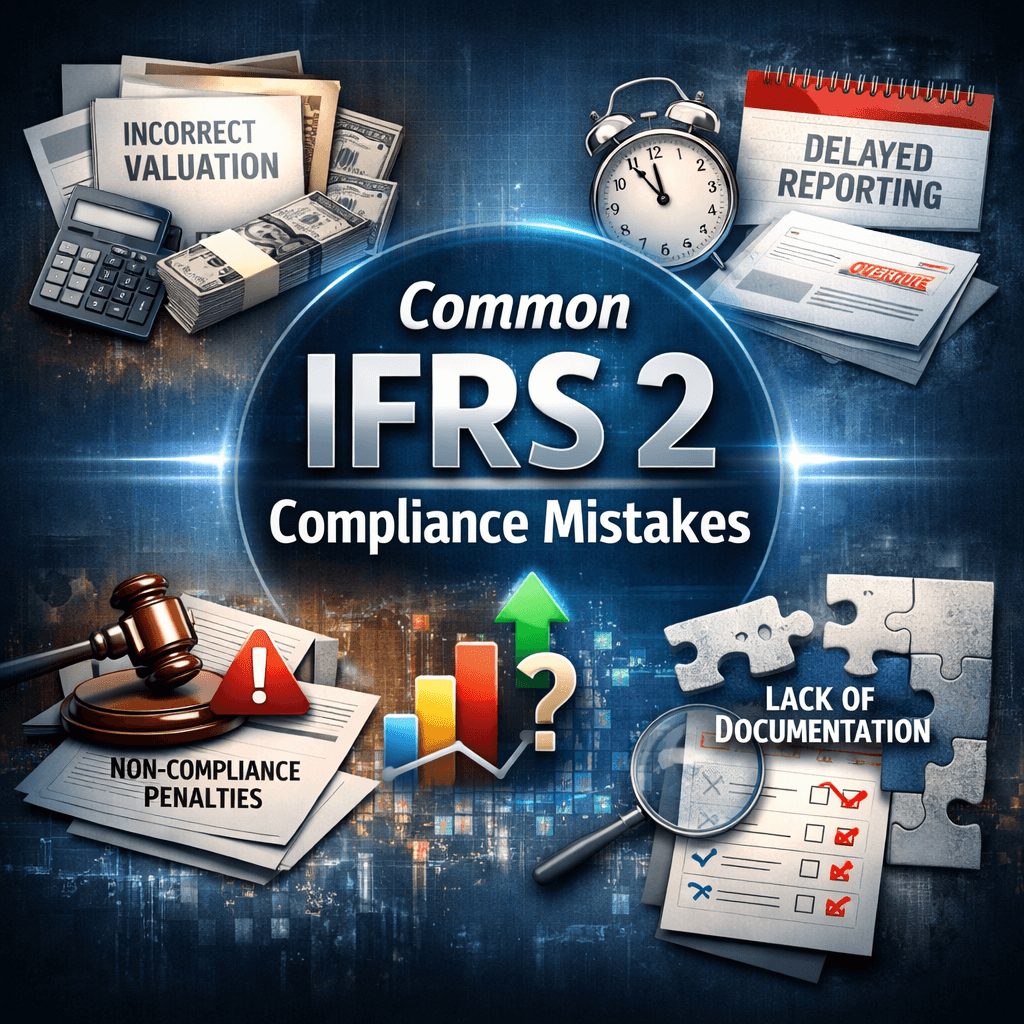
Professional infographic illustrating common IFRS 2 Compliance mistakes, including incorrect valuation, delayed reporting, non-compliance penalties, and lack of documentation in share-based payment reporting.

Common IFRS 2 Compliance Mistakes 

TL;DR IFRS 2 compliance is critical to avoid common audit issues and accounting gaps in share-based payments. This article outlines typical IFRS 2 mistakes related to stock options, vesting, and fair value measurements. You’ll find a practical checklist to help identify and fix errors in IFRS share-based reporting. Understanding these

Read More

IFRS 15 Revenue Recognition Scenarios: Real-World Examples with Solutions

IFRS 15 scenarios show how companies apply the five-step revenue recognition model to real contracts involving bundled services, variable pricing, and performance obligations examples. This guide breaks down revenue recognition case studies from technology, e-commerce, construction, and telecommunications sectors showing when to recognize revenue over time versus at a point

Read More
Basics of IFRS 3 Business Combinations showing business mergers, financial reporting, and acquisition accounting framework

Basics of IFRS 3 Business Combinations: A Complete Guide

The basics of IFRS 3 business combinations are covered in this guide, showing you how to apply business combination accounting, the acquisition method IFRS 3 requires, and the key steps in practice. You’ll understand how to identify the acquirer, determine the acquisition date, measure the consideration transferred (including purchase consideration

Read More
Professional office desk setup featuring IFRS binders, financial reports, calculator, and bold typography reading “IASB Updates 2026: What CFOs Must Know,” designed as a realistic corporate infographic thumbnail for LinkedIn and finance websites.

IASB Updates 2026: What CFOs Must Know

The IASB updates 2026 have already started hitting financial statements. Four amendments became mandatory on 1 January 2026, covering IFRS 9, IFRS 7, IAS 21, and Annual Improvements Volume 11. This digest covers what each change requires, who is in scope, and the status of active exposure drafts — including

Read More
IFRS 13 Fair Value Measurement Explained – a visual breakdown of key valuation principles, measurement techniques, and market-based assessment concepts.

IFRS 13 Fair Value Measurement Explained Guide

IFRS 13 Fair Value Measurement Explained gives you a clear roadmap to measure assets and liabilities consistently across industries and markets. This guide breaks down the fair value hierarchy (Levels 1–3), key IFRS 13 valuation techniques market, cost, and income approaches and what fair value disclosures mean for transparency and

Read More
Professional finance-themed thumbnail for ecl model validation IFRS 9 featuring audit documents, financial charts, a magnifying glass, and an IFRS 9 binder representing auditor review and model governance checks.

ECL Model Validation IFRS 9: What Auditors Actually Check

ECL model validation under IFRS 9 is what separates banks that pass audits cleanly from those that spend Q4 in remediation mode. A Big Four auditor checks five areas: governance and documentation, PD/LGD/EAD methodology, forward-looking overlays, backtesting results, and management overlay justification. For each area there’s a clear line between

Read More