TL;DR
Picking IFRS 17 consulting firms comes down to three things: technical depth, proven experience with your insurance products, and a delivery model that fits your timeline. You need consultants who understand the standard’s nuances, can handle complex scenarios like onerous contract testing and reinsurance alignment, and bring real implementation track records. Don’t just compare IFRS 17 consulting pricing. Look at technical capabilities, resource availability, and post-go-live support. Get this decision right, and you’ll meet compliance deadlines without derailing operations. Get it wrong, and you risk costly delays and compliance failures.
IFRS 17 Consulting Firms: Insurer Selection Guide
The short answer: the best IFRS 17 consulting firms prove three things before you sign. Real go-lives on portfolios like yours, senior actuaries and accountants named in the proposal (not swapped out later), and a working knowledge of your regulator, whether that’s SAMA, CBUAE, or the Central Bank of Ireland. Price matters last. A cheap engagement that slips six months past your reporting deadline costs far more than the fee you saved.
Selecting IFRS 17 consulting firms isn’t just another procurement decision for insurers. It’s a strategic choice that decides whether your organization meets compliance deadlines without disrupting operations. With implementation costs reaching up to $200 million for large multinationals, getting this right matters.
The stakes are real. Insurers face complex technical requirements, tight reporting schedules, and resource constraints. The right consulting partner brings specialized skills that turn compliance from a burden into an advantage. Wrong choice? You risk delays, cost overruns, and compliance failures.
This guide helps insurers compare IFRS 17 consulting firms on technical capabilities, industry experience, and proven delivery models. You’ll learn what questions to ask, which criteria matter most, and how to structure engagements that deliver value beyond ticking a compliance box. If you’re still deciding whether to hire at all, our guide to IFRS 17 implementation challenges shows where most projects run into trouble.
How to Choose the Best IFRS 17 Consulting Firms
Choosing IFRS 17 consulting firms takes more than reviewing proposals and comparing prices. You need a clear evaluation framework that weighs technical depth, implementation method, and long-term support.
Start with your own needs. Different insurers face different problems based on portfolio mix, existing systems, and how ready the organization actually is. A life insurer with participating contracts needs different skills than a property and casualty carrier running the premium allocation approach.
Bring your finance, actuarial, and IT teams into the process. Cross-functional input makes sure you pick a firm that covers technical, operational, and technology needs. It also builds internal buy-in, which you’ll want when the hard implementation decisions land.
Key Evaluation Criteria for Insurers
Focus on what a firm can demonstrate, not what it can claim. Look for proven track records in IFRS 17 implementation across insurance portfolios like yours.
Track record speaks louder than a slide deck. Ask for specific case studies showing how the firm handled onerous contract testing, reinsurance alignment, and transition adjustments. Probe how they deal with the IFRS 17 implementation challenges that quietly derail projects, the ones that don’t show up until month eight.
Industry recognition is another signal. Check whether the firm’s consultants contribute to technical forums, publish analysis, or take part in standard-setting discussions. That involvement points to real depth, not surface knowledge.
Resource availability matters as much as skill. Over 10,000 full-time employees are needed globally to deliver IFRS 17, which means fierce competition for qualified people. Confirm your prospective firm has dedicated resources now, not a promise to staff up later.
Technical IFRS 17 Expertise to Look For
Technical skill has to span accounting, actuarial modeling, and regulatory interpretation. The best IFRS 17 consulting firms field multi-disciplinary teams that understand how these three pull on each other.
Accounting skill should cover contractual service margin calculations, risk adjustment methods, and revenue recognition patterns. Your consultants need to read a principle-based standard and apply it to your specific contract types, not a textbook example.
Actuarial skill becomes critical for cash flow projections, discount rate selection, and sensitivity testing. Look for actuaries who have modeled products like yours under both the general measurement approach and the variable fee approach. If you want to see how deep that goes, our breakdown of IFRS 17 actuarial assumptions walks through discount rate sensitivity and profit volatility.
Regulatory knowledge stretches past IFRS 17 itself. Consultants should understand how it interacts with IFRS 9, how your local regulator reads specific provisions, and what disclosures will actually get scrutinized. For the cross-standard piece, our comparison of IFRS 17 vs IFRS 9 shows where the two standards collide on measurement.

Systems Integration & Data Capabilities
Technology skill separates firms that deliver lasting solutions from those handing you a manual workaround. Your partner has to design something that plugs into your existing systems and still runs efficiently at each reporting cycle.
Data management is where most of the pain sits. Insurers must track policy groups by year of issue, aggregation levels for onerous contract testing, and reinsurance matching, all at once. That needs solid data architecture and validation, not spreadsheets held together with hope.
System integration knowledge spans finance, actuarial, and source systems. A good firm will tell you honestly whether your current setup supports IFRS 17 or needs work, and where automation can cut manual effort. If you’re weighing tooling, our guide to insurance reserving software compares build-versus-buy for the reserving engine.
Cloud versus on-premise is another call. Some firms specialize in specific platforms, others stay software-neutral. Make sure their preferred approach fits your technology strategy and your IT team’s capacity to run it.
Industry Experience with Insurance Portfolios
Portfolio-specific experience shows up directly in implementation quality. Success with life insurance doesn’t automatically carry over to property and casualty, and the reverse is just as true.
Life insurance portfolios bring long-duration contracts, embedded options, and participating features. Consultants need real experience with variable fee approach calculations and the transition headaches that come with in-force business.
Property and casualty insurers usually run the premium allocation approach for short-duration contracts. Even these “simple” portfolios get messy around reinsurance, IBNR discounting, and proving PAA eligibility.
Reinsurance skill becomes critical for cedants and reinsurers alike. IFRS 17 actuarial assumptions differ between direct and reinsurance contracts, which creates measurement challenges and accounting mismatches if the team hasn’t seen it before.
Explore our advisory services
IFRS 17 Consulting Firms Compared: Which Type Fits Your Insurer?
Here’s the thing the “consulting firms” search almost never answers directly: there isn’t one type of firm. There are four, and the right one depends on your size, your portfolio, and how much of the work you want to keep in-house. Big Four practices, boutique actuarial consultancies, regional specialists, and software-implementation arms each win in different situations.
The table below sums up how they compare on the factors that actually move a decision. Read it as a starting filter, not a verdict.
| Firm type | Best for | Measurement coverage | SAMA / GCC track record | Typical cost |
|---|---|---|---|---|
| Big Four (Deloitte, PwC, EY, KPMG) | Large multinationals needing global consistency and audit-firm brand | GMM, VFA, PAA across all product lines | Present, but senior staff often shared across many clients | Highest ($$$$) |
| Boutique actuarial (e.g. Milliman, WTW) | Complex life and reinsurance portfolios needing deep actuarial judgment | Strong on GMM/VFA, actuarial modeling | Variable by office | High ($$$) |
| Regional specialists (e.g. Prima Consulting) | Mid-sized GCC insurers wanting senior attention and local regulatory depth | GMM, VFA, PAA with Takaful experience | Deep, hands-on SAMA/CBUAE go-lives | Mid ($$) |
| Software-led implementers | Insurers who have chosen a platform and need configuration, not strategy | Tied to their tool’s model coverage | Depends on regional deployments | Mid ($$) |
One caveat worth stating plainly: the lowest bidder often turns out most expensive. A firm that under-scopes to win the deal, then extends the timeline when reality hits, costs you the parallel-run months and the audit stress you were trying to avoid. Weigh the fee against the total cost of the program, not the invoice.
IFRS 17 Consulting in the Middle East (SAMA, CBUAE & GCC)
If you’re a GCC insurer, “global brand” is not the top selection criterion. Regional regulatory fluency is. SAMA in Saudi Arabia and CBUAE in the UAE each have their own disclosure expectations, transition rules, and supervisory habits that a generic global playbook won’t capture.
Look for firms with completed go-lives under your specific regulator, not just “Middle East experience” on a capabilities slide. Ask directly: which SAMA-supervised insurers have you taken through parallel run, and can we speak to them?
Takaful adds another layer. Sharia-compliant products don’t map cleanly onto the standard’s default assumptions, and the treatment of the participants’ risk fund needs a team that has actually modeled it. Our comparison of IFRS 17 vs IFRS 4 includes a Takaful walkthrough that shows where the old approach breaks.
Regional specialists often deliver more responsive service and better value for mid-sized insurers than global brands, while keeping the technical depth complex portfolios demand. That’s the trade the GCC market keeps rediscovering.
Why Insurers Need IFRS 17 Consulting Support
Building it all in-house sounds appealing right up until you cost it out. IFRS 17 consulting firms bring concentrated skill that most insurers can’t justify keeping on payroll forever.
The standard’s complexity outruns a typical accounting change. It demands deep knowledge across several disciplines, comfort with interpretation grey areas, and hands-on implementation experience. Few teams hold all three internally.
Resource constraints make it worse. Your finance and actuarial people already have day jobs. Bolt IFRS 17 on without outside help and you either slip the project or starve their core work.
Managing Implementation Complexity
Complexity starts with reading a principle-based standard. IFRS 17 leaves several areas open to interpretation and hands insurers a menu of options. Pick wrong and you build inefficiency or a suboptimal outcome into the foundation.
Consultants bring structured methods that break the work into manageable phases. They’ve watched what works across different organizations and can bend best practice to fit yours.
Change management is the quiet half of the job. IFRS 17 touches finance, actuarial, IT, and business operations. A good consultant keeps those functions talking and builds consensus around the calls that have to be made.
Improving Compliance & Reporting Accuracy
The right support delivers improved risk management and strategic decision-making, because the standard pushes finance, actuarial, and the business into a more joined-up way of working.
Stakeholders get clearer and more useful information about insurance obligations, moving past stale assumptions and giving you metrics to track performance over time. That’s how you turn implementation into something worth more than a compliance checkbox.
Reporting accuracy demands granular data and complex calculations under tight deadlines. Consultants help stand up processes that produce reliable numbers and still hit the regulator’s dates.
Audit readiness is the other consideration. External auditors go through IFRS 17 implementations carefully. Consultants who know what auditors look for design documentation and controls that make the audit faster and less painful.
Optimizing Processes and Costs
Cost optimization runs past the implementation budget. Organizations gain the opportunity to gain new insights from richer data, tighter processes, and stronger reporting quality when consultants design the solution with that in mind from day one.
Long-term running costs come down to the design choices you make now. A consultant with real insurance contract advisory experience helps you avoid the quick fix that becomes a permanent maintenance burden. That single call often saves more than the entire fee.
What Services Do IFRS 17 Consulting Firms Provide?
Service scope varies a lot across IFRS 17 consulting firms. Knowing the full menu helps you match what you’re buying to what you actually need.
Full-service firms cover everything from first assessment to post-go-live tuning. Specialists focus on one phase or one technical area. Neither is automatically better, it depends on your gaps.
Delivery models differ too. Some firms embed people in your team, some work remotely, some blend both. Pick the model that fits how your organization actually operates.
Gap Assessments & Readiness Reviews
Gap assessments set your baseline. Consultants weigh current accounting policies, systems, data quality, and readiness against what IFRS 17 demands.
A good assessment covers technical, operational, and technology angles. It names the specific gaps in each and sizes the effort to close them, so you’re not guessing.
Readiness reviews give executives a clear read on scale before they commit budget. They’re the foundation for real project planning, not the optimistic kind.
Implementation Roadmaps & Governance
Roadmaps turn a gap assessment into an actionable plan with phases, milestones, resource needs, and dependencies spelled out. Our actuarial reserving solution guide shows what an end-to-end IFRS 17 roadmap looks like in practice.
Governance frameworks set decision rights, escalation paths, and stakeholder communication. Strong governance is what stops a project stalling on indecision.
Project management keeps the whole thing moving. Consultants who’ve hit the common walls before help you route around them and manage scope changes without blowing the timeline.
Automation, Data & Systems Alignment
Automation opportunities sit all through the IFRS 17 process. Consultants find where technology can replace manual calculation, cut errors, and speed up the close.
Data alignment means mapping source-system data to IFRS 17 needs, setting quality rules, and building validation. This is the unglamorous work that makes reliable reporting possible.
Systems alignment covers picking software, configuring it to your needs, and wiring it into your existing stack. Some consultants bring proprietary tools, others stay neutral. Prima’s affiliate builds Delta, a dedicated IFRS 17 engine, but the advisory work stays tool-agnostic where that serves you better.
Training & Change Management
Training builds the internal muscle you’ll need to run this after the consultants leave. Good programs hit different audiences with the right depth: technical training for finance staff, overview sessions for executives, process training for operational users.
Change management handles the human side. IFRS 17 audit support for insurers brings new processes, systems, and ways of working, and people resist all three. Consultants help manage that resistance and build commitment.
Knowledge transfer is the point of the whole exercise. Look for firms that build your capability rather than your dependency on them.
Who Prima works with
Across industries and geographies — delivering measurable outcomes
🏦
Banks & Financial Institutions
IFRS 9 ECL models, credit risk, impairment methodology, regulatory reporting
🛡️
Insurance & Takaful Companies
IFRS 17 implementation, actuarial modelling, GMM/VFA/PAA, CSM calculations
🏢
Corporates & Multinationals
IFRS 15, 16, IAS 36 compliance, financial statements, internal controls
📈
Investment & Asset Managers
IFRS 9 classification, fair value (IFRS 13), derivative valuations, hedge accounting
🏗️
Real Estate & Construction
IFRS 16 lease accounting, IFRS 15 revenue recognition, project-based reporting
🏛️
Family Offices & Holding Groups
Governance frameworks, board advisory, risk management, portfolio evaluation
Common IFRS 17 Implementation Challenges for Insurers
Understanding the common failure points helps you judge how a prospective firm handles them. The best firms have specific answers ready, not reassurance.
Challenges fall into three buckets: technical, operational, and organizational. Troubled projects usually fight all three at once.
Spotting trouble early is what separates a smooth project from a scramble. Experienced consultants read the warning signs and adjust before a small issue becomes a crisis.
Data Quality & System Integration Issues
Data quality trips up most implementations. Legacy systems were never built for IFRS 17 granularity, so the required information simply isn’t there in the right shape.
Policy administration systems may lack detailed cash flow projections or aggregation criteria. Actuarial systems might not track contracts finely enough. Finance systems need work to hold the new measurement approaches.
Integration gets harder when data lives in several systems. Consultants have to design flows that stay consistent and still land inside the reporting window.
Interpretation & Regulatory Alignment
Interpretation challenges come straight from the principle-based design. Two reasonable professionals can reach different conclusions on the same technical question.
Industry practice keeps shifting as more insurers implement. What looked like settled interpretation last year sometimes moves as practical issues surface.
Regulatory alignment adds a layer. Some jurisdictions pile requirements on top of IFRS 17 itself. Consultants need to hold both the global standard and the local expectation in their heads at once.
Resource and Timeline Constraints
Resource constraints hit every insurer. Large multinationals face average program costs between $175 million and $200 million each, while mid-size insurers spend around $20 million.
Timeline pressure builds as deadlines close in. Parallel run requirements mean running two reporting systems at once while you finish the build.
Talent shortages make planning harder. Demand for IFRS 17 expertise far outstrips supply, which turns recruitment and retention into their own project.
How Much Does IFRS 17 Consulting Cost?
IFRS 17 consulting pricing spans a wide range, and anyone who quotes a firm number before understanding your portfolio is guessing. That said, the published benchmarks give you a frame.
| Insurer size | Typical program cost | What drives it |
|---|---|---|
| Large multinational | $175m to $200m | Multiple entities, product lines, legacy systems, parallel runs |
| Mid-size insurer | Around $20m | Single jurisdiction, moderate portfolio complexity |
| Smaller / single-line | Well below $20m | PAA-eligible short-duration book, fewer integrations |
Two points matter more than the headline figure. First, consulting fees are the visible cost; internal salaries, opportunity cost, and delay penalties are the invisible ones, and they’re often larger. Second, IFRS 17 consulting pricing should be read against the total cost of implementation, not in isolation. A higher fee that hits the deadline usually beats a lower one that doesn’t.
Build vs Buy: Consulting vs Internal Implementation
The build-versus-buy call sets your whole approach. Few insurers go pure internal, but the mix of internal and external resources swings widely.
Pure consulting-led work minimizes internal disruption but leaves you dependent and short on knowledge. Pure internal work dodges consulting fees but risks delays and quality gaps.
Hybrid approaches pair internal ownership with targeted external expertise. You build capability while pulling in specialist knowledge exactly where you lack it.
Cost, Risk, and Speed Considerations
Cost comparisons have to count everything. Consulting fees are visible; internal implementation carries salaries, opportunity cost, and the price of delay.
Risk assessment should weigh implementation quality, not just whether the project finishes. A poor build creates operational drag and compliance exposure that outlast the go-live party.
Speed often makes the decision for you. If you’re already behind, internal-only won’t hit the deadline. External expertise is how you claw back time.
Hybrid Implementation Approaches
Hybrid models fit most insurers. You keep ownership and control while reaching for specialist skill where your team is thin.
The right mix depends on you. Large insurers with strong finance and actuarial teams might need consultants only for technical interpretation and quality assurance. Smaller insurers usually need more.
Hybrid only works with clear role definitions. Leave who-owns-what ambiguous and you get confusion and delay instead of leverage.
Questions to Ask Before Hiring an IFRS 17 Consultant
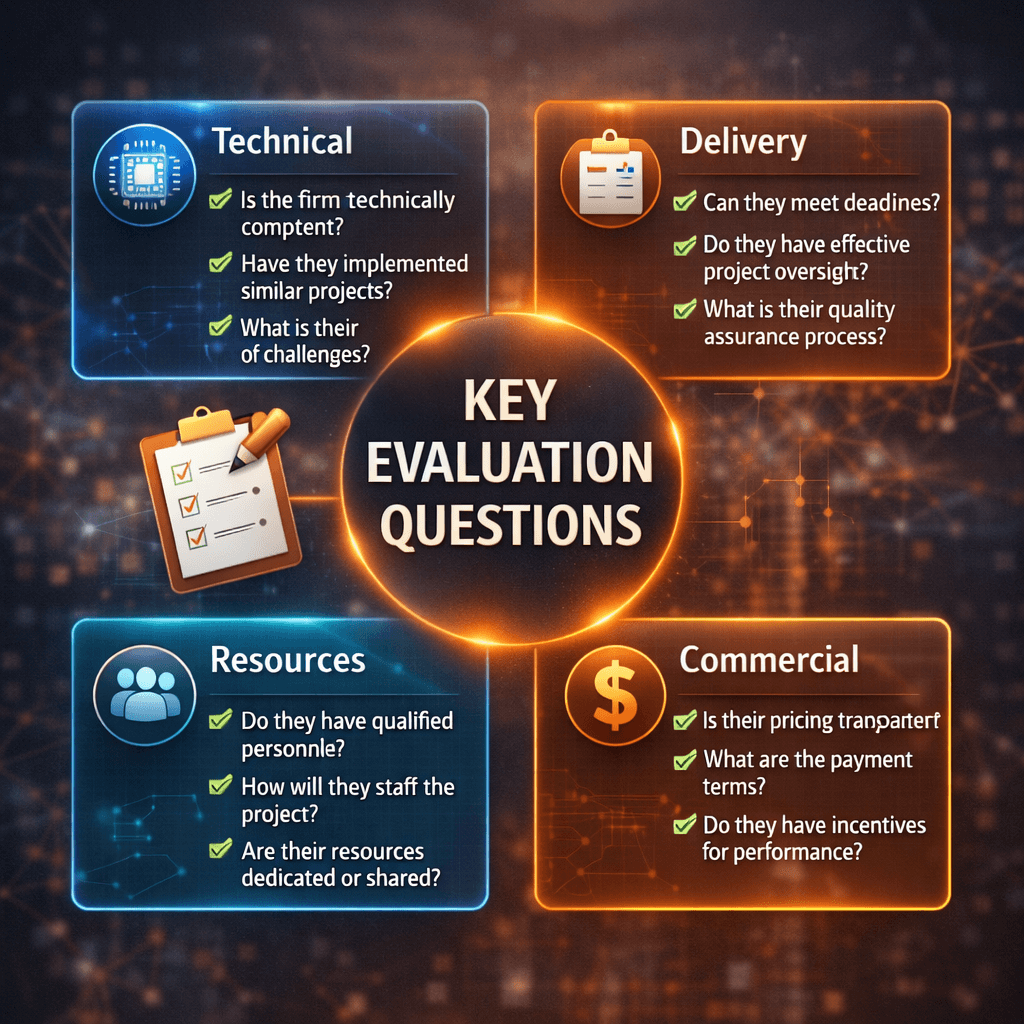
Due diligence questions let you compare IFRS 17 consulting firms on the same footing. Ask every candidate the same set so the answers actually line up.
Your questions should probe technical skill, method, resource model, and commercial terms. Prepare follow-ups based on what you hear.
Bring your project team into the evaluation meetings. Different people catch different concerns, and it builds the consensus you’ll need later.
Capability & Delivery Model Questions
Ask about specific IFRS 17 experience with your exact product types. Request client references you can call directly, not written testimonials.
Probe the method. How do they structure projects? What deliverables do you get? How do they handle scope changes when, not if, they come?
Understand the resource model. Who actually works on your project? What are their credentials? How much of their time do you really get?
Support, Governance & Post-Go-Live Services
Clarify governance. How do they escalate issues? Who makes the key calls? How often do they report progress?
Talk about post-go-live support. What happens after the initial build? Do they stay on? What does that cost?
Ask about knowledge transfer. How do they build your team’s skill? What training comes with the engagement? When can you run it alone?
IFRS 17 Consulting Firms: Selection Checklist
A structured checklist makes sure you weigh every dimension that matters. Use it to compare proposals on the same axes.
Weight the criteria to your priorities. Technical depth might dominate for a complex portfolio, while delivery speed wins if you’re already behind.
Document the process. Clear documentation explains the decision to stakeholders and gives you accountability later.
Technical, Operational & Strategic Factors
Technical factors: depth of IFRS 17 knowledge, actuarial capability, systems integration skill. Test these through case studies and consultant interviews, not brochures.
Operational factors: project management, resource availability, delivery method. Check the track record for on-time, on-budget delivery.
Strategic factors: fit with your goals, cultural match, long-term partnership potential. Decide whether you want a transaction or a partner.
Vendor Scoring Framework for Insurers
Build a scoring framework that puts numbers on the criteria. Assign points per dimension based on what matters to your organization.
Include must-have requirements that disqualify any firm that fails them. That narrows the field fast to serious contenders.
Use multiple evaluators to cut bias. Several perspectives produce a more balanced read than one person’s judgment.
How Long Does IFRS 17 Consulting Implementation Take?
Timelines depend on readiness, portfolio complexity, and resources. Most engagements run 12 to 24 months from kickoff to go-live.
Estimates need to count every phase, not just the core build. Transition activities, parallel runs, and audit prep eat real time.
Plan for your own situation, not the industry average. An over-aggressive schedule just manufactures pressure that hurts quality.
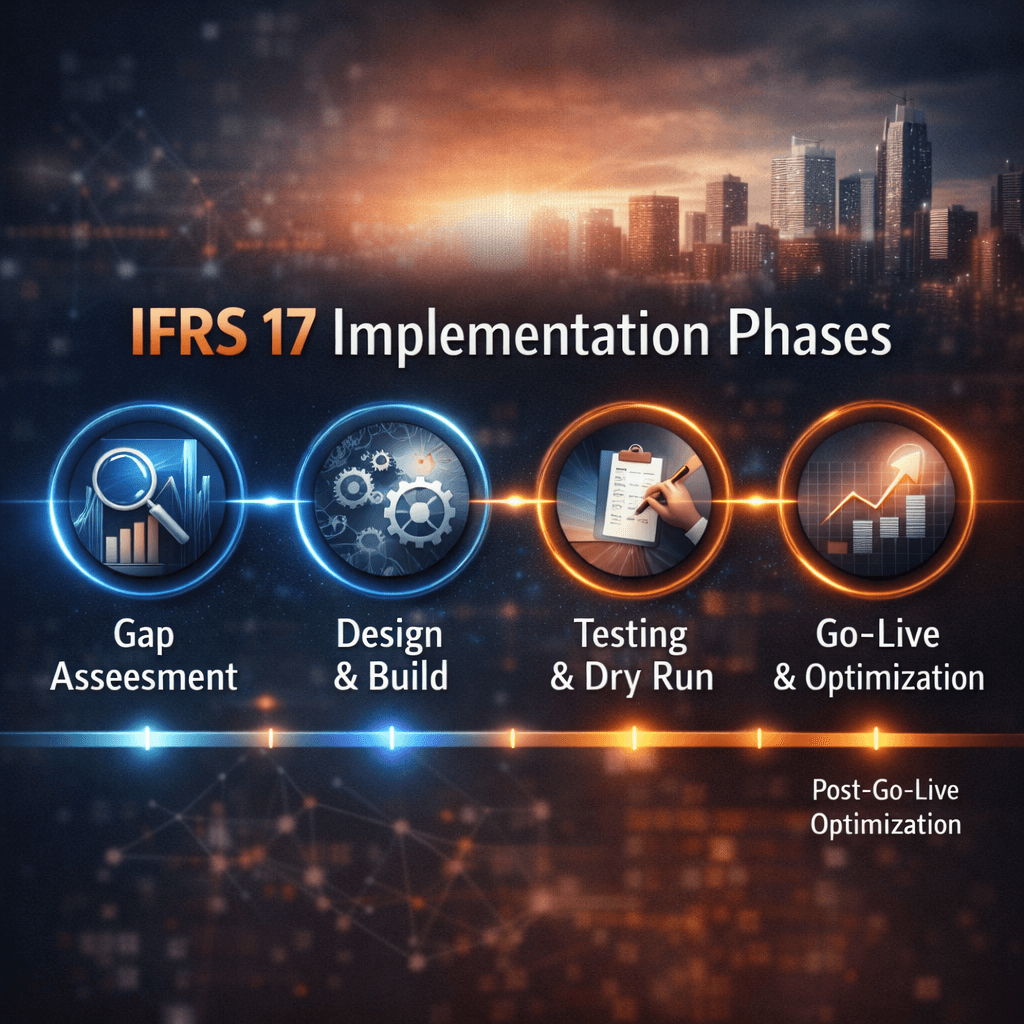
Typical Project Phases Explained
Gap assessment and planning usually take 8 to 12 weeks. This phase sets the foundation for everything after it.
Design and build run 6 to 12 months, covering policy development, methodology, system configuration, and process design.
Testing and validation take 3 to 6 months. Parallel runs prove the new processes produce accurate numbers before you rely on them for external reporting.
Factors That Affect Timelines
Portfolio complexity drives the clock. Simple property and casualty books on PAA finish faster than complex life businesses with participating contracts.
Organizational readiness sets the pace. Strong governance, dedicated resources, and executive backing speed things up. Weak governance and part-time staff drag them out.
System capability shapes the tempo. Modern, flexible systems enable faster implementation than legacy infrastructure that needs heavy work first.
How to Maximize ROI from IFRS 17 Consulting Engagements
ROI comes from active partnership, not passive consumption. The most successful implementations run as genuine working relationships.
Set objectives beyond compliance and value opportunities appear. Stakeholders benefit from clearer information about insurance obligations once you aim implementation at strategic value, not just the deadline.
Measurement frameworks track whether that value shows up. Define success metrics upfront and watch them through the engagement.
Governance & Stakeholder Alignment
Strong governance makes sure you use your consultants well. Regular steering committee meetings keep alignment and kill issues fast.
Stakeholder alignment stops scope creep and conflicting priorities. Executive sponsorship reinforces the project’s weight and unlocks resources.
Decision speed matters as much as decision quality. Fast resolution of open questions keeps the project moving.
Continuous Optimization Strategies
Post-implementation tuning captures extra value. Many insurers find efficiency gains once the IFRS 17 processes settle.
Regular process reviews surface automation opportunities and cut steps out of the workflow. Small improvements compound.
An ongoing consultant relationship keeps you current as best practice evolves. As industry approaches mature, you refine accordingly.
Partner with Prima Consulting for IFRS 17 Excellence
Selecting the right IFRS 17 consulting firms decides whether implementation becomes a compliance burden or a strategic opportunity. Technical depth, proven method, and industry experience separate effective partners from expensive mistakes.
Base your evaluation on what a firm can show, not what it can promise. Ask hard questions about experience with your specific products. Demand evidence of successful go-lives, not theory.
Quality consulting support pays back through faster implementation, stronger compliance, and operational efficiency. Read IFRS 17 consulting pricing against the total cost of the program, including your own resources and opportunity cost.
Prima Consulting brings IFRS 17 implementation experience for insurers across Saudi Arabia, the UAE, Pakistan, and beyond. Our team pairs accounting, actuarial, and technology skill to deliver complete solutions, and we build your internal capability while getting you compliant. See how Prima supports your IFRS 17 journey, or start with a conversation about where you are today.
Free Consultation
Ready to discuss your IFRS 17 program?
Prima’s advisors work with insurers across the GCC, Europe, and Asia-Pacific. First conversation is always free — no pitch, just expertise.