TL;DR
IFRS 9 makes banks book credit losses before they happen, not after. This guide covers the two-gate classification test (business model + SPPI), the three impairment stages, and the ECL formula worked with real numbers: the same loan jumps from 8,000 to 48,000 in provisions once it slips from Stage 1 to Stage 2. You also get the GCC-specific parts most guides skip, oil price overlays, SOCPA and CBUAE guidance, and Islamic finance SPPI traps on murabaha and sukuk. Read it once and your staging calls stop being guesswork.
IFRS 9 Financial Instruments Explained: What Banks and CFOs Actually Need
You run a loan portfolio where every provisioning call gets picked apart. Finance and risk don’t always agree. Your auditors want documentation you haven’t finished building. And somewhere in that mess, IFRS 9 asks you to book credit losses before they happen, not after.
So here’s the honest version. IFRS 9 isn’t harder accounting bolted onto the old rules. It’s a different way of thinking about risk. As of 2024, 169 jurisdictions require or permit IFRS Standards, and IFRS 9 sits at the centre of how banks and corporates report financial instruments.
Get it wrong and it’s not just your numbers that move. Your capital ratios move. Your standing with regulators moves. Auditors start asking harder questions about how you govern the whole thing. This guide walks the full standard, classification, impairment, hedge accounting, and the GCC-specific parts most guides skip, in plain terms.
Why IFRS 9 Replaced IAS 39, and Why That Mattered
IFRS 9 took over from IAS 39 in 2018. Calling it a swap undersells it.
IAS 39 looked backward. You booked a loss once it had already happened. IFRS 9 flips that. Now you book expected losses up front, based on what your models say could go wrong, not just what already did.
Three things shifted at once. How you classify instruments, measure impairment, hedge accounting lines up with the way you actually manage risk. Each one hits your balance sheet, your income statement, and your capital position in its own way.
Banks felt it fast. On average, extra provisions after IFRS 9 came in above 1% of gross loans, up from roughly 0.8% before. That gap is real money when you’re managing capital adequacy.
The standard reaches into lending strategy, underwriting, and how risk, finance, and accounting talk to each other. If those teams work off different playbooks, you get inconsistent staging and provision swings that regulators notice. IFRS advisory services exist to tie those teams into one framework.
Who we are
50+ years of combined IFRS, risk, and actuarial expertise
Prima Consulting serves banks, insurers, and corporates across Saudi Arabia, UAE, Pakistan, Ireland, and Europe, delivering IFRS advisory, ECL modelling, risk management, and audit support.
IFRS 9 Classification: The Two-Gate Test Every Asset Must Pass
Classification runs on two tests: your business model and the contractual cash flow characteristics. Think of it as two gates. Both have to open before an asset qualifies for amortised cost.
You end up in one of three measurement buckets: amortised cost, fair value through other comprehensive income (FVOCI), or fair value through profit or loss (FVTPL). That choice drives everything downstream, from how the balance sheet reads to how much profit volatility you carry.
Business Model Assessment for Classification
Your business model says how you hold financial assets. Holding to collect contractual cash flows? Holding to collect and sell? Or trading for short-term profit?
It’s not about what you intend. It’s about what you actually do. Past sales patterns count. So does how you manage risk. Even how you pay your portfolio managers counts.
Take a loan book. Hold loans to maturity to collect interest and principal, and that’s a “hold to collect” model. Sell them off before maturity on a regular basis, and you’re in “hold to collect and sell”.
The test needs judgment. So document it well. Regulators will ask, and your paper trail has to show you understood the grey areas, not just that you ticked a box.
Contractual Cash Flow Characteristics Test (SPPI Test)
The SPPI test asks one thing. Are the cash flows solely payments of principal and interest? Interest here means the time value of money and credit risk. Nothing more. Anything carrying commodity price or equity exposure fails and lands in FVTPL.
A plain fixed-rate corporate bond passes. A convertible bond with an equity conversion feature fails. For institutions across the GCC, this is where sukuk structures, hybrids, and structured products get tricky. Get SPPI wrong and you’ve got a material misstatement. Auditors catch these.
Classification at a Glance: Which Category an Asset Lands In
Run the two gates in order. Business model first, then SPPI. Here’s how the common cases fall out.
| Instrument | Business model | SPPI result | Measurement |
|---|---|---|---|
| Fixed-rate corporate loan held to maturity | Hold to collect | Pass | Amortised cost |
| Government bond you may sell for liquidity | Hold to collect and sell | Pass | FVOCI |
| Convertible bond with equity upside | Any | Fail | FVTPL |
| Trading-book position | Trading for profit | Not tested | FVTPL |
| Murabaha with a non-standard profit rate | Hold to collect | Often fails | FVTPL, check carefully |
One rule saves headaches: if either gate is in doubt, write down why you landed where you did. That note is what an auditor reads first.
The Three Stages of Impairment, and Why Stage Migration Keeps CFOs Awake
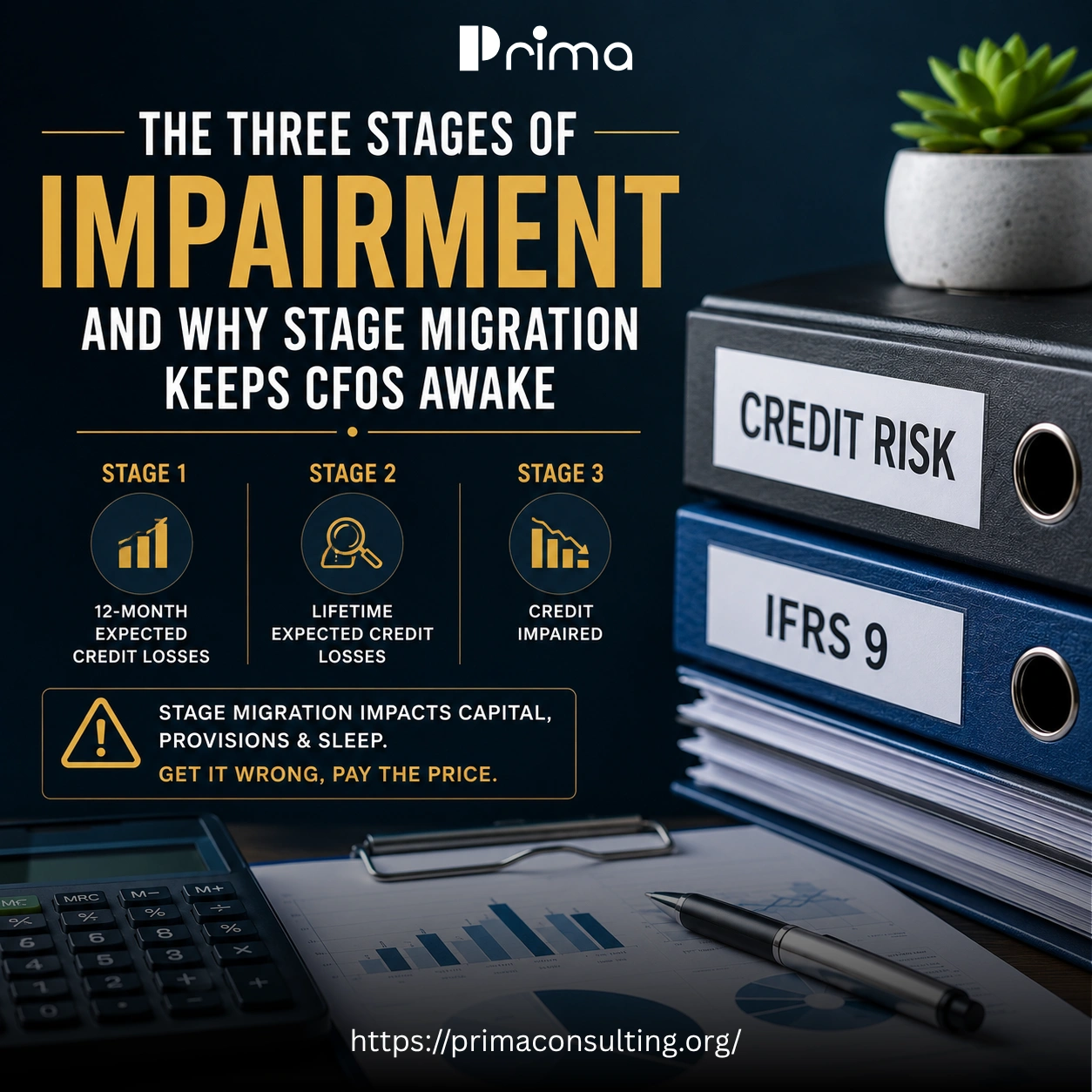
Under IFRS 9, every financial asset sits in one of three stages based on how much credit quality has slipped. Where it sits drives your impairment number. Movement between stages drives volatility. And the trigger for that movement is the part most institutions read wrong. Prima’s IFRS 9 ECL stages guide breaks each one down with worked numbers.
Stage 1: 12-Month Expected Credit Loss
Stage 1 holds performing assets with no meaningful credit deterioration since you first booked them. You carry a loss allowance equal to 12-month expected credit losses, covering defaults that could hit inside the next year.
Most of your performing book lives here. The customer pays on time. Credit metrics hold steady. Nothing flags in monitoring. Fast-growing banks post the heaviest Stage 1 reserves, and some hold more than 1% of Stage 1 loans as provisions. For GCC banks growing their loan books quickly, that number builds faster than you’d expect.
Stage 2: Lifetime ECL for Significant Credit Deterioration
Stage 2 kicks in when credit risk jumps significantly. Now you book lifetime expected credit losses, the whole remaining life of the instrument, not just twelve months.
What pushes a loan into Stage 2? Payments more than 30 days late. Falling credit scores. Covenant breaches. A borrower’s industry turning sour. A broad macro downturn.
For many large institutions, Stage 2 loans make up around a third of total reserves. Deciding what counts as a “significant increase” is a judgment call. So set clear triggers, watch them continuously, and write down every decision. Your IFRS 9 impairment calculation has to capture these shifts, or your provisions come out light.
Stage 3: Lifetime ECL for Credit-Impaired Assets
Stage 3 is for credit-impaired assets, where default has already happened or is close. You still book lifetime ECL, but with harsher assumptions. Now the question is recovery.
The evidence here isn’t subtle. Payments more than 90 days overdue. Bankruptcy proceedings. Covenant violations. Restructuring driven by financial distress. For many banks, Stage 3 impaired exposures sit near half of total reserves. Some central banks let institutions add IFRS 9 provision increases back to regulatory capital during transition. For most, those windows have closed.
The ECL Formula: Simple on Paper, Hard in Practice
The expected credit loss model replaced the old incurred-loss approach. Under IAS 39 you booked losses once they showed up. Under IFRS 9 you build a forward-looking estimate of what could go wrong across the portfolio, weighted by probability.
PD, LGD, and EAD: What Each One Actually Means
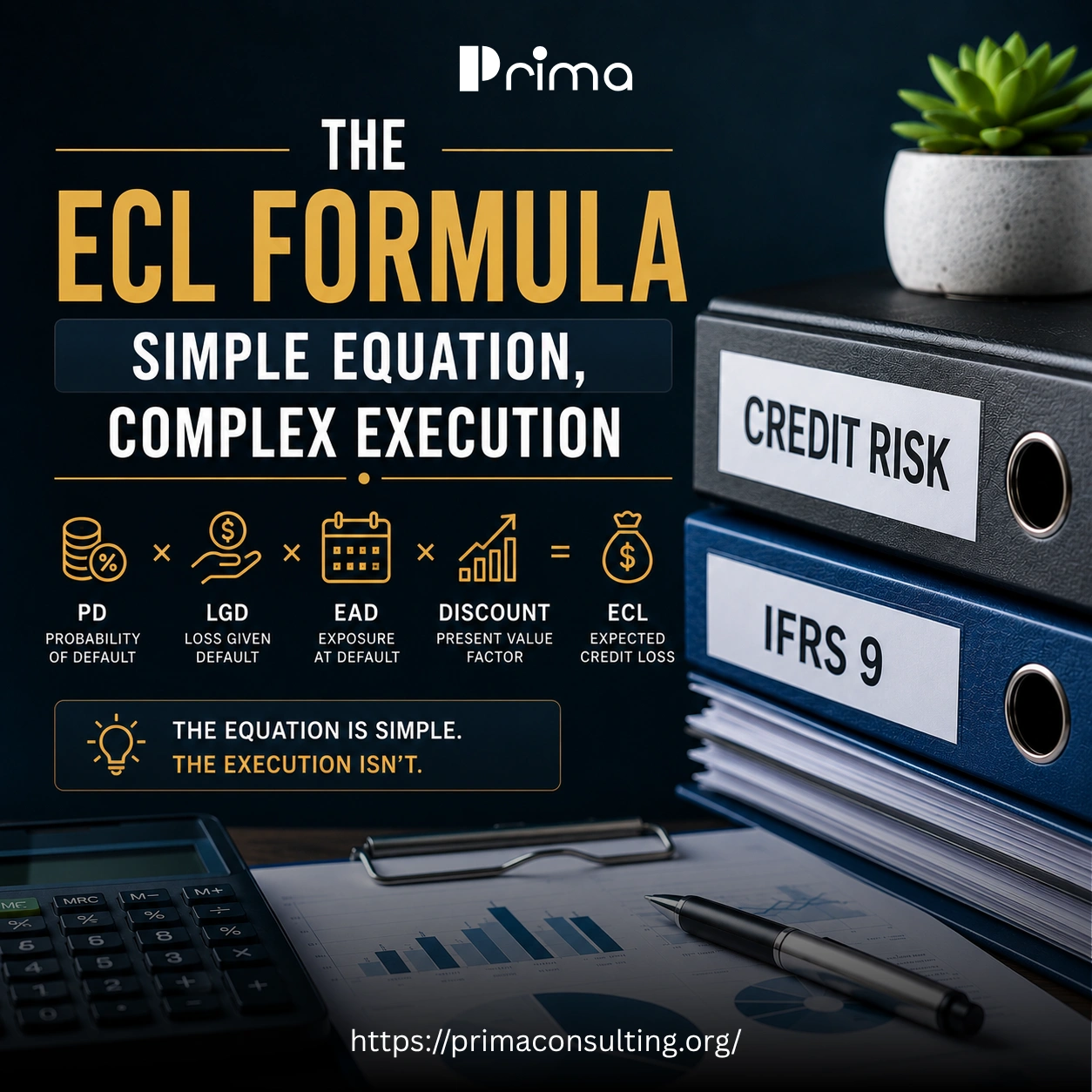
ECL = PD × LGD × EAD. Three letters. The build is anything but three lines. For a full worked example, see Prima’s PD, LGD and EAD calculation guide.
Probability of Default (PD) is how likely a borrower defaults over a set period. You build it from historical default rates, credit ratings, and payment behaviour, then adjust for where the economy is heading.
Loss Given Default (LGD) is the share you lose if default happens. It rides on collateral values, recovery rates, and legal recovery costs. A secured mortgage carries lower LGD than an unsecured personal loan. But collateral values move with the market, and in real estate-heavy GCC portfolios they move a lot.
Exposure at Default (EAD) is the balance outstanding when default hits. For a term loan it’s the drawn amount. For revolving facilities and cards it includes undrawn room the borrower is likely to pull, and people often draw hard right before they default.
You need solid historical data, validated models, and regular backtesting. If your history runs shorter than five years, your PD estimates are probably underselling tail risk. I’ve seen that catch teams out more than once.
A Worked ECL Example: Stage 1 vs Stage 2 on the Same Loan
The formula only clicks once you run real numbers. Take a single corporate loan, 1,000,000 outstanding, and watch what happens when it slips from Stage 1 to Stage 2.
In Stage 1 you book 12-month ECL. Say the 12-month PD is 2%, LGD is 40%, and EAD is the full 1,000,000.
Stage 1 ECL = 2% × 40% × 1,000,000 = 8,000
Now credit risk jumps significantly. The loan migrates to Stage 2, so you move to lifetime ECL. Over the remaining life the cumulative PD is far higher, say 12%. LGD and EAD hold.
Stage 2 ECL = 12% × 40% × 1,000,000 = 48,000
Same loan. Same LGD and EAD. The provision jumps six-fold, from 8,000 to 48,000, purely because the PD horizon stretched from twelve months to the loan’s whole life. That single migration is where provision volatility comes from, and why your significant-increase triggers matter so much. For a full multi-loan build with discounting, see Prima’s PD, LGD and EAD calculation walkthrough.
12-Month ECL vs Lifetime ECL: The Difference That Drives Your Number
| 12-Month ECL (Stage 1) | Lifetime ECL (Stage 2 & 3) | |
|---|---|---|
| Loss horizon | Defaults possible in next 12 months | Defaults across full remaining life |
| Trigger to apply | Performing, no significant deterioration | Significant increase in credit risk, or impaired |
| Interest income basis | Gross carrying amount | Gross (Stage 2), net (Stage 3) |
| Provision size | Lower | Materially higher |
Prima’s 12-month vs lifetime ECL guide works through the interest-income mechanics in more depth.
Forward-Looking Information and Macroeconomic Overlays
IFRS 9 wants forward-looking information baked into ECL models. GDP growth shapes lending risk. Unemployment shapes whether customers can pay. Real estate values shape collateral-backed exposures.
Between year-end 2023, 53% to 76% of sampled banks used overlays to handle novel risks in their provisioning. Overlays adjust model output when something without precedent hits, a pandemic shutdown, a geopolitical shock, a sudden rate move.
Run multiple scenarios to capture the uncertainty. Weight them by probability. Write down your assumptions. That documentation becomes your first line of defence when regulators and auditors come looking.
Explore our advisory services
IFRS 9 in the GCC: What Regional Banks Handle Differently
Most guides treat IFRS 9 as one-size-fits-all. On the ground, GCC banks deal with conditions that make parts of it much harder.
Oil price swings are the obvious one. When crude drops, corporate credit quality across Saudi Arabia, Kuwait, and the UAE weakens faster than macro models built on European data expect. Your ECL scenarios need real downside weighting on oil, not a base case plus one polite adverse case.
Then there’s the regulatory layer. Saudi banks under SOCPA, UAE banks under the CBUAE, Qatari institutions under the QCB, each face jurisdiction-specific guidance stacked on top of the standard itself. Operate across GCC borders and that reporting load multiplies.
Construction exposure is another sore spot. GCC real estate portfolios carry LGD uncertainty that residential mortgage books in older markets simply don’t. Collateral values moved sharply in some markets after 2020, and models that missed that correlation threw up Stage 2 migration surprises. Prima’s ECL model examples for GCC banks show how oil sensitivity, sector concentration, and government-related exposure get built into PD and LGD. The approach isn’t the European one.
Islamic finance needs its own care on SPPI. Murabaha, ijara, and sukuk each demand specific analysis before you classify them at amortised cost. A murabaha contract can pass the business model test and still fail SPPI if the profit-rate structure introduces non-standard cash flows. This is the bit most generic guides drop entirely.
Who Prima works with
Across industries and geographies, delivering measurable outcomes
🏦
Banks & Financial Institutions
IFRS 9 ECL models, credit risk, impairment methodology, regulatory reporting
🛡️
Insurance & Takaful Companies
IFRS 17 implementation, actuarial modelling, GMM/VFA/PAA, CSM calculations
🏢
Corporates & Multinationals
IFRS 15, 16, IAS 36 compliance, financial statements, internal controls
📈
Investment & Asset Managers
IFRS 9 classification, fair value (IFRS 13), derivative valuations, hedge accounting
🏗️
Real Estate & Construction
IFRS 16 lease accounting, IFRS 15 revenue recognition, project-based reporting
🏛️
Family Offices & Holding Groups
Governance frameworks, board advisory, risk management, portfolio evaluation
Hedge Accounting: More Freedom, Same Documentation Discipline
IFRS 9 lines hedge accounting up with how you actually manage risk. That’s a genuine shift. IFRS 9 software for banks can automate the effectiveness testing, but the thinking still starts with you. IAS 39’s hedge rules were complex and often out of step with real risk management. IFRS 9 fixes that gap.
The wins: more relationships qualify for hedge accounting, less documentation drag, tighter alignment with your risk strategy, and less earnings noise from ineffectiveness. For macro hedge accounting, banks can now hedge portfolio-level interest rate risk far better than asset by asset.
The catch? You still need strong risk processes, clear documentation, and consistent effectiveness testing. Hedge currency, rate, or commodity exposure with derivatives and IFRS 9 gives you room to move. But room isn’t a substitute for process. Sloppy documentation is still a finding.
Where IFRS 9 Implementation Actually Goes Wrong
Let me be blunt. IFRS 9 isn’t just an accounting change. It’s a business transformation that reaches every corner of the organisation, and most teams underrate that until they’re already knee-deep.
Cross-Functional Coordination Failures
IFRS 9 tears down the walls between departments. Finance can’t carry it alone.
Risk owns the PD, LGD, and EAD models. IT owns the data plumbing. Treasury aligns hedges with actual hedging. Front-line credit officers need to grasp staging triggers. Audit committees own governance oversight.
When those groups don’t line up, you get staging that clashes with credit-officer judgment, provisions that won’t reconcile to risk-system output, and documentation that folds under audit. Bringing in IFRS 9 advisory firms that know both the accounting and the risk architecture cuts that coordination time hard.
Technology and Data Problems That Sink Good Intentions
Legacy systems weren’t built for this. You need tech that handles cash-flow-level impairment, configurable stage rules, scenario-based ECL, integration with risk systems, and a clean audit trail.
Data quality is where it usually breaks, and it’s expensive. Missing historical default data blinds your PD calibration. Patchy collateral records skew LGD. Inconsistent customer IDs cause reconciliation failures that surface late, exactly when they’re hardest to fix.
So fix data early. Build automated controls that catch errors before they spread. The best setups work with what you already have and fill the gaps with purpose-built tools rather than a rip-and-replace you can’t afford.
Prima Consulting
Questions about your IFRS 9 implementation? Our advisory team offers a free first consultation.
No obligation · Responds within 1 business day · GCC, Europe & APAC
Regulatory Considerations and Real-World Application
Financial institutions apply IFRS 9 inside regulatory frameworks that shape how it lands in practice.
Prudential Filters and What Regulators Actually Scrutinise
Some central banks issued prudential filters that let banks add IFRS 9 provision increases back to regulatory capital across a transition window. Those filters eased the capital hit while reserves were being built.
But windows close. Now you absorb ECL provisions fully in your capital calculations. No more add-backs. Stay current with your supervisors’ guidance, and sit in on industry forums. In the GCC that means tracking CBUAE, SOCPA, QCB, and CBB circulars as they update IFRS 9 expectations.
Case Studies: How Staging Decisions Play Out
Take a retail mortgage book. Economic indicators show real estate cooling. Payment patterns show small delays. You check loan-to-value, review debt service coverage, scan industry trends. If the significant-increase criteria are met, you shift the affected loans to Stage 2 and book lifetime ECL. That’s the mechanism.
Now a corporate example. An oil services firm hits sector headwinds. Revenue falls 30%. Covenant ratios tighten. Even with payments still current, forward-looking information alone can trigger Stage 2. That’s the proactive edge of IFRS 9, and the exact spot where credit officers trained on IAS 39 thinking stumble. IFRS 9 loan loss provisioning at this level of judgment needs clear staging criteria, documented model logic, and governance that survives outside review.
Frequently Asked Questions on IFRS 9 Financial Instruments

Building an IFRS 9 Compliance Framework That Actually Holds
IFRS 9 isn’t a one-off project. Banks and corporates that treat it as one end up reopening ECL assumptions every time the macro picture moves, with no governance built to do it consistently.
The ones who get it right run IFRS 9 as an integrated business process. They put data quality ahead of model sophistication, write staging criteria a credit officer can actually apply, build audit trails that survive outside scrutiny. And they run cross-functional reviews with risk, finance, and treasury in one room.
That’s the base. Your capital position, your regulatory relationships, and stakeholder confidence all follow from it. Where’s the weakest joint in your current framework? That’s the honest question to sit with before the next reporting cycle.
Ready to tighten your IFRS 9 compliance framework? Prima Consulting brings over 50 years of combined experience helping banks and corporates build classification systems, impairment models, and governance that hold up under audit. Let’s talk about where your framework has gaps.
Free Consultation
Ready to discuss your IFRS 9 compliance framework?
Prima’s advisors work with banks, insurers, and corporates across the GCC, Europe, and Asia-Pacific on ECL modelling, impairment methodology, and regulatory alignment. First conversation is always free, no pitch, just expertise.