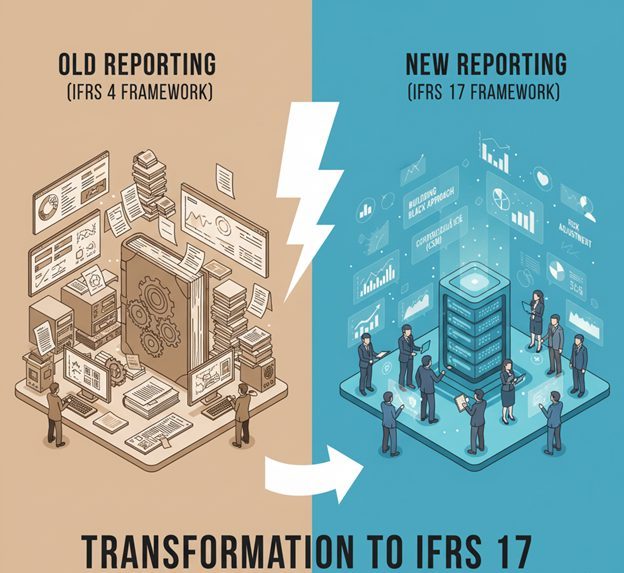
IFRS 18 applies to every full-IFRS reporter, though it’s worth confirming whether IFRS 18 applies to your company before you plan anything.
TL;DR
IFRS 18 financial statements replace IAS 1 for annual periods starting 1 January 2027. This standard restructures the income statement into five defined categories of income and expense, mandates an operating profit subtotal, and brings management-defined performance measures like “adjusted EBITDA” into the audited financial statements for the first time. This article covers the five new categories, the MPM disclosure rules, a before-and-after income statement layout, and what your team needs to do in 2026 to avoid restating under pressure. Start your IFRS 18 impact assessment now, the comparative period is already underway.
Why IFRS 18 Exists — and What Problem It Actually Solves
Pick up the annual reports of two companies in the same industry and try to compare their operating profit figures. You probably can’t. One defines it to include income from associates. Another strips out lease-related costs. A third excludes “one-off” restructuring charges that have appeared every year for six years running. There’s no standard definition, so every number tells a different story.
That’s the problem IFRS 18 is built to fix.
The IASB issued IFRS 18 Presentation and Disclosure in Financial Statements on 9 April 2024, replacing IAS 1 — a standard that had been in place, in various forms, since 1997. That’s nearly 30 years during which companies were largely free to structure their income statements however they liked. Investors, analysts, and regulators have spent years complaining about the inconsistency. IFRS 18 is the IASB’s answer.
What this article covers:
- The five new income and expense categories IFRS 18 introduces, and how they work
- The mandatory operating profit subtotal and the new MPM disclosure rules
- A before-and-after income statement comparison, and your 2026 preparation checklist
Prima Consulting’s IFRS advisory team has been tracking this standard since the exposure draft stage. If you’re a CFO, financial controller, or reporting manager at a GCC-based or internationally listed company, this directly affects your 2026 comparative figures.
The Old World: IAS 1 and the Free-For-All Income Statement
IAS 1 required a statement of profit or loss. It did not prescribe much about what went inside it. Companies could present income and expenses in any format they chose, include any subtotals they found useful, and define those subtotals however they liked.
“Adjusted EBITDA.” “Underlying earnings.” “Recurring operating profit.” These weren’t rogue inventions — they filled a genuine gap. Companies were communicating real information about performance. The problem was that no two companies used the same definitions, so comparisons across businesses became guesswork.
Here’s a question worth sitting with: how many investors have made a decision based on an “adjusted” figure that was never reconciled to anything audited? I don’t have a precise number. But based on the volume of regulatory concern from ESMA, the SEC, and the IASB going back more than a decade, it’s safe to say the answer is: a lot.
If you’re unsure how your current income statement structure will change under IFRS 18, Prima Consulting’s IFRS advisory services can help you map the gaps before they become a problem.
IFRS 18 vs IAS 1: The Five New Categories of Income Explained
This is the structural heart of IFRS 18. Every item of income and expense in the statement of profit or loss must now be classified into one of five defined categories:
- Operating — the default category. If an item doesn’t fit into investing, financing, income taxes, or discontinued operations, it goes here.
- Investing — returns on investments that aren’t integral to the company’s main business activities (for example, returns on excess cash holdings or equity investments in associates where the associate relationship is not central to the business).
- Financing — interest expense on liabilities and other financing costs arising from the capital structure.
- Income taxes — tax on profit or loss, classified separately from all other items.
- Discontinued operations — results from operations classified as discontinued, consistent with existing IFRS 5 requirements.
What’s important here is what the categories don’t do: they don’t align with the similarly named categories in the cash flow statement. This confuses people. An item classified as “investing” in the statement of profit or loss might not be classified as “investing” in the statement of cash flows. The IFRS 18 definitions are specific and require careful analysis, entity by entity.

How the Five Categories Work in Practice
For most companies — manufacturers, retailers, service providers — the vast majority of income and expenses fall into the operating category by default. That’s by design. The investing and financing categories are narrower than you might expect.
Banks and insurers are different. IFRS 18 recognizes this with a separate set of rules for entities with “specified main business activities.” For a bank, lending is the main business, so interest income flows into the operating category. For a manufacturing company, that same interest income would fall into investing. The classification depends entirely on what the entity does.
The right approach here is to go line by line through your current income statement and apply the IFRS 18 definitions. Don’t assume. Some items that look like operating expenses under your current presentation may need to be reclassified. Get this wrong, and your 2026 comparative figures — which will sit alongside your 2027 results — will need to be restated again.
The Mandatory Operating Profit Subtotal: Why It Matters
Under IAS 1, presenting an “operating profit” line was optional. Many companies did it. But without a standard definition, the number was only as useful as the footnotes explaining it.
IFRS 18 changes that. All entities are now required to present an operating profit or loss subtotal in the statement of profit or loss. It’s defined as the total of all income and expenses in the operating category. Full stop.
A second mandatory subtotal is also required: profit or loss before financing and income taxes. Together, these two subtotals create a common framework that investors can use to compare performance across companies and industries for the first time under IFRS.
For companies that currently present an operating profit figure — this is either good news or a disruption, depending on how your current definition compares to the IFRS 18 one. If you’ve been including income from associates in your operating line, that may no longer be appropriate depending on your business model. Run the comparison now.
IFRS 18 Management Performance Measures: The Rules Have Changed
This is probably the single most significant change for companies that use non-GAAP measures in their investor communications. And most listed companies do.
The IASB isn’t banning adjusted EBITDA. It isn’t prohibiting “underlying earnings” or any other measure management chooses to communicate. What it’s doing is something more surgical: it’s pulling those measures into the financial statements and requiring a formal reconciliation.
That changes everything about how those numbers are audited, disclosed, and scrutinized.
What Qualifies as an MPM Under IFRS 18?
Not every non-GAAP measure becomes an MPM. A measure qualifies as a management-defined performance measure (MPM) under IFRS 18 when it meets all three of these conditions:
- It’s a subtotal of income and expenses (so free cash flow, which is a cash flow measure, doesn’t qualify)
- It’s used in public communications outside the financial statements — in earnings releases, investor presentations, or press releases
- It communicates management’s view of the financial performance of the entity as a whole, and it’s not already required by IFRS
Common examples: adjusted operating profit, adjusted EBITDA, adjusted earnings per share. Note the word “adjusted” — that’s often the tell.
What’s interesting is the presumption in the standard. If a company uses a measure in public communications, it’s presumed to be an MPM. The company doesn’t need to actively rebut that presumption. That means your investor relations team and your finance team need to be looking at the same list.

What the MPM Disclosure Note Must Include
For each MPM, entities must include a single note in the financial statements that explains:
- Why the measure provides useful information about financial performance
- How the MPM is calculated
- A reconciliation from the MPM to the most similar IFRS-defined subtotal
- The tax effect and the effect on non-controlling interests
That reconciliation is the part that matters most. It’s audited. It sits in the notes. Every investor can see exactly how your “adjusted” figure differs from your reported one, and what you’ve stripped out to get there.
The restated numbers reach further than presentation, see how IFRS 18 affects audits and financing.
Is your team ready for IFRS 18 MPM reporting?
Take Prima Consulting’s 5-question IFRS 18 Readiness Assessment to identify gaps in your current reporting structure before the 2026 comparative period locks in your approach.
IFRS 18 Income Statement: Before and After Layout
The simplest way to understand what changes is to see it side by side. The table below shows a simplified income statement for a manufacturing company under IAS 1 versus IFRS 18.
| Line Item | Under IAS 1 | Under IFRS 18 |
|---|---|---|
| Revenue | Revenue | Revenue (Operating) |
| Cost of sales | Cost of sales | Cost of sales (Operating) |
| Gross profit | Gross profit (optional subtotal) | Gross profit (optional subtotal) |
| Distribution & admin expenses | Distribution & admin expenses | Distribution & admin (Operating) |
| Share of associate profit | Often included in operating | Investing (if not main business) |
| Operating profit | Optional — no standard definition | Mandatory subtotal |
| Finance costs | Finance costs | Finance costs (Financing) |
| Profit before tax | Profit before tax | Profit or loss before financing and income taxes (new mandatory subtotal) + profit before tax |
| Income tax expense | Income tax expense | Income taxes (separate category) |
| Net profit | Net profit | Net profit (unchanged) |
Notice that bottom line. Net profit doesn’t change. IFRS 18 doesn’t touch recognition or measurement, it only restructures how items are presented between the top and bottom of the statement. Getting that restructuring right is where IFRS 18 implementation support earns its keep. It’s a point some preparers miss when they first meet the standard.
IFRS 18 Transition: Retrospective Application and What It Means for 2026
Here’s the part that should be driving your preparation schedule right now.
IFRS 18 requires retrospective application. For calendar-year-end entities, that means your 2026 income statement must be prepared under IFRS 18 rules to serve as the comparative period in your 2027 financial statements. In the first year of adoption, entities must also present a reconciliation for each line item in the statement of profit or loss, showing the differences between amounts reported under IAS 1 and those restated under IFRS 18.
That’s not a 2027 problem. That’s a 2026 problem. Your systems, your classifications, and your data collection need to be aligned with IFRS 18 before the 2026 year starts, or at the very latest, from 1 January 2026. By May 2026, when this article was published, your window is already narrower than it looks.
Early adoption is permitted. A handful of companies globally were already applying IFRS 18 voluntarily in their 2025 financial statements. PwC’s illustrative consolidated financial statements for 2025 include IFRS 18 early adoption as a featured scenario. If you have the capacity, early adoption gives you a full year of dry-run before the mandatory date.
Prima Consulting has supported IFRS transitions for listed entities across Saudi Arabia, UAE, and the wider GCC since the adoption of IFRS in the region. See how our team approaches standards transitions.
The move brings its own hurdles, mapped in our guide to IFRS 18 transition challenges.
IFRS 18 Implementation: Your 2026 Preparation Checklist
Most IFRS 18 readiness guides list the same five or six steps. They’re right. But the order matters more than most guides admit, and two of those steps are consistently underestimated.
Five Steps to Start Now
-
Run a full income statement impact assessment.
Go line by line through your current statement of profit or loss and classify each item under the IFRS 18 five-category framework. This step alone typically reveals two or three items that are more complicated than expected, associate income, lease-related costs, and certain financing items are the usual surprises.
-
Identify your MPMs.
Pull together every performance measure you’ve used in earnings calls, press releases, investor presentations, and annual report highlights over the past two years. Any subtotal of income and expenses on that list is a candidate MPM. Your IR team and finance team need to agree on the complete list before you can start building disclosure notes.
-
Assess system and process changes.
Your ERP or consolidation system needs to tag income and expense items to the correct IFRS 18 category. This is not a last-minute configuration change. For companies running SAP, Oracle, or any large consolidation platform, this is a project that requires IT involvement, testing, and parallel runs.
-
Engage your auditors early.
The classification judgments in IFRS 18, particularly around the investing category for entities with associate interests — will generate audit conversations. Having those conversations in 2026, not in the final weeks of your 2027 audit, will save significant time and stress.
-
Train your finance team.
IFRS 18 isn’t just a technical accounting change. It changes how your team thinks about categorizing transactions as they happen. Controllers and management accountants who record items under the wrong category will create reclassification headaches at year-end. Training now prevents that.
The step most teams underestimate? Step two. Identifying MPMs sounds straightforward until you realize your CEO uses six different versions of “adjusted” in different investor communications, and half of them have slightly different inputs. Getting to a clean, agreed, and auditable MPM list takes longer than the technical accounting work.
What You Now Know
- IFRS 18 replaces IAS 1 from 1 January 2027 and restructures the income statement into five defined categories — operating, investing, financing, income taxes, and discontinued operations, with two mandatory subtotals that didn’t previously exist.
- Management-defined performance measures like adjusted EBITDA must now be disclosed in the audited financial statements with a full reconciliation to IFRS-defined figures, changing how non-GAAP measures are scrutinized and communicated.
- Retrospective application means your 2026 figures become your comparative period, so preparation isn’t optional if you’re a calendar-year-end entity. The clock is already running.
The 2027 Deadline Is Closer Than It Looks
IFRS 18 financial statements don’t change what your company earns. The net profit stays the same. But they change how that performance is explained, categorized, and compared and that matters enormously to the investors, analysts, and lenders reading your accounts.
The companies that struggle with IFRS 18 adoption won’t be the ones who find it technically difficult. They’ll be the ones who started too late. Getting the income statement classification right, building the MPM disclosure note, and restating 2026 comparatives all require groundwork that takes months, not weeks.
The right approach is to treat 2026 as your IFRS 18 year, not 2027. Run IFRS 18 in parallel with your IAS 1 reporting through 2026. Identify your MPMs. Train your team. Fix your systems. Then the 2027 adoption is a confirmation, not a scramble.
If you’re ready to start that process, Prima Consulting’s IFRS 18 implementation advisory covers everything from initial impact assessment through MPM identification, system configuration, and first-year adoption support across the GCC and beyond.

See how Prima Consulting’s IFRS advisory team handles IFRS 18 adoption from impact assessment to first-year disclosure →
We’ve guided IFRS transitions for listed entities across Saudi Arabia, UAE, Kuwait, and Bahrain. Our team includes CPAs, CFAs, and IFRS specialists who’ve been tracking IFRS 18 since the exposure draft stage.
Start Your IFRS 18 Impact Assessment with Prima Consulting →
Frequently Asked Questions
What is IFRS 18 and when is it effective?
IFRS 18 is the new IASB standard on presentation and disclosure in financial statements, replacing IAS 1. It’s mandatory for annual reporting periods beginning on or after 1 January 2027. Early adoption is permitted. It introduces five income statement categories, two mandatory subtotals, and new disclosure rules for management-defined performance measures.
What are the key differences between IFRS 18 and IAS 1?
The main IFRS 18 vs IAS 1 differences include: five defined income and expense categories replacing IAS 1’s flexible structure, a mandatory operating profit subtotal that IAS 1 left optional, and new MPM disclosure requirements that bring non-GAAP measures into the audited financial statements. Recognition and measurement rules remain unchanged.
How does IFRS 18 change financial statement presentation for GCC companies?
IFRS 18 requires GCC-listed entities applying IFRS to restructure their income statements into the five defined categories, identify and formally disclose any management-defined performance measures, and restate 2026 comparative figures. Companies in Saudi Arabia and UAE that report under IFRS standards are directly affected by the 2027 effective date.
What are management performance measures under IFRS 18?
Under IFRS 18, management performance measures (MPMs) are subtotals of income and expenses that management uses in public communications outside the financial statements and that reflect management’s view of the entity’s financial performance. Common examples include adjusted EBITDA, adjusted operating profit, and underlying earnings. Each MPM requires a reconciliation note in the financial statements.
What should companies do in 2026 to prepare for IFRS 18 adoption?
Companies should complete an income statement impact assessment, identify all MPMs used in investor communications, assess system and data changes needed for category tagging, engage auditors early on classification judgments, and train finance teams. For calendar-year entities, 2026 is the mandatory comparative period, making preparation urgent.