
TL;DR
IAS 19 assumptions need clear documentation and market-based backing to survive an actuarial audit. This guide covers the seven assumptions auditors check, how discount rate, salary growth, mortality, and data quality drive the obligation, and the compatibility test (IAS 19.77) that trips most companies up. You’ll also see regional differences across Saudi Arabia, the UAE, and Europe, plus how sensitivity analysis shapes the numbers you disclose.
IAS 19 assumptions are the actuarial estimates used to measure a defined benefit obligation. They split into two groups. Financial assumptions cover the discount rate, salary increase rate, and inflation. Demographic assumptions cover mortality, retirement age, and staff turnover. Paragraphs IAS 19.75 to 19.98 govern how you set them, and 19.77 to 19.78 say they must be unbiased and mutually compatible. That last word, compatible, is where most audits get tense.
The Seven IAS 19 Assumptions Auditors Check
Here is the short list before we go deep. Four are financial. Three are demographic.
| # | Assumption | Type | What auditors look for |
|---|---|---|---|
| 1 | Discount rate (IAS 19.83) | Financial | High quality corporate bond yields, matched to the currency and term of the obligation. |
| 2 | Salary increase rate | Financial | Realistic career progression, tied to real pay history, not a wish list. |
| 3 | Inflation | Financial | Feeds salary growth and any benefit indexation; must agree with the discount rate. |
| 4 | Expected return on plan assets | Financial | Only where funded plans exist; aligned to current market conditions. |
| 5 | Mortality and longevity | Demographic | Current tables with an improvement scale, not decade-old data. |
| 6 | Retirement age | Demographic | What people actually do, not just the statutory number. |
| 7 | Staff turnover | Demographic | Three to five years of your own data beats any borrowed benchmark. |
Get any one of these wrong and the obligation moves. Get the discount rate wrong and it moves a lot. So that is where auditors start, and so will we.
Understanding IAS 19 Assumptions

IAS 19 assumptions form the foundation of employee benefit valuations as they help organizations calculate the present value of future benefit obligations using actuarial methods.
IAS 19 requires an entity to recognize a liability when an employee has provided service in exchange for employee benefits to be paid in the future. This requirement makes assumptions critical for accurate financial reporting.
The projected unit credit method serves as the primary valuation approach. It sits in IAS 19.67 and 19.155, and it spreads the cost of a promised benefit across the years an employee works for it. Both financial and demographic assumptions feed into it. For a full walk-through, see our projected unit credit method guide.
Organizations must justify each assumption based on market conditions and regulatory requirements. The justification becomes particularly important during audit reviews.
Also review our blog on: IAS 19 Simplified
Unbiased and Mutually Compatible: The Rule Behind the Rules (IAS 19.77 to 78)
Before any single number, IAS 19.77 sets the test every assumption has to pass. Assumptions must be unbiased, so neither cautious nor optimistic, and mutually compatible, so they tell one coherent story about the same economy.
What does incompatible look like? A salary growth rate of 8% sitting next to an inflation assumption of 2%. Or high pay rises paired with high staff turnover. Each number might defend itself alone. Together they contradict each other, and an auditor will spot the gap in minutes.
This is the part people miss. You are not defending seven numbers. You are defending one view of the future, told seven ways.
Financial vs. Demographic IAS 19 Assumptions

Financial assumptions focus on economic factors affecting benefit costs. These include discount rates, salary increase rates, and inflation expectations.
Discount rates represent the most critical financial assumption. They directly impact the present value calculation of future benefit payments.
Demographic assumptions address population characteristics. These cover mortality rates, retirement ages, and staff turnover patterns.
The interaction between financial and demographic assumptions creates the final valuation. Auditors examine how these assumptions work together to produce reasonable results.
Key Financial Assumptions Auditors Review
Discount Rate: Basis and Auditor Expectations
Discount rate selection requires careful market analysis. The same repo rate ended 2024 at 5.00%, compared to the end-2023 value of 6.00% in Saudi Arabia, showing how rates fluctuate significantly.
Auditors expect discount rates to reflect high-quality corporate bond yields. In markets without deep corporate bond markets, government bond yields with risk adjustments become acceptable.
One term you will see in every audit file is HQCB, high quality corporate bonds. IAS 19 never defines it outright. In practice, bonds rated AA or AAA count, and the IFRS Interpretations Committee has confirmed the rate should be pre-tax. Miss that detail and the whole discount basis is open to challenge.
According to the 2023 and 2024 Global Survey of Accounting Assumptions for Defined Benefit Plans by Willis Towers Watson, discount rates varied significantly by country. Canada saw rates rise from 5.17% to 5.25%, while Germany increased from 4.15% to 4.40%.
The currency matching principle requires critical attention. Benefit payments in Saudi Riyals need Saudi market-based discount rates, not global averages.
Documentation becomes crucial for audit success. Organizations must show how they selected specific rates and why they’re appropriate for their circumstances. If you want the mechanics of how the rate is built, our IAS 19 discount rate guide breaks down the four-step process.
Salary Increase Rate: Justification and Reasonableness
Salary increase assumptions require both historical analysis and future projections. Auditors look for rates that reflect realistic career progression patterns.
Industry-specific salary trends matter significantly. Technology companies typically see higher increases than traditional manufacturing sectors.
Regional economic conditions affect salary assumptions. Saudi Arabia’s unprecedented economic transformation is progressing well, influencing local salary increase expectations.
Long-term sustainability considerations prevent overly optimistic assumptions. Auditors question rates that seem disconnected from economic reality.
Expected Return on Plan Assets: Market Alignment
Asset return assumptions must reflect current market conditions. Historical returns provide context but don’t guarantee future performance.
Asset allocation drives return expectations. Equity-heavy portfolios typically support higher return assumptions than bond-focused investments.
Market volatility requires conservative approaches. Auditors prefer assumptions that acknowledge current uncertainty rather than chase historical highs.
Regular assumption updates prevent outdated projections. Annual reviews help maintain relevance with changing market conditions.
Inflation Rate and Other Economic Assumptions
Inflation expectations influence multiple assumption categories. They affect salary increases, benefit escalations, and discount rate selections.
Central bank policies provide valuable guidance. Regional monetary authorities’ statements help justify inflation assumptions.
Currency-specific inflation rates matter for multinational organizations. Each country’s economic conditions require separate analysis.
Long-term inflation trends help validate assumptions. Auditors appreciate assumptions that consider economic cycles rather than short-term fluctuations.
Prima Consulting
Unsure your discount rate would survive audit? Our actuarial team will pressure-test your IAS 19 assumptions.
No obligation · Responds within 1 business day · GCC, Europe & APAC
Critical Demographic Assumptions in IAS 19
Mortality and Longevity Rates: Importance of Current Data
Mortality assumptions directly impact liability calculations. The 2024 Global Survey reports life expectancy at age 60 for males to generally range between 20 and 30 years, depending on the country.
Current mortality tables prevent outdated assumptions. Using decade-old data creates significant valuation errors and audit concerns.
Country-specific mortality data provides better accuracy. Saudi Arabia’s improving healthcare system affects local life expectancy trends differently than European markets.
Mortality improvement assumptions add complexity. Auditors expect justification for how organizations account for improving longevity trends.
Retirement Age: Alignment with Policies and Regulations
Legal retirement ages provide baseline assumptions. However, actual retirement patterns often differ from statutory requirements.
Employee policies influence retirement timing. Early retirement incentives or mandatory retirement provisions affect demographic assumptions.
Cultural factors impact retirement decisions. Regional preferences for extended careers or early retirement create country-specific patterns.
For EOSB, organizations in Saudi Arabia must have the following: reconciliation of the beginning and ending balances of the defined benefit obligations, which includes retirement age assumptions.
Staff Turnover/Attrition Rates: Historical and Forecasted Trends
Historical turnover data provides the assumption foundations. Three to five years of data helps establish reliable patterns.
Industry-specific turnover rates vary significantly. Technology sectors typically see higher turnover than government organizations.
Economic conditions affect turnover assumptions. Strong job markets increase employee mobility and turnover rates.
Age-based turnover patterns require detailed analysis. Younger employees typically show higher turnover than senior staff members. For the wider set of inputs that feed a valuation, see our note on actuarial valuation factors.
What Auditors Evaluate in Practice
Appropriateness and Compatibility of Assumptions
Assumption reasonableness forms the foundation of actuarial audit reviews. Auditors compare client assumptions against market benchmarks and regulatory guidance.
Internal consistency between assumptions prevents contradictory projections. High salary increases with low turnover rates might signal unrealistic optimism.
Assumption changes require careful justification. Auditors scrutinize significant year-over-year variations for proper documentation and business rationale.
Best estimate principles guide assumption selection. Auditors prefer unbiased assumptions over conservative or aggressive approaches.
Consistency with Market Data and Regulatory Environment
Market data validation ensures assumption credibility. Auditors expect organizations to demonstrate how assumptions align with observable market conditions.
Regulatory compliance adds another review layer. Local pension regulations might mandate specific assumption approaches or ranges.
Peer comparison analysis helps validate reasonableness. Industry surveys provide valuable benchmarking data for assumption validation.
Professional actuarial guidance supports assumption selection. Following recognized actuarial standards strengthens audit defenses.
Data Integrity and Accuracy of Employee Information
Employee data quality determines valuation accuracy. Prima Consulting highlights key auditor expectations for IAS 19 valuations: high data quality assurance, no errors (such as incorrect salaries), and no omissions (such as missing dates of birth).
Data reconciliation procedures prevent valuation errors. Payroll system extracts must match the actuarial model inputs exactly.
Missing data treatment requires documented procedures. Assumptions for missing birthdates or service records need clear justification.
Data validation controls catch common errors. Automated checks for negative ages or impossible service periods improve data reliability.
Validation of Actuarial Models and Valuation Methods
Actuarial model validation ensures calculation accuracy. Auditors expect organizations to test model outputs against independent calculations.
Methodology consistency prevents year-over-year variations. Changes in actuarial approaches require careful documentation and impact analysis.
Software testing procedures validate calculation engines. Regular model testing helps identify potential errors before audit reviews.
Professional actuarial oversight adds credibility. The appointment of a reputable professional actuarial provider with strong credentials and expert knowledge addresses audit concerns about valuation quality.
Disclosure Requirements and Transparency in Financial Statements
Financial statement disclosures communicate assumption impacts. Main actuarial assumptions used in the evaluation (discount rate, salary increase rate, turnover rate). Sensitivity analysis must be presented.
Sensitivity analysis quantifies assumption risks. Auditors expect disclosures showing how assumption changes affect liability calculations.
Assumption change explanations provide valuable context. Clear descriptions of why assumptions changed help stakeholders understand financial impacts.
Comparative information aids understanding. Prior year assumption comparisons highlight trends and changes affecting benefit obligations.
Also checkout our blog: How Audit-Ready IAS 19 Valuations Are Delivered in UAE, KSA, and Pakistan.
Explore our advisory services
Regional Considerations for IAS 19 Assumptions
Challenges in the Gulf Region (Saudi Arabia, UAE, Pakistan)
Gulf region markets present unique assumptions and challenges. Limited corporate bond markets affect discount rate selection methodologies.
Government bond yields provide alternative benchmarks. The benchmark interest rate in Saudi Arabia was last recorded at 5 percent, influencing regional discount rate approaches.
Expatriate workforce patterns create demographic complications. High expatriate turnover rates differ significantly from national employee patterns.
Local labor law requirements influence assumption selection. End-of-service benefit calculations follow country-specific regulatory frameworks.
Data and Market Practices in Germany and Europe
European markets offer robust corporate bond data. Germany increased from 4.15% (2023) to 4.40% (2024) in discount rate assumptions, reflecting market developments.
Eurozone monetary policy affects assumption selection. ECB policies influence regional interest rate environments and discount rate assumptions.
Mortality data availability supports accurate demographic assumptions. European statistical agencies provide comprehensive mortality tables and improvement scales.
Industry practice standardization aids assumption selection. European actuarial associations provide guidance on best practices for assumption selection.
Impact of Local Regulations and Market Conditions
Local pension regulations mandate specific approaches. Regulatory authorities might require particular assumption ranges or methodologies.
Tax considerations influence assumption selection. Local tax rules for pension contributions and benefits affect valuation approaches.
Economic development stages affect assumption validity. Emerging markets might see higher salary increase assumptions than developed economies.
Currency stability impacts long-term assumptions. Exchange rate volatility affects multinational organizations’ assumption selection processes.
Common Audit Findings and Risks
Outdated or Inconsistent Assumptions
Outdated assumptions create immediate audit concerns. Using five-year-old mortality tables or discount rate methodologies raises accuracy questions.
Assumption inconsistency across business units indicates poor controls. Different discount rates for similar operations lack proper justification.
Benchmark comparison failures highlight assumption problems. Assumptions significantly different from market or industry practices need strong justification.
Documentation gaps prevent assumption validation. Missing support for assumption selection decisions creates audit findings.
Overreliance on Group-wide vs. Country-specific Discount Rates
Group-wide discount rates ignore local market conditions. Saudi operations using German discount rates lack proper currency matching.
Local market depth affects discount rate selection. Countries without corporate bond markets require different methodological approaches.
Currency denomination matching ensures appropriate discount rates. SAR-denominated benefits need SAR-based discount rate assumptions.
Regional economic differences justify separate assumptions. Gulf region economic cycles differ significantly from European patterns.
Documentation Deficiencies and Data Gaps
Assumption documentation must support audit review. Missing rationales for assumption selection create immediate audit findings.
Data quality documentation proves valuation reliability. Reconciliation procedures and error-checking processes need clear documentation.
Change analysis documentation explains assumption variations. Year-over-year changes require business rationale and impact quantification.
Professional review documentation validates assumption selection. Actuarial sign-off procedures and peer review processes strengthen audit defenses.
Misclassification or Incomplete Employee Data
Employee classification errors affect assumption application. Misclassifying executives as general employees creates demographic assumption problems.
Incomplete service records distort liability calculations. Missing employment start dates prevent accurate benefit accrual calculations.
Beneficiary information gaps affect survivor benefit calculations. Missing spouse or dependent data creates liability understatement risks.
Payroll data reconciliation prevents calculation errors. Mismatched salary information between payroll systems and actuarial models creates audit findings. If you want the fuller list of slips that cost companies at audit, we cover them in common IAS 19 employee benefit mistakes.
Best Practices for Preparers and Auditors
Documenting and Justifying IAS 19 Assumptions
Assumption documentation must show a clear rationale. Market data sources, regulatory requirements, and business considerations need an explicit connection to assumption selection.
Professional actuarial standards provide documentation frameworks. Following recognized actuarial guidance strengthens assumption justification processes.
Assumption committee structures improve governance. Regular committee reviews of assumptions create proper oversight and documentation trails.
External validation supports assumption credibility. Third-party reviews of assumptions provide additional audit comfort and validation.
Performing and Disclosing Sensitivity Analysis
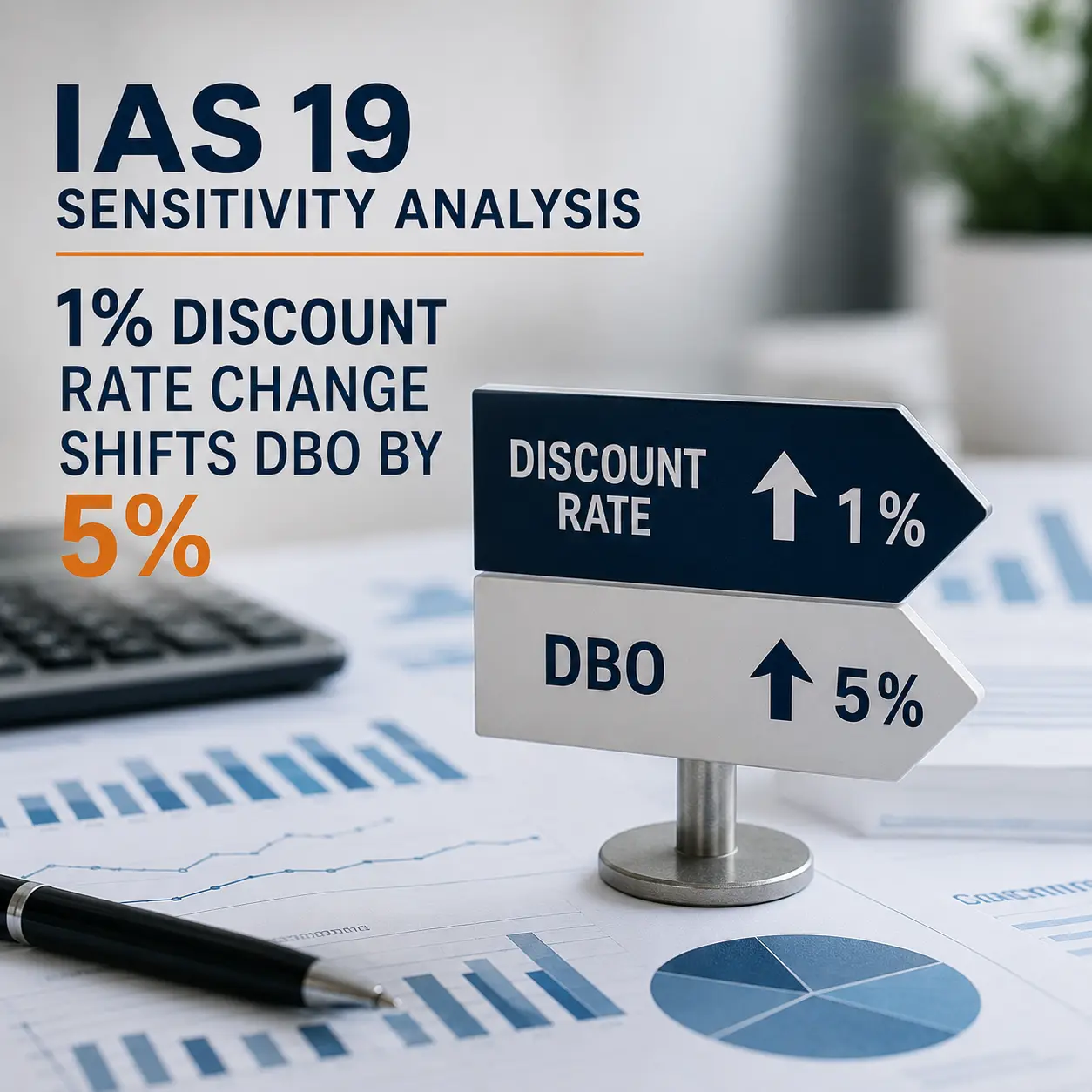
Sensitivity analysis on key assumptions like discount rates and salary growth is essential: A ±1% change in discount rate can alter the defined benefit obligation by approximately ±5%.
Multiple sensitivity scenarios provide a comprehensive risk assessment. Testing various assumption combinations shows potential liability ranges.
Financial statement disclosure requirements mandate sensitivity presentation. Clear communication of assumption impacts helps stakeholder understanding.
Risk management applications utilize sensitivity results. Treasury and risk management teams use sensitivity analysis for financial planning purposes.
Maintaining Updated Data and Assumptions
Regular assumption review cycles prevent outdated projections. Annual or semi-annual reviews keep assumptions current with market conditions.
Market monitoring systems track assumption-relevant data. Automated alerts for significant market changes trigger review processes of assumptions.
Data refresh procedures maintain valuation accuracy. Regular employee data updates prevent calculation errors and audit findings.
Professional development keeps assumption selection current. Ongoing actuarial education ensures awareness of emerging best practices and regulatory changes.
Collaborative Engagement for Regulatory and Market Compliance
Cross-functional teams improve assumption quality. HR, finance, and actuarial collaboration produces better assumption selection and documentation.
Regulatory monitoring ensures compliance awareness. Tracking regulatory changes prevents assumption methodology problems.
Market practice research validates assumption approaches. Industry surveys and peer analysis support the assumption of reasonableness.
External advisor relationships provide expert guidance. Professional actuarial advisors offer specialized knowledge for complex assumption situations.
IAS 19 Assumptions: Frequently Asked Questions

Key IAS 19 Assumptions that Drive Audit Success
The complexity of IAS 19 assumptions demands meticulous attention to detail and comprehensive documentation. Your audit success depends on how well you prepare assumptions, document rationales, and maintain data quality.
Market conditions continue evolving rapidly, making regular assumption updates essential. Whether you’re operating in the dynamic Gulf markets or established European economies, staying current with local conditions prevents audit complications.
Professional actuarial support makes the difference between smooth audits and problematic findings. The investment in proper assumption development and documentation pays dividends during audit reviews and stakeholder reporting.
Ready to strengthen your IAS 19 audit readiness? Prima Consulting’s actuarial services provide comprehensive support for assumption development, documentation, and audit preparation across all regions and regulatory environments.
Free Consultation
Want your assumptions audit-ready before year-end?
Prima’s advisors work with organisations across the GCC, Europe, and Asia-Pacific. First conversation is always free, no pitch, just expertise.