TL;DR
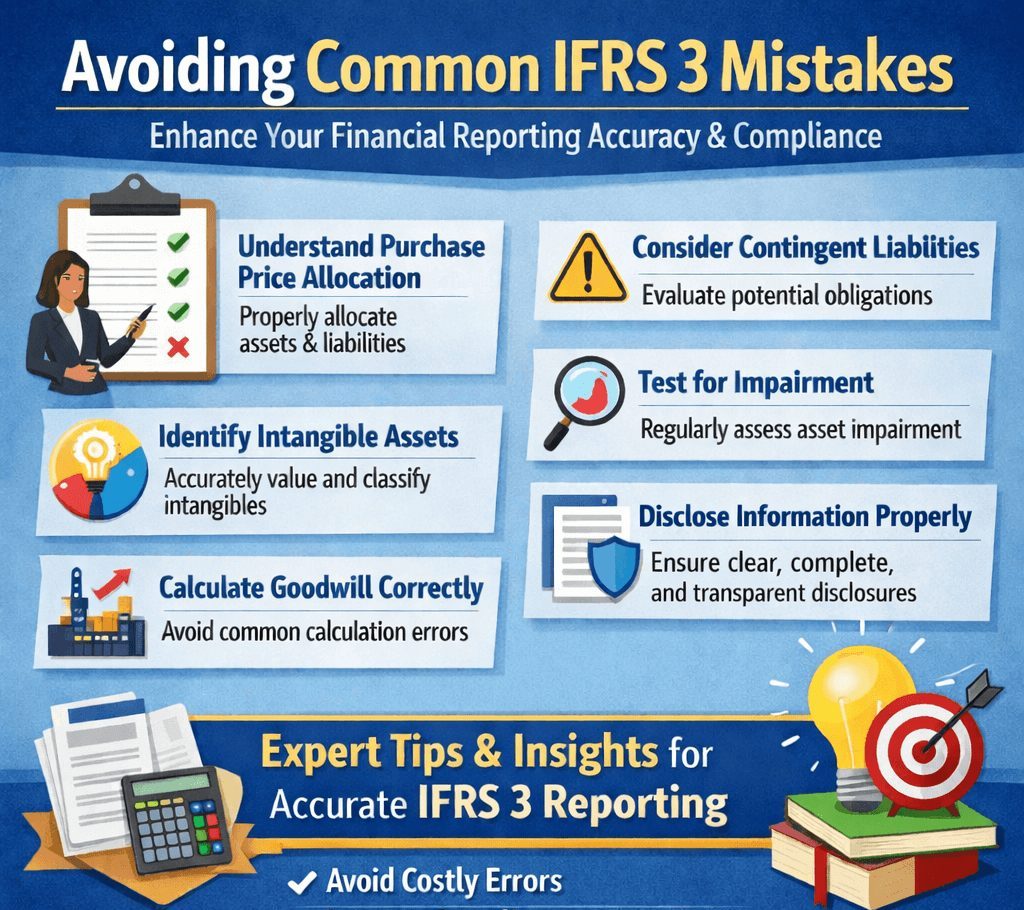
Seven common IFRS 3 mistakes can derail your business combination accounting and trigger costly restatements. This checklist covers business combination errors including misidentifying the acquirer, incorrect acquisition dates, goodwill mistakes from improper intangible asset valuation, and purchase price allocation errors with contingent consideration. You’ll learn how to avoid fair value omission in acquisition due diligence, prevent consolidation mistakes during the 12-month measurement period, and handle post-acquisition issues correctly. Master these merger accounting pitfalls to protect your organization from regulatory scrutiny, maintain accurate financial reporting, and preserve investor confidence throughout your next acquisition.
You’re about to close a major acquisition deal. The contracts are signed, due diligence is complete, and stakeholders are excited about the synergies ahead.
But here’s what keeps finance professionals awake at night: one IFRS 3 mistake in your business combination accounting could trigger regulatory scrutiny, restatements, and investor confidence loss.
IFRS 3 business combination transactions represent some of the most complex accounting challenges you’ll face. The stakes couldn’t be higher. According to the March 2024 IASB Exposure Draft on “Business Combinations – Disclosures, Goodwill and Impairment,” evolving guidance signals ongoing challenges practitioners face with these standards.
The reality? Most business combination errors stem from seven predictable IFRS 3 mistakes. Master these pitfalls, and you’ll protect your organization from costly missteps that have derailed countless deals.
Common IFRS 3 Mistakes Start With Misidentification
The foundation of accurate IFRS 3 accounting starts with correctly identifying what qualifies as a business combination versus an asset acquisition.
Here’s where many get it wrong: they assume any purchase of assets constitutes a business combination. Wrong.
IFRS 3 mistakes often begin at this critical juncture. A business combination requires acquiring control over a business—an integrated set of activities and assets capable of being conducted and managed to provide returns. If you’re merely buying assets without processes and organized workforce, you’re dealing with an asset acquisition under different accounting rules.
The Test You Need
Ask yourself these critical questions:
- Are there substantive processes being acquired?
- Does the acquired entity have inputs, processes, and outputs?
- Can the acquired activities be managed to generate returns?
If you answer “no” to any of these, you’re looking at an asset acquisition, not a business combination. This distinction affects everything from goodwill recognition to fair value measurements.
Real-World Impact
Companies that misclassify asset acquisitions as business combinations often recognize goodwill mistakes incorrectly. This creates unnecessary complexity and potential write-downs that impact financial performance.
The IASB’s 2020 amendments to IFRS 3 remain critical for transitional application through 2025-mid 2026, emphasizing the importance of getting this classification right from the start.
Mistake 2: Inaccurate Identification of the Acquirer
Identifying the acquirer seems straightforward until you encounter complex deal structures. Many finance professionals assume the entity paying cash is automatically the acquirer. Not necessarily true.
The acquirer is the entity that obtains control, regardless of the legal structure or consideration form. In reverse acquisitions or mergers of equals, the actual acquirer might surprise you.
Control Indicators to Check
- Voting rights and board composition
- Ability to appoint key management
- Size differential between combining entities
- Contractual arrangements and veto rights
Why This Matters
Getting the acquirer wrong means you’ll:
- Apply fair value measurements to the wrong entity’s assets
- Calculate goodwill incorrectly
- Prepare consolidated statements from the wrong perspective
Each of these business combination errors cascades through your financial statements, creating material misstatements that could require costly restatements.
Mistake 3: Misjudging the Acquisition Date
The acquisition date isn’t always the closing date. This simple misunderstanding creates timing errors that affect asset valuations, goodwill calculations, and income statement presentation.
IFRS 3 defines the acquisition date as when control transfers to the acquirer. This could happen:
- Before legal closing through irrevocable commitments
- After closing due to regulatory approvals
- On a different date than contract signing
Critical Timing Considerations
Your acquisition date determines:
- Fair value measurement dates for all acquired assets and liabilities
- When to start consolidating the acquired business
- Cut-off for including acquired entity’s results
Documentation Requirements
You must document:
- Evidence of control transfer
- Reasons for any difference between acquisition date and closing date
- Impact on financial statement presentation
Example Scenario
A pharmaceutical company signed acquisition papers on December 15, but regulatory approval came January 10. If control didn’t transfer until approval, the acquisition date is January 10, not December 15. This affects which period’s results include the acquired entity.
Common errors in reporting IFRS 3 often stem from this timing confusion, leading to incorrect period allocation of revenues and expenses.
Mistake 4: Incorrect Valuation of Intangible Assets and Goodwill
Goodwill mistakes represent one of the costliest business combination errors. Here’s what goes wrong: companies either fail to identify separately recognizable intangible assets or measure them incorrectly.
The Two-Step Problem
First, you must identify all intangible assets that meet recognition criteria separately from goodwill. Customer relationships, technology, trade names, and non-compete agreements often qualify.
Second, you must measure these assets at fair value, not book value or replacement cost.
Common Valuation Errors
- Bundling customer relationships into goodwill instead of separate recognition
- Using book values instead of fair values for acquired intangibles
- Failing to recognize internally developed intangibles that don’t appear on the target’s books
- Incorrectly measuring contingent assets
The Goodwill Calculation
Goodwill equals:
- Consideration transferred
- Plus non-controlling interest fair value
- Plus previously held interest fair value
- Minus net identifiable assets at fair value
Each component must be measured correctly, or your goodwill calculation becomes meaningless.
According to the KPMG 2024 IFRS vs US GAAP study, identification and measurement issues remain prevalent, highlighting recognition and measurement differences that suggest common IFRS 3 misapplications.
Impairment Testing Consequences
Incorrect goodwill recognition creates ongoing impairment testing headaches. You’ll either:
- Test goodwill that shouldn’t exist
- Miss impairments of separately recognized intangibles
- Allocate goodwill to wrong cash-generating units
Mistake 5: Omitting or Incorrectly Measuring Contingent Consideration
Purchase price allocation errors frequently involve contingent consideration. These are payments tied to future performance metrics or milestones.
Many companies make these mistakes:
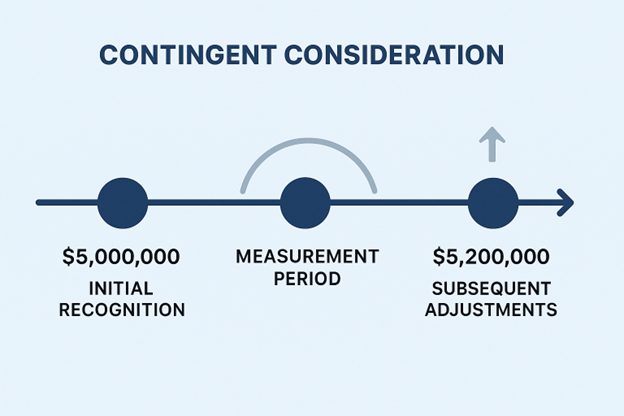
- Forgetting to recognize contingent consideration at acquisition date
- Using expected values instead of fair values
- Failing to reassess measurements during the 12-month window
Recognition Requirements
You must recognize contingent consideration at fair value on the acquisition date, even if payment is uncertain. This includes:
- Earn-outs based on revenue targets
- Milestone payments for product approvals
- Performance-based equity awards
- Escrow arrangements
Measurement Approaches
Fair value measurement should consider:
- Probability-weighted expected outcomes
- Time value of money effects
- Market participant perspectives
- Risk-adjusted discount rates
Subsequent Measurement
Post-acquisition changes in contingent consideration fair value generally flow through earnings, not as acquisition accounting adjustments. This distinction affects both balance sheet and income statement presentation.
The EY June 2024 Business Combinations guide includes new interpretive clarifications, implying prior misinterpretations among practitioners regarding contingent consideration measurement.
Mistake 6: Poor Disclosure and Documentation Practices
IFRS 3 disclosure requirements are extensive and detailed. Poor disclosure practices create compliance risks and undermine investor confidence.
Required Disclosures Include
- Business combination rationale and expected synergies
- Acquisition date and control percentage acquired
- Fair value of consideration transferred by component
- Amounts recognized for major asset and liability classes
- Goodwill calculation and factors contributing to recognition
- Pro forma revenue and profit information
Documentation Challenges
Many organizations fail to:
- Document significant assumptions used in fair value measurements
- Explain timing differences between acquisition and closing dates
- Detail measurement period adjustments and their rationale
- Provide adequate narrative about integration plans
Best Practice Framework
Create a comprehensive documentation package including:
- Valuation reports supporting fair value measurements
- Board resolutions and management analyses
- Expert opinions on identified intangibles
- Sensitivity analyses for key assumptions
Audit and Regulatory Risks
Inadequate documentation leads to:
- Extended audit procedures and higher fees
- Regulatory scrutiny and potential enforcement actions
- Investor confusion about deal economics
- Management credibility questions
How to avoid mistakes in IFRS 3 accounting starts with robust documentation practices that support every significant judgment and assumption.
Mistake 7: Mismanagement of Post-Combination Adjustments
The 12-month measurement period provides flexibility to finalize purchase price allocations, but mismanaging this period creates significant problems.
Common Post-Acquisition Issues
- Making adjustments beyond the 12-month deadline
- Treating measurement period adjustments as current period expenses
- Failing to distinguish between new information and changed circumstances
- Poor communication about provisional versus final measurements
Measurement Period Rules
During the 12-month period after acquisition, you can adjust:
- Asset and liability fair values based on new information
- Goodwill calculations resulting from asset/liability adjustments
- Recognition of previously unidentified assets or liabilities
What Doesn’t Qualify
You cannot adjust for:
- Changes in facts or circumstances after acquisition date
- Errors in applying acquisition method
- Changes in accounting estimates unrelated to acquisition date facts
Documentation Requirements
For each adjustment, document:
- Nature of new information obtained
- How information affects acquisition date measurements
- Impact on goodwill and other recognized amounts
- Reasons adjustment wasn’t made earlier
Post-acquisition IFRS 3 issues often arise when companies treat all changes as measurement period adjustments rather than properly categorizing them.

Additional Considerations for IFRS 3 Compliance
In-Process Research and Development
In-process research and development (IPR&D) should be recognized as a separate intangible asset from goodwill under IFRS, even when future cash flows remain uncertain.
The fair value should reflect that uncertainty through appropriate discount rates and probability adjustments, not through non-recognition.
Many companies incorrectly include IPR&D in goodwill, creating impairment testing complications and understating identifiable intangible assets.
This becomes particularly challenging in pharmaceutical and technology acquisitions. Consider a biotech company acquiring another firm with three drug candidates in different development phases.
Each candidate requires separate valuation based on:
- Development phase completion probability
- Regulatory approval likelihood
- Market penetration assumptions
- Patent protection duration
Companies often make the mistake of bundling all IPR&D into goodwill because individual asset valuation seems complex. This approach violates IFRS 3 requirements and creates ongoing compliance issues.
Deferred Tax Implications in Business Combinations
Deferred tax accounting in business combinations creates frequent errors:
- Not recognizing deferred tax liabilities on acquired intangible assets that aren’t tax-deductible
- Failing to disclose whether goodwill is tax-deductible
- Incorrectly calculating deferred tax on fair value adjustments
These errors affect both goodwill calculations and ongoing tax expense recognition.
Share-Based Payment Replacement
When acquirers replace target company share-based payment awards, the accounting treatment depends on whether replacement was required or voluntary.
- Required replacements: Include in consideration transferred
- Voluntary replacements of expired awards: Recognize as compensation expense
This distinction significantly affects purchase price calculations and goodwill recognition.
Measurement of Contract Liabilities (Deferred Revenue)
Contract liabilities should be measured at fair value, not the acquiree’s carrying value. This can lead to material errors if misapplied.
Fair value reflects the cost of fulfilling performance obligations plus a normal profit margin, which often differs from the target’s recorded amounts.
Understanding Non-Controlling Interest Treatment
Non-controlling interests can be measured at either:
- Fair value (full goodwill method)
- Proportionate share of identifiable net assets
The choice affects goodwill recognition and subsequent impairment testing. Consolidation mistakes often stem from inconsistent application of this choice.
The decision impacts your financial statements significantly. Under the full goodwill method, you recognize goodwill attributable to both the controlling and non-controlling interests. This increases total goodwill on your balance sheet.
Under the proportionate method, you only recognize goodwill attributable to your ownership percentage. This results in lower goodwill amounts but doesn’t capture the full value of the business combination.
Most multinational corporations prefer the full goodwill method for consistency. That said, local regulations in certain jurisdictions might influence your choice.
Strategic Considerations in IFRS 3 Implementation
Successful IFRS 3 implementation requires more than technical compliance. You need strategic planning that aligns with your organization’s broader objectives.
Start your business combination planning early. Don’t wait until deal execution to address accounting complexities. Early planning allows you to:
- Identify potential accounting challenges
- Structure transactions for optimal reporting
- Prepare stakeholders for financial statement impacts
- Develop robust documentation processes
Consider establishing a dedicated business combination team. Include representatives from accounting, tax, legal, and operations. This cross-functional approach prevents common oversights that create IFRS 3 mistakes.
Technology plays a crucial role in modern business combinations. Invest in systems that support fair value measurements, consolidation processes, and ongoing monitoring requirements.
Many organizations underestimate the ongoing compliance burden. IFRS 3 requirements don’t end at acquisition date. You’ll face annual impairment testing, disclosure updates, and measurement period adjustments.
Recognizing Bargain Purchases and Goodwill Correctly
When identifiable net assets exceed consideration transferred, you have a bargain purchase that requires:
- Reassessment of all measurements
- Recognition of gain in profit or loss
- Detailed disclosure of circumstances
Don’t automatically assume you have goodwill in every business combination.
Industry-Specific IFRS 3 Challenges
Different industries face unique business combination challenges that require specialized knowledge and approaches.
Technology Sector Complications
Technology acquisitions often involve significant intangible assets that traditional valuation methods struggle to capture. Software, algorithms, user databases, and intellectual property require sophisticated measurement techniques.
Common tech industry IFRS 3 mistakes include:
- Undervaluing user databases and customer relationships
- Incorrectly treating software as internally generated (not recognizable) versus acquired
- Mishandling open-source software licenses and restrictions
- Failing to separate technology platforms from ongoing development activities
The rapid pace of technological change creates additional complications. Fair values established at acquisition date may become obsolete quickly, but this doesn’t justify measurement period adjustments unless new information comes to light about acquisition date conditions.
Financial Services Sector Considerations
Financial institutions face unique challenges in IFRS 3 applications, particularly around regulatory capital requirements and intangible asset recognition.
Bank acquisitions must carefully review:
- Core deposit intangibles and their fair value measurement
- Loan portfolio fair values and credit loss provisions
- Regulatory licenses and their transferability
- Technology platforms and customer relationship values
The intersection of IFRS 3 with banking regulations creates additional complexity. Some intangible assets recognized under IFRS 3 may not qualify for regulatory capital purposes, creating book-tax differences that require careful management.
Healthcare and Pharmaceutical Industry Issues
Healthcare acquisitions present unique valuation challenges around intellectual property, regulatory approvals, and patient relationships.
Drug development pipelines require careful review of:
- Clinical trial data and regulatory submission status
- Patent portfolios and competitive positioning
- Manufacturing capabilities and regulatory compliance
- Distribution networks and customer relationships
The high failure rate in drug development makes probability-weighted valuation approaches necessary. Still, many companies struggle with appropriate discount rates and success probability estimates.
Key IFRS 3 Statistics and Updates
Understanding current trends helps contextualize these common merger accounting pitfalls:
- March 2024 IASB Exposure Draft issued on “Business Combinations – Disclosures, Goodwill and Impairment,” signaling evolving IFRS 3 guidance
- IASB’s 2020 amendments to IFRS 3 (Conceptual Framework reference) remain critical for transitional application through 2025-mid 2026
- Grant Thornton Insights series active in 2024: 4 updates published since February 2024 covering goodwill, non-controlling interests, and disclosure practice
- Identification and measurement issues remain prevalent: KPMG 2024 IFRS vs US GAAP study highlights recognition and measurement differences suggesting common IFRS 3 misapplications
- EY’s June 2024 Business Combinations guide includes new interpretive clarifications implying prior misinterpretations among practitioners
Your Path to Avoiding IFRS 3 Mistakes
These seven IFRS 3 mistakes represent the most common pitfalls that derail business combination accounting. From misidentifying business combinations to botching post-acquisition adjustments, each error creates cascading problems through your financial statements.
The stakes are real: regulatory scrutiny, audit complications, investor confidence loss, and potential restatements all flow from these preventable IFRS 3 mistakes. But here’s the opportunity—companies that master these complexities gain competitive advantages through smoother transactions, stronger stakeholder relationships, and reduced compliance costs.
Your next business combination doesn’t have to become a cautionary tale about acquisition due diligence failures or fair value omission.
Ready to make sure your next business combination meets IFRS 3 requirements flawlessly? Prima Consulting’s expert team has guided hundreds of organizations through complex business combinations across Saudi Arabia, UAE, Pakistan, Germany, and Europe. Our proven IFRS advisory services prevent these costly IFRS 3 mistakes before they impact your financial statements. Avoiding Common Pitfalls in IFRS 3 Business Combinations starts with the right expertise at your side.