TL;DR
You’ll find clear answers to the most common IFRS 16 lease FAQs finance teams face daily. This guide breaks down IFRS 16 questions about scope, recognition, exemptions, and financial statement impacts. You’ll learn how to identify leases correctly, measure right-of-use assets and liabilities, and apply short-term and low-value exemptions. We also explain how IFRS 16 changes EBITDA and balance sheet metrics compared to IAS 17. Read on for straight answers you can actually use.
Finance teams keep running into the same wall with IFRS 16. You’re not alone if you’re searching for clear answers to the lease questions that come up in your daily work.
The transition from IAS 17 created ripple effects across industries. Companies reported significant balance sheet changes, with some seeing liability increases of 20-30% because of lease recognition requirements.
This guide tackles the most common IFRS 16 FAQs that finance professionals encounter. We’ll break down complex concepts into actionable insights that help you handle IFRS 16 with confidence.
Whether you’re dealing with lease modifications, struggling with initial measurements, or trying to understand exemption criteria, you’ll find practical solutions ahead.
What is IFRS 16 and Why Was It Introduced?
IFRS 16 represents a fundamental shift in how organizations account for lease arrangements. This international standard replaced IAS 17 on January 1, 2019, bringing operating leases onto company balance sheets for the first time.
The standard addresses a critical gap in financial reporting. Under IAS 17, companies could keep billions in lease obligations off their balance sheets, which created an incomplete picture of their financial position.
IFRS 16 has seen widespread adoption since its introduction in 2019, with most publicly listed companies in IFRS jurisdictions now compliant with the new standard. The primary goal was transparency.
IFRS 16 requires lessees to recognize most leases as right-of-use assets and lease liabilities on their balance sheets. This gives stakeholders a clearer view of a company’s financial commitments.
Key improvements include better comparability between companies that lease versus buy assets, more accurate representation of leverage and capital structure, and enhanced decision-making information for investors and lenders.
The IFRS 16 impact affects virtually every industry. Retail companies with store leases, airlines with aircraft leases, and manufacturing companies with equipment leases all face similar recognition requirements.
Companies seeking comprehensive support often turn to specialized leases advisory services to handle these complex requirements.
Prima Consulting
Need expert guidance on this topic? Our advisory team is available for a free initial consultation.
No obligation · Responds within 1 business day · GCC, Europe & APAC
Common Questions About IFRS 16 Lease Scope
IFRS 16 covers all lease arrangements with specific exemptions. Understanding scope remains crucial for proper implementation and compliance.
The standard applies to leases of identifiable assets including property leases like offices, warehouses, and retail spaces, vehicle leases such as cars, trucks, and delivery vehicles, plus equipment leases covering machinery, IT equipment, and furniture.
Two key exemptions exist for lessees. Short-term leases with terms of 12 months or less without purchase options allow companies to expense these on a straight-line basis rather than capitalizing them. Low-value asset leases for individual assets with fair values below $5,000 when new include tablets, phones, and small office furniture.
Many companies have reported using the exemption for low-value assets to reduce the administrative burden of tracking numerous small-value leases. The exemptions offer practical relief but require careful consideration.
Companies must evaluate each lease individually and document their exemption elections consistently. Service contracts don’t fall within IFRS 16’s scope because these include maintenance agreements, insurance policies, and other arrangements that don’t convey control over identifiable assets.
How Does IFRS 16 Define a Lease?
IFRS 16 provides specific criteria for lease identification. A contract contains a lease if it conveys the right to control an identified asset for a period in exchange for consideration.
Control requires two elements: obtaining substantially all economic benefits from the asset’s use and having the right to direct how and for what purpose the asset is used.
An identified asset must be physically distinct or represent substantially all of an asset’s capacity. The supplier can’t have substantive substitution rights throughout the lease term.
Consider these examples. A lease exists when a company rents a specific floor in an office building for five years where the floor is identified and the company controls its use. That’s different from when a company contracts for 10,000 hours of server capacity from a cloud provider where the specific servers aren’t identified and the provider can substitute them.
A service contract exists when a company hires a cleaning service for its offices because the cleaning company controls how and when to provide the service.
The identification process requires judgment. Companies should document their analysis, especially for complex arrangements combining lease and service elements.
Lease modifications may create new lease identification questions. When contracts change, companies must reassess whether lease criteria are still met.
Many organizations find that professional IFRS 16 advisory support helps handle complex lease identification and measurement requirements.
How Does a Lessee Account for a Lease Under IFRS 16?
Lessee accounting under IFRS 16 follows a straightforward recognition model. All leases except exempted ones result in balance sheet recognition of assets and liabilities.
Initial Measurement of Lease Liability and ROU Asset
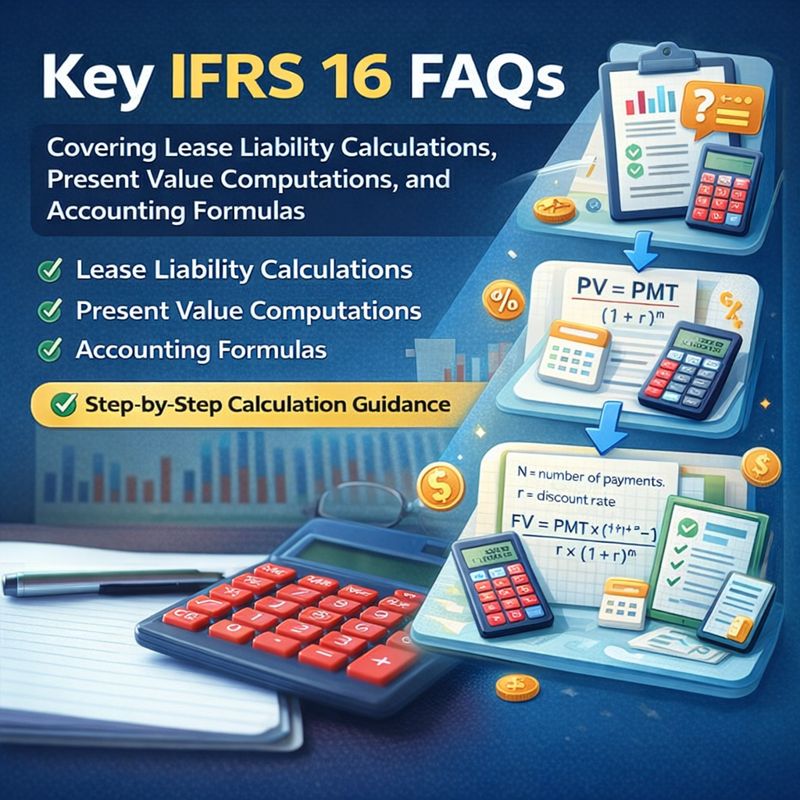
At lease commencement, lessees recognize a lease liability and right-of-use (ROU) asset simultaneously. The lease liability equals the present value of unpaid lease payments.
This includes fixed payments minus any lease incentives received, variable payments based on an index or rate, residual value guarantees expected to be paid, purchase option prices if exercise is reasonably certain, and termination penalties if lease term reflects their payment.
The discount rate should be the interest rate implicit in the lease. When this rate isn’t readily determinable, lessees use their incremental borrowing rate.
The ROU asset comprises the lease liability amount, initial direct costs incurred by the lessee, prepaid lease payments, estimated restoration costs, less any lease incentives received.
Subsequent Measurement and Depreciation
After initial recognition, lessees apply different measurement approaches to each component. The lease liability increases by interest expense using the effective interest method, decreases by lease payments made, and gets remeasured when lease modifications occur or variable payment assumptions change.
The right-of-use asset depreciates over the shorter of lease term or asset’s useful life, gets tested for impairment when indicators exist, and adjusts for lease liability remeasurements.
The income statement reflects two expenses: depreciation of the ROU asset and interest on the lease liability. This replaces the straight-line rent expense under IAS 17.
Professional IFRS 16 lease accounting teams often use specialized software to automate these complex calculations accurately.
What Are the Key Exemptions Under IFRS 16?
IFRS 16 provides practical exemptions that reduce implementation complexity. Understanding these exemptions helps companies optimize their accounting approach.
Short-term lease exemption applies when lease term is 12 months or less, no purchase option exists, and company elects to apply the exemption by asset class. Companies choosing this exemption expense lease payments on a straight-line basis over the lease term, which mirrors IAS 17 treatment for operating leases.
Low-value asset exemption applies when underlying asset has low value when new, typically under $5,000, lessee can benefit from the asset independently or with readily available resources, and asset isn’t highly dependent on or interrelated with other assets. The exemption applies per individual lease, not asset class, so companies must evaluate each lease separately.
Portfolio application allows companies to apply IFRS 16 to lease portfolios rather than individual leases. This works when the financial statement effect doesn’t differ materially from individual application.
Transition rules provided additional relief during initial implementation. Companies could use various practical expedients to avoid restating prior periods or reassessing lease identification for expired contracts.
Variable payments not based on an index or rate don’t form part of the lease liability. These payments are expensed as incurred. Portfolio exemptions are particularly useful for companies with numerous similar lease arrangements across their operations.
Explore our advisory services
How Does IFRS 16 Affect Financial Statements and EBITDA?
IFRS 16 creates significant changes in financial statement presentation and key performance indicators. The impact extends beyond simple balance sheet recognition.
Research shows that IFRS 16 implementation has significantly increased reported liabilities for companies with substantial operating lease portfolios. Many experienced increases of 20-30% or more in their total liabilities because of lease recognition requirements.
Assets increase through ROU asset recognition, which affects total assets and asset turnover ratios, return on assets calculations, and asset-based lending covenant compliance.
Liabilities increase through lease liability recognition, which impacts debt-to-equity ratios, interest coverage ratios, and credit facility covenant compliance. A 2025 study on listed mining companies confirmed IFRS 16 adoption significantly changed debt-to-equity and debt-to-assets ratios while return on assets remained largely unaffected.
The expense pattern changes significantly. Instead of straight-line rent expense, companies report depreciation expense, typically straight-line, plus interest expense, which is front-loaded using effective interest method. This creates higher expenses in early lease years and lower expenses in later years for individual leases.
IFRS 16 typically increases EBITDA because rent expense included in EBITDA calculation is eliminated, while depreciation and interest excluded from EBITDA replace rent expense. Companies may see EBITDA improvements of 10-20% or more, depending on their lease portfolio size.
Operating cash flows improve because lease payments are split between interest payments in operating activities and principal payments in financing activities. This reclassification can significantly improve operating cash flow metrics.
Many finance teams use an IFRS 16 checklist to make sure they’ve addressed all financial statement impact areas comprehensively.
What Are the Key Disclosures Required Under IFRS 16?
IFRS 16 mandates comprehensive disclosures that provide stakeholders with insights into lease arrangements and their financial impact.
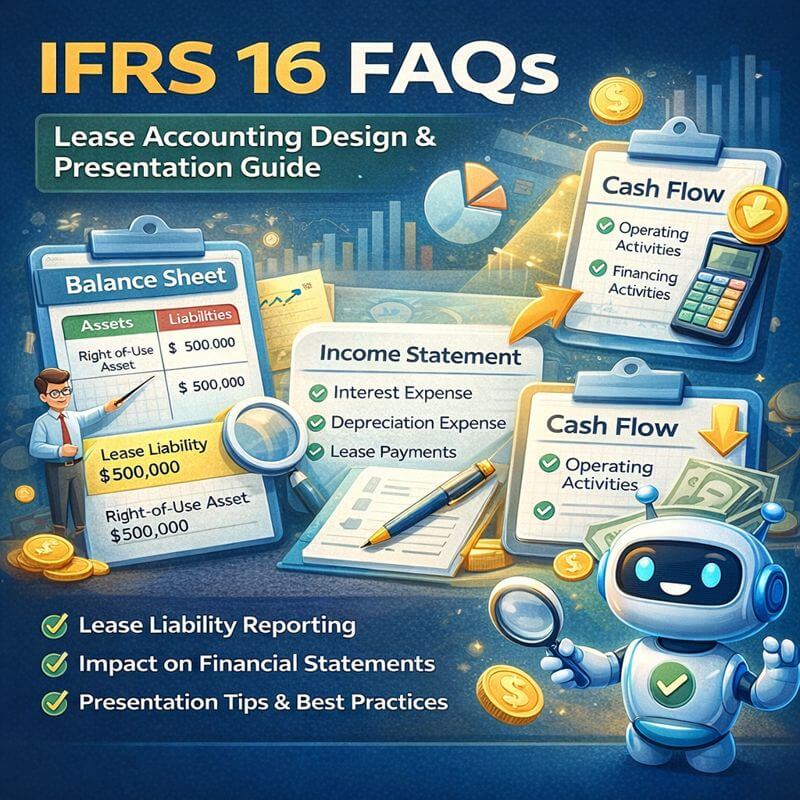
Balance sheet disclosures include ROU assets by class of underlying asset, lease liabilities separated into current and non-current portions, and additions to ROU assets during the reporting period.
Income statement disclosures include depreciation of ROU assets by asset class, interest expense on lease liabilities, expense relating to short-term leases, expense relating to low-value asset leases, and variable lease payments not included in lease liabilities.
Cash flow disclosures include total cash outflows for leases and cash flows separated by operating and financing activities.
Companies must provide an analysis of lease liabilities showing undiscounted cash flows by maturity period and reconciliation to lease liabilities recognized.
Qualitative disclosures include nature of leasing activities, future cash flows from lease extensions and termination options, restrictions or covenants imposed by leases, and sale and leaseback transactions. The disclosures help users understand the magnitude, timing, and uncertainty of cash flows arising from leases.
How Does IFRS 16 Compare to IAS 17?
The transition from IAS 17 to IFRS 16 represents one of the most significant changes in accounting standards. Understanding the differences helps explain implementation challenges.
IAS 17 classified leases as either finance or operating leases. Finance leases appeared on balance sheets while operating leases remained off-balance-sheet. IFRS 16 eliminates the classification distinction for lessees, so all leases except exempted ones receive similar accounting treatment.
Under IAS 17, operating leases generated footnote disclosures only. Companies reported substantial off-balance-sheet obligations. IFRS 16 requires balance sheet recognition for virtually all leases, which creates more comparable financial statements across companies.
IAS 17 operating leases generated straight-line rent expense over the lease term. IFRS 16 creates front-loaded expense patterns through depreciation and interest recognition.
IAS 17 lessor accounting remains largely unchanged under IFRS 16. Lessors continue to classify leases as finance or operating leases.
The changes affect debt covenant calculations, management compensation tied to balance sheet metrics, lease versus buy decision-making, and internal control procedures.
Does IFRS 16 Apply to Property, Software, and Finance Leases?
IFRS 16’s scope includes various asset types with specific considerations for each category.
All property leases fall within IFRS 16’s scope unless exempted. This includes office buildings and retail spaces, warehouses and manufacturing facilities, land leases with buildings, and bare land leases. Property leases often involve complex terms, variable payments, and lease extensions that require careful analysis.
Software arrangements require careful evaluation. IFRS 16 applies when software is hosted on identifiable hardware, customer controls the identified hardware, and the arrangement conveys more than just access rights.
Software-as-a-Service (SaaS) arrangements typically fall outside IFRS 16’s scope because they provide access to software rather than control over identifiable assets.
Finance leases under IAS 17 continue receiving similar treatment under IFRS 16. The main changes involve updated lease liability measurement requirements, enhanced disclosure requirements, and potential differences in lease term determination.
Manufacturing equipment, vehicles, and IT hardware typically meet IFRS 16’s lease definition. Companies must evaluate asset identification criteria, control assessment, and exemption applicability.
Specialized leases advisory services can help organizations develop comprehensive approaches to handle these various asset categories and their unique requirements.
When Did IFRS 16 Come Into Effect?
IFRS 16 became effective for annual reporting periods beginning on or after January 1, 2019. The implementation timeline varied by jurisdiction and entity type.
Most publicly traded companies implemented IFRS 16 in 2019. The transition required system updates and process changes, staff training and education, audit procedure modifications, and stakeholder communication.
Companies could choose between full retrospective application and modified retrospective application with various practical expedients. Most companies chose modified retrospective application to reduce implementation costs.
Finance teams continue to report challenges in identifying and measuring certain lease contracts under IFRS 16, particularly for complex arrangements involving non-standard terms or embedded lease components.
Many IFRS 16-compliant companies now use specialized lease accounting software to automate calculations of right-of-use assets and lease liabilities, which significantly reduces manual errors compared to spreadsheet-based methods. Companies continue to refine their processes as they gain experience with the standard’s requirements.
IFRS 16 Lease FAQs: New Additions for Prima Consulting
What Is an IFRS 16 Office Lease Example and How Is It Accounted For?
An IFRS 16 office lease example is any arrangement where a company rents office space from a landlord for a defined period in exchange for regular payments. Under IFRS 16, the lessee must recognize a right-of-use (ROU) asset and a corresponding lease liability on day one, reflecting the present value of all future lease payments.
Say your company signs a 5-year office lease with monthly payments of $10,000. Using your incremental borrowing rate of 6% per annum, the present value of those payments comes to roughly $517,000. That amount lands on your balance sheet as both an ROU asset and a lease liability from the lease start date.
Here’s how the accounting plays out over the lease term:
- ROU asset: Depreciated on a straight-line basis over 5 years, giving you a monthly depreciation charge of roughly $8,617.
- Lease liability: Reduced each month by the cash payment made and increased by the unwinding of the discount (interest). In the first month, interest is roughly $2,585, so the principal repayment is $7,415.
- Income statement: You report depreciation and interest separately, rather than a single rent line. This increases EBITDA because the rent expense disappears from operating costs.
The IFRS 16 office lease example also covers lease incentives, rent-free periods, and tenant fit-out contributions. If your landlord gives you three months rent-free, those savings reduce the initial ROU asset value rather than being spread as income. It’s a detail many finance teams miss during their first year of compliance.
One more thing worth noting: if your office lease includes an extension option and you’re reasonably certain to exercise it, the extended term must be included in your lease liability calculation. This can materially change the numbers, so always document your assumptions.
Prima Consulting works with finance teams across the KSA, UAE, Pakistan, and neighboring regions to build clean, audit-ready IFRS 16 workings for office leases of all sizes. If you’re unsure whether your office lease accounting holds up to scrutiny, book a free consultation today.
How Does IFRS 16 Apply to a Ground Lease?
An IFRS 16 ground lease is a long-term arrangement where a lessee rents land from a landowner, typically for 25 to 99 years, and constructs or operates buildings on it. Under IFRS 16, ground leases require the same recognition approach as any other lease: the lessee records a right-of-use asset for the land and a matching lease liability for the present value of all future ground rent payments.
Ground leases are common in commercial real estate across the GCC and South Asian markets. A real estate developer in KSA, UAE, or Pakistan, among other markets, might hold land on a ground lease while owning the buildings constructed on that land outright. IFRS 16 treats the land component and the building component as separate right-of-use assets where applicable.
There are a few specific points that make ground lease accounting different from a standard office lease:
- Long lease terms: Many ground leases run for 50 or more years. The present value of payments over that term can be substantial, and your discount rate selection has a significant effect on the opening balance sheet figures.
- Land doesn’t depreciate: Under IAS 16, land generally isn’t depreciated. When the right-of-use asset relates purely to land, you typically don’t depreciate the ROU asset unless ownership transfers at the end of the lease term. This is a common point of confusion for teams new to IFRS 16 ground lease accounting.
- Variable rent reviews: Ground leases often include periodic rent reviews linked to open market value or an index. When payments vary based on an index such as CPI, IFRS 16 requires remeasurement of the lease liability at each review date using the updated lease payments.
- Renewal options: Ground leases frequently include renewal options. If you’re reasonably certain to exercise the option, you include the renewal period in your lease term calculation. For a 49-year initial term with a 49-year renewal, that could mean an enormous lease liability if exercise is considered certain.
One practical challenge many clients raise: what discount rate do you use for a 99-year ground lease when long-term borrowing rates are hard to pin down? The standard points you toward the interest rate implicit in the lease or your incremental borrowing rate. For very long-term ground leases, getting this rate right is worth the time it takes.
Prima Consulting’s IFRS advisory team has hands-on experience with ground lease accounting across KSA, UAE, Pakistan, and additional markets. We build your ROU asset and lease liability schedules with full audit documentation, so your auditors won’t send them back for rework.
Free Consultation
Ready to discuss your specific situation?
Prima’s advisors work with organisations across the GCC, Europe, and Asia-Pacific. First conversation is always free — no pitch, just expertise.
How Does IFRS 16 Treat Office Rent, and What Changes for Finance Teams?
Under IFRS 16, office rent is no longer a simple operating expense line. When your company rents office space for more than 12 months, that arrangement triggers lease recognition. You record a right-of-use asset and a lease liability, and your profit and loss account shows depreciation plus interest instead of the flat monthly rent charge you were used to under IAS 17.
For most businesses, IFRS 16 office rent accounting changes three things at once: your balance sheet grows, your EBITDA improves, and your expense profile front-loads. That last point catches a lot of people off guard.
Here’s why IFRS 16 office rent matters for your day-to-day reporting:
- No more straight-line rent expense: Under IAS 17, you spread rent evenly over the lease term. Under IFRS 16, your income statement shows depreciation (roughly even) plus interest (higher in early years, lower later). Total charges are higher at the start of the lease and taper off toward the end.
- EBITDA impact: Rent expense sits above EBITDA, but depreciation and interest sit below it. Once you move to IFRS 16, your EBITDA almost always goes up because the old rent charge disappears from operating expenses. Stakeholders need context here, or your numbers look misleadingly good.
- Short-term office rentals: If you rent office space for 12 months or less, IFRS 16’s short-term lease exemption lets you keep that as a straight-line expense. Many companies in KSA, UAE, Pakistan, and similar regions use serviced offices or co-working arrangements on rolling short-term contracts. These typically qualify for the exemption.
- Lease modifications: If your landlord agrees to reduce your office rent mid-lease, or you hand back part of the floor space, that’s a lease modification under IFRS 16. You remeasure the lease liability and adjust the ROU asset on the modification date. Miss this step and your balance sheet figures will be wrong.
- Incremental borrowing rate: You discount future office rent payments using either the rate implicit in the lease (which landlords rarely disclose) or your incremental borrowing rate. Getting this rate right is important. A 1% difference in the discount rate on a 5-year office lease can shift your opening lease liability by thousands.
Mastering IFRS 16 FAQs for Long-term Success
IFRS 16 implementation doesn’t have to be overwhelming. These frequently asked questions about IFRS 16 for finance teams represent the foundation of successful compliance.
The statistics show that most companies have successfully adopted IFRS 16, with widespread compliance now achieved across IFRS jurisdictions. Those who invested in proper training, systems, and processes report smoother ongoing compliance.
Your next steps depend on your current implementation status. Companies still struggling with identification and measurement issues should prioritize staff training and consider specialized software solutions.
Remember that IFRS 16 compliance is an ongoing process, not a one-time project. Regular process reviews and updates help maintain accuracy and efficiency.
Still have a question this page didn’t answer? That’s exactly what the form above is for. Send it to Prima Consulting and a member of our IFRS advisory team will get back to you directly.