TL;DR
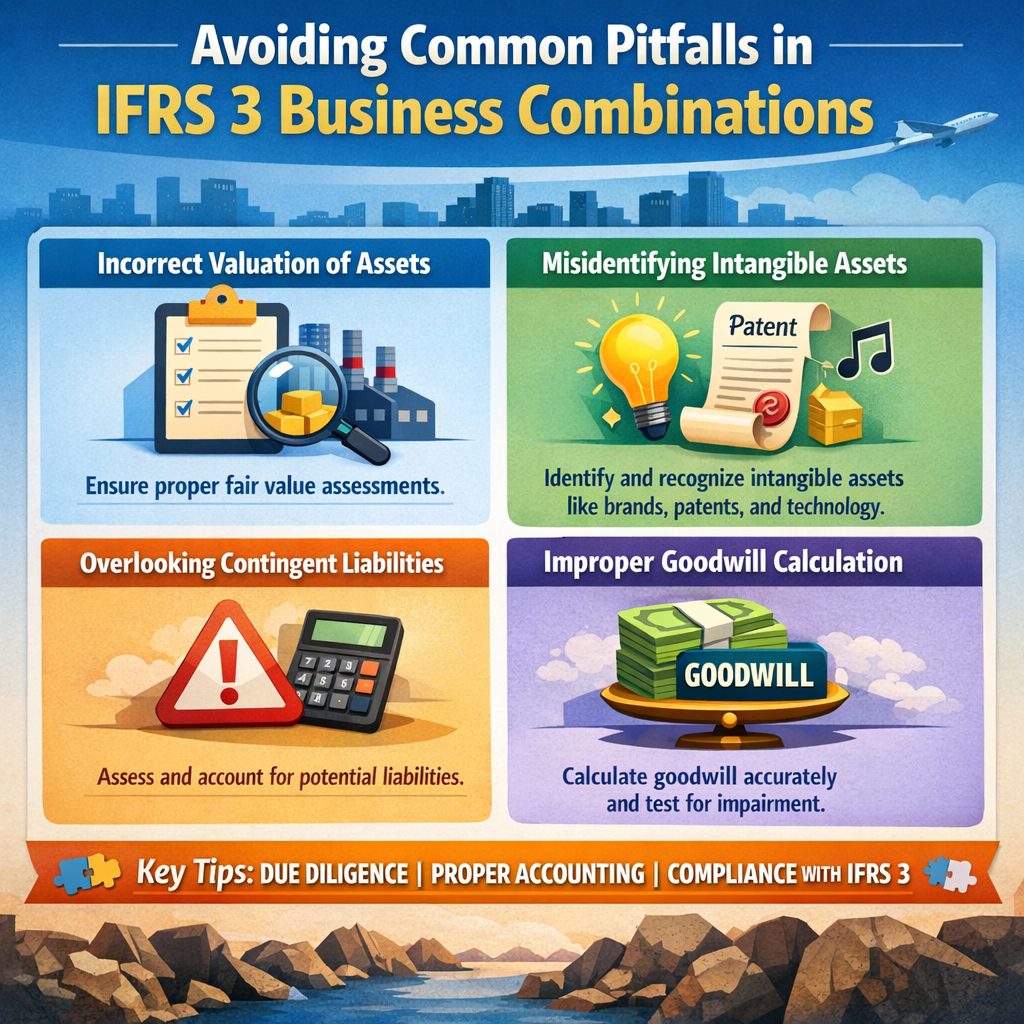
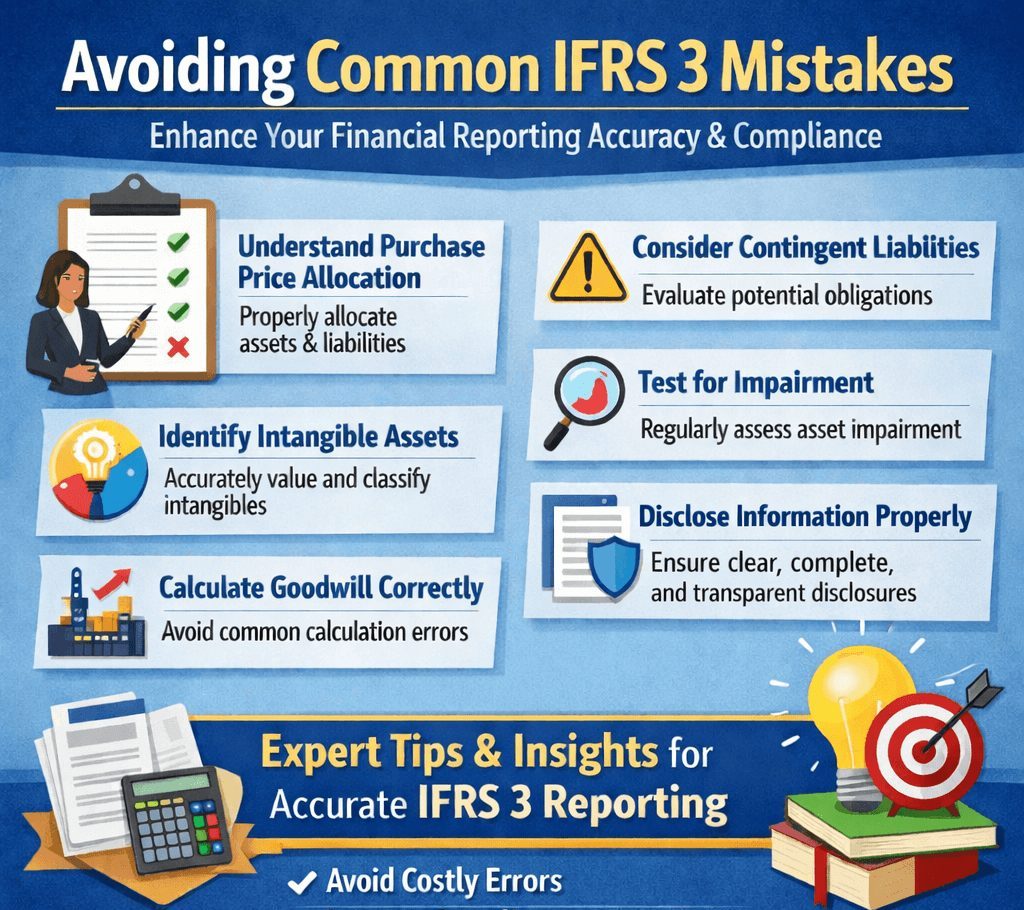
You’ll find the most critical IFRS 3 common mistakes that cost companies millions in restatements and penalties. This guide explains acquisition accounting errors like misidentifying the acquirer, purchase price allocation failures, and goodwill calculation mistakes. You’ll learn how to recognize intangible assets separately from goodwill, handle contingent consideration correctly, and meet disclosure requirements.
When companies merge or acquire other businesses, they’re dealing with transactions worth trillions of dollars globally. Yet many organizations still struggle with IFRS 3 common mistakes that can cost them dearly.
The scale is staggering. In 2023, global acquisitions reached US $3.2 trillion. Post-implementation reviews found that over 55% of analyzed business combinations disclosed only basic information without adequate financial detail. This widespread non-compliance highlights the urgent need for better understanding of common pitfalls.
Prima Consulting
Need expert guidance on this topic? Our advisory team is available for a free initial consultation.
No obligation · Responds within 1 business day · GCC, Europe & APAC
What Is IFRS 3 and Why Does It Matter?
IFRS 3 Business Combinations sets the rules for how companies account for acquisitions. It applies when one entity obtains control over another business.
The standard matters because it affects how you measure assets, liabilities, and goodwill. Get it wrong, and you risk material misstatements that can trigger regulatory action or damage stakeholder confidence.
The IASB discontinued its project on business combinations under common control in November 2023. This change has increased reporting diversity and complexity across jurisdictions.
Key Steps in the Acquisition Method Under IFRS 3
The acquisition method follows five key steps. Many organizations struggle with these requirements, and getting any one of them wrong cascades through the rest.
Step 1 – Identifying the Acquirer Correctly
Getting the acquirer identification wrong is one of the most fundamental acquisition accounting errors. The acquirer is the entity that obtains control, not necessarily the legal buyer.
Control assessment IFRS 3 requires examining three key elements:
- Power over the investee
- Exposure to variable returns
- Ability to use power to affect returns
You must look beyond legal structures to economic substance. In reverse acquisitions, the legal acquirer might actually be the acquiree for accounting purposes.
Control Indicators Worth Checking Before You Sign Off
The three-element test above is the legal test. In practice, four practical indicators settle most disputes faster:
- Voting rights and board composition after close
- Who gets to appoint key management
- Size differential between the combining entities
- Contractual arrangements and veto rights baked into the deal
Miss this call and the fallout is not cosmetic. You’ll apply fair value measurements to the wrong entity’s assets, calculate goodwill against the wrong base, and prepare consolidated statements from the wrong perspective. Every one of those errors cascades through the financial statements and can force a restatement.
Step 2 – Determining the Acquisition Date
The acquisition date is when the acquirer obtains control, not when contracts are signed or cash changes hands. This distinction creates frequent IFRS 3 common mistakes in timing recognition.
Conditional acquisitions add complexity. You can’t recognize a business combination until all conditions are met and control transfers. Staged acquisitions require remeasuring previously held interests at fair value on the acquisition date.
A Timing Mistake That Actually Happens
Take a pharmaceutical company that signed acquisition papers on December 15. Regulatory approval didn’t land until January 10. If control didn’t transfer until approval came through, the acquisition date is January 10, not December 15.
That six-week gap decides which reporting period picks up the acquired entity’s revenue and expenses. Get the date wrong and you’ve misallocated a quarter’s worth of numbers, not just missed a technicality.
Step 3 – Recognizing Identifiable Assets and Liabilities
Fair value mistakes in asset recognition represent some of the costliest IFRS 3 common mistakes. You must recognize all identifiable assets and liabilities at their acquisition-date fair values.
This includes contingent liabilities that meet IFRS 3’s recognition criteria, even if they wouldn’t qualify under other standards.
Handling Non-Controlling Interest (NCI)
NCI measurement offers two choices: fair value or proportionate share of net assets. Your choice affects goodwill calculation and subsequent reporting.
Fair value measurement increases goodwill but provides more relevant information. Proportionate share reduces goodwill but may not reflect economic reality.
Full Goodwill vs Proportionate: Which One Should You Pick?
Under the full goodwill method, you recognize goodwill attributable to both the controlling and non-controlling interests. That pushes total goodwill higher on the balance sheet. Under the proportionate method, you only recognize goodwill tied to your own ownership percentage, which produces a lower number but doesn’t capture the full value of what you bought.
Most multinationals default to full goodwill for consistency across their portfolio. That said, local regulations in some GCC and European jurisdictions can push the choice one way or the other, so check before you assume. Whichever method you pick, apply it consistently. Inconsistent application across deals is one of the more common consolidation mistakes auditors flag.
Intangible Assets vs Goodwill
Separating intangible assets from goodwill requires careful analysis. Intangible assets must meet identifiability criteria, either separable or arising from contractual rights.
Common missed intangibles include:
- Customer relationships and contracts
- In-process research and development
- Trade names and trademarks
- Non-compete agreements
- Technology and software
Purchase price allocation mistakes often result from failing to identify these separately recognizable intangibles.
Step 4 – Measuring Consideration Transferred
Consideration measurement encompasses all forms of payment: cash, equity instruments, contingent consideration, and replacement awards.
Contingent consideration must be measured at fair value on the acquisition date, with subsequent changes generally recognized in earnings.
Deferred vs Contingent Consideration
Understanding the difference between deferred and contingent consideration prevents classification errors. Deferred consideration is unconditional, meaning you’ll pay regardless of future events. Contingent consideration depends on future performance.
Deferred consideration gets discounted to present value. Contingent consideration requires fair value measurement considering probability-weighted outcomes.

Step 5 – Calculating Goodwill or Bargain Purchase
Goodwill calculation follows a specific formula:
- Consideration transferred
- Plus: NCI measured at fair value
- Plus: Previously held interest at fair value
- Less: Net identifiable assets at fair value
Common calculation errors include:
- Using book values instead of fair values
- Incorrect NCI measurement
- Missing fair value adjustments
- Including transaction costs in consideration
Common Calculation Errors
Transaction costs belong in operating expenses, not consideration transferred. These costs include advisory fees, legal costs, and due diligence expenses.
Pre-existing relationship settlements require separate treatment as gains or losses, not as part of the business combination accounting.
Goodwill Formula Explained
Goodwill represents future economic benefits from assets that aren’t individually identified. Bargain purchases (negative goodwill) are rare but possible. Before recognizing a gain, you must reassess all measurements.
Common Pitfalls and Complexities in Applying IFRS 3
Business Combination or Asset Acquisition?
The distinction between business and asset acquisitions fundamentally changes accounting treatment. Asset acquisitions don’t follow IFRS 3, they’re accounted for as asset purchases without goodwill recognition.
The concentration test provides a practical screen: if substantially all fair value concentrates in a single asset or group of similar assets, it’s likely an asset acquisition.
Reverse Acquisition Challenges
Reverse acquisitions occur when the legal acquirer is actually the acquiree for accounting purposes. This happens when a smaller public company acquires a larger private company.
The accounting follows the economic substance: the larger entity is treated as the acquirer even though it’s legally acquired.
In-Process R&D and Recognition Issues
In-process research and development must be recognized separately from goodwill if it meets intangible asset criteria. This recognition occurs regardless of whether the acquiree previously recognized these assets.
Why This Gets Messy in Practice
Picture a biotech acquiring another firm with three drug candidates sitting in three different development phases. Each candidate needs its own valuation based on completion probability, regulatory approval likelihood, market penetration assumptions, and how much patent life is left on it.
Most teams bundle all of it into goodwill because valuing each candidate separately feels like too much work. That shortcut violates IFRS 3 and creates an impairment headache down the road, since goodwill that should have been an intangible asset gets tested the wrong way.
Tax Base Differences and Deferred Tax Implications
Deferred tax recognition in business combinations follows specific rules. You recognize deferred taxes on temporary differences between fair values assigned and tax bases of acquired assets and liabilities.
Handling Share-Based Payment Replacements
When acquirers replace the acquiree’s share-based payment awards, the accounting depends on whether replacement is required. Required replacements are part of consideration transferred.
Voluntary replacements represent separate transactions accounted for as compensation cost.
Pre-existing Relationship Settlements
Business combinations sometimes settle pre-existing relationships between the parties. These settlements require separate accounting as gains or losses outside the business combination framework.
Misclassification in Statement of Cash Flows
Acquisition-related costs frequently get misclassified in cash flow statements. These costs belong in operating activities, not investing activities.
Only the consideration paid for the business belongs in investing activities.
Contract Liability Measurement (Deferred Revenue)
Contract liabilities (deferred revenue) in business combinations get measured at fair value, which often differs from the acquiree’s carrying amount.
Goodwill Impairment Testing Fallout
Nobody talks enough about what happens after the deal closes. If you got the earlier steps wrong, the goodwill line you’re carrying on the balance sheet is wrong too, and that mistake doesn’t sit quietly. It resurfaces every year at impairment testing.
Three things tend to go wrong here. You end up testing goodwill that shouldn’t exist in the first place, because it should have been a separately recognized intangible. You miss impairments on intangibles that got bundled into goodwill instead of standing on their own. And you allocate goodwill to the wrong cash-generating units, which throws off every subsequent impairment test tied to that unit.
I don’t have a clean statistic on how often this specific chain of errors triggers a restatement versus a quiet write-down, and I’d be skeptical of anyone who claims a precise number. What auditors consistently report is that impairment testing is where earlier acquisition accounting mistakes get found, sometimes years later.
Disclosure Requirements Under IFRS 3
Core Disclosure Categories
IFRS 3 disclosure requirements are extensive, covering transaction details, consideration measurement, asset and liability recognition, and goodwill changes.
Key disclosure areas include:
- Business description and acquisition rationale
- Acquisition date and control percentage
- Consideration measurement and contingent consideration
- Recognized assets and liabilities by major class
- Goodwill calculation and recognized amounts
Revenue and profit information for the acquired business helps users understand the acquisition’s impact.
Explore our advisory services
Recent Regulatory Focus and Common Omissions
The IASB’s 2023 exposure draft proposed requiring disclosure of expected synergies by category, amounts, costs, and duration.
Disclosure deficiencies remain common. Over 55% of analyzed business combinations provide only basic percentage stake information without adequate financial detail.
Common omissions include:
- Inadequate description of the acquired business
- Missing fair value measurement details
- Insufficient information about contingent consideration
- Lack of pro forma financial information
What Poor Disclosure Actually Costs You
Thin disclosure isn’t just a checkbox failure. It triggers extended audit procedures and higher audit fees, invites regulatory scrutiny that can escalate to enforcement action, confuses investors trying to understand deal economics, and raises questions about management credibility at exactly the moment you want confidence, not doubt.
Measurement Period Adjustments: What’s Allowed and What’s Not
Qualifying vs Prohibited Adjustments
The 12-month measurement period allows provisional amount adjustments, but only for new information about acquisition-date facts and circumstances.
Qualifying adjustments include:
- New information about asset or liability values
- Discovery of previously unknown assets or liabilities
- Changes in contingent consideration valuation based on acquisition-date factors
Prohibited adjustments include:
- Changes from post-acquisition events
- Corrections of errors in applying IFRS 3
- Changes in estimates not related to acquisition-date conditions
Documentation and Audit Readiness
Proper documentation supports measurement period adjustments and shows compliance with IFRS 3 requirements. You need clear evidence that adjustments reflect acquisition-date information.
Due diligence records, valuation reports, and third-party assessments provide crucial support for initial measurements and subsequent adjustments.

Best Practices for UAE Businesses Implementing IFRS 3
Region-Specific Considerations in M&A
UAE businesses face unique challenges in applying IFRS 3, particularly in cross-border acquisitions involving different legal systems and currency environments.
Family-owned business acquisitions are common in the region, creating complexities in fair value measurement and related-party considerations.
Local Regulatory Expectations
UAE regulatory authorities expect full compliance with IFRS 3 requirements, including comprehensive disclosure of business combination details.
Local audit firms report frequent findings related to inadequate purchase price allocation and insufficient disclosure of contingent consideration arrangements.
Avoiding Frequent Errors Noted in UAE Audits
Common audit findings in the UAE include:
- Insufficient documentation of fair value measurements
- Inadequate identification of intangible assets
- Missing disclosure of acquisition-related costs
- Incorrect treatment of contingent consideration
IFRS 3 Challenges by Industry
The seven steps above apply everywhere. What breaks in practice looks different depending on what you’re buying.
Technology
Tech deals live and die on intangibles that traditional valuation methods weren’t built for: software, algorithms, user databases, intellectual property. The recurring errors are undervaluing customer databases, treating acquired software as if it were internally generated, mishandling open-source license restrictions, and failing to separate the technology platform from ongoing development work. Fair values set at close can look stale within months given how fast the sector moves, but that alone doesn’t justify a measurement period adjustment unless the new information relates back to acquisition-date facts.
Financial Services
Banks and insurers have to work through core deposit intangibles and their fair value, loan portfolio values against credit loss provisions, whether regulatory licenses are transferable, and technology platform value tied to customer relationships. The added wrinkle: intangibles recognized under IFRS 3 don’t always qualify for regulatory capital purposes, which opens a book-tax gap that needs active management, not a one-time fix.
Healthcare and Pharma
Drug pipelines force probability-weighted valuation because failure rates in development are high. Teams have to work through clinical trial status, patent portfolio strength, manufacturing and regulatory compliance, and distribution network value, and most struggle to defend their discount rate and success probability assumptions under audit scrutiny.
Taking Action: Steps to Strengthen IFRS 3 Compliance
Checklist for Pre- and Post-Acquisition Accounting
Pre-acquisition planning prevents many IFRS 3 common mistakes.
Pre-Acquisition:
- Identify potential intangible assets early in due diligence
- Plan fair value measurement approaches
- Consider NCI measurement method choice
- Prepare disclosure framework
Post-Acquisition:
- Complete purchase price allocation within reasonable timeframes
- Document all measurement decisions
- Prepare comprehensive disclosures
- Monitor contingent consideration arrangements
Start the Accounting Conversation Before the Deal Closes
Most of the mistakes on this page trace back to the same root cause: accounting got looped in after the deal was already structured. Bring a dedicated business combination team, accounting, tax, legal, and operations, into the room while the deal is still being negotiated, not after signing.
Early involvement lets you flag accounting challenges before they’re locked into the deal structure, prepare stakeholders for what the financial statements will actually show, and build the documentation trail as you go instead of reconstructing it under audit pressure months later. It also buys you time to invest in the systems that support fair value measurement and consolidation, rather than scrambling with spreadsheets against a reporting deadline.
Free Consultation
Ready to discuss your specific situation?
Prima’s advisors work with organisations across the GCC, Europe, and Asia-Pacific. First conversation is always free, no pitch, just expertise.
Team Training and Internal Controls
Regular training on IFRS 3 updates and common pitfalls strengthens your organization’s capability.
Internal controls should include:
- Independent review of acquisition accounting
- Documentation requirements for key judgments
- Regular monitoring of measurement period adjustments
- Quality review of disclosures before publication
When to Consult an IFRS Specialist
Complex acquisitions benefit from expert IFRS advisory services. Consider specialist consultation for:
- Reverse acquisitions or complex control assessments
- Significant intangible asset identification and measurement
- Cross-border transactions with currency considerations
- First-time application of IFRS 3 requirements
Mastering IFRS 3 for Better Business Outcomes
IFRS 3 common mistakes can cost organizations millions in restatements, penalties, and lost credibility. But with proper understanding and preparation, you can avoid these pitfalls.
The key lies in recognizing that IFRS 3 is more than just an accounting standard. It’s a framework for transparent communication about your most significant business transactions.
Remember the critical success factors: early planning, thorough documentation, appropriate expertise, and comprehensive disclosure.
Don’t let IFRS 3 complexity hold back your growth ambitions. Empowering your business with expert risk and financial advisory services can help you navigate these challenges with confidence. Take action today to strengthen your IFRS 3 compliance and build a foundation for successful future acquisitions.
IFRS 3 Common Mistakes: FAQ
What is the most common IFRS 3 mistake companies make?
Misidentifying the acquirer tops the list. Teams often assume whoever pays cash is automatically the acquirer, but IFRS 3 defines the acquirer as whoever obtains control. In reverse acquisitions this gets the answer backwards, which then throws off fair value measurement and goodwill for the entire deal.
How is the IFRS 3 acquisition date determined?
The acquisition date is when control actually transfers, not when contracts are signed or funds move. Regulatory approval, staged closings, or conditional terms can push the real date weeks past the signing date, and that gap decides which reporting period absorbs the acquired entity’s results.
Can goodwill be adjusted after the 12-month measurement period ends?
No. Adjustments after the 12-month window only apply if you’re correcting an error under IAS 8, not simply revising an estimate. New information about acquisition-date facts must be identified and recorded within that year, or the provisional figures become final.
Do asset acquisitions follow IFRS 3?
No. If the concentration test shows substantially all fair value sits in one asset or a group of similar assets, you’re looking at an asset acquisition, not a business combination. Asset acquisitions get accounted for as asset purchases and don’t generate goodwill.
Why does NCI measurement method matter for goodwill?
Choosing fair value for non-controlling interest recognizes goodwill for the whole entity and produces a higher goodwill figure. Choosing the proportionate share method only recognizes goodwill tied to your ownership stake, producing a lower number. Both are compliant, but the choice needs to stay consistent across your acquisitions.