TL;DR
Outsourced accounting services can cut your SME’s finance costs by 20 to 60 percent while improving accuracy and compliance. You’ll learn how finance outsourcing removes overhead like salaries, training, and software fees. This guide covers accounting BPO benefits, compares in-house against outsourced costs, and shows which services deliver the biggest savings. Find out how to pick the right partner and start cutting accounting expenses today.
Running a small or medium enterprise comes with its own financial headaches. You’re juggling cash flow, managing growth, and staying compliant with regulations.
What if you could cut accounting costs by up to 60 percent while getting better financial insight?
These services are changing how SMEs handle their books. The global accounting outsourcing market is projected to reach $81.25 billion by 2030, growing at 8.21 percent a year. This shift helps businesses save money and focus on core operations.
You don’t need a full-time accounting team for professional financial management. You need the right partner who understands your business and delivers results without the overhead.
Why SMEs Are Turning to Outsourced Accounting Services
The market today is competitive and fast-moving. SMEs face real pressure to make every dollar work while keeping their records accurate.
Roughly 37 percent of small businesses outsource their accounting function globally. That makes accounting the second most outsourced business process after IT.
SMEs are catching up fast. The push toward digital tools and lean operations makes the switch an easy call for many owners.
Your competitors are already making this move, and they report real gains in accuracy, compliance, and cost control.

Local regulations demand precise records and on-time filing. Miss a deadline or make an error and the penalties bite. Outsourced bookkeeping providers specialize in compliance, which pulls your risk down fast.
The question isn’t whether you should consider outsourcing. It’s how quickly you can put it in place.
Who we are
50+ years of combined IFRS, risk, and actuarial expertise
Prima Consulting serves banks, insurers, and corporates across Saudi Arabia, UAE, Pakistan, Ireland, and Europe, delivering IFRS advisory, ECL modelling, risk management, and audit support.
Top Cost-Saving Benefits of Outsourced Accounting Services
The financial upside runs past simple cost cutting. You’re buying complete financial management that pays back in several ways.
Cut Overhead and Payroll Costs
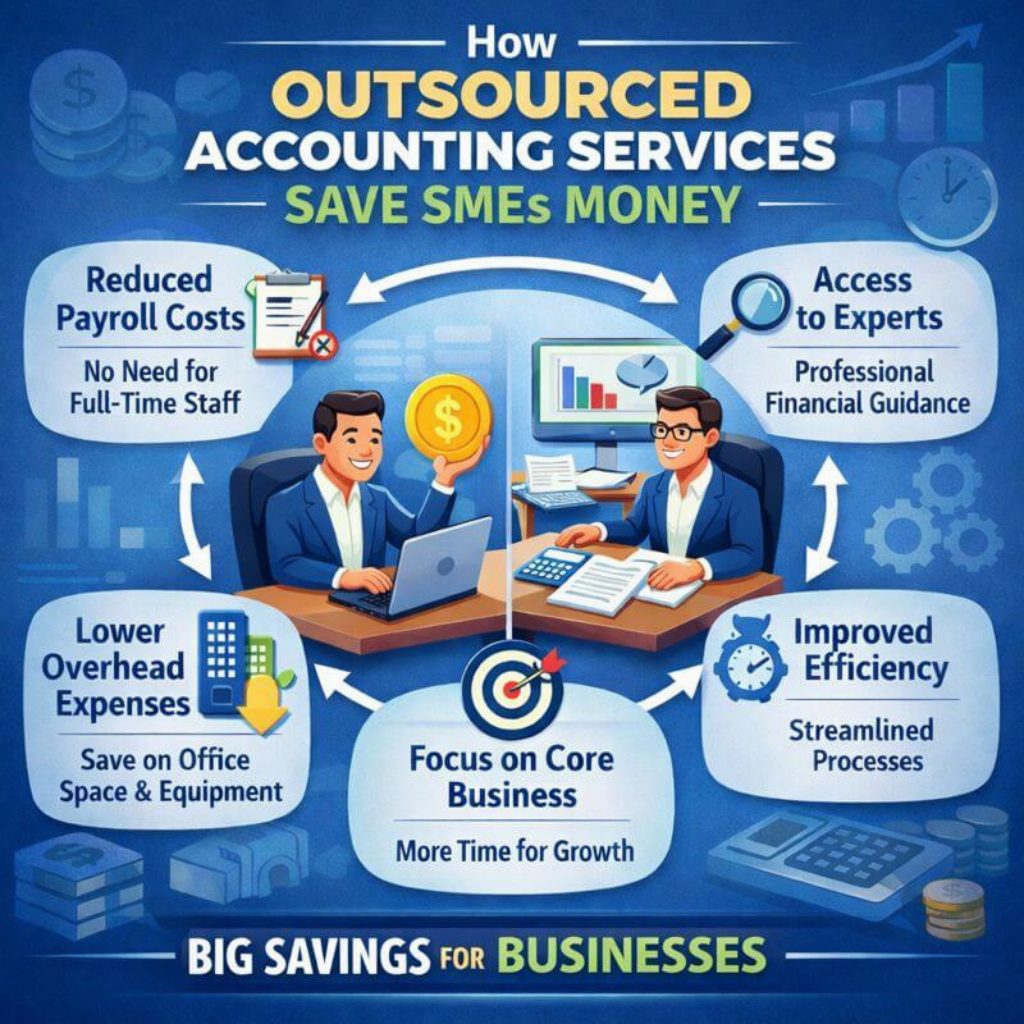
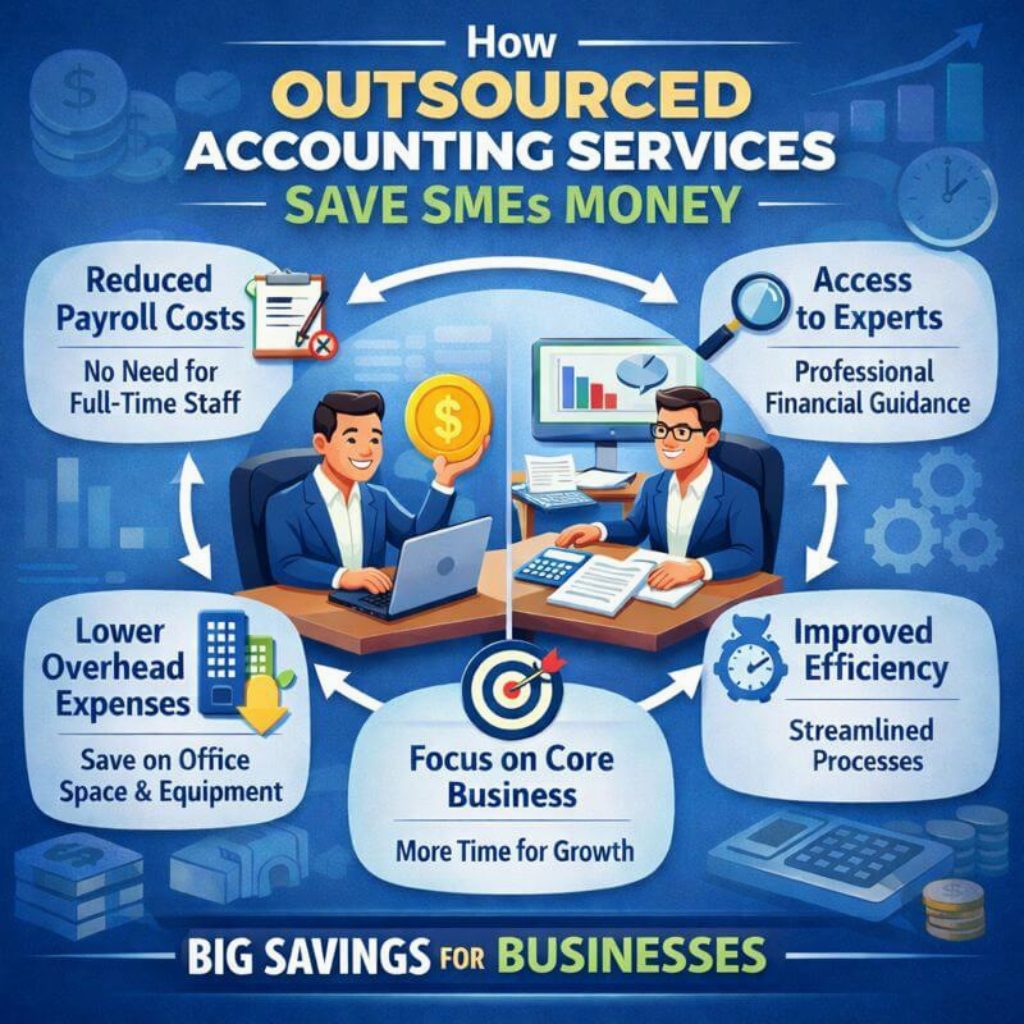
In-house accounting teams carry hidden costs many SME owners never fully add up. You’re paying for salaries, benefits, office space, equipment, and constant training.
Businesses save between 20 and 60 percent on finance operations by outsourcing. For an SME spending $4,000 a month on internal accounting, outsourcing could pull that to $1,600 to $3,200.
Think about these often-missed costs of in-house staff:
- Visa processing and work permit fees, which alone can run into the thousands per hire before anyone touches a ledger
- Health insurance and retirement benefits
- Recruitment and training
- Software licenses and system upkeep
- Office space and equipment
Finance outsourcing wipes out most of these overhead lines. You pay only for the accounting work you receive, with no hidden employment costs.
Pay Only for What You Need
Traditional hiring locks you into full-time commitments even when the work isn’t full-time. Your business might need heavy bookkeeping at month-end but barely any support in the quiet weeks.
A good provider flexes with you. Scale up in busy periods, scale back when things slow. This matters most for seasonal businesses and anyone growing fast.
Cloud accounting platforms let your team work with you in real time, wherever they sit. That alone cuts the need for expensive office space.
Avoid Expensive Accounting Mistakes
Accounting errors cost businesses millions a year in penalties, missed tax breaks, and compliance trouble. VAT and corporate tax rules demand a precision many in-house teams struggle to hold.
Professional outsourced bookkeeping providers run multi-level reviews. Every transaction gets checked before it’s recorded. That control cuts error rates by up to 30 percent against typical in-house work.
Preventing mistakes saves money in several ways:
- Dodging VAT penalties and interest
- Heading off audit complications and their costs
- Keeping cash flow projections accurate
- Spotting tax breaks you’d otherwise miss
Save Time With Tighter Processes
Time is money, and never more so than for an SME owner wearing five hats. A good provider frees your calendar for the work that brings in revenue: sales, marketing, business development.
Modern providers run automation that clears routine transactions faster than any manual method. Your records stay current, so your decisions rest on today’s numbers, not last month’s.

In-House vs Outsourced Accounting: What Costs Less?
The outsourced accounting vs in-house debate isn’t only about the monthly invoice. You need to weigh total cost of ownership, quality, and how well each option scales.
In-house accounting demands a big upfront outlay. You’re hiring staff, buying software, setting up systems, writing procedures. That makes sense for large companies and rarely for SMEs.
Outsourced accounting services spread those costs across many clients. You reach enterprise-grade tools and expertise for a fraction of what carrying them alone would cost. The economics favor outsourcing for most SMEs.
Quality matters too. In-house staff often lack deep knowledge in areas like international tax or industry-specific rules. Accounting BPO providers keep specialists across each of those areas.
Then there’s scaling. Growing an in-house team takes time and carries hiring risk. Outsourced providers scale up or down the moment your needs change.
The cost of outsourced accounting services usually runs $800 to $2,000 a month for a full SME package. Compare that to $3,200 to $6,700 a month for the same capability in-house.
What Services Can SMEs Outsource?
Knowing which functions you can hand off helps you get the savings and the efficiency. Modern providers cover nearly every financial job you have.
Bookkeeping and Daily Transactions
Daily transaction recording is the base of accurate books. Cloud based bookkeeping services handle invoice processing, expense tracking, and bank reconciliations with real efficiency.
Automated data entry cuts manual work by up to 80 percent. Transactions flow straight from bank feeds and digital receipts into the right accounts.
Accounts Payable and Receivable
Cash flow makes or breaks SME survival. Outsourced bookkeeping providers tighten both incoming and outgoing payments.
Receivable management covers invoice generation, payment tracking, and collections. Good providers often lift collection rates by 15 to 25 percent through steady follow-up.
Payable work covers vendor management, payment scheduling, and catching early-payment discounts. Those moves can trim operating costs by 3 to 5 percent a year.
Payroll Processing
Payroll means messy calculations for benefits, allowances, and shifting labor rules. Outsourced payroll clears all of that while cutting your cost.
Providers handle onboarding, monthly runs, and regulatory filings. You skip the specialized software and the training treadmill that comes with rule changes.
Tax Preparation and Filing
Tax compliance got a lot harder with VAT and corporate tax. Providers bring tax expertise most SMEs can’t justify hiring in-house.
Professional tax prep lowers audit risk and finds legitimate ways to trim your bill. The savings from proper planning often clear the outsourcing fee by a wide margin.
Financial Reporting and Analysis
Finance and corporate reporting separates the SMEs that grow from the ones that stall. Real reporting hands you the insight to make sharper calls and plan for scale.
Monthly statements, cash flow forecasts, and performance analytics let you read your business properly. That backs your strategy and your investor conversations if you’re raising money.
Virtual CFO Services
Growing SMEs need strategic financial guidance but can’t carry a full-time CFO salary. Virtual CFO services put senior-level thinking on a fractional basis.
A virtual CFO helps with budgeting, planning, investment calls, and growth strategy. That support earns its keep most during expansion or a market shift.
How to Choose the Right Outsourced Accounting Partner
Pick the wrong provider and the savings vanish. You need a partner who gets your business and can grow with you.
Key Factors: Expertise, Technology, and Security
Specific expertise sits at the top of the list. Your provider has to understand local regulations, VAT, and how business actually works in your market. Accounting BPO providers with local experience carry a real edge.
Technology decides service quality. Look for providers on modern cloud accounting platforms that connect to your existing systems. Real-time access to your numbers is no longer optional.
Data security has to meet international benchmarks. Your financial information needs encryption, secure data centers, and access controls. Check the provider’s certifications before you sign.
Questions to Ask Before Hiring
Due diligence saves you from costly mistakes. Ask these before you commit:
- What specific regional experience does your team have, and can you point to a client in my sector who has been with you for more than three years?
- Which cloud accounting platforms do you support?
- How do you handle data security and client confidentiality?
- What are your response times for urgent requests?
- Can you give references from similar businesses?
Confirm It Scales With You
Your accounting needs will shift as you grow. Choose providers who adapt their service without forcing you to switch partners.
A good provider absorbs higher transaction volumes, extra entities, and expanded reporting without drama. Flexible service levels and pricing keep pace with your changing needs.
Common Challenges With In-House Accounting for SMEs
Understanding the limits of in-house accounting makes the case for outsourcing clearer. These problems hit most SMEs running a traditional finance department.
High Staffing and Training Costs
Qualified accountants command premium salaries, especially those with local experience. The savings from outsourcing show up the moment you total real employment costs.
Training never stops as rules change and software updates. Development budgets, conferences, and certification upkeep all add to your bill.
Staff turnover piles on more cost and disruption. Finding replacements, training them, and moving knowledge across eats time you should spend on growth.
Limited Access to Modern Tools
Enterprise accounting software carries heavy licensing and setup costs. Most SMEs can’t justify the reporting tools that big firms use as standard.
Providers give you that premium software without the individual license fee. You get reporting and analysis power that would otherwise sit out of reach.
Juggling several in-house systems multiplies integration headaches. Good providers run one connected technology stack that works together cleanly.
Risk of Fraud and Errors
Internal accounting teams face higher fraud risk because small teams can’t separate duties well. Too much access sits with one person, and that’s a weak point.
Our outsourced accounting case study shows how outside oversight cuts fraud risk through systematic controls and independent checks.
Providers run multi-person approvals and automated controls that flag odd transactions. Those safeguards beat what most SME internal controls can manage.
How Much Do Outsourced Accounting Services Cost?
The cost of outsourced accounting services shifts with business complexity, transaction volume, and the service level you need. Knowing the pricing helps you budget right.
Basic bookkeeping usually runs $650 to $1,300 a month. That covers transaction recording, bank reconciliations, and basic statements. Most SMEs with straightforward operations land here.
Full accounting packages cost $1,300 to $2,650 a month. These add full-service bookkeeping, tax prep, management reporting, and advisory. Growing SMEs with complex needs usually want this level.
Specialized work like virtual CFO support or complex tax planning adds $530 to $1,300 a month. That layer earns back its cost through better business performance.
Set those against in-house pay: qualified accountants earn $2,100 to $4,000 a month plus benefits. Senior staff command $4,000 to $6,650. Total employment cost often runs 50 to 100 percent above the outsourcing fee.
Real Example: Cost Savings From Outsourcing Accounting
Theory means less than results. This real SME case shows the kind of savings strategic outsourcing delivers.
Before vs After: One SME’s Numbers
A trading company with $2.6 million in annual revenue ran an internal accounting team costing $5,850 a month. That covered two full-time staff, software licenses, and equipment.
The company kept hitting month-end delays, compliance worries, and thin financial insight. Management burned hours reviewing accounting work instead of running the business.
After switching to outsourced accounting services, monthly cost dropped to $2,520, and that included full bookkeeping, tax prep, and management reporting. The saving came to $3,330 a month.
Cost Breakdown: In-House vs Outsourced
In-House Costs (Monthly):
- Senior Accountant: $3,200
- Junior Accountant: $1,600
- Software licenses: $400
- Equipment and office allocation: $320
- Training and development: $210
- Recruitment and turnover: $120
- Total: $5,850
Outsourced Costs (Monthly):
- Full accounting services: $2,000
- Tax preparation and filing: $400
- Management reporting: $120
- Total: $2,520
Net Monthly Savings: $3,330
Annual Savings: $39,960
What They Learned
The change paid off past cost alone. Reporting went from quarterly to monthly. Compliance confidence rose through professional oversight and steady process.
The time management got back went into strategy, and revenue climbed 15 percent in the first year. Because the service scaled, that growth didn’t add admin load.
Quality improved too: faster month-end closes, cleaner statements, and tax planning done ahead of time, not in a panic. Those gains added value on top of the direct savings.
Start Saving With Professional Outsourced Accounting Services
SMEs can’t afford to wave off what outsourced accounting services offer. Lower cost, better quality, and flexible service build a strong case for making the switch.
Outsourcing can cut your accounting expenses by 20 to 60 percent while lifting service quality and compliance. You reach professional expertise, modern technology, and services that grow with you.
The best outsourced accounting firms deliver work that meets international standards. Regional know-how paired with global best practice gets growing SMEs the result they want.
Your next step is simple. Compare your current accounting cost against professional outsourcing. Total your real employment costs, factor in the quality gains, and weigh the value of freeing up management time. If you want to run those numbers as a return calculation, our guide on outsourced finance ROI walks through the full math.
Ready to change how your SME handles its books and start saving now? Prima Consulting provides outsourced accounting services built for SMEs. Our approach has helped hundreds of businesses cut costs while improving performance and compliance.
Free Consultation
Ready to discuss your specific situation?
Prima’s advisors work with organisations across the GCC, Europe, and Asia-Pacific. First conversation is always free, no pitch, just expertise.