TL;DR
Outsourced finance ROI for SMEs usually runs 15 to 30 percent in cost savings, and a well-run transition can hit a 300 percent first-year return. This analysis breaks down the real cost-benefit math, efficiency gains like a month-end close cut from 12 days to 4, and a manufacturing SME case study showing $45,000 net benefit in year one. You’ll learn how to measure the return on outsourcing your finance function, compare outsourced finance against in-house, and spot the five signs your business needs an outsourced CFO. The short answer: for most growing SMEs, it pays. The honest answer: it depends on your books, your stage, and the partner you pick.
Is Outsourced Finance Worth It? The ROI Numbers for SMEs
Most SMEs that move finance off their payroll cut 15 to 30 percent off the cost. One manufacturer we’ll get to below hit a 300 percent return in the first year. So the short answer is yes, outsourced finance ROI usually pays. But the honest answer is that it depends on your books, your stage, and the partner you pick.
Thirty-seven percent of SMEs already outsource accounting and finance work. That’s not a fad. These owners ran the math and the math held.
This piece skips the brochure language. You get the cost-benefit calculations, the efficiency gains, a real SME case study, and a side-by-side against keeping finance in-house. By the end you’ll know how to size your own outsourced finance ROI for your own situation.
Here’s the one question worth sitting with before you read on: how much of your week disappears into work that doesn’t grow the business?
What Actually Drives Outsourced Finance ROI for SMEs
The Cost Savings Show Up Fast
Cost is the first thing owners notice. Small businesses report 15 to 30 percent savings. And the real number is bigger than salary math suggests.
Think about everything an in-house finance team costs beyond paychecks. Benefits. Office space and equipment. Software licenses that renew every month. Training. The recruiter fee and the weeks of onboarding before anyone’s productive.
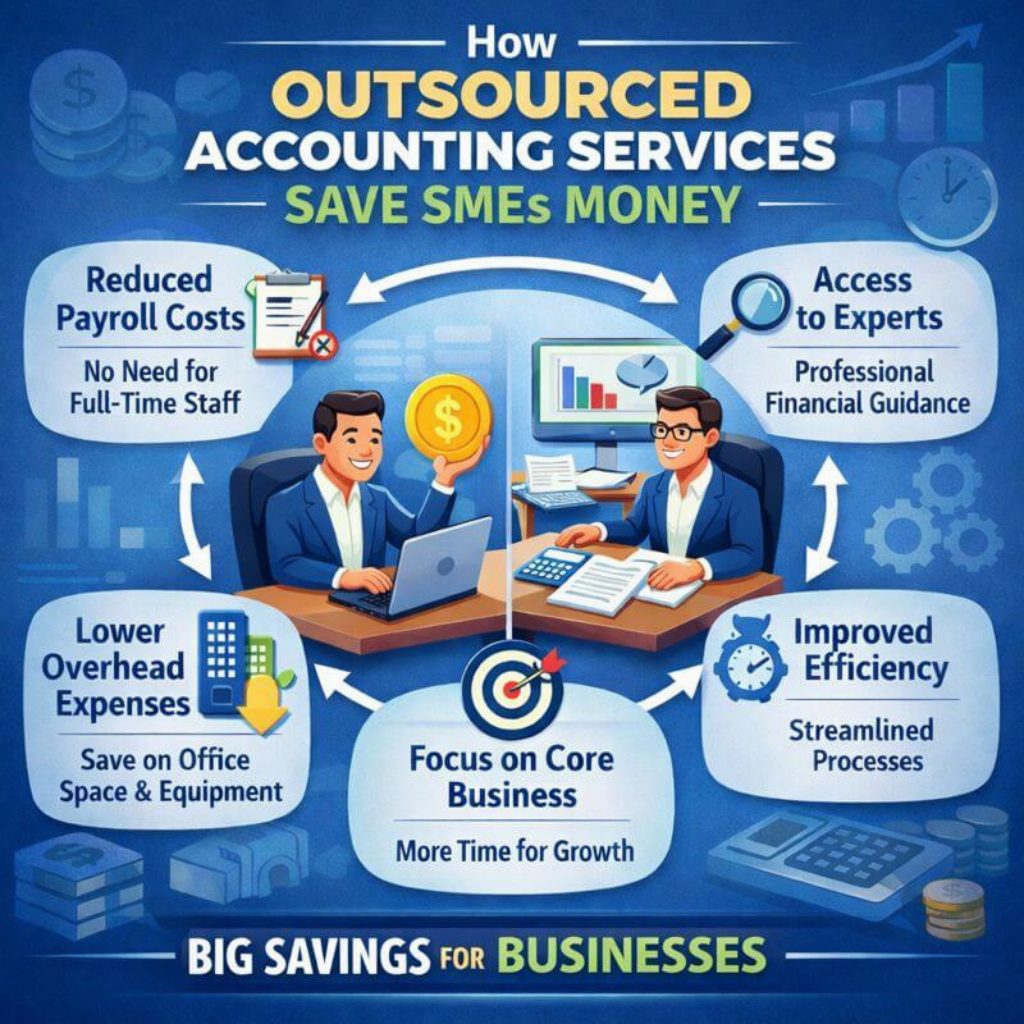
Take an SME spending $200,000 a year running finance internally. Strategic outsourcing pulls that to roughly $140,000 to $170,000. That’s $30,000 to $60,000 back in the business, straight to the bottom line. That gap is your outsourced finance ROI in its plainest form. If your question is narrower and it’s really about the bookkeeping bill, our guide on how outsourced accounting services save money runs those numbers in more detail.
Speed and Accuracy Improve Too
Outsourced teams run tighter systems because they run them all day, for many clients. That repetition sharpens the process and cuts mistakes.
The payoff shows up in the timeline. Processing time drops 40 to 60 percent, and error rates fall sharply against in-house work. Month-end close that used to drag 10 to 15 days lands in 3 to 5. Automated workflows kill the manual data entry that ate whole afternoons.
You Get Senior Expertise Without the Senior Salary
Demand for fractional and virtual CFOs jumped 103 percent in 2023 over 2022. SMEs worked out that high-level financial thinking doesn’t require a full-time hire.
An outsourced team puts certified accountants and analysts in your corner, people who’ve seen your sector’s problems before. They bring real financial modeling for growth planning, tax moves that trim your liability, and compliance knowledge that keeps penalties off your books.
Hire that bench internally and the cost climbs hard. That’s exactly why the cost-benefit of outsourced CFO services reads so well for most growing companies.
It Scales Both Ways
Forty percent of businesses outsource for flexibility. A finance function you can dial up or down beats one you can’t.
Scale up in a growth sprint. Scale back when things slow, without layoffs. Add a specialist service for one quarter and drop it the next. In-house teams just can’t flex like that.
So for owners asking why outsource the finance department at all, flexibility is often the deciding line in the ROI analysis.
And You Get Your Attention Back
When you’re not signing off on reconciliations, you’re working on the things that actually make money. The benefits run past cost into focus, and focus compounds.
More room for strategy means you spot opportunities before rivals do. Sharper cash flow management frees up working capital, the same discipline behind solid financial forecasts and projections. Faster calls let you move on a deal while it’s still open. For a fast-moving market, that recovered attention is the quiet payoff nobody puts on the invoice.
Explore our finance and advisory services
Where the Return Really Comes From
You Rent the Technology Instead of Buying It
Providers pour money into technology that an individual SME can’t justify buying alone. You get cloud accounting with access to your numbers from anywhere. Live dashboards instead of week-old reports. Automated reconciliation that handles the grind. Real-time analytics that flag a trend before it turns into a problem, plus integrations that keep data moving between your systems.
Those tools cut manual work and lift accuracy, and both feed directly into your outsourced finance ROI.
The Compliance Risk Drops
A compliance slip costs money and bruises your reputation for years. Average penalties for compliance failures run to $14.82 million. For most SMEs, one of those is fatal.
Providers cut that risk with tight processes and expert eyes. They track regulatory changes so you’re current. They keep documentation and audit trails ready for any review. Backup and recovery systems hold the line on continuity, and professional liability cover sits underneath the whole arrangement.
Security and Analytics Get Better
Good providers run enterprise-grade security most SMEs can’t afford on their own. Multi-factor login locks out the wrong people. Encrypted transfers protect data in motion. Regular audits surface weak spots early, and standards compliance shows clients you take their data seriously. The same setup turns raw numbers into analytics you can actually act on.
How to Measure the ROI of Outsourced Finance
The Numbers That Count
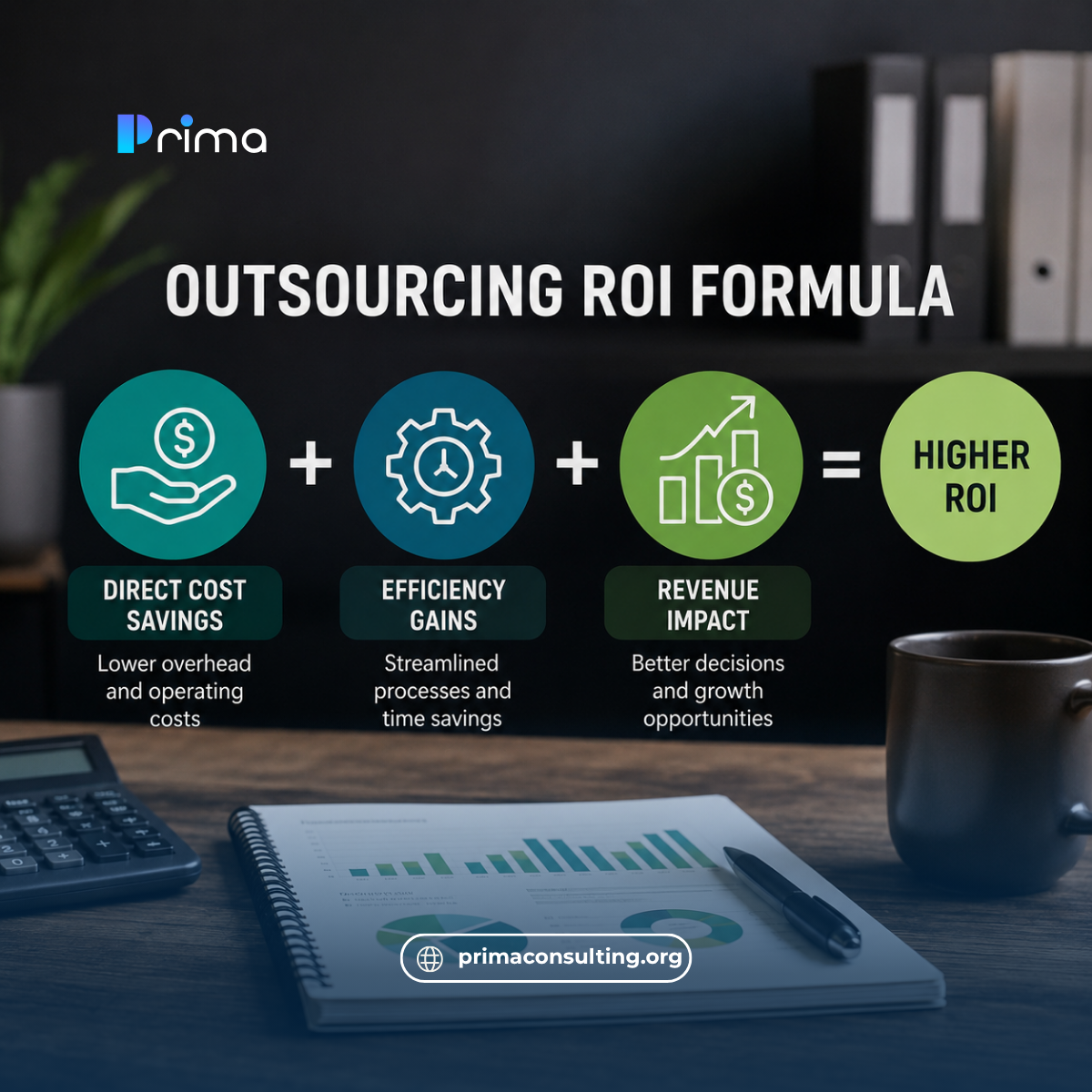
A real ROI analysis tracks specific figures, not vibes. Three buckets matter.
Direct cost first. Monthly service fee against your fully loaded internal cost. Then the overhead you stop paying: office space, equipment, admin support. Technology you no longer license. Training you no longer fund.
Then revenue impact, which is where the strategic value hides. Hours of leadership time redirected to growth. Faster decisions on live opportunities. Tighter cash flow and working capital, the kind of gain you also see from structured financial forecasting. Planning accurate enough that surprises stop showing up at quarter-end.
The Soft Factors Still Matter
Some returns don’t sit neatly in a spreadsheet. Clearer visibility into what’s driving performance. More confidence from investors and partners reading clean statements. Stronger strategic planning. And, frankly, fewer Sunday nights spent worrying about whether the numbers are right. That last one is hard to price and easy to underrate.
The Value Keeps Compounding
The return on outsourcing your finance function outlives the first year’s savings. Your finance function grows with you instead of capping out. You get tools normally reserved for bigger firms. Clean books lift your valuation and make you readier for investment or a sale. Buyers pay more for a company whose finances they can trust on day one.
Outsourced Finance Case Study: One SME’s Real Numbers
A manufacturing SME doing $5 million in annual revenue was burning $180,000 a year on internal finance before something had to change. After moving the work to a finance transformation case study partner, the first year beat every projection.
Finance cost dropped to $120,000. That’s a 33 percent cut landing straight on the bottom line. Reporting accuracy improved 78 percent, which ended the cycle of catching and fixing financial modeling mistakes. Month-end close fell from 12 days to 4. And the CEO got back 15 hours a week, time that went into work that actually grew revenue.
Run the ROI. Annual savings of $60,000. Implementation cost of $15,000, recovered fast. Net first-year benefit of $45,000. That’s a 300 percent return, and it made the call obvious in hindsight.
One case won’t predict your numbers exactly. But it shows what the return looks like when the partner fit is right and the transition is run properly.
Outsourced Finance vs In-House: The Full Comparison
| Factor | In-House Finance | Outsourced Finance |
|---|---|---|
| Annual Cost | $180,000 to $300,000 | $60,000 to $150,000 |
| Expertise Level | Limited by team size | Access to specialized team |
| Scalability | Requires hiring or firing | Instant scaling |
| Technology Access | Limited by budget | Enterprise-grade tools |
| Compliance Risk | Higher under resource constraints | Lower with specialist knowledge |
| Focus on Core Business | Cut down by admin tasks | Noticeably increased |
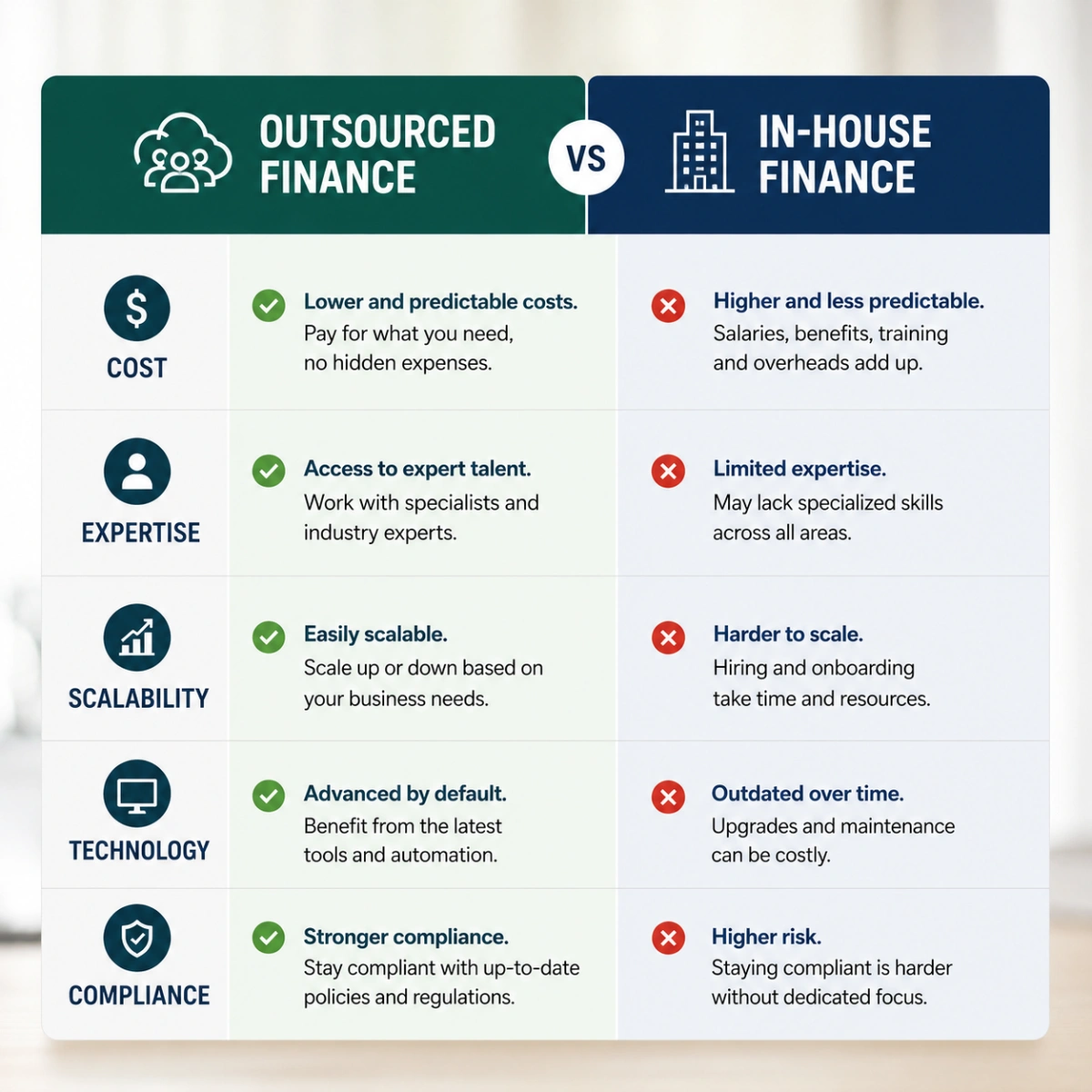
Weigh the in-house CFO vs outsourced question and the gap shows up on every row that matters. The same build-or-hire logic plays out in outsourced actuarial work too.
Who Prima works with
SMEs and larger firms, across industries and geographies
🏢
Corporates & SMEs
Fractional CFO, FP&A, financial statements, internal controls
🏦
Banks & Financial Institutions
IFRS 9 ECL models, credit risk, regulatory reporting
📈
Investment & Asset Managers
IFRS 9 classification, fair value, derivative valuations
🏛️
Family Offices & Holding Groups
Governance frameworks, board advisory, portfolio review
What to Check Before You Outsource
Run the Cost-Benefit Analysis First
Don’t sign anything until you’ve done the math on your own situation. Start with where you stand today.
Add up your true internal finance cost: salaries plus the overhead nobody counts. Track the hours leadership loses to financial admin, because that’s an opportunity cost with a real dollar value. Flag your error rates and any compliance gaps. Total the technology and infrastructure you’re paying for, some of which a provider makes redundant.
Then price the other side. Monthly service fees. One-off implementation and transition costs. Any integration tools. The onboarding effort to get your team across.
Now weigh the benefits against both. Direct savings give immediate relief. Efficiency gains build over time, much like the payoff from disciplined budgeting and forecasting. Risk reduction protects you from the expensive failures. And the strategic value opens doors that pure cost-cutting never does.
Pick the Partner Carefully
Your outsourced finance ROI lives or dies on this choice. Get the fit wrong and the savings evaporate.
Match technical capability to where you are and where you’re going. Industry experience means they get your specific headaches, the kind that show up in financial modeling for CFOs. Platform compatibility keeps integration clean. Service that scales means you won’t outgrow them in two years.
Then the human side. Cultural fit cuts daily friction. Communication style decides how smoothly you collaborate. Geography and time zones shape how fast they answer when something’s urgent.
And check that the provider itself is stable. Their financial health signals whether they’ll still be around. Client retention tells you if people stay. Certifications and insurance back up the rest.
Set Up Control and Communication
Build clear protocols so you keep visibility without doing the work yourself. Fixed reporting schedules. KPIs that track real progress. An escalation path so problems get solved, not buried. Regular reviews that feed improvement back into the relationship.
Plan the Transition
A clean handover protects you from disruption. Set a timeline with milestones that create accountability. Tell your staff early and manage the concerns honestly. Lock down data migration so nothing gets corrupted, and keep a contingency plan for the things that always go sideways.
Lock Down Data and Privacy
Protect your financial data the whole way through. Encryption standards block unauthorized access. Access controls limit who sees what. Compliance certifications prove the provider means it, and audit trails keep everyone accountable.
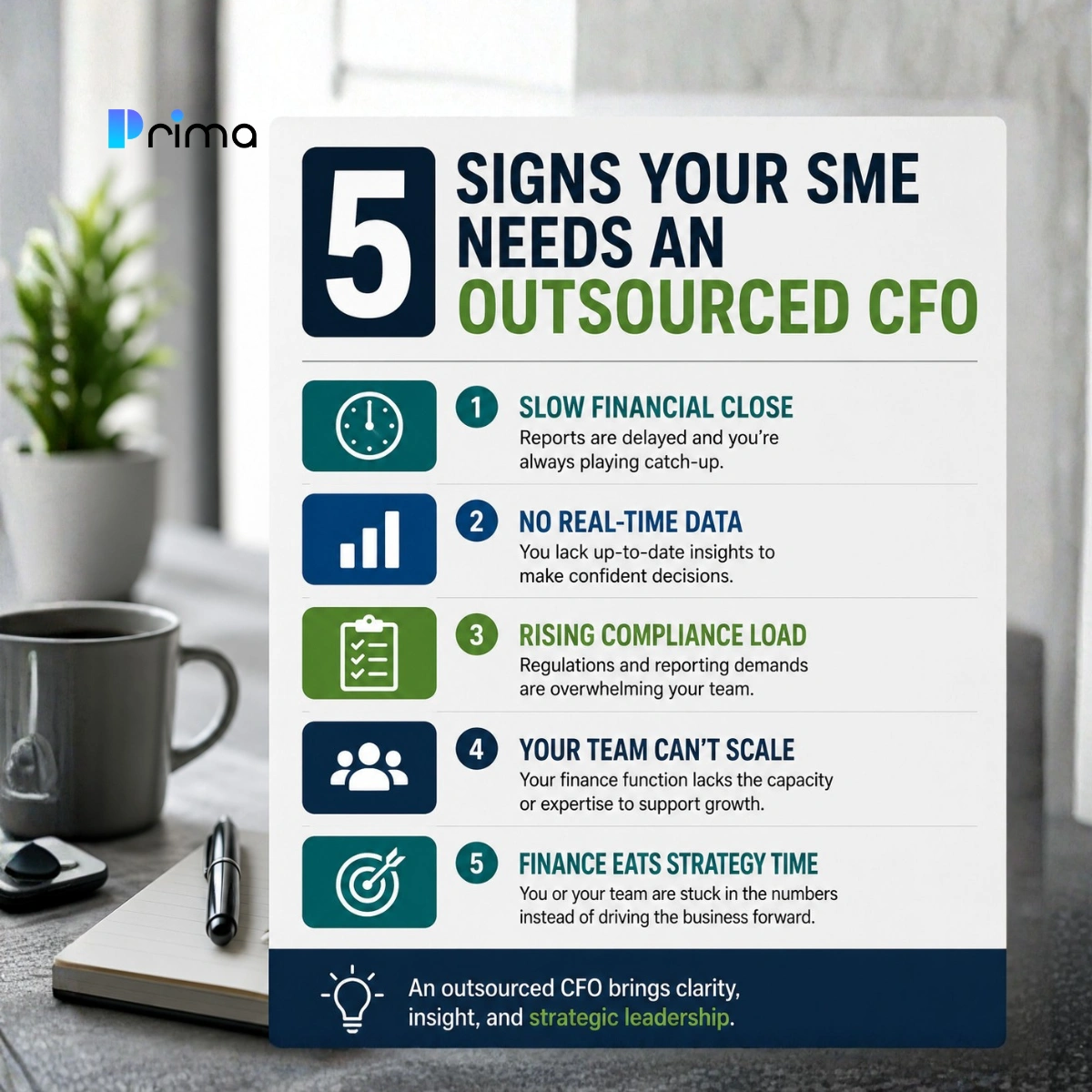
Five Signs Your Business Needs an Outsourced CFO
Knowing when to make the move shapes your ROI analysis as much as the math does. Watch for these.
Your month-end close runs past 10 days, so you’re always deciding on stale numbers. You’re flying without real-time data, and the delay costs you opportunities. Compliance keeps getting more complex than your team can handle. Hiring and training can’t keep pace with growth, the same build-or-buy call firms face elsewhere. And you’re spending more hours on finance than on strategy, which is backwards for an owner.
When those signs pile up, the cost-benefit of outsourced CFO services gets hard to argue with, especially for firms weighing CFO expansion plans.
How to Get the Most From Outsourced Finance
Set Clear Goals and KPIs
Pin down specific, measurable targets so accountability has something to hang on. Cost reduction numbers. Efficiency metrics. Quality standards. Compliance requirements that keep penalties off the table. Vague goals get vague results.
Keep the Communication Tight
Steady contact keeps your needs and their delivery in sync. Weekly status updates. Monthly performance reviews that surface what to fix. Quarterly planning sessions on direction. Annual contract reviews to confirm you’re still getting value.
Review Performance Honestly
Hold the work against agreed metrics. Service level agreements set expectations. Quality standards hold the line. Cost targets keep spend in check, and timelines keep delivery reliable. Track where the market’s moving and adjust, so the benefits don’t erode while you’re not looking.
Maximizing Your Outsourced Finance ROI
A virtual CFO runs $5,000 to $12,000 a month. A full-time in-house CFO runs around $441,000 a year all-in. Put those side by side and the cost case for outsourcing speaks for itself.
Eighty-three percent of small businesses hold or grow their outsourced-services spend, with cost and expertise running neck and neck as the reasons. People don’t keep paying for something that doesn’t work.
For SMEs chasing growth, outsourced finance isn’t only about spending less. It’s about reaching capability that a full-time hire would put out of budget. Lower cost, faster operations, senior thinking on tap. That mix is the case.
The real question was never whether to outsource. It’s how to do it so the return actually shows up. With global accounting-outsource spend up 39 to 41 percent since 2019, the market’s already voting with its budget.
Your next move is simple. Run the numbers on your own books, your own hours, your own stage. The data says it probably works for SMEs like yours. But your situation is yours, so prove it on your own figures before you commit.
FAQs: Outsourced Finance ROI

Free Consultation
Want to know your outsourced finance ROI?
Prima’s advisors will run the numbers on your books and show you the real return before you commit. First conversation is free, no pitch, just the math.
Ready to see what outsourced finance does for your SME’s numbers? Prima Consulting helps businesses run the transition and pin down their return through finance outsourcing built around your situation.