TL;DR
This outsourced accounting case study shows how real businesses cut finance costs while improving accuracy and reporting speed. You’ll see results from UAE manufacturing firms, German e-commerce companies, and software corporations that pulled month-end closing from 15 days down to 5. The guide covers what the transformations had in common, cloud accounting automation, and the steps these companies followed. Read on for the exact playbook behind each turnaround, and what it takes to run one across multiple markets.
Picture the scene. Your finance team works overtime every month-end, errors pile up, and compliance deadlines never stop coming. Sound familiar?
You’re not alone. Businesses across UAE, Germany, Pakistan, and the wider Middle East hit these same walls every month. The fix isn’t hiring more people or working later.
It’s smarter financial management, and the proof sits in the numbers below.
The market has already made its call. The global finance and accounting outsourcing market is projected to reach $81 billion by 2030, growing over 8 percent a year. And global spend on accountancy outsourcing rose 40 percent between 2019 and 2024. That’s a lot of finance chiefs voting the same way.
Let’s get into the real transformations.
What Outsourced Accounting Actually Means for a Growing Business
Outsourced accounting means handing your financial processes to an outside specialist team. That covers bookkeeping, payroll, reporting, tax prep, and compliance.
Think of it as a full finance department without the payroll bill. Your partner runs the day-to-day transactions and feeds back the insight that helps you grow.
The model works differently from traditional hiring. Instead of recruiting one person at a time, you plug into a whole team of certified professionals. They stay current on regulations, technology, and practice, so you don’t have to chase it.
Modern services run on cloud systems with real-time reporting and automation that cuts errors. You keep full control and gain the expertise and tooling.
This fits SMEs and fast-growing firms especially well, along with companies moving into new markets like UAE or Saudi Arabia. Bigger enterprises find value too. The size of the win just changes.
The Benefits That Show Up in Every Turnaround
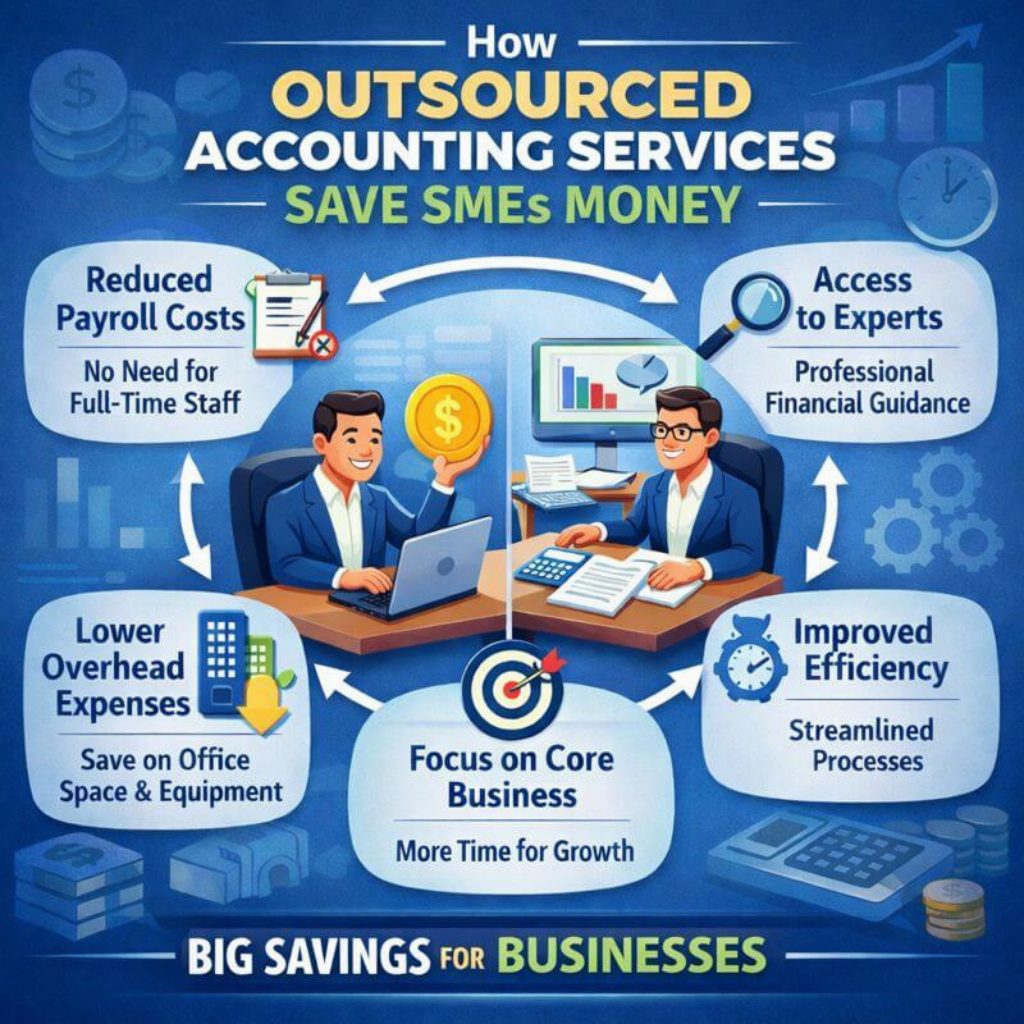
Cost reduction leads the list. Businesses typically save 40 to 60 percent against an in-house team. Those savings come from lower salaries, fewer benefits, less training, and no technology bill. For the full breakdown of where the money goes, see how outsourced accounting services save money line by line.
Expertise is the next big gain. Your partner brings years across many industries and jurisdictions. That matters most when you expand into a market with its own rules, like EOSB in Saudi Arabia or IAS 19 pension valuations in Pakistan.
Scaling gets easy through professional Prima Consulting Managed Services. In a busy season or a growth spurt, your team adjusts resources fast. No long hiring cycle, no training lag.
Technology upgrades happen without you spending capital. Good providers pour money into software, AI tools, and automation. You get the benefit without the upfront cost or the upkeep.

Risk drops through professional oversight and steady quality control. Experienced teams run tight procedures, keep clean audit trails, and stay on top of changing rules. That cuts costly errors and penalties.
Time frees up too. Instead of processing the same transactions over and over, your staff can read trends, plan growth, and build client relationships.
How These Turnarounds Sharpen Accuracy and Transparency
Real-time reporting changes how you decide. Modern platforms show live dashboards with cash flow, profitability, and your key metrics. You see where you stand at any hour of the day.
Standardized process cuts human error. Professional firms follow documented procedures, run automated checks, and layer in review steps. That kills the inconsistency you get from one bookkeeper working alone.
Analytics surface things buried in your data. Your team can read spending patterns, forecast cash needs, and flag where you’re overspending. Most of that stays hidden in traditional setups.
Compliance turns proactive instead of reactive. Rather than scrambling at audit season, your partner monitors compliance all year and rolls in changes as they land.
Documentation quality jumps through proper record-keeping. Firms keep detailed records, clean audit trails, and organized filing. That pays off fast during any audit or due diligence.
Integration keeps data moving cleanly across your business. Modern platforms connect to your ERP and CRM, which ends duplicate entry and keeps everything consistent.
How to Roll Out Outsourced Accounting Without the Disruption
Start with an honest look at your current processes and pain points. Write down how work flows today, name the specific bottlenecks, and set baseline metrics. That foundation guides the move and lets you measure the result.
Set clear objectives before you pick a partner. Whether you want lower cost, better accuracy, or faster reporting, specific goals let you judge whether it worked.
Research partners hard before you commit. Look for real experience in your industry, your target markets, and your compliance needs. Ask for case studies and check references before you sign.
Plan the transition in phases. The turnarounds that go smoothly usually start with basic bookkeeping, then add payroll and detailed reporting once the base is solid.
Set communication protocols early. Regular check-ins, fixed reporting schedules, and a clear escalation path stop misunderstandings before they start.
Track performance against your metrics and adjust. Watch processing speed, accuracy, and satisfaction. Regular reviews keep your partner honest over time.
Getting Your Internal Team Ready
Change management makes or breaks the transition. Tell your staff early and be straight about how it affects them. Show them outsourcing frees them from routine processing to do higher-value work.
Decide what stays in-house and what moves out. Usually strategy, analysis, and client relationships stay internal while routine processing goes to the partner.
Train your team on the new systems. They need to know how to work with the partner and pull reports from the new tools.
Service Level Agreements That Hold People Accountable
SLAs set expectations for everyone. Spell out processing times, accuracy standards, reporting requirements, and communication rules.
Build in penalties and fixes for missed marks. Clear consequences for late or sloppy work keep standards high.
Review the SLA regularly. Update it every year or whenever your operations change.
Risk and Compliance in the Partnership
Data security needs real attention when you share financial information. Check that your partner holds the right certifications, uses strong encryption, and enforces strict access controls.
Backup and recovery plans guard against outages and data loss. Your partner should run redundant systems and test recovery procedures.
Compliance stays a shared job. Your partner handles the daily tasks, but you remain accountable for the regulatory outcome.
Fitting It Into Your Existing Systems
API connections move data between your systems and the partner’s platform. That ends manual entry and cuts errors sharply.
Real-time sync keeps every system current. A change in one place updates everywhere at once.
Some customization may be needed to match your workflows. Work with both your ERP vendor and your partner to design the integration.
Common Challenges and How to Beat Them
Communication gaps cause most of the friction. Different time zones, languages, and expectations complicate the work.
Fix: set clear communication rules from day one, book regular meetings, and document your escalation path. Providers with a local presence in your market help with cultural fit.
Data security worries plenty of owners. Handing sensitive numbers to an outside party feels risky without the right guardrails.
Fix: vet the partner’s security credentials hard, review certifications, and check their track record. Add extra encryption and access controls where you need them.
Building Trust in the Partnership
Regular contact builds a partnership that lasts. Weekly status calls, monthly reviews, and quarterly planning sessions keep everyone aligned.
Transparency runs both ways. Share your goals openly, talk through problems honestly, and expect the same back.
Cultural fit beats geographic closeness. Pick a partner who gets your business style, wherever they sit.
Doing the Due Diligence on Data Privacy
Real due diligence protects you before you commit. Read the privacy policies, examine the security certifications, and understand the breach response before you sign anything.
Contracts and NDAs add another layer. Spell out data handling, retention, and destruction in writing.
Security audits keep it honest over time. Schedule periodic reviews and update requirements as rules change.
The Technology Behind the Results
Cloud accounting platforms are the foundation now. They give real-time access, automatic backup, and scalable processing with no big infrastructure spend.
AI clears routine tasks like invoice processing, expense categorization, and reconciliations. One survey found 71 percent of accounting professionals expect AI to reshape the profession. These tools process transactions faster and more accurately than manual work.

Automated reporting generates statements, management reports, and filings on schedule. That ends reporting delays and keeps every period consistent.
Integration connects the accounting system to your other tools. APIs move data across platforms without manual work.
Mobile access lets you check performance from anywhere. Modern platforms run fully on phone and tablet.
Cloud and AI in Modern Finance
Cloud accounting cuts infrastructure cost while giving you enterprise-grade features. You get advanced tools without running your own servers or buying licenses.
AI automation cuts processing time across the board. Outsourced bookkeeping gets faster and more accurate as manual errors fall away.
Machine learning spots patterns and oddities a human reviewer might miss. That sharpens fraud detection and expense oversight.
Natural language processing reads invoices automatically, which slashes data entry. The tech pulls key details from documents without a person keying them in.
Security and Compliance Through Better Technology
Multi-layer security guards your financial data. Leading providers run encryption, firewalls, intrusion detection, and regular audits.
Compliance automation keeps you current without manual tracking. Systems update tax rates, adjust formats, and change filing rules as jurisdictions move.
Audit trails hold a complete transaction history. Every change, approval, and access gets logged with a timestamp and a user.
Backups and disaster recovery guard against data loss. Leading providers keep multiple copies in separate locations.
Picking the Right Partner
Industry experience beats company size. Look for a provider who understands your sector’s specific rules and habits.
Geographic knowledge matters for international moves. A partner who knows local rules in UAE, Germany, Pakistan, or Saudi Arabia gives you a real edge.
Technology decides service quality. Check the software, automation, and integration each partner runs before you choose.
Scaling keeps the relationship working as you grow. Pick a partner with the resources to handle rising volume and wider scope.
References tell you the truth beyond the sales deck. Call existing clients and ask about their real experience.
Judging Expertise and Experience
Certifications signal competence. Look for staff holding CPA, ACCA, or the local equivalent.
Case studies show proven results across different situations. Ask to see businesses like yours that got where they wanted to go.
Regulatory knowledge counts in complex markets. Make sure your partner tracks things like VAT in UAE or corporate tax changes in Saudi Arabia.
Cost Models and Pricing
Fixed pricing gives you budget certainty but may not flex with growth or seasonality. Check whether it fits your business rhythm.
Variable pricing based on volume or service level gives flexibility but needs watching to keep cost in line.
Hybrid models mix a fixed base with variable parts, often the best balance for a growing business.
Value-based pricing ties the fee to outcomes rather than hours. That lines up the partner’s incentives with yours.
Communication and Collaboration
Response-time commitments set clear expectations. Look for guaranteed times on routine questions and urgent issues.
Reporting schedules should match how you make decisions. Daily, weekly, or monthly, your partner should fit your cadence.
Collaboration tools lift efficiency. Client portals, live dashboards, and mobile access all help.
Regular reviews keep both sides aligned. Book periodic calls to talk performance and plan improvements.
Real Success Stories Across Industries
Let’s look at specific turnarounds across different industries and markets.
Manufacturing, E-commerce, and Software
Manufacturing Company in UAE
A mid-sized manufacturer in Dubai was stuck with a 15-day month-end close. Manual reconciliations, spreadsheet reporting, and thin resources kept delaying statements and frustrating management.
After bringing in outside support through Finance and corporate services, the numbers moved fast. Month-end close fell from 15 days to 5, a 67 percent cut. Accounting costs dropped 30 percent while quality held. Real-time inventory valuation and cost tracking came online through integrated systems. Automated VAT filing killed the manual errors and the deadline stress. And sharper cash flow forecasting freed up working capital.
The change sped up decisions across the company and let internal staff focus on production and customers instead of reconciliations.
E-commerce Business in Germany
A fast-growing e-commerce company was drowning in multi-currency transactions, marketplace accounting, and VAT across European markets. Its internal systems couldn’t keep up with the volume.
Bringing in a partner changed that. Automated multi-currency processing ended manual conversion errors. Real-time profitability by product line drove better merchandising calls. Cleaner reconciliations for Amazon, eBay, and other platforms saved hours every week. Compliant VAT handling across the EU cut audit risk. Reporting sped up 40 percent, which quickened every decision. And accurate reporting gave investors the confidence to back the next round.
The company scaled from 2 million to 10 million euros in revenue while keeping tight financial control.
Software Corporation Across Markets
A global software company needed consistent finance processes across offices in Pakistan, UAE, and Germany. Different systems, currencies, and rules had turned reporting into a nightmare.
The solution delivered across all three. A standard chart of accounts brought consistency across geographies. Consolidated multi-entity reporting gave headquarters full visibility. Local compliance in each market cut regulatory risk. Real-time dashboards let management act early. Audit prep time dropped 60 percent. And the company saved $200,000 a year in internal resources.
Headquarters gained a clear view of global operations while local teams focused on business development. Where local autonomy made sense, it stayed, so the business kept its market responsiveness.
Seeing how outsourcing reshapes operations gets clearer through these examples. Each company redirected internal resources toward revenue work while improving the quality of its financial management.
Real Estate Firm Managing a Portfolio
A property developer managing assets across several markets needed sophisticated accounting for complex transactions, joint ventures, and compliance.
The results held up across every metric. Annual savings of 1.8 million pounds against an in-house expansion plan. Scalable infrastructure for a growing property portfolio. Automated tenant billing and collections that improved cash flow and cut arrears. Real-time profitability by property for sharper investment calls. Cleaner partnership and investor reporting. And stronger due diligence that sped up acquisitions.
The firm accelerated its expansion while keeping tight control and transparency throughout.
These stories share a pattern. Cost reduction, better accuracy, faster reporting, and sharper strategic focus turn up across every industry and market.
Measuring the Impact: Cost, Efficiency, and Scale
Hard numbers prove this out, not anecdotes. Track specific metrics before and after so you can measure the win.
Cost reduction depends on where you start and what you buy. The finance and accounting BPO market hit $60 billion in 2023 and is expected to reach $111 billion by 2030, growing 9.3 percent a year. That reflects wide adoption and proven value.
Efficiency shows up in speed, error rates, and reporting timeliness. By 2023, 40 percent of finance organizations globally had consolidated outsourcing with a single provider, up from 24 percent in 2019. That signals real confidence.
Scale shows during growth or seasonal swings. Your partner adjusts resources without the delay of hiring and training.
Quality metrics like accuracy, compliance scores, and audit findings usually improve after the switch. Professional teams run better controls than a stretched internal team can.
Return calculations should count both direct savings and indirect gains like faster decisions, lower risk, and sharper focus. Many companies find the total value clears the initial cost target. If you want to run that as a formal return calculation, our guide on outsourced finance ROI shows the exact method.
Time-to-market improves as financial processes speed up. Companies report faster product launches and quicker expansion calls when the finance function keeps pace.

Pairing internal audit and outsourcing services builds complete financial oversight. Your partner runs routine processing while internal audit focuses on risk assessment and control testing.
Risk and controls improve through professional oversight and documented procedure. Providers usually run tighter control environments than a small internal team can.
Where This Is Heading
AI will keep reshaping outsourced accounting. Today it handles invoice processing, expense categorization, and anomaly detection. Next comes predictive analytics, decision support, and natural language reporting.
Real-time insight will become standard, not a premium add-on. Businesses will expect instant access to cash flow, profitability, and KPIs through mobile dashboards and automated alerts.
Why Real-Time Insight Keeps Growing
Instant access to your numbers speeds decisions in a competitive market. Real-time reporting flags problems before they turn critical and catches opportunities early.
Predictive analytics will forecast cash needs, spot seasonal trends, and read customer payment patterns. That turns accounting from a rear-view report into forward planning.
Interactive dashboards will replace static reports. Managers will drill into metrics, compare periods, and read trends from any device.
Automated alerts will flag big changes, looming deadlines, or odd transactions. That heads off problems and keeps responses timely.
More Automation, More Digital Tools
Robotic process automation will take on more routine work like reconciliations, invoice matching, and filings. That cuts cost further while lifting accuracy and speed.
Blockchain may reshape transaction verification and audit trails. Immutable records could simplify compliance and cut fraud risk.
Machine learning will keep tuning processes without human input, learning from patterns and improving workflows on its own.
Integration will reach more business apps. Full data connectivity ends information silos and builds real business intelligence on one platform.
The future points to closer partnerships between businesses and their providers. Rather than a transactional handoff, these relationships will center on growth, risk management, and competitive edge.
Providers will keep expanding into emerging markets with local presence. That helps businesses going international build the finance infrastructure they need.
Run Your Own Finance Turnaround
The evidence stacks up across industries and markets. Businesses in UAE, Germany, Pakistan, and beyond are reworking their finance operations through outside partnerships. Lower cost, better accuracy, faster reporting, and sharper focus build an edge internal teams struggle to match.
It comes down to picking the right partner and rolling out the change with a plan. You need clear objectives at the start, careful planning through the move, and ongoing performance management. Companies that treat this as strategy beat the ones that wing it.
Your turnaround can start today with the right planning and the right partner. Whether you’re fighting month-end delays, compliance stress, or thin resources, outsourced accounting gives you a proven path that scales as you grow.
The stories above show one thing clearly. The question isn’t whether outsourcing works. It’s whether you’re ready to put it to work in your business.
Ready to rework your finance function and join the companies already ahead? Contact Prima Consulting today to see how our team can tighten your financial processes, cut cost, and give you the insight to grow in your market.
Explore our advisory services