TL;DR
Choosing the right ESG consulting firm in the Gulf decides whether your compliance holds up. This guide covers how to pick ESG consulting firms in the UAE and KSA: the criteria that matter, framework choices (GRI, SASB, TCFD, ISSB, IFRS S1/S2), what services cost, red flags to avoid, and the difference between an ESG audit and ESG consulting. You also get a step-by-step implementation roadmap and how ESG ties into IAS 19 and post-IFRS 17 reporting. Read it before you sign anything.
How to Choose ESG Consulting Firms in the Middle East
ESG Consulting Firms Guide for Middle East (2026)
Regulatory pressure is rising. Investors are getting selective. And boards across the Gulf are waking up to a straightforward reality: ESG isn’t optional anymore.
The MEA ESG investing market reached USD 2,212.2 million in 2024 and is projected to grow at an 18.1% CAGR through 2030. That trajectory tells you everything you need to know about where capital is flowing.
But here’s the thing: picking the wrong ESG consulting firms can cost you more than the engagement itself. You risk misaligned frameworks, generic reporting, and compliance blind spots that expose your business to regulatory or reputational risk.
This guide cuts through the noise. You’ll get a clear, practical breakdown of how to choose the right ESG consulting firms in the UAE, Saudi Arabia, and across the broader GCC, what questions to ask, what red flags to spot, and what it all costs.
What Is ESG and Why It Matters in Middle East
ESG stands for Environmental, Social, and Governance. It’s not just a reporting exercise. It’s the framework through which your stakeholders, regulators, and investors measure whether your business is built to last.
The three pillars break down like this:
- Environmental: Carbon emissions, energy use, waste management, water consumption
- Social: Labor practices, community engagement, diversity, supply chain ethics
- Governance: Board composition, executive accountability, anti-corruption policies, transparency
Four out of five large Middle Eastern companies now report formal sustainability strategies, up from 64% in 2023, according to Mordor Intelligence. That shift reflects a region that’s moved from early adoption to institutional expectation.
GCC sustainable-finance assets are projected to post 31.1% annualized growth through 2032. At the same time, 80% of institutional investors now prefer companies that actively disclose ESG metrics.
If you’re running a business in this region and haven’t mapped your ESG position yet, you’re already behind. That’s why selecting the right ESG consulting partner matters so much right now.
What ESG Consulting Actually Involves
ESG consulting is professional advisory work that helps a company assess, plan, and improve its performance across environmental, social, and governance areas. It’s not report-writing. It’s building a strategy that survives investor, regulator, and stakeholder scrutiny.
Here’s how it runs in practice. The firm reviews your current state first: what you measure, what you miss, and where you sit against industry benchmarks. From there they build a roadmap. Set goals, pick the right frameworks, collect clean data, report it so it meets regulatory requirements.
The work usually spans materiality assessments, carbon footprint analysis, governance reviews, disclosure alignment to GRI, SASB, or IFRS S1 and S2, and third-party certification support such as EcoVadis. Vague sustainability ambitions become measurable results.
One number frames the demand. Around 80% of GCC companies had an ESG strategy by 2023, up more than 15% in five years. But 20% still had none. That gap is where consulting earns its fee.
Prima Consulting
Need expert guidance on this topic? Our advisory team is available for a free initial consultation.
No obligation · Responds within 1 business day · GCC, Europe & APAC
How to Choose ESG Consulting Firms: Key Criteria
You don’t choose an ESG consulting firm the same way you’d hire a general management consultancy. ESG work requires a specific blend of regulatory knowledge, data capability, and strategic depth. Here’s what to look for.
Industry Experience and Regional Expertise
A firm that’s helped a pharmaceutical company in Europe won’t automatically know how to handle a logistics company in Riyadh. Industry-specific experience is non-negotiable.
Ask for case studies from your sector. Ask whether they’ve worked in the GCC before and what outcomes they delivered. The Saudi Arabia consulting market grew 18.2% in 2023, reaching $3.2 billion, while the UAE market grew 15.2% to $1.1 billion. Both markets are competitive, and genuine regional expertise is rarer than most firms admit.
A strong ESG consulting partner brings knowledge of local business culture, stakeholder relationships, and regulatory timelines, not just global templates dropped into a regional context.
ESG Frameworks and Methodologies Used
The framework question matters more than most businesses realize. GRI, SASB, TCFD, and ISSB aren’t interchangeable. Each serves a different purpose.
- GRI (Global Reporting Initiative): Broad multi-stakeholder disclosure
- SASB (Sustainability Accounting Standards Board): Industry-specific financial materiality
- TCFD (Task Force on Climate-related Financial Disclosures): Climate risk and scenario analysis
- ISSB (International Sustainability Standards Board): Investor-focused global baseline
The best ESG advisory services help you select the right framework for your audience, whether that’s regulators, investors, or both. If a firm tells you there’s one standard for everyone, that’s a red flag.
Data, Reporting, and Technology Capabilities
Good intentions without data infrastructure produce bad reports. The Middle East Cloud-Based ESG Performance Reporting Platforms Market was valued at USD 1.2 billion in 2024, and projected investment in cloud infrastructure for ESG reporting in the region is set to hit USD 2 billion.
Your ESG consulting partner should have strong technology tools for data collection, validation, and real-time reporting. Ask specifically about their data governance approach, how they handle missing or inconsistent data, and whether their platform integrates with your existing systems.
If they’re still working from spreadsheets, look elsewhere.
Regulatory Knowledge in UAE and Saudi Arabia
The regulatory environment in the UAE and Saudi Arabia has changed a lot since 2023. Any firm you work with needs to know these changes, not just speak generally about “local compliance.”
This brings us to the specifics.
ESG Regulations in UAE and Saudi Arabia (2025 to 2026)

UAE ESG Disclosure and Compliance Requirements
The UAE has moved quickly. The Securities and Commodities Authority (SCA) mandates ESG disclosures for listed companies. The UAE Net Zero by 2050 Strategic Initiative has pushed all government-linked entities to report on climate-aligned KPIs.
Abu Dhabi Global Market (ADGM) and Dubai International Financial Centre (DIFC) have both adopted sustainability reporting frameworks aligned with international standards. UAE renewable energy capacity increased by 70% in 2023, reflecting how seriously the government takes its own targets.
For businesses operating in the UAE, ESG reporting is moving from voluntary to mandatory for listed entities, and the expectations are getting more specific every year. You need a firm that tracks these changes, not one that updates its templates once a year.
Saudi Arabia Vision 2030 and ESG Expectations
Saudi Arabia’s ESG story runs through Vision 2030. The Kingdom aims for 130 GW of renewable capacity by 2030. The Public Investment Fund (PIF) allocated USD 5.2 billion from green bonds for renewable energy, green buildings, and sustainable water management as of June 2024.
The Capital Market Authority (CMA) in Saudi Arabia requires ESG disclosures for listed companies and has been building out its expectations progressively. Tadawul, the Saudi Exchange, also ties its own disclosure guidance directly to Vision 2030 targets.
The best esg consulting firms operating in KSA understand how Vision 2030 goals map to specific sector KPIs, whether you’re in energy, real estate, financial services, or logistics.
For more context on how ESG reporting Middle East is evolving across the region, it’s worth reviewing the shifting disclosure requirements across jurisdictions before locking in any engagement.
Why IFRS S1 and IFRS S2 Change the GCC Reporting Game
IFRS S1 covers general sustainability-related financial disclosures. IFRS S2 targets climate-related risks and opportunities, including Scope 1, Scope 2, and Scope 3 emissions plus transition and physical risk. GCC regulators keep referencing these standards, so companies that haven’t started aligning are already behind.
The reach is regional, not local. Qatar’s exchange runs its own disclosure expectations, Oman’s Muscat Stock Exchange moved from voluntary guidance toward mandatory reporting, and the Central Bank of Bahrain enforced ESG reporting for listed corporations and financial institutions in 2024.
Here’s the part boards miss. IFRS S1 and S2 sit inside financial reporting, not beside it. So your sustainability numbers now face the same audit expectations as your accounts. A consultant who treats them as a separate PDF is setting you up to fail an assurance review.
What Services Do ESG Consulting Firms Offer?
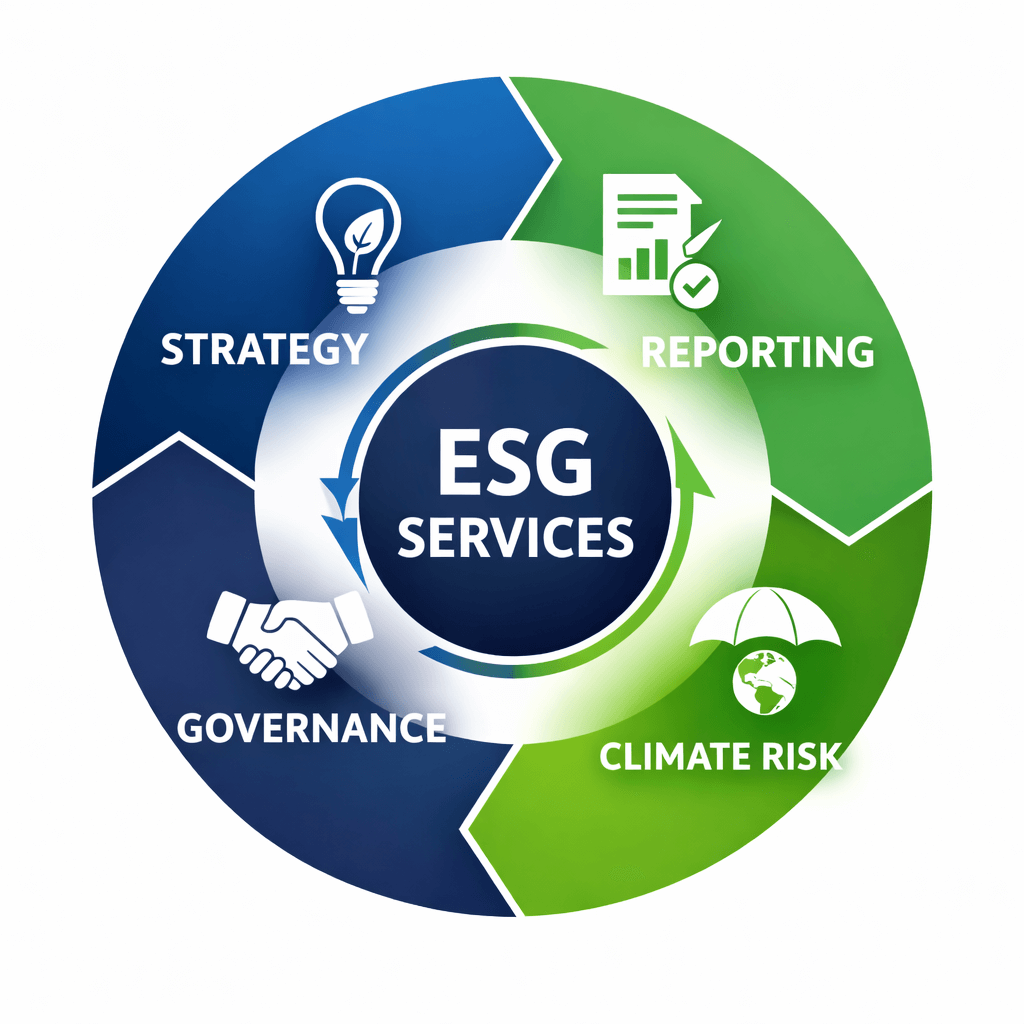
ESG Strategy and Materiality Assessment
A materiality assessment identifies which ESG issues are most relevant to your business and your stakeholders. It’s the starting point for any credible ESG program.
This isn’t a one-size-fits-all exercise. A bank has different material ESG topics than a construction firm or an insurer dealing with post-IFRS 17 obligations.
The best consultants run stakeholder interviews, benchmark against peers, and produce a prioritized ESG topic matrix your leadership team can actually use. They also tie those results straight to a strategy with measurable goals and clear ownership.
Without this step, you’re reporting on the wrong things.
ESG Reporting and Disclosure Support
Reporting support covers data collection, KPI setting, narrative writing, and final disclosure aligned to GRI, ISSB, TCFD, or SASB standards. This is where most companies start, and it’s where a lot of ESG programs stall.
The gap between collecting data and publishing a credible, investor-ready report is wider than most boards expect. Strong esg services firms bridge that gap through clear processes, quality checks, and alignment with auditable data trails.
Carbon Footprint and Climate Risk Analysis
Climate disclosure is no longer voluntary for many GCC-listed companies. IFRS S2 requires reporting on Scope 1, Scope 2, and Scope 3 emissions, along with transition risks and physical climate risks.
ESG consultants help you measure your carbon footprint accurately, spot reduction opportunities, and build climate scenario analyses that satisfy both regulators and investors. The Saudi Green Initiative has pledged a SAR 700 billion investment in sustainability projects including afforestation and renewable energy, setting a regional tone the private sector is expected to follow.
Climate Risk and Net Zero Strategy
Climate risk is no longer a future problem. Physical risks like heat stress, water scarcity, and flood exposure affect GCC operations right now. Transition risks, such as carbon pricing and stranded assets, are coming faster than most businesses planned for.
A strong ESG advisory services provider helps you map both risk types, quantify their financial impact, and build a credible pathway toward net zero. This includes TCFD-aligned scenario analysis and renewable energy transition roadmaps.
At least USD 75 billion is available by 2030 for sustainable investments in Qatar alone, which tells you how much capital is being mobilized around these targets.
Governance and ESG Integration
ESG doesn’t belong in a sustainability department. It belongs in your governance structure, your risk committee, and your board reporting.
Strong ESG consulting firms help you build that integration: defining board-level KPIs, embedding ESG into executive incentive structures, and connecting sustainability targets to financial planning. They also assess board composition, risk oversight, anti-corruption policies, and whistleblower frameworks, then align ESG controls to established internal audit frameworks like COSO. This is where grc services and internal audit consulting intersect with ESG, giving you a more complete picture of your governance health.
ESG Audit vs ESG Consulting: What’s the Difference?
People use these terms interchangeably. They’re not the same thing, and the mix-up costs companies real money.
An ESG audit is a verification exercise. An independent third party examines your ESG data and practices to confirm whether what you’re reporting is accurate and matches stated policy. It’s retrospective. It looks back at what you already did.
ESG consulting is forward-looking. A consultant builds the strategy, policies, data systems, and reporting structures before the audit happens. Think of consulting as the preparation and auditing as the verification.
Most GCC companies need both. You can’t pass an EcoVadis review or meet IFRS S2 requirements without solid data infrastructure and a credible strategy underneath. Get the consulting wrong and the audit becomes a very expensive way to learn what you missed.
Free Consultation
Ready to discuss your specific situation?
Prima’s advisors work with organisations across the GCC, Europe, and Asia-Pacific. First conversation is always free. No pitch, just expertise.
ESG Implementation Roadmap for GCC Businesses

Wondering where to start? Here’s the path most credible programs follow. You can also work through the full ESG implementation guide for detail on each stage.
Step 1: Gap Assessment and Benchmarking
Map where you stand today. A gap assessment compares your current practices against your chosen framework, GRI, SASB, or IFRS S1 and S2, and against industry peers. That tells you what’s missing and what to fix first. Run a materiality assessment alongside it, so you don’t burn resources reporting on things that don’t move the needle. According to icmai.in, only 43% of GCC companies in 2023 had ESG matters inherently integrated into corporate strategy.
Step 2: Data Collection and KPI Development
Once you know the gaps, you need reliable data. Build systems to track energy, water, waste, employee metrics, supply chain practices, and governance indicators. Then train internal teams to collect and validate it consistently. Your KPIs should connect to both your materiality findings and your regulatory duties. IFRS S2 wants Scope 1, 2, and 3 emissions data. Only 40% of GCC companies currently follow recognized ESG reporting standards, which is both a risk and an opening.
Step 3: Reporting, Assurance, and Continuous Improvement
Reporting is where it comes together. Your report should show strategy, performance against KPIs, and forward targets in a way that’s clear and verifiable. Assurance adds credibility, since third-party verification signals to investors and regulators that your numbers hold up. Then it repeats. ESG isn’t a one-time project. It’s an annual cycle of measure, report, improve, and the companies that treat it that way stop scrambling every disclosure season.
Explore our advisory services
Benefits of Hiring ESG Consulting Firms
The ROI question is legitimate, and it deserves a direct answer.
Here’s what companies working with strong ESG advisory services firms typically see:
- Regulatory risk reduction: Staying ahead of disclosure mandates avoids fines and reputational damage from non-compliance.
- Improved investor access: The MEA ESG investing market is projected to reach USD 5,738.9 million by 2030. Investors screening for ESG performance can’t include you if your data isn’t available.
- Access to green finance: Sustainable sukuk volume in the Middle East hit USD 11.4 billion in 2025, up from USD 7.9 billion the year before. Incomplete ESG reporting locks you out of that pool.
- Operational cost savings: Energy audits, waste reduction, and supply chain optimization built into ESG strategies generate measurable savings, often 10-20% on targeted operational areas within the first two years.
- Talent and brand value: Employees increasingly pick employers on sustainability credentials, and B2B clients now run ESG due diligence on their supply chains.
- Strategic clarity: A proper ESG roadmap forces long-term priority decisions many boards avoid until they’re cornered.
The Middle East and Africa holds 8.4% of the global environmental and social consulting market share in 2025. That share is growing because the value is real.
Who Prima works with
Across industries and geographies, delivering measurable outcomes
🏦
Banks & Financial Institutions
IFRS 9 ECL models, credit risk, impairment methodology, regulatory reporting
🛡️
Insurance & Takaful Companies
IFRS 17 implementation, actuarial modelling, GMM/VFA/PAA, CSM calculations
🏢
Corporates & Multinationals
IFRS 15, 16, IAS 36 compliance, financial statements, internal controls
📈
Investment & Asset Managers
IFRS 9 classification, fair value (IFRS 13), derivative valuations, hedge accounting
🏗️
Real Estate & Construction
IFRS 16 lease accounting, IFRS 15 revenue recognition, project-based reporting
🏛️
Family Offices & Holding Groups
Governance frameworks, board advisory, risk management, portfolio evaluation
Common ESG Challenges and How Consultants Solve Them
Most businesses hit the same walls when they try to build an ESG program internally. Here’s what those look like in practice:
Data gaps and quality issues. Companies often don’t have consistent baseline data for emissions, energy use, or social metrics across subsidiaries. A good ESG consulting team builds a data governance framework that standardizes collection across your organization.
Resistance to change. ESG requires buy-in from operations, HR, finance, and procurement, not just sustainability teams. Experienced consultants bring change management expertise and stakeholder engagement approaches that reduce friction.
Regulatory complexity. Reporting to the UAE’s SCA, Saudi Arabia’s CMA, and international investor requirements at once is complicated. A firm with strong regulatory knowledge maps these obligations, finds overlaps, and builds one integrated response instead of three.
Resource constraints for SMEs. Managed ESG services give smaller companies expert-level support without the cost of an internal function. This matters most for family-owned businesses and mid-market companies where family governance consulting meets broader ESG governance needs.
Scalability. As businesses expand across the GCC, their ESG obligations grow. The right consulting partner builds frameworks that scale, not ones that need rebuilding for every new jurisdiction.
How to Evaluate ESG Consultants: Checklist
Questions to Ask Before Hiring
Before signing any engagement, ask these directly:
- Which ESG frameworks do you work with, and how do you select the right one for our sector?
- Can you share two to three case studies from similar industries in the GCC?
- What technology platform do you use for data collection and reporting?
- How do you handle regulatory changes mid-engagement?
- What does your materiality assessment process look like?
- How do you measure and report implementation outcomes?
- What is your pricing model: fixed fee, retainer, or project-based?
- Do you offer ongoing monitoring after the initial strategy phase?
- How do your esg advisory services connect to internal audit consulting or governance reviews?
- What are the estimated esg consulting services pricing in UAE for a company our size?
Red Flags to Avoid
Watch out for these signs during your evaluation:
- Generic proposals with no sector-specific content or regional references
- No framework explanation when asked how they’d approach your disclosure obligations
- Overemphasis on reports over strategy without a plan for embedding ESG into your operations
- No technology infrastructure for data management or reporting automation
- Vague ROI claims without examples or benchmarks from comparable projects
- No mention of regulatory bodies specific to your markets (SCA, CMA, DIFC, ADGM)
- Short-term project only mindset with no post-delivery monitoring or review cycle
- Inability to explain how ESG connects to your financial disclosures, particularly if IFRS standards are relevant to your reporting
ESG Trends in the Middle East (2026 Outlook)
The ESG market in the Middle East is changing fast. Here’s where it’s heading.
Mandatory disclosure is expanding. Both the UAE and Saudi Arabia are tightening reporting requirements for listed entities. Voluntary disclosure is becoming the floor, not the ceiling.
Nature and biodiversity are entering the picture. The Taskforce on Nature-related Financial Disclosures (TNFD) framework is gaining traction globally and will reach the GCC. Companies with water-intensive or land-use operations need to start mapping nature risk now.
Supply chain ESG due diligence. As global buyers apply ESG screens to procurement, GCC exporters face pressure to demonstrate ESG performance throughout their supply chains.
Renewable energy targets are accelerating. Renewable energy projects in the Middle East are poised to reach USD 75.63 billion by 2030. Companies in energy, infrastructure, and real estate need credible transition strategies.
The Asia Pacific, Middle East and Africa, and Latin America regions all recorded double-digit growth in environmental and sustainability consulting in 2024. The Middle East is one of the fastest-growing markets globally for ESG services.
How ESG Consulting Aligns with IAS 19 Valuation
This is an area most ESG consultants won’t connect for you, and it matters.
IAS 19 governs employee benefits, including defined benefit pension obligations and post-employment liabilities. These valuations are directly affected by ESG factors: workforce demographic assumptions, mortality projections influenced by health and safety records, and long-term salary assumptions tied to social and labor practices.
For insurers operating post-IFRS 17, the intersection is even more direct. ESG advisory for insurers post-IFRS 17 requires mapping sustainability metrics to liability assumptions, discount rate frameworks, and risk adjustment calculations. A consultant who understands both sides of that relationship, the actuarial and the ESG advisory dimension, gives you a material advantage.
ESG programs that connect to financial statement assumptions give boards and audit committees a more complete view of long-term business risk. This is where firms offering both Prima Consulting’s ESG Services and technical accounting expertise deliver value that specialized ESG-only boutiques simply can’t match.
FAQs About ESG Consulting Firms in Middle East
What makes a good ESG consulting firm?
A strong ESG consulting firm combines three things: deep knowledge of the regulatory environment in your specific market (UAE, KSA, or broader GCC), experience with international frameworks like GRI, SASB, TCFD, and ISSB, and the technology infrastructure to collect, validate, and report data at scale. Industry-specific experience matters too. Ask for case studies and check whether their past work produced measurable compliance or strategic outcomes for clients.
How much do ESG consulting services cost?
ESG consulting services pricing in UAE and KSA varies with scope and firm type. A standalone materiality assessment for a mid-sized company typically runs USD 15,000 to USD 50,000. A full ESG strategy and implementation engagement can range from USD 80,000 to USD 300,000 or more for larger organizations. Managed ESG services in GCC markets run on retainer models around USD 3,000 to USD 10,000 per month. Always clarify what’s included before signing.
What’s the difference between an ESG audit and ESG consulting?
ESG consulting is forward-looking. A consultant builds your strategy, data systems, and reporting structures before disclosure. An ESG audit is retrospective. An independent third party verifies whether your reported data is accurate and matches policy. Most GCC companies need both, since you can’t pass an EcoVadis review or meet IFRS S2 rules without solid consulting groundwork first.
How long does ESG implementation take?
The timeline depends on where you’re starting. A baseline materiality assessment and gap analysis usually takes six to twelve weeks. Full ESG strategy development, including KPI framework and roadmap, takes three to six months. Reporting preparation aligned to GRI or ISSB standards can add another three to four months. For companies starting from scratch, plan for a 12 to 18 month journey to a credible first public disclosure, then continuous cycles after.
Why do GCC businesses specifically need ESG consulting?
Because the regulatory environment in the GCC changes faster than most internal teams can track. Between Tadawul disclosures, UAE net zero targets, IFRS S1 and S2 rollout, and rising institutional investor expectations, GCC companies face a compliance and strategy challenge that needs specialized support. Around 75% of GCC institutional investors now apply ESG criteria to decisions, so the cost of inaction keeps climbing.
Is Your ESG Program Built to Last, or Just Built to Comply?
There’s a real difference between ESG programs that produce reports and ESG programs that protect and grow your business. The right ESG consulting firms don’t just help you check boxes. They help you build governance structures, data systems, and strategic frameworks that give your business a concrete edge with investors, regulators, and the talent market.
The Middle East & Africa ESG investing market is on a clear growth trajectory. The question isn’t whether ESG matters in this region. The question is whether your program is strong enough to stand up to scrutiny when it counts.
If you’re ready to move past generic frameworks and work with a team that understands the GCC regulatory landscape, financial reporting standards, and real operational outcomes, Prima Consulting’s ESG Services are built for exactly that. Get in touch today to start a conversation about where your program stands and what it needs to get where it should be.