TL;DR
This esg implementation guide walks KSA and UAE firms through every step, from materiality assessment to audit readiness. Both markets face real regulatory pressure, and the business case for ESG is backed by hard numbers. Saudi Arabia’s ESG investing market is on track to reach USD 1,847.4 million by 2030, and GCC sustainable sukuk issuance hit a record $11.4 billion in 2025. You’ll learn how to build governance structures, choose the right compliance frameworks, collect and validate data, and publish a credible sustainability report. Use this guide to move from planning to action, on your timeline, with the right strategic guidance.
ESG Implementation Guide for KSA and UAE Firms
This esg implementation guide is for KSA and UAE firms that are done waiting and ready to act.
Most companies in both markets know they need to move on ESG. The real question is where to start, what to prioritize, and how to build something that holds up under regulatory and investor scrutiny.
Saudi Arabia’s ESG investing market hit USD 673.2 million in 2024, projected to reach USD 1,847.4 million by 2030. That’s a CAGR of 19.2%. The UAE and Qatar already lead the region, with over 80% of large-cap firms publishing ESG reports.
What you’ll find here is a step-by-step esg implementation guide built around the specific regulatory, governance, and reporting realities of the GCC, not a generic global template.
ESG Implementation Guide: Where to Start
Every esg implementation guide worth following starts with three foundational questions before touching a framework or picking a reporting tool.
What are you trying to achieve? Who are your stakeholders? And what issues actually matter to your business?
Define Objectives and Scope
Start by deciding what success looks like for your organization.
Are you reporting to meet Tadawul’s phased disclosure timeline? Attracting foreign capital? Aligning with your parent company’s global ESG commitments?
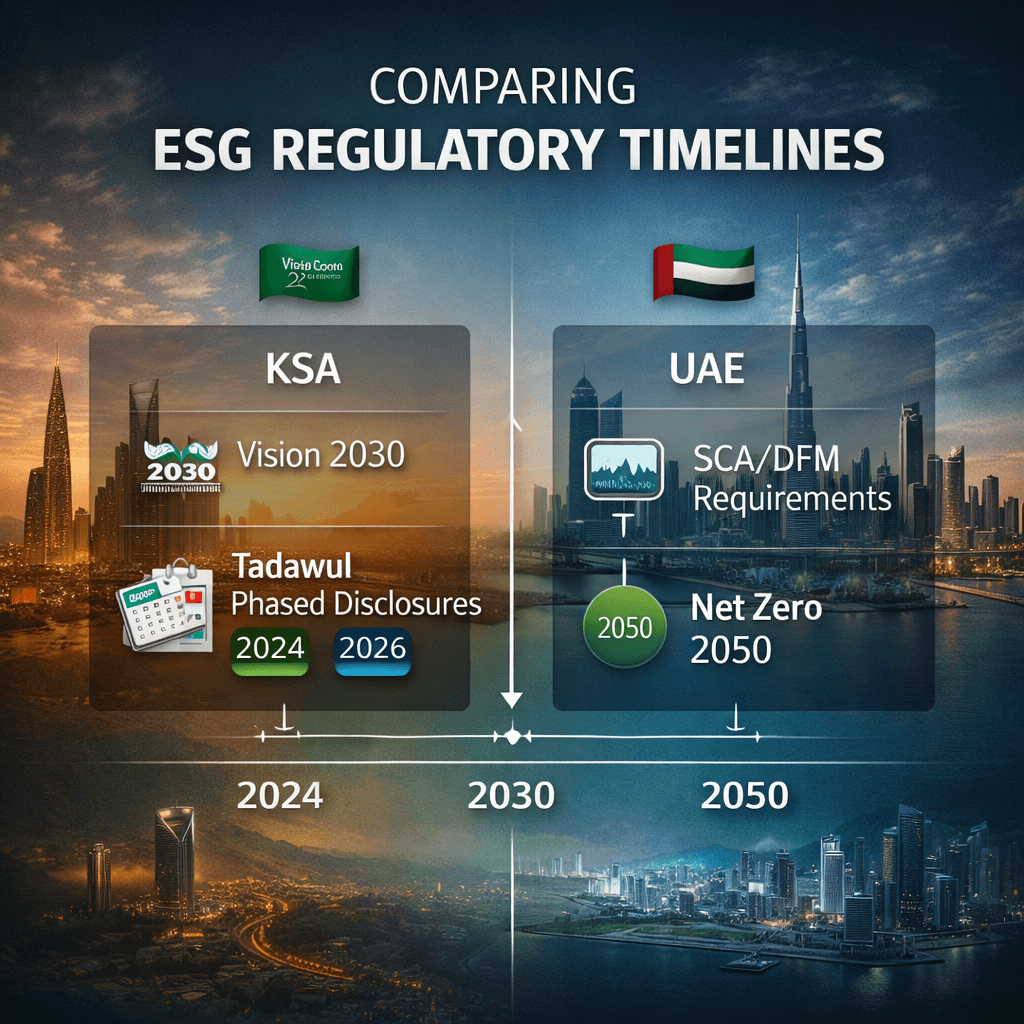
Your objectives shape everything else. A listed Saudi company working toward the 2024-2026 Saudi Exchange phased disclosure schedule has different priorities than a UAE SME preparing for voluntary GRI reporting.
Define scope early: which subsidiaries are included, which geographies, and which reporting year you’re targeting. Gaps here create problems during external assurance.
Run a Materiality Assessment
A materiality assessment tells you which ESG issues are relevant to your business and your stakeholders.
You’re not reporting on everything. You’re reporting on what’s material. That distinction matters for credibility and resource allocation.
The process typically involves four steps: identify all potential ESG topics relevant to your sector, gather input from stakeholders on what they consider important, score each topic by business impact and stakeholder concern, and map results against UN Sustainable Development Goals (SDGs) to show broader alignment.
Over 80% of Saudi companies using GRI standards reported improved stakeholder trust in 2024, according to data cited by Insightss.co. That trust starts with a rigorous, documented materiality process.
Identify Stakeholders and Expectations
Map your stakeholders before you start any reporting work.
Internal stakeholders include your board, leadership team, finance, HR, and operations. External ones include investors, regulators, customers, suppliers, and local communities.
Each group has different expectations. Investors want data-driven performance metrics. Regulators want compliance with disclosure timelines. Employees want clarity on social and governance policies.
Stakeholder mapping is not a one-time exercise. Build a mechanism to revisit it annually.
KSA and UAE ESG Regulations Explained
Understanding the regulatory landscape is non-negotiable. Both markets have distinct rules, and they’re evolving fast.
Saudi Regulatory Landscape
The Saudi Exchange (Tadawul) published its ESG disclosure guidelines to push listed companies toward structured sustainability reporting.
By the end of 2023, only 6% of Tadawul-listed firms had submitted formal sustainability reports. That figure rose to 60% of TASI-listed firms disclosing ESG data by 2024. The push toward 70% TCFD-aligned reporting compliance under Vision 2030 is real, and regulators are watching.
For oil and gas sectors specifically, 40% of Saudi businesses adopted SASB standards in 2024, with projections rising to 55% by 2025.
Vision 2030 ties directly into this. Reducing oil dependency, hitting 50% renewables in the energy mix by 2030 (from 30% in 2024), and attracting foreign investment all require credible ESG disclosure. ESG-compliant businesses in Saudi Arabia reported a 20% increase in FDI in 2024, with inflows expected to surpass $50 billion by 2025.
UAE Disclosure Requirements
The UAE has built one of the most active ESG regulatory environments in the region.
Large and listed firms are now expected to report using recognized global frameworks. The Securities and Commodities Authority (SCA) and Dubai Financial Market (DFM) both push for sustainability disclosures aligned with GRI, TCFD, and increasingly, IFRS Sustainability Standards.
The UAE’s net-zero by 2050 target is driving sector-level mandates, particularly in energy, finance, and real estate. Green buildings, renewable energy ($48B opportunity), and the circular economy ($25B opportunity) all represent areas where ESG reporting intersects directly with business strategy.
For ESG reporting Middle East specifics, regulatory requirements are shifting quickly, and staying ahead of mandatory timelines is what separates prepared firms from reactive ones.
Alignment with National Sustainability Agendas
Both KSA and UAE sustainability agendas create natural alignment for ESG implementation.
Vision 2030 in Saudi Arabia prioritizes economic diversification, social development, and environmental stewardship. In the UAE, the National Net Zero by 2050 Strategic Initiative sets the tone for corporate sustainability ambition.
Aligning your ESG program to these agendas isn’t just good optics. It directly positions your firm for government contracts, green financing, and public-private partnership opportunities.
Build ESG Governance and Accountability
Governance is the first structural layer every esg implementation guide should address. Without clear ownership, ESG commitments stay on paper.
Board Oversight Roles
Board-level ESG oversight is the foundation of credible sustainability governance. Firms working with an esg consulting partner often accelerate this step significantly.
In KSA, Tadawul guidelines specifically call for board involvement in ESG oversight. That means establishing clear mandates, not just adding ESG as an agenda item. Your board should review material ESG risks, approve targets, and receive regular performance updates.
Consider creating a dedicated ESG or Sustainability Committee at board level. This signals to investors, regulators, and employees that the commitment is structural, not cosmetic.
Internal Policies and Controls
Your ESG governance structure needs to be supported by documented internal policies.
These include environmental management policies, anti-corruption and ethics frameworks, supplier code of conduct, diversity and inclusion commitments, and data privacy standards. Each policy should have an owner, a review cycle, and measurable compliance indicators.
Internal audit plays a critical role here. Building audit readiness from the start, rather than as an afterthought, saves time and credibility during external assurance reviews.
Cross-Department Responsibilities
ESG cannot sit in one department.
Finance owns emissions data tied to Scope 1-3 accounting, energy costs, and green financing. HR manages social metrics like diversity, safety, and training hours. Operations handles waste, water, and supply chain data. Legal and compliance tracks regulatory alignment.
For resource-limited firms, even virtual cross-functional teams with clear KPI ownership can work. The key is assigning accountability before data collection starts, not after.
Select the Right ESG Frameworks
Choosing your reporting framework isn’t just a technical decision. It’s a strategic one, and it’s a step no esg implementation guide should skip.
It affects how investors, regulators, and raters read your disclosures.
IFRS Sustainability Standards
The International Sustainability Standards Board (ISSB) issued IFRS S1 and IFRS S2 in 2023, creating a global baseline for sustainability-related financial disclosures.
IFRS S1 covers general sustainability-related disclosures. IFRS S2 focuses specifically on climate-related risks and opportunities. For firms already reporting under IFRS financial standards, integrating IFRS S1 and S2 creates a unified reporting architecture that’s increasingly favored by capital markets regulators across the GCC.
UAE and KSA regulators are actively monitoring IFRS sustainability adoption as a benchmark for disclosure quality.
GRI and TCFD Usage
The Global Reporting Initiative (GRI) remains the most widely used framework for ESG disclosure globally and in the GCC.
GRI covers a comprehensive range of ESG topics across environmental, social, and governance pillars. It’s well-suited for stakeholder communication and materiality-driven reporting.
TCFD (Task Force on Climate-related Financial Disclosures) is specifically built for climate risk. It focuses on governance, strategy, risk management, and metrics tied to climate scenarios. In Saudi Arabia, the target is 70% TCFD compliance among listed companies under Vision 2030 commitments.
SASB standards provide industry-specific metrics. They’re particularly relevant for KSA’s oil and gas sector, where 40% of businesses have already adopted them.
When to Combine Frameworks
Most mature ESG reporters use more than one framework.
A practical approach: use GRI as your core reporting structure, layer TCFD for climate-specific disclosures, align with IFRS S1/S2 for investor-facing financial integration, and apply SASB for sector-specific metrics. This multi-framework approach gives you broader coverage and reduces the risk of gaps during regulatory reviews.
Talk to esg consulting firms with GCC-specific experience before finalizing your framework strategy. The right combination depends on your sector, listing status, and investor base.
Collect and Manage ESG Data
Data is where most ESG programs struggle, and it’s the section of any esg implementation guide that requires the most operational planning.
Companies often have the intent but lack the systems to collect, verify, and report ESG data reliably.
Define KPIs and Metrics
Your KPIs should be tied directly to your materiality assessment outcomes.
Environmental KPIs include Scope 1, 2, and 3 greenhouse gas emissions (measured in tCO2e), energy consumption (MWh), water withdrawal (m3), and waste diversion rates. Social KPIs cover employee turnover, training hours per employee, workforce diversity (gender, nationality), and community investment spend. Governance KPIs track board diversity, policy compliance rates, and ethics violation reports.
Keep your initial KPI set focused. A short list of well-measured metrics beats a long list of poorly tracked ones.
Set Up Data Systems
Manual spreadsheets won’t scale.
Start with structured templates for each data category, then move toward ESG data management software that automates collection, flags anomalies, and integrates with your finance systems. Purpose-built ESG platforms offer audit trails, which are critical for external assurance.
For firms integrating ESG with enterprise risk management consulting, connecting ESG data flows to existing ERP or risk management platforms reduces duplication and improves data quality.
Internal Validation Checks
Before any data goes into a report, it needs internal validation.
Build a review process where data owners sign off on their metrics. Cross-check environmental data against utility bills and procurement records. Reconcile social data with HR systems. Flag year-over-year anomalies for review.
This internal validation step is what makes external assurance feasible. Auditors look for evidence trails, documented processes, and sign-off chains.
ESG Reporting and Disclosure Steps
Your report is the visible output of everything above. It needs to be accurate, structured, and readable.
Draft the Sustainability Report
A sustainability report typically covers your company overview and ESG strategy, material topics and how you manage them, quantitative performance data with year-over-year comparisons, governance structure and oversight, and your forward-looking targets.
Write for two audiences simultaneously: technically rigorous for analysts and regulators, and accessible enough for customers, employees, and media. Integrated financial and ESG reporting, where sustainability data appears alongside financial statements, is the direction both KSA and UAE markets are moving.
Meet Exchange Disclosure Expectations
For Saudi-listed firms, the Tadawul phased disclosure timeline runs from 2024 to 2026.
Each phase introduces additional disclosure requirements. Know which phase applies to your company, what’s required, and what the submission process looks like. Missing a deadline or submitting incomplete data creates regulatory risk.
For UAE-listed firms, DFM and ADX have their own ESG reporting templates. Download and review those templates before you start drafting, not after.
Improve Transparency Year over Year
Your first report won’t be perfect. That’s fine.
What matters is that you build a credible baseline and show progression. Year-over-year improvement in data quality, coverage, and performance metrics is what ESG-focused investors track.
Build a post-report review process. Identify what data was missing, what took too long to collect, and where stakeholder feedback pointed to gaps. Use that to improve your next cycle.

Common ESG Implementation Challenges
Most KSA and UAE firms hit the same obstacles when working through an esg implementation guide. Knowing them in advance helps you plan around them.
Data Gaps
The most common challenge is not having the data you need, in the format you need it.
Scope 3 emissions are particularly difficult. They require data from suppliers and customers across your value chain. Supply chain ESG is underdeveloped across much of the GCC, which means many firms will need to start with Scope 1 and 2, then build toward Scope 3 over multiple reporting cycles.
Document your data gaps in your first report. Transparency about limitations is more credible than silence.
Skills Shortages
ESG expertise is in high demand and short supply across the GCC.
Many firms lack internal staff who understand both sustainability concepts and financial reporting requirements. This is especially true for SMEs in Dubai and across the UAE.
Options include upskilling internal teams through targeted training programs, partnering with specialized grc consulting or bpm consulting services firms, or embedding an ESG specialist on a project basis. Don’t delay implementation because you’re waiting for a full internal team.
Integration with Finance Systems
ESG and finance need to speak the same language.
Integrating ESG with IFRS standards requires connecting sustainability disclosures to financial risk frameworks, particularly for climate-related financial risks under IFRS S2.
Many firms find that their existing finance systems weren’t built to capture ESG data, which means either workarounds or system upgrades.
Internal audit consulting services can help bridge this gap. Auditors who understand both financial and ESG reporting can identify where controls need strengthening before external assurance reveals the gaps.
Using Technology and AI in ESG
Technology doesn’t replace ESG strategy. But it makes executing an esg implementation guide faster, more accurate, and more scalable.
Automated Data Capture
IoT sensors can capture real-time energy consumption, water use, and emissions data from facilities.
API integrations with utility providers, logistics platforms, and HR systems can automate the data flows that used to require manual spreadsheet updates. This removes human error from your data collection process and creates audit-ready records.
Analytics and Dashboards
AI-powered analytics tools let you track ESG performance against targets in real time.
Dashboards give leadership and the board visibility into where performance is on track and where it’s falling behind. That visibility is what turns ESG from a reporting exercise into a management tool.
For firms with complex supply chains, AI analytics can flag suppliers whose ESG profiles create risks, supporting proactive management rather than reactive disclosure.
Continuous Monitoring
ESG is not an annual reporting exercise. It’s a continuous management discipline.
Blockchain-based traceability systems can verify supply chain sustainability claims with tamper-proof records. Continuous monitoring platforms alert you to operational events that affect your ESG metrics before they become disclosure problems.
Firms that invest in monitoring infrastructure spend less time correcting data errors and more time improving performance.
ESG Assurance and Audit Readiness
External assurance is where your ESG program gets tested. Any credible esg implementation guide includes audit readiness as a core deliverable.
Being ready before the auditor arrives makes a significant difference.
Prepare Documentation
Assurance providers look for evidence, not claims.
That means documented data collection processes, sign-off chains, raw data sources tied to reported figures, and records of any estimation methodologies used. Build a documentation library as you go, not at the end of the reporting cycle.
Internal Review Process
Before external assurance, run an internal review.
Cross-check reported figures against source data. Test your controls against the requirements of your chosen assurance standard (ISAE 3000 is commonly used for ESG). Identify and resolve discrepancies before the external auditor does.
Firms with strong internal audit functions have a significant advantage here. Those without can benefit from dedicated internal audit consulting services that specialize in ESG assurance readiness.
External Assurance Benefits
Third-party assurance does two things: it catches errors you missed, and it tells stakeholders your data is reliable.
Limited assurance (lower scope) is a practical starting point for most firms. Reasonable assurance (higher scope, closer to financial audit standards) provides stronger credibility and is increasingly expected by institutional investors.
The GCC sustainable sukuk market reached $7.9 billion in 2024 and a record $11.4 billion in 2025. Access to this green financing requires credible, assured ESG data. That’s a direct financial return on your assurance investment.
ESG Implementation Checklist for Year One
This esg implementation guide checklist gives you a structured path through your first year.
First 90 Days
- Appoint an ESG lead and form a cross-functional working group
- Conduct initial materiality assessment with key internal stakeholders
- Map external regulatory requirements (Tadawul, SCA, DFM timelines)
- Select primary reporting framework (GRI, TCFD, IFRS S1/S2)
- Inventory existing ESG-related data, policies, and initiatives
- Identify data gaps and assign data owners for each KPI
Six-Month Milestones
- Complete stakeholder engagement process and validate material topics
- Establish board-level ESG oversight structure and committee mandate
- Launch internal data collection for selected KPIs
- Document internal policies: environmental, social, anti-corruption
- Select ESG data management platform or structured spreadsheet system
- Begin drafting report structure and key narrative sections
Annual Review Plan
- Publish first sustainability report aligned to chosen framework
- Commission limited assurance from an independent third party
- Collect stakeholder feedback on report quality and relevance
- Review ESG targets against actual performance
- Update materiality assessment for next reporting cycle
- Build a post-reporting improvement plan for year two
ESG FAQs for KSA and UAE Companies
How Long Does ESG Implementation Take?
A realistic first-year ESG implementation program, from initial assessment to published report, typically takes 9 to 18 months.
Firms with existing data infrastructure and governance structures can move faster. Those starting from scratch, especially SMEs, should plan for the longer end of that range. Post-implementation monitoring and year-two improvements continue from there.
What Data Is Mandatory?
For Tadawul-listed Saudi firms, required disclosures follow the Saudi Exchange ESG disclosure guidelines and depend on the phase of the rollout applicable to your company.
Common mandatory items include GHG emissions (Scope 1 and 2), energy consumption, board composition, and anti-corruption policies. TCFD-aligned climate risk disclosures are also targeted under Vision 2030. In the UAE, DFM and ADX have published ESG reporting guides that specify required vs. recommended disclosures.
Do SMEs Need ESG Reporting?
Mandatory reporting requirements in both KSA and UAE currently focus on large and listed firms. But ESG services for SMEs in Dubai and across the region are growing fast because voluntary adoption is becoming a commercial advantage.
SME suppliers to large corporates increasingly face ESG questionnaires as part of procurement processes. Access to green financing and sustainable sukuk also depends on ESG credentials. This esg implementation guide approach, starting small with a focused set of material KPIs, is more practical than waiting for mandatory requirements to land.
Your ESG Implementation Starts Now
The regulatory and market case for ESG in KSA and UAE has never been clearer. Saudi Arabia’s ESG investing market is growing at 19.2% annually. The GCC sustainable bond market hit $11.4 billion in 2025. Consumer willingness to pay premiums for sustainable products is documented and rising.
This esg implementation guide gives you the structure to move forward, from materiality assessment and stakeholder mapping to governance, data systems, reporting, and assurance. The firms that build credible ESG programs now will have a structural advantage in attracting capital, meeting regulatory requirements, and building long-term stakeholder trust.
Prima Consulting’s ESG Services are built for firms operating across the GCC. Whether you’re starting your esg implementation guide from scratch or need to strengthen an existing program, the team at Prima Consulting’s ESG Services brings the sector expertise, regional regulatory knowledge, and hands-on implementation experience to get it done right.
Talk to the team today and build an ESG program that’s ready for what’s ahead.