TL;DR
This guide covers IFRS 15 revenue recognition implementation with practical steps for successful adoption. You’ll learn how to evaluate contracts, handle contract modifications, and create an effective transition plan. The article also highlights key factors like performance obligation identification, revenue deferral, and disclosure requirements. Plus, it explains essential IFRS 15 training to prepare your team and improve audit readiness. Use this step-by-step approach to simplify complex accounting standards updates and ensure a smooth IFRS 15 adoption. Read on to master your IFRS 15 transition options and strengthen your revenue policies.
Implementing new accounting standards can feel like trying to solve a puzzle with missing pieces. You know the end result should look professional and compliant, but the path there seems unclear.
This reality hits particularly hard with IFRS 15 revenue from contracts with customers. The standard affects nearly every business that sells goods or services, yet many organizations struggle with practical implementation.
Studies show that industries with complex contracts face significant changes in revenue recognition timing and values. For example, telecommunications companies experienced notably higher disclosure and accounting changes compared to straightforward retail sectors.
You’ll find everything you need to learn about IFRS 15 Revenue Recognition Implementation in this comprehensive guide. From understanding the five-step model to handling contract modifications, we’ll walk through each element with real-world examples and practical solutions.
What Is IFRS 15 Revenue Recognition Implementation?
IFRS 15 revenue recognition implementation involves adopting the International Financial Reporting Standard 15 for recognizing revenue from customer contracts.
This process requires organizations to restructure their revenue recognition policies, update systems, and train staff on new procedures.
The implementation affects your business operations beyond just accounting entries. You’ll need to review existing contracts, modify internal controls, and potentially change how you price and structure customer agreements.
Implementation success depends on thorough planning and systematic execution. Companies that rush through this process often face compliance issues and audit challenges later.
IFRS 15 Five-Step Model for Revenue Recognition
The five-step model forms the foundation of IFRS 15 revenue recognition implementation. Each step builds on the previous one, creating a comprehensive framework for consistent revenue treatment.
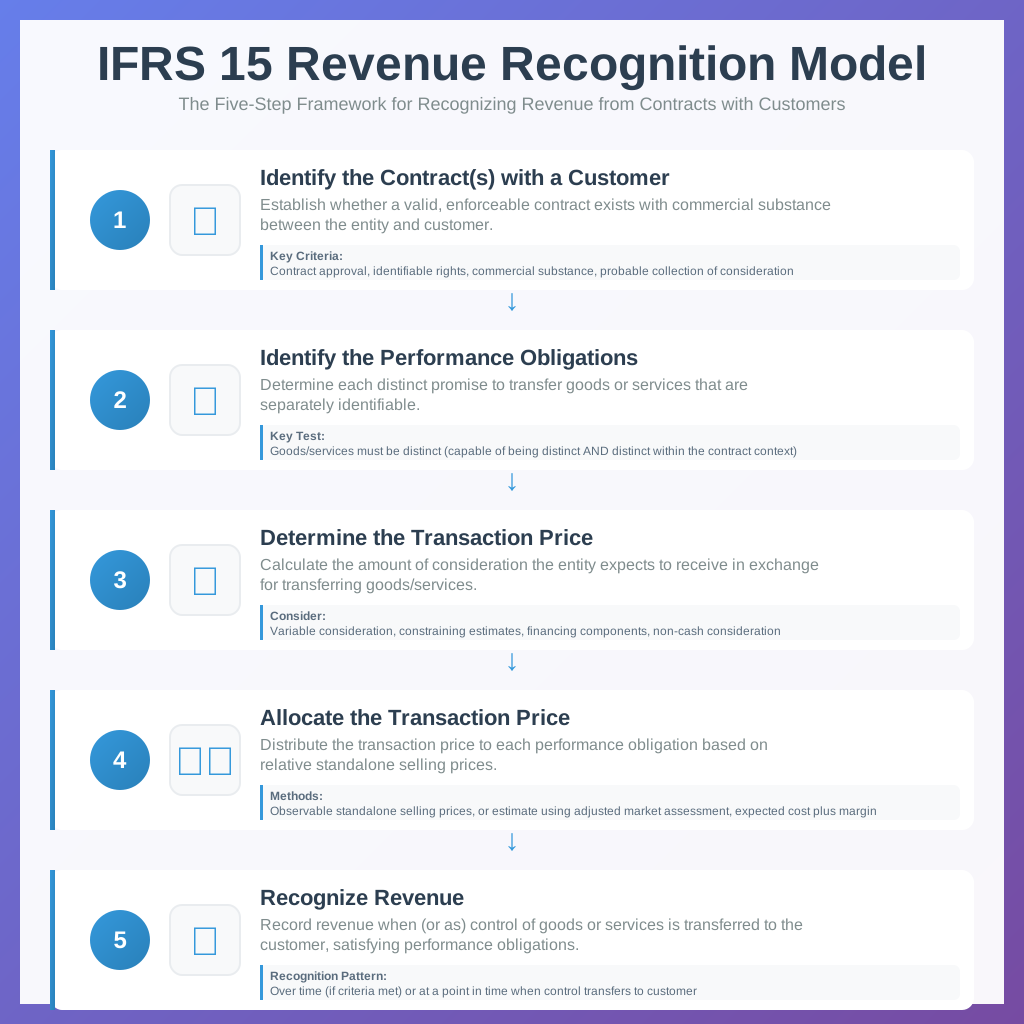
Step 1: Identify the Contract with a Customer
Your first step involves determining whether you have an enforceable contract with commercial substance. The contract must create rights and obligations for both parties.
Key criteria include:
- Written or oral agreement with clear terms
- Commercial substance exists
- Payment collection is probable
- Both parties committed to their obligations
A retail sale typically meets these criteria immediately. Service contracts may require more analysis, especially when terms allow for modifications or cancellations.
Step 2: Identify the Performance Obligations
Performance obligations represent distinct goods or services you promise to deliver. This step requires careful analysis of what customers actually purchase from you.
Consider a software company selling licenses with implementation services. These represent two distinct performance obligations if customers can benefit from each separately.
The standard defines distinct obligations as:
- Customer can benefit from the good or service on its own
- Promise is separately identifiable from other contract promises
Step 3: Determine the Transaction Price
Transaction price includes all consideration you expect to receive for fulfilling contract obligations. This includes fixed amounts, variable consideration, and any financing components.
Variable consideration requires estimation using either expected value or most likely amount methods. You can only include variable amounts when it’s highly probable that revenue won’t reverse significantly.
Common variable elements include:
- Performance bonuses
- Volume discounts
- Penalty clauses
- Price concessions
Step 4: Allocate the Transaction Price
You must distribute the total transaction price among identified performance obligations based on standalone selling prices. When standalone prices aren’t observable, you’ll need to estimate them.
Allocation methods include:
- Adjusted market assessment
- Expected cost plus margin
- Residual approach (limited circumstances)
For our software example, if the license sells separately for $80,000 and implementation for $20,000, you’d allocate the contract price proportionally.
Step 5: Recognize Revenue When Obligations Are Met
Revenue recognition occurs when you satisfy performance obligations by transferring control to customers. This happens either over time or at a point in time.
Over-time recognition applies when:
- Customer receives and consumes benefits as you perform
- Customer controls the asset as you create it
- Asset has no alternative use and you have enforceable payment rights
Point-in-time recognition applies when none of the over-time criteria are met.
Key Principles of IFRS 15 Revenue Recognition
Understanding core principles helps you apply the standard consistently across different situations. These principles address common accounting scenarios that require special consideration.
Contract Costs
IFRS 15 requires capitalizing incremental costs of obtaining contracts when you expect to recover them. Sales commissions often qualify for capitalization.
You can expense contract costs immediately if the amortization period would be one year or less. This practical expedient simplifies accounting for short-term arrangements.
Implementation costs capitalize only if they relate specifically to the contract and will generate resources for fulfilling obligations.
Sale with a Right of Return
Return rights create variable consideration that requires careful estimation. You’ll recognize revenue for products not expected to be returned and record a refund liability for expected returns.
The approach involves:
- Estimating return rates based on historical data
- Recognizing revenue for expected final sales
- Recording refund liabilities for expected returns
- Adjusting estimates as new information becomes available
Warranties
Standard warranties that protect customers against defects don’t create separate performance obligations. Extended warranties that provide additional services do create distinct obligations.
Service-type warranties require allocation of transaction price and separate revenue recognition as warranty services are provided.
Practical Examples of IFRS 15 Implementation
Real-world examples help clarify how theoretical principles work in practice. These scenarios demonstrate journal entries and decision-making processes.

Simple Retail Sale Example
A furniture retailer sells a dining set for $2,000 cash with immediate delivery.
Analysis:
- Contract: Clear sale agreement
- Performance obligation: Deliver dining set
- Transaction price: $2,000
- Allocation: Single obligation receives full price
- Recognition: Point in time upon delivery
Journal Entry:
Cash $2,000
Revenue $2,000
This straightforward example shows how simple transactions remain largely unchanged under IFRS 15.
Telecom Contract Example with Journal Entries
TeleConnect sells a two-year mobile plan including a phone and service for $1,200 total.
1-2 Analysis:
- Contract: Two-year service agreement
- Performance obligations: Phone ($300 standalone) and service ($50/month standalone)
3-4 Analysis:
- Transaction price: $1,200
- Allocation: Phone $300, Service $900 (based on standalone prices)
5 Recognition:
- Phone: Point in time upon delivery
- Service: Over time (monthly)
Journal Entries:
At contract inception:
Cash $1,200
Contract Liability $1,200
Upon phone delivery:
Contract Liability $300
Revenue $300
Monthly service recognition:
Contract Liability $37.50
Revenue $37.50
($900 service revenue ÷ 24 months = $37.50 monthly)
Disclosure Requirements Under IFRS 15
IFRS 15 introduces comprehensive disclosure requirements that provide transparency about revenue recognition judgments and estimates. These disclosures help users understand your revenue streams and contract balances.
Required disclosures include:
- Revenue by major product or service lines
- Contract balances and changes during the period
- Performance obligations and timing of satisfaction
- Significant judgments in applying the standard
Quantitative disclosures must show:
- Remaining performance obligations and expected timing
- Contract assets and liabilities
- Revenue recognized from prior period contract liabilities
You’ll also need to explain your policies for determining transaction prices, allocating amounts to performance obligations, and recognizing revenue over time versus at a point in time.
Companies utilizing IFRS 15 compliance solutions often find these disclosure requirements easier to manage through automated reporting features.
Transitioning to IFRS 15 Revenue Recognition: What Businesses Should Know
The transition to IFRS 15 requires careful planning and execution. Organizations can choose between full retrospective and modified retrospective approaches for adoption.
Full Retrospective Approach:
- Apply IFRS 15 to all contracts as if always in effect
- Restate comparative periods
- Provides most comparable information
- Requires extensive historical contract analysis
Modified Retrospective Approach:
- Apply IFRS 15 only to contracts active at transition date
- No restatement of comparative periods
- Record cumulative effect adjustment to opening retained earnings
- Less burdensome but reduces comparability
Most organizations choose the modified retrospective approach due to practical considerations. The IFRS 15 transition options should align with your organization’s resources and user needs.
Your transition plan should include:
- Contract evaluation and analysis
- System updates and testing
- Staff training programs
- Internal control modifications
- Communication with stakeholders
Empirical evidence from Australian and New Zealand firms indicates IFRS 15 introduced more prescriptive revenue recognition practices, impacting both financial statements and internal business models.
The IFRS Foundation’s 2023 guidance confirms that the five-step model functions effectively, with firms applying consistent accounting for similar circumstances. This consistency reduces the diversity in revenue recognition practices that existed under previous standards.
Challenges in IFRS 15 Revenue Recognition Implementation
Implementation challenges vary by industry and contract complexity. Understanding common obstacles helps you prepare appropriate solutions and avoid delays.
Industry-Specific Issues
Different industries face unique IFRS 15 implementation challenges:
Technology Companies:
- Software licenses versus services distinction
- Multiple-element arrangements
- Intellectual property licensing models
Construction:
- Over-time revenue recognition criteria
- Contract modifications and claims
- Progress measurement methods
Telecommunications:
- Bundled offerings with multiple obligations
- Variable consideration from usage charges
- Customer incentives and promotions
An IFRS 15 Checklist for Retailers can help identify sector-specific considerations and required actions.
Variable Consideration Treatment
Variable consideration creates complexity in transaction price determination. You must estimate amounts using appropriate methods while applying the constraint for reversals.
Common challenges include:
- Selecting appropriate estimation methods
- Applying the reversal constraint
- Updating estimates as circumstances change
- Supporting estimates with sufficient documentation
Contract Modifications
Contract modifications require careful analysis to determine whether they create new contracts or modify existing ones. The treatment affects revenue recognition timing and amounts.
Modifications can be:
- Separate contracts: When additional goods/services are distinct and priced at standalone selling price
- Termination and new contract: When remaining goods/services are distinct
- Cumulative catch-up: When remaining goods/services aren’t distinct
Risk & Financial Advisory services can help navigate complex modification scenarios and establish appropriate accounting policies.
Frequently Asked Questions on IFRS 15 Implementation
What Is the Main Objective of IFRS 15?
IFRS 15 aims to establish consistent principles for revenue recognition across industries and transactions. The standard provides a comprehensive framework that improves comparability between companies and geographic regions.
How Does IFRS 15 Differ from Previous Standards?
IFRS 15 replaces multiple industry-specific standards with a single, principles-based approach. The five-step model applies universally, reducing variation in revenue recognition practices.
Previous standards often focused on risks and rewards transfer, while IFRS 15 emphasizes control transfer. This shift affects timing and measurement of revenue recognition.
Which Industries Are Most Affected by IFRS 15?
Industries with complex, long-term, or multiple-element contracts experience the most significant impact. These include:
- Telecommunications
- Software and technology
- Construction and real estate
- Aerospace and defense
- Healthcare and pharmaceuticals
Studies demonstrate that telecommunication companies face more significant changes compared to straightforward retail sectors, which experienced minimal impact.
How Does IFRS 15 Handle Variable Consideration?
Variable consideration requires estimation using expected value or most likely amount methods. You can only include estimates when it’s highly probable that significant revenue reversal won’t occur.
Common types include performance bonuses, penalties, discounts, rebates, and price concessions. Regular reassessment ensures estimates remain appropriate.
What Are the Transition Methods for IFRS 15?
Two transition approaches are available:
- Full retrospective: Apply to all contracts with comparative period restatement
- Modified retrospective: Apply only to active contracts with cumulative effect adjustment
Most organizations choose modified retrospective due to practical considerations and resource constraints. Check out our blog on IFRS 15 Construction review for detailed insights.
How does IFRS 15 define performance obligations in contracts?
Performance obligations are distinct goods or services promised to customers. They must be separately identifiable and provide standalone benefit to qualify as distinct obligations.
Bundled offerings require careful analysis to identify separate performance obligations. The standard provides specific criteria for making these determinations.
What are the key steps to apply IFRS 15 in revenue recognition?
The five-step model provides the framework:
- Identify contracts with customers
- Identify performance obligations
- Determine transaction price
- Allocate transaction price to obligations
- Recognize revenue when obligations are satisfied
Each step requires specific analysis and documentation to support conclusions.
How do companies identify contract boundaries under IFRS 15?
Contract boundaries include all goods and services promised to customers, including implied promises based on business practices. Written terms, oral agreements, and customary practices all contribute to contract scope.
Enforceable rights and obligations determine contract boundaries. Unilateral rights to terminate or modify don’t create boundaries.
What are common challenges in applying the five-step model of IFRS 15?
Common challenges include:
- Identifying distinct performance obligations in bundled arrangements
- Estimating standalone selling prices
- Determining transaction prices with variable elements
- Assessing control transfer timing
- Managing contract modifications
How can businesses ensure compliance with IFRS 15 requirements?
Compliance requires:
- Comprehensive staff training on the standard
- Updated policies and procedures
- System modifications to capture required data
- Strong internal controls over revenue recognition
- Regular monitoring and assessment processes
IFRS Advisory services can provide specialized guidance for complex implementation scenarios and ongoing compliance requirements.

Mastering IFRS 15 Revenue Recognition Implementation
IFRS 15 revenue recognition implementation represents a significant undertaking that affects your entire organization. The five-step model provides a robust framework for consistent revenue treatment, but successful implementation requires careful planning, adequate resources, and ongoing commitment.
Your implementation success depends on understanding the standard’s principles, analyzing existing contracts, training your team, and establishing appropriate systems and controls. While challenges exist, particularly for complex or long-term contracts, the benefits include improved consistency, transparency, and comparability.
The key lies in taking a systematic approach. Start with contract evaluation, develop appropriate policies, invest in necessary training, and establish monitoring procedures. Organizations that view implementation as a process improvement opportunity rather than just a compliance requirement often achieve better results.
Remember that IFRS 15 implementation isn’t a one-time event. Contract modifications, new business models, and changing circumstances require ongoing attention and potentially updated approaches.
Ready to transform your revenue recognition processes? Prima Consulting’s experienced professionals can guide you through every aspect of IFRS 15 implementation, from initial assessment to ongoing compliance monitoring.
Contact us today to discuss your specific requirements and develop a customized implementation strategy.