
IFRS 17 implementation support in Bangladesh closes the gap between current reserving and reporting practice and the standard, covering data, actuarial models and systems, in taka. The regulator has issued no formal IFRS 17 guidance yet, so early preparation is the practical route.












































Insurers that wait for a firm date tend to squeeze the hardest work into one year. Data lineage, assumption governance and CSM tooling take several reporting cycles to settle, and a first close done in a rush usually needs rework. Early IFRS 17 implementation support in Bangladesh lets finance and actuarial teams run parallel numbers without audit pressure.
The Financial Reporting Council, created by the Financial Reporting Act 2015, sets financial reporting, auditing and actuarial standards and monitors public interest entities. In a February 2026 interview with The Financial Express, the IDRA chairman said a proposed Actuaries Act is meant to support IFRS 17 implementation. Insurance companies in Bangladesh should expect the regulator and the FRC to both shape the timetable.
| Milestone | Body | Status |
|---|---|---|
| 1 January 2023 | IASB | IFRS 17 effective for annual periods from this date |
| November 2020 | Bangladesh (listed companies) | IFRS Accounting Standards adopted for companies on the Dhaka and Chittagong exchanges |
| September 2022 | IDRA | Chairman said regulators would draft an action plan with ICAB and the FRC |
| July 2026 | IFRS Foundation profile | No formal IDRA guidance on adopting IFRS 17 |
Skills are scarce too. People who understand both actuarial modelling and IFRS 17 disclosure are hard to find, so insurers that begin sooner can train their own teams instead of buying capacity later. The wider IFRS advisory and accounting services team covers the standards that sit next to IFRS 17.
Needed: One data model that both actuaries and finance trust, with no manual bridge.
How Prima helps: Prima sets today's reserving and reporting practice against IFRS 17 and lists each difference before any build starts. The reference point is actuarial practice for IFRS 17.
Needed: Reporting and actuarial systems that exchange data without spreadsheets in between.
How Prima helps: Prima picks, configures and joins up the systems IFRS 17 needs. Delta is one option where a dedicated platform suits.
Needed: Teams that can run IFRS 17 reporting each quarter without outside help.
How Prima helps: Prima coaches actuarial and finance staff until they run and maintain the method on their own.
Needed: A plain inventory of where policy, claims and reinsurance data lives across older systems.
How Prima helps: Prima moves existing data into a structure ready for IFRS 17, checked against the IFRS 17 data requirements, and keeps every step traceable.
Needed: Models that produce steady, reliable fulfilment cash flows.
How Prima helps: Prima's modelling projects insurance liabilities with whichever approach applies to your contracts: general model, PAA or VFA. To see how the CSM is built, read the worked CSM example.
Needed: An honest view of readiness today, even before regulator guidance arrives.
How Prima helps: With Prima's projections and disclosure help, finance leaders can bring the board a clear position.
| Service | What You Get |
|---|---|
| Readiness gap review | See how current practice differs from the standard before you set a budget. |
| Data mapping and migration | Reshape policy, claims and reinsurance data for IFRS 17 while keeping the audit trail intact. |
| Systems and integration | Link actuarial and reporting systems, including Delta, so teams stop passing spreadsheets around. |
| Actuarial modelling | Get fulfilment cash flows and CSM calculations on assumptions you can document. |
| Cash flow projections | Projections that agree from one quarter to the next and cut audit queries. |
| Training for your teams | Build in-house skill so your actuarial and finance people produce the reporting themselves. |
| Step 1: Readiness Review |
Prima compares current actuarial, accounting and data practice with IFRS 17 and records every difference before any build begins. | OUTPUT: A written gap report with a ranked list of fixes. |
| >>> | ||
| Step 2: Data Mapping |
Prima assesses and moves the data IFRS 17 calculations need, mapping older extracts field by field and adding validation checks to each transfer. | OUTPUT: Validated, IFRS 17-ready data with lineage notes attached. |
| >>> | ||
| Step 3: Model and System Design |
Prima designs and configures the models and systems that produce the risk adjustment, CSM and fulfilment cash flows for each measurement approach, using documented actuarial assumptions. | OUTPUT: A working model, tested on your own history. |
| >>> | ||
| Step 4: Parallel Run |
Prima runs the new model beside current reporting to confirm the results agree, with assumptions recorded and outputs traceable for an auditor. | OUTPUT: A validated close that is ready for review. |
| >>> | ||
| Step 5: Handover |
Prima coaches your actuarial and finance teams until they run the process alone, and leaves documentation written for each role. | OUTPUT: Written procedures and a team able to run the next close alone. |
Long-duration contracts, discount rate sensitivity and CSM release over decades of cover.
Participant fund separation and surplus handling under IFRS 17, a topic with thin general guidance.
Whether the premium allocation approach is available, onerous contract testing and disclosure for short coverage periods.
Sorting product lines into IFRS 17 scope or other standards.
Ceded contract measurement that follows the direct contracts being reinsured, with support from the reinsurance consulting team.
Aligning regulator, stock exchange and group reporting under one internal method.
An insurer that waits for a firm date still carries the work. It moves into one compressed year, when a rushed model or an audit query costs more to fix than a scheduled gap review would have cost. Most of the traps are known in advance, as this guide to common IFRS 17 pitfalls shows.
Key-person risk sits quietly underneath. If the single actuary who knows the CSM roll-forward leaves, the method leaves too, and the following close begins from zero. IFRS 17 implementation in Bangladesh is no exception.
Early IFRS 17 implementation support in Bangladesh is a cost that protects the quarterly close, the audit file and the regulator relationship, so none of them turns into a fire drill when a date is announced.

Most insurers find at least one gap the first time the numbers run. Book a free review and see where your IFRS 17 implementation in Bangladesh stands.
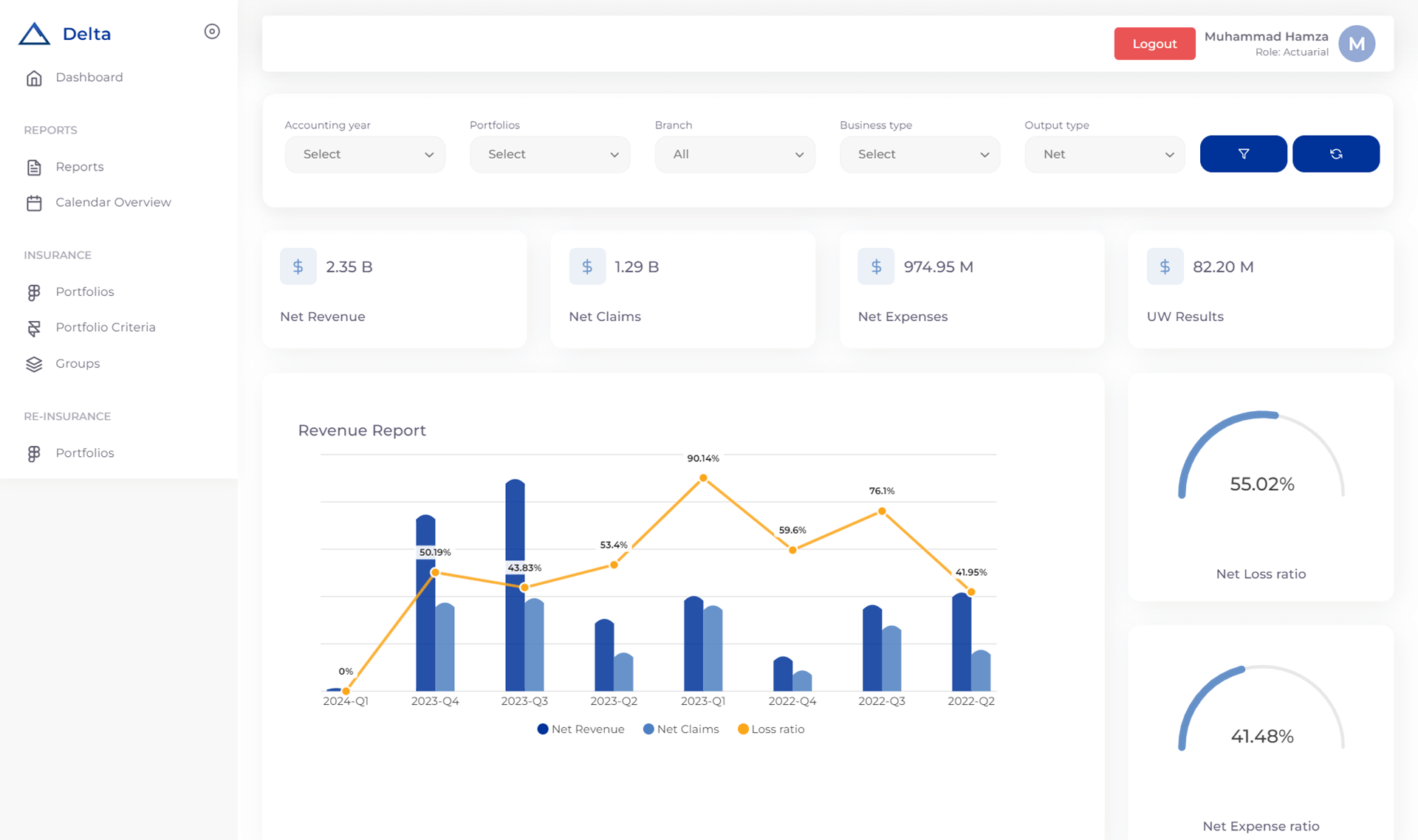
Delta is a cloud platform built for insurers to run IFRS 17 measurement, CSM and disclosure in one place.
Our Delta IFRS 17 platform covers insurance accounting end to end, so teams can run the numbers in house.
IFRS 17 is the global standard for insurance contracts, effective for annual periods from 1 January 2023. It asks insurers to measure contracts on current assumptions and to release profit via the Contractual Service Margin. For the full picture, read the plain-language IFRS 17 explainer.
The IFRS Foundation's jurisdiction profile, updated on 31 July 2026, says the Insurance Development and Regulatory Authority has issued no formal guidance on adopting IFRS 17. Companies listed on the Dhaka and Chittagong exchanges must use IFRS Accounting Standards, and insurers also follow their regulator's rules. Confirm your current position with IDRA and your auditor.
The Financial Reporting Council, created under the Financial Reporting Act 2015, sets financial reporting, auditing and actuarial standards and monitors public interest entities. In September 2022 the IDRA chairman said regulators would draft an IFRS 17 action plan with ICAB and the FRC.
Yes. Data mapping, assumption governance and model design do not depend on a regulator date, and finishing them early removes pressure from the first formal close. Prima begins IFRS 17 implementation support in Bangladesh with a gap review for this reason.
A gap analysis compares your actuarial, accounting and data practice with IFRS 17 and records each difference. Prima delivers a written report and a ranked roadmap in the first weeks after the project starts.
Scope follows policy book size, how many contract groups exist and how much data needs rebuilding. Prima fixes scope after the gap analysis, so the plan rests on your own portfolio.
Timing depends on data readiness and product complexity. A gap analysis gives a realistic timeline for your portfolio, which is better than a generic industry average.
Yes. Prima delivers full project implementation and, afterwards, ongoing IFRS 17 support in Bangladesh through access to actuarial and reporting specialists once the system is live.
Exchange-listed companies must apply IFRS Accounting Standards, but insurers also follow their own regulator, and IDRA has set no IFRS 17 date. Listed insurers should check timing with their auditor and IDRA before fixing a plan.
Under IFRS 4 each market kept its own insurance accounting habits. IFRS 17 replaces them with one principles-based model, and the IFRS 17 and IFRS 4 comparison includes worked examples.
Yes. Their insurance contracts are in scope, and participant fund separation and surplus sharing add steps that conventional insurers skip.
Only for insurance products they issue, not for banking activity as a whole. A product-line review shows what is in scope, and the IFRS 17 and IFRS 9 overlap matters for banks with insurance subsidiaries. Banks in Bangladesh can also read about IFRS 9 implementation support in Bangladesh.
Both, with one accountable lead. Finance owns the reported numbers and actuarial owns the cash flow models, so the data model between them needs a single owner. For IFRS 17 in Bangladesh, the gap review run by Prima's actuarial services team names that owner early.
Regulator guidance may arrive later than the work needs to start. Models and data built now can be refined as guidance lands, while a rushed first close usually cannot. Whether you are starting from a blank page or tidying a first draft of the numbers, Prima Consulting delivers documented methods, validated results and audit-ready workings your insurer needs in Bangladesh. The full range of work is listed under Prima Consulting services.
Ready to elevate your business with Prima Consulting? Fill out the form below to discuss your needs with our experts and discover how we can help you achieve your business goals.
We Schedule a call at your convenience
We do a discovery and consulting meeting
We prepare a proposal
Regulatory Compliance Notice
Our services are delivered in accordance with applicable laws and regulations in each jurisdiction.
Prima Consulting provides its services and engages in accordance with the local applicable laws, regulations, professional standards, and regulatory requirements of the jurisdiction in which each service is performed.
Thus, our services are delivered through the appropriate Prima network firm, office or, where required, an appropriately licensed or authorised professional partner. Where a service is not to be provided by one Prima Consulting entity, it may be provided through another Prima Consulting entity or an appropriately authorised third party or not at all for some services, subject to applicable laws and regulations and we ensure strict compliance in this regard.
Nothing on this website constitutes a representation that any particular Prima Consulting entity is licensed or authorised to provide every service in every jurisdiction. Regulatory permissions and service eligibility are assessed on a service-by-service and jurisdiction-by-jurisdiction basis. This is done to ensure compliance in the face of changing local and global trends in laws, regulations and standard best practices.
The user of this website by entering accepts that such services shall be sought and procured through official legal channels appropriate and allowed for such service. In case of any ambiguity in this regard, it is strongly advisable to seek help from professionals or our team.