TL;DR
The right BPM consulting firms fix late closes, invoice pileups, and compliance headaches. Most don’t. This guide gives you the criteria that actually separate the two, the questions to ask before you sign a contract, and how to build a shortlist for finance operations specifically. You’ll see how the best BPM consulting firms measure ROI, handle change management, and scale with your team. From AP automation to IFRS-aligned reporting and risk control, it covers what separates firms that deliver from those that just present decks. Read it before you shortlist anyone.
Top BPM Consulting Firms for Finance Operations
Your finance team closes the books late every quarter. Invoices pile up. Approvals bounce between inboxes. Reports take days to produce. Sound familiar? These aren’t just workflow problems. They’re symptoms of broken processes that cost real money.
That’s where BPM consulting firms come in. Business process management consultants map, redesign, and automate the workflows slowing your finance function down. But not all firms deliver the same results. Choosing the wrong one wastes time, budget, and trust.
This guide breaks down what to look for in bpm consulting firms, what questions to ask, how the process works, and which trends matter for finance in 2026.
Who we are
50+ years of combined IFRS, risk, and actuarial expertise
Prima Consulting serves banks, insurers, and corporates across Saudi Arabia, UAE, Pakistan, Ireland, and Europe, delivering IFRS advisory, ECL modelling, risk management, and audit support.
BPM Consulting Firms: How to Choose the Right One
What Do BPM Consulting Firms Do?
BPM consulting firms analyze your existing workflows, find where things break down, and redesign those processes for better results. That said, they don’t just draw flowcharts.
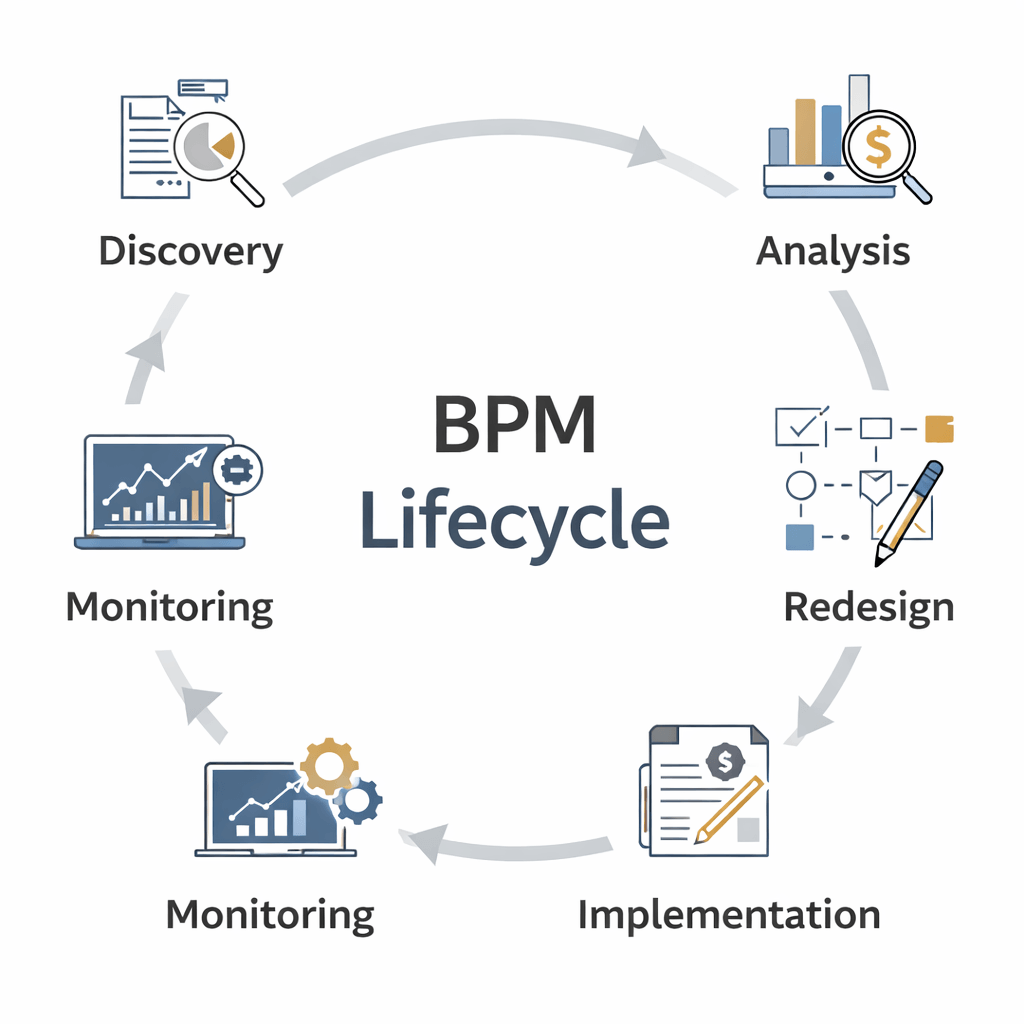
They also handle technology selection, system integration, staff training, and post-launch monitoring. From discovery to continuous improvement, a solid firm stays involved through the entire lifecycle.
Good business process management consulting covers five core phases: process discovery, current-state analysis, process redesign, implementation, and ongoing monitoring.
Why Finance Teams Need BPM Consultants
Finance is one of the most process-heavy functions in any business. Accounts payable (AP), accounts receivable (AR), financial close, and compliance reporting all run on defined sequences.
When those sequences have gaps, costs climb fast.
Consider this: the average manual invoice costs $15 to process and takes 14.6 days, according to DocuClipper. That’s before accounting for errors, which affect roughly 39% of invoices.
BPM consultants cut through that waste. They identify duplication, flag approval bottlenecks, and set up automation that actually fits your finance stack. The result is faster closes, fewer errors, and better compliance.
BPM vs Traditional Process Consulting
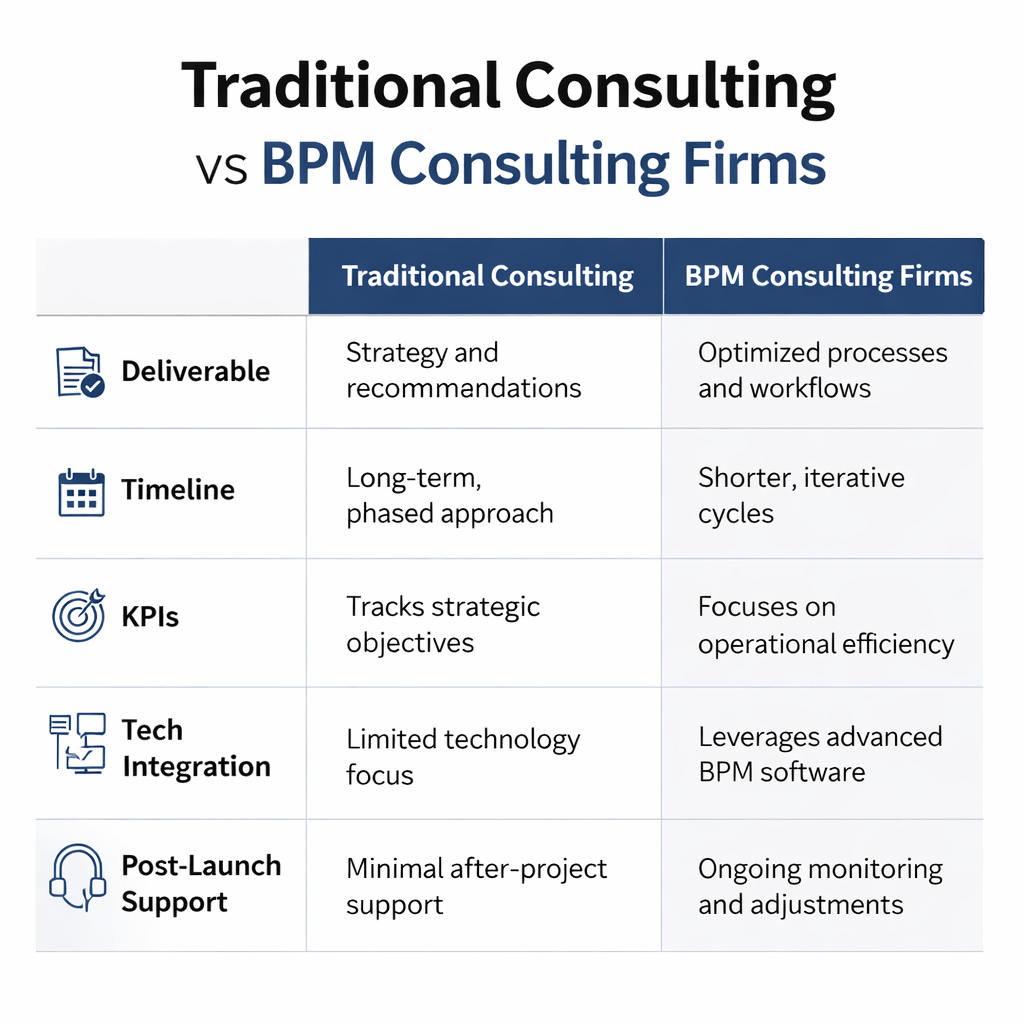
Traditional consultants hand you a report and leave. BPM consulting firms stay through implementation and take ownership of measurable outcomes.
The difference is accountability. BPM firms tie their work to KPIs: cycle times, error rates, cost per transaction, compliance scores. You’re not buying advice. You’re buying results.
Key Criteria to Evaluate BPM Consulting Firms
Industry Experience in Finance Operations
Finance isn’t a generic process environment. It runs on regulatory timelines, IFRS standards, tax cycles, and audit trails. A BPM firm without finance-specific experience will miss the nuances that matter most.
Ask for case studies in AP, AR, financial close, or risk management. Look for evidence of work in your industry vertical, whether that’s banking, insurance, manufacturing, or corporate finance.
You can also ask for references from finance leaders, not just IT directors. That tells you whether the firm understands operations or just the technology side.
Process Mapping and Automation Expertise
Process mapping is the foundation of every BPM project. If a firm can’t show you clear as-is and to-be process maps, that’s a red flag.
Look for firms that use tools like Lucidchart, Bizagi, or Celonis for mapping, and platforms like UiPath or Power Automate for RPA. Their tech stack signals how seriously they take execution.
You’ll also want to check their bpm optimization methodology. Ask specifically how they handle exceptions, edge cases, and finance-specific approval hierarchies.
Technology Stack and Integration Capabilities
Your finance systems are probably already layered: an ERP, a reporting tool, maybe a payroll platform. Any BPM firm you hire needs to integrate with that stack, not replace it.
Check for API experience, ERP integration track records (SAP, Oracle, Microsoft Dynamics), and cloud readiness. Firms that only work with one platform create dependency. Firms with broad integration experience create flexibility.
Proven Results and Case Studies
Case studies aren’t optional. They’re proof. Ask every firm you consider to walk you through a finance-specific engagement from start to finish.
You want to see measurable outcomes: percentage reduction in invoice processing time, improvement in approval cycle duration, cost savings per transaction. If a firm can’t quantify past wins, they won’t be able to quantify yours.
Explore our advisory services
What Questions Should You Ask BPM Firms?
How Do They Measure ROI and KPIs?
This is the most important question you can ask. A good BPM consulting firm should give you a clear framework for measuring ROI before the project starts.
Typical finance KPIs include invoice processing cost, days payable outstanding (DPO), close cycle time, error rate per transaction, and compliance audit scores.
According to Fortune Business Insights, the global BPM market was valued at USD 21.51 billion in 2025 and is projected to reach USD 91.87 billion by 2034, growing at 17.2% CAGR. That growth is driven by measurable ROI, not theory.
What Is Their Implementation Approach?
Some firms do big-bang implementations. Others take a phased approach. For finance, phased is almost always safer.
Ask whether they run pilots before full rollout, how they handle rollbacks if something breaks, for a week-by-week project plan, not just a summary.
A phased rollout lets you validate results at each stage and course-correct without disrupting your entire finance operation.
How Do They Handle Change Management?
BPM projects don’t fail because of bad technology. They fail because finance teams don’t adopt the new way of working.
Ask what training is included. Ask how the firm handles resistance from AP clerks, finance managers, or department heads who are used to doing things a certain way.
The best BPM consulting firms build structured change management into scope: communication plans, training sessions, feedback loops, and on-site support during go-live.
Free Consultation
Ready to discuss your specific situation?
Prima’s advisors work with organisations across the GCC, Europe, and Asia-Pacific. First conversation is always free — no pitch, just expertise.
BPM Consulting Process: From Assessment to Execution
As-Is vs To-Be Process Design
Every BPM engagement starts with mapping what’s actually happening today. That’s the as-is state: every step, every handoff, every manual workaround your team has built over the years.
From there, the firm builds the to-be design: a streamlined version that removes duplication, automates repetitive tasks, and shortens cycle times. The gap between the two is where savings live.
In finance, that gap runs deeper than most CFOs expect. Firms doing this work well keep finding more savings the closer they look.
Workflow Optimization and Automation
Once the to-be design is approved, the firm begins implementation. For finance, this typically means automating invoice capture, routing approvals digitally, and syncing data across ERP modules.
Automation has a measurable impact. Automated AP solutions can cut invoice processing times by up to 80%, according to Payouts.com. That’s not marginal. That’s transformative.
On top of that, automating business processes saves organizations an average of $51,000 per year, per Cflow. For a finance team running dozens of processes, the math adds up fast.
Continuous Improvement Frameworks
Good BPM doesn’t end at launch. The best firms build a continuous improvement cycle into the engagement, using performance data to keep refining workflows over time.
This is critical for finance because regulatory changes, headcount shifts, and growth all affect how processes need to work. A firm that monitors and adjusts saves you from having to start over in two years.
Benefits of Hiring BPM Consulting Firms
Cost Reduction and Efficiency Gains
The cost case for BPM in finance is straightforward. Manual processes burn time and money at every step.
AP automation alone can deliver a 67% reduction in invoice processing costs, per Kefron. The same data shows 99% accuracy in automated data capture, cutting down the error correction cost that plagues manual finance teams.
For a mid-sized finance team processing thousands of invoices monthly, that’s a material impact on the bottom line.
Improved Financial Reporting Accuracy
Faster close cycles and cleaner data directly improve financial reporting. When your AP, AR, and GL processes run on structured, automated workflows, your reports reflect reality.
That matters for board reporting, investor disclosures, IFRS compliance, and audit readiness. Business process management consultant teams that specialize in finance understand these reporting needs and design processes accordingly.
Enhanced Compliance and Risk Control
Compliance isn’t optional for finance. Whether you’re dealing with VAT regulations, IFRS reporting, anti-money laundering (AML) requirements, or internal audit standards, your processes need to leave a clean trail.
BPM consulting firms build compliance into workflow design from day one. Approval hierarchies, audit logs, segregation of duties, and exception flagging are all part of a well-designed finance process.
BPM services for risk management specifically target these control points, reducing the chance of regulatory violations and financial misstatements.
Common Challenges in BPM Implementation
Resistance to Change in Finance Teams
Finance teams are often cautious by nature. They’ve built reliable workarounds over years of doing things manually. New processes feel risky.
The fix isn’t to force adoption. It’s to involve finance staff in the redesign process from the start. When the people doing the work help design the new process, they’re far more likely to follow it.
Data Integration and System Silos
Most finance departments run multiple systems that don’t talk to each other: a separate AR platform, a payroll tool, a manual expense tracking sheet.
That’s where integration expertise matters most. BPM consulting firms with strong API and ERP experience can connect those silos without forcing a costly system replacement.
Scaling Process Improvements
A process that works for 50 invoices a day may break at 500. BPM implementations need to be built for scale from day one.
Ask any firm you’re considering how they’ve handled rapid growth scenarios. Look for examples of finance teams that scaled without rebuilding their workflows from scratch.
How to Compare BPM Consulting Firms Effectively
Pricing Models and Engagement Types
Most bpm consulting services come in three pricing structures: fixed-fee project, time and materials, or retainer-based managed service.
For finance teams running their first BPM project, a fixed-fee model gives predictable costs. For ongoing optimization and monitoring, a retainer works better.
Ask each firm to clarify what’s included at each pricing tier. Training, post-go-live support, and software licensing are often quoted separately.
In-House vs Outsourced BPM Strategy
Some companies try to run BPM projects using internal resources. That works when you have dedicated process improvement staff. For most finance teams, it doesn’t.
External BPM consulting firms bring methodology, tools, and experience you can’t build internally without significant investment. They’ve seen what works across dozens of similar projects. You haven’t.
The real question isn’t whether to outsource. It’s which firm to choose and how involved your internal team will stay throughout.
Shortlist Checklist for Decision-Making
Use these criteria to narrow your list of bpm consulting firms:
- Finance-specific case studies with quantifiable results
- Clear KPI measurement framework before project start
- Phased implementation methodology
- ERP and legacy system integration experience
- Change management and training included in scope
- Post-launch monitoring and continuous improvement support
- Transparent pricing with no hidden licensing costs
- References from finance leaders, not just IT contacts
Trends in BPM Consulting for Finance (2026)
AI and Automation in Finance Processes
AI is no longer optional in BPM. It’s becoming core to how finance workflows get designed and run.
According to McKinsey data, AI implementation in professional services surged from 33% in 2023 to 71% in 2024. AI consulting is expected to reach 40% of firm revenue by 2026.
For finance, that means intelligent invoice routing, predictive exception flagging, real-time fraud detection, and AI-assisted reconciliation. The best bpm consulting firms are already building these capabilities into standard finance process designs.
Data-Driven Decision Making
Finance has always been numbers-driven. But BPM consulting now gives finance leaders real-time visibility into how their processes perform, not just what the financials look like.
Process mining tools like Celonis sit on top of your existing ERP data and show you exactly where delays, errors, and compliance gaps live. That’s data that drives smarter process decisions.
Feasibility study consultants working in finance now factor process performance data into business case modeling. A financially viable process is also an operationally sound one.
Cloud-Based BPM Solutions
Cloud-based BPM is the dominant deployment model. According to Precedence Research, cloud-based deployment generated more than 64% of total BPM market revenue in 2024.
For finance teams, cloud BPM means lower infrastructure costs, faster deployment, and easier scaling. It also means your process data can integrate across geographies, which matters for multinational finance operations.
Whether you’re looking at the best BPM consulting firms in Pakistan, feasibility study services in the Middle East, or managed payroll in KSA, cloud-first firms will give you the most flexible long-term platform.
How the Right BPM Consulting Firms Change Finance for Good
Slow closes, manual errors, compliance gaps: these aren’t inevitable. They’re fixable with the right bpm consulting firms and a clear process improvement strategy.
The best BPM consulting firms deliver more than process maps. They deliver measurable improvements in cost, accuracy, compliance, and scalability, and they do it with your team, not around it.
At Prima Consulting, our business process management consulting practice is built specifically for finance operations. From AP redesign and workflow automation to IFRS-aligned reporting processes and risk management frameworks, we bring finance-specific expertise that generic BPM firms can’t match.
Ready to see where your finance processes can improve? Get a structured process assessment from Prima Consulting, with clear, measurable recommendations.