TL;DR
Choosing the right IFRS 2 advisory services KSA partner is critical for companies managing complex share-based payment accounting. This guide shows why expert support matters, how to evaluate potential advisors, what services you actually need, and practical ways to reduce compliance risks. You’ll get actionable criteria for selecting partners who bring technical depth, local regulatory knowledge, and implementation experience that turns IFRS 2 compliance from a burden into a strategic advantage for your organization.
Why IFRS 2 Advisory Services KSA Matter for Your Business
Share-based compensation isn’t optional anymore for companies in growing capital markets.
You’re planning an IPO, rolling out employee stock options, or restructuring executive pay packages. The accounting requirements under IFRS 2 Share-Based Payments can make or break your financial reporting credibility. One misstep triggers regulatory scrutiny, delays listings, and damages investor trust.
Saudi Arabia raised $4.1 billion through 42 IPO listings in 2024, the highest in the GCC. With 239 companies listed on Tadawul and market capitalization exceeding $3 trillion, demand for specialized IFRS 2 advisory services KSA has grown rapidly.
Finding the right advisory partner isn’t about picking the biggest firm. It’s about technical depth, local market understanding, and practical implementation experience. This guide shows you exactly how to evaluate and select the best IFRS 2 advisory services KSA providers who’ll protect your compliance and strengthen your financial reporting.
Understanding IFRS 2 Share-Based Payment Requirements
IFRS 2 implementation governs how you account for share-based payment transactions. This covers stock options, restricted stock units, performance shares, and employee share purchase plans.
The standard requires recognizing equity compensation at fair value as an expense. Simple concept, but execution gets complex fast.
Why does this matter right now? Vision 2030 has transformed the Kingdom’s economic landscape. Non-oil revenue hit $137.29 billion in 2024, up 113% from 2016 baseline.
The private sector now contributes 47% of GDP, exceeding 2024 targets. More private sector growth means more companies accessing capital markets. More IPOs mean more equity compensation plans requiring IFRS 2 consultants UAE and KSA expertise.
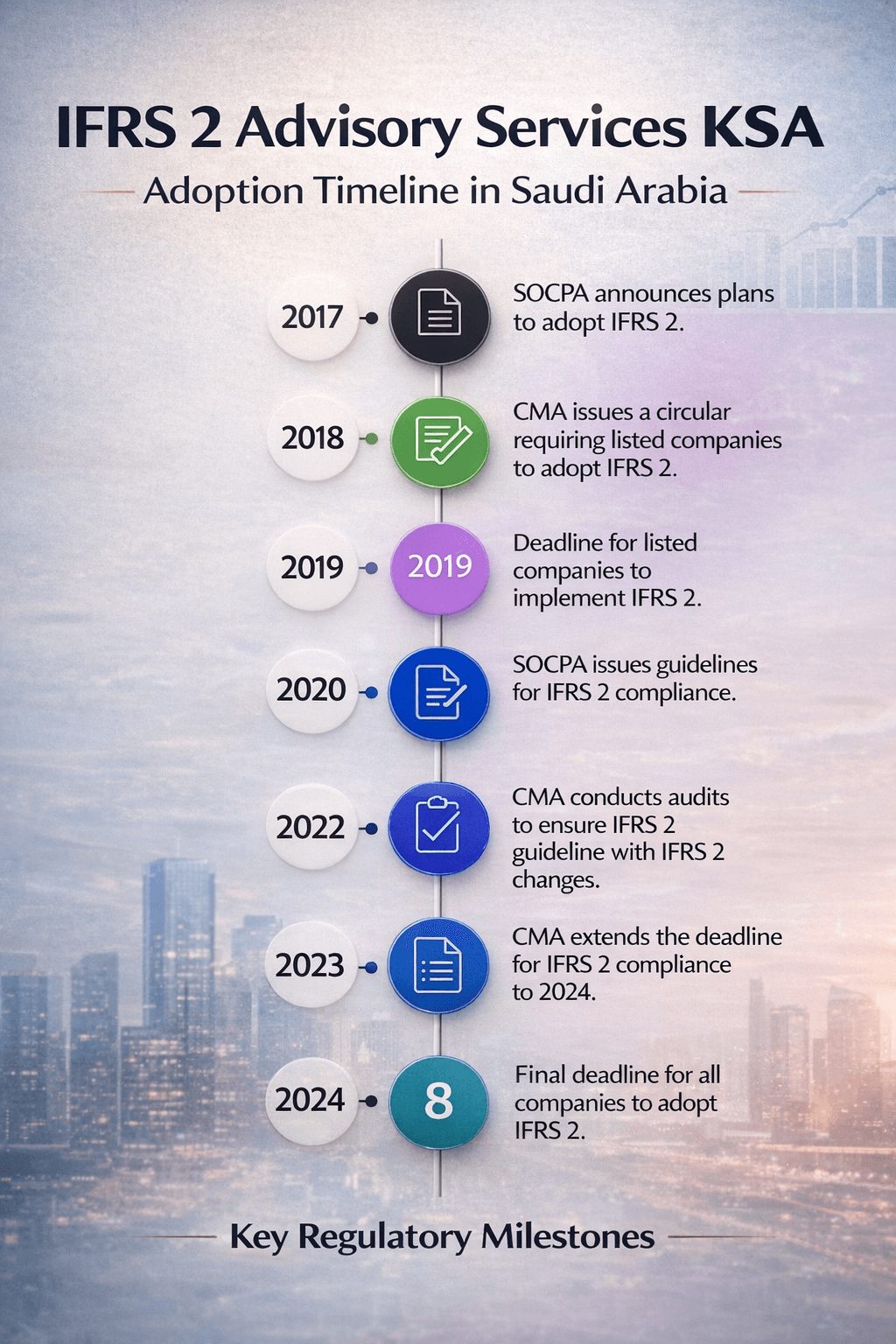
All listed companies adopted IFRS for financial periods beginning January 1, 2017. Non-compliance isn’t an option. SOCPA enforces standards strictly, and penalties for misreporting can be severe.
IFRS 2 compliance protects you from regulatory risk. It builds investor confidence by showing your financial statements reflect true economic costs of equity compensation.
That said, selecting qualified IFRS 2 advisory services KSA becomes critical when you’re managing these complex requirements. The right partner understands both global standards and local nuances that affect your implementation approach.
What IFRS 2 Covers: Scope and Transaction Types
Get the scope wrong and every downstream number is wrong too.
IFRS 2 governs how you recognise, measure, and disclose share-based payment transactions. It reaches further than most finance teams expect. The standard captures employee stock options, share appreciation rights, employee share purchase plans, and phantom share arrangements. If your people receive anything whose value tracks your share price, IFRS 2 almost certainly applies.
Regional listing rules make this sharper. Companies on the Dubai Financial Market and the Saudi Stock Exchange must apply IFRS 2 to their equity plans, and regulators read those disclosures closely. A phantom plan you treated as a simple bonus can turn out to be a cash-settled award that needs remeasurement every reporting date.
So the first question good IFRS 2 share-based payment consultants ask isn’t “how do we value this?” It’s “which of your arrangements even fall inside the standard?” Answer that badly and the valuation work is built on sand. Where does your current plan register list stand on that test?
Core Principles of IFRS 2 Share-Based Payment Accounting
IFRS 2 splits share-based payments into three transaction types. Each has different measurement and recognition rules you must follow correctly.
Equity-settled transactions: You grant shares or stock options to employees. Measure fair value at grant date and recognize it over the vesting period.
Cash-settled transactions: You promise cash payments based on share price. Remeasure fair value at each reporting date until settlement occurs.
Choice of settlement: Either party can choose equity or cash settlement. Accounting depends on who controls the choice ultimately.
The core principle is straightforward. Record goods or services received at fair value. If you can’t measure those directly, use the fair value of equity instruments granted instead.
Vesting conditions change your calculations significantly. Service conditions and non-market performance conditions affect the number of awards expected to vest. Market conditions affect grant-date fair value but not subsequent estimates you make.
Measurement timing differs by transaction type substantially. Equity-settled awards use grant-date fair value only. Cash-settled awards require remeasurement every reporting date continuously.
Expense recognition follows straight-line basis over the vesting period for equity-settled awards. You adjust for forfeitures as they occur or estimate them upfront consistently.
Understanding IFRS 2 share-based payment fundamentals prevents costly mistakes during implementation processes. Share-based payment advisory experts help you apply these principles correctly from day one of your program.
Disclosure requirements are extensive and detailed. You must explain the nature of arrangements, how you determined fair values, and the effect on profit and financial position clearly.
Companies seeking IFRS 2 advisory services KSA need advisors who can translate these technical principles into practical accounting policies. The gap between theory and application is where most implementation problems occur regularly.
Grant Date and Vesting Period: The Two Dates That Set Your Expense
Two dates decide most of your IFRS 2 numbers. Miss either and the whole expense schedule shifts.
Pinning Down the Grant Date
Grant date is the point where you and the employee reach a shared understanding of the award’s terms and conditions. Sounds simple. It rarely is.
Board approval timing, shareholder consent, regulatory sign-off, and the employee acceptance window all muddy the picture. A plan “approved” in a March board meeting might not reach grant date until shareholders ratify it in May. That two-month gap changes the share price you measure against, and with it your expense. Getting the date wrong by one reporting period can misstate the charge materially.
Choosing the Right Vesting Treatment
Vesting conditions fall into three buckets, and IFRS 2 treats each differently. Service conditions turn on continued employment. Non-market performance conditions turn on targets like revenue or profit. Market conditions turn on share price or total shareholder return.
Here’s the catch that trips teams up. Service and non-market conditions change how many awards you expect to vest, so you true up the count over time. Market conditions get baked into grant-date fair value and never get revisited, even if the target is missed. Mix these up and you either over-accrue or under-accrue for years. Which condition type dominates your current plan design?
Challenges Specific to IFRS 2 Implementation
Companies face unique obstacles when implementing IFRS 2 requirements. The regulatory environment, technology gaps, and talent shortages create real friction points throughout the process.
Local Regulatory Considerations and SOCPA Guidelines
SOCPA provides the regulatory framework for accounting standards domestically. While IFRS is adopted, local interpretations add complexity to your implementation efforts.
Saudi Arabian Accounting Standards became mandatory for listed companies starting January 1, 2023. This layered additional compliance requirements on top of IFRS obligations already in place.
The Capital Market Authority scrutinizes financial statements closely, especially during IPO processes. Any IFRS 2 misstatements can delay listings or trigger enforcement actions against your company.
Corporate governance regulations were amended effective January 1, 2024, strengthening audit and remuneration committee requirements. These bodies must understand IFRS 2 implications for executive compensation programs thoroughly.
The language barrier presents real challenges for many organizations. Most IFRS guidance is in English, but many finance teams work primarily in Arabic. Translation gaps lead to misinterpretation of requirements.
Finding expert IFRS 2 help requires advisors who can communicate technical concepts in both languages effectively. This bridges the knowledge gap between global standards and local implementation needs directly.
Working with experienced IFRS 2 consultants UAE and KSA firms familiar with SOCPA requirements reduces regulatory risk significantly. They know what regulators expect and how to document your compliance properly.
System and Technology Gaps for IFRS 2 Compliance
Many companies lack specialized software for managing equity compensation plans accurately. Manual spreadsheets create error risks and make audit trails difficult to maintain.
IFRS 2 requires tracking individual grants, vesting schedules, exercise activity, and forfeiture patterns continuously. This data must feed into financial reporting systems accurately and timely.
Integration between HR systems and accounting platforms often doesn’t exist at all. When HR administers equity plans separately, reconciliation becomes a nightmare for finance teams.
Valuation models need regular updates for changing inputs like volatility, risk-free rates, and expected terms. Without proper systems, these calculations become time-consuming and error-prone throughout the year.
Cloud-based equity management platforms are available but adoption lags other markets noticeably. Cultural preferences for on-premise solutions and data privacy concerns slow implementation significantly.
Share-based payment advisory services must address both accounting and technology dimensions together. You need advisors who understand systems integration, not just accounting theory alone.
The best IFRS 2 advisory services KSA providers help you select and implement appropriate technology solutions practically. They know which platforms work in the local context and how to integrate them with your existing systems efficiently.
How to Evaluate IFRS 2 Advisory Services KSA Partners
Choosing the right partner requires a structured evaluation process. Don’t just pick the biggest name or cheapest option available.
Criteria for Choosing a Trusted Advisory Partner
Technical competence comes first every time. Your advisor must understand IFRS 2 inside out completely. They should stay current with IFRS Interpretations Committee decisions and emerging issues constantly.
Look for firms with actuarial or valuation specialists on staff permanently. IFRS 2 often requires complex option pricing models demanding mathematical sophistication beyond typical accounting skills alone.
Track record matters for your decision significantly. Ask for case studies of similar engagements in Saudi Arabia or the broader Middle East region. Client references give you real insights into working relationships and outcomes.
Communication skills can’t be overlooked at all. Technical brilliance means nothing if your advisor can’t explain concepts clearly to your board or audit committee members.
Service integration adds value to your engagement substantially. Firms offering both Middle East IFRS consulting and audit support provide continuous assistance throughout the year. They understand auditor expectations and documentation requirements thoroughly.
Cultural fit affects project success more than most realize. Your advisor should respect local business practices while bringing global best practices forward. They need to work within your organizational hierarchy respectfully.
When evaluating IFRS 2 advisory services pricing, don’t focus solely on hourly rates charged. Consider the total value delivered, including risk reduction, time savings, and knowledge transfer to your team members.
Importance of Industry Experience and Local Market Knowledge
Industry specialization creates significant value for your organization specifically. IFRS 2 challenges differ between technology startups, traditional family businesses going public, and state-owned enterprises substantially.
Advisors with banking sector experience understand unique equity structures financial institutions use regularly. Those with oil and gas expertise know the nuances of performance units tied to commodity prices directly.
Local market knowledge prevents costly mistakes during implementation processes. Regional regulatory requirements, Tadawul listing rules, and SOCPA interpretations require hands-on experience locally.
Your advisor should have relationships with local regulators, auditors, and legal advisors already. These connections smooth approval processes and resolve technical questions faster than starting fresh.
In 2024, over 31 IPOs were priced, with volumes standing at $11.8 billion. Advisors active in this market bring current knowledge of practices and investor expectations realistically.
Language capabilities matter for effective collaboration with your teams. Bilingual teams who work in both English and Arabic eliminate communication barriers with your local staff members.
The best IFRS 2 advisory services KSA firms combine global technical expertise with deep local market understanding. This combination is rare but incredibly valuable for successful implementations across the board.
Prima Consulting
Need expert guidance on this topic? Our advisory team is available for a free initial consultation.
No obligation · Responds within 1 business day · GCC, Europe & APAC
Essential IFRS 2 Advisory Services: Scope and Deliverables
Understanding what services you need prevents scope gaps and budget overruns later. Here’s what core deliverables should include for your engagement.
Policy development: Your advisor creates IFRS 2 accounting policies tailored to your equity compensation plans specifically. This includes recognition, measurement, and disclosure policies compliant with IFRS and local requirements simultaneously.
Grant-date valuations: Fair value determinations for new equity awards using appropriate valuation techniques professionally. This includes option pricing models, Monte Carlo simulations, and market-based condition modeling accurately.
Ongoing measurement support: For cash-settled awards or plans with market conditions, your advisor provides remeasurement support at each reporting date. This includes updating inputs and recalculating fair values continuously.
Expense calculation assistance: Determining correct expense amounts for each reporting period based on vesting progress, forfeiture estimates, and performance condition assessments accurately.
Disclosure preparation: Drafting the IFRS 2 note disclosure for your financial statements, including quantitative and qualitative information the standard requires comprehensively.
Successful IFRS 2 implementation depends on complete service scope definition upfront clearly. Gaps found mid-project create delays and cost overruns that could have been avoided with better planning initially.
Technical accounting memos: Documenting complex IFRS 2 judgments and positions for internal use and external audit support thoroughly. These memos become critical defense files during audits annually.
IFRS 2 audit support: Working alongside your external auditors to address technical questions and provide supporting documentation promptly. This reduces audit adjustments and accelerates timelines significantly.
Implementation project management: For companies adopting equity compensation plans for the first time, advisors manage end-to-end implementation from plan design through first-year accounting comprehensively.
Quality IFRS 2 compliance consultant services include all these deliverables in an integrated package. Piecemeal approaches create gaps and increase your overall risk unnecessarily.
A Phased Roadmap for IFRS 2 Implementation
A good IFRS 2 rollout isn’t one big push. It’s three deliberate phases, each with a different job.
It starts with a gap analysis. Your advisor reviews existing award agreements, board resolutions, and employee communications, then flags what’s missing against IFRS 2. This is where teams discover their current accounting software can’t track vesting or forfeitures at grant level. Better to learn that now than during an audit.
Phase 1 tackles the fires. Critical gaps that expose you to immediate regulatory risk get fixed first, so a looming reporting deadline doesn’t catch you short.
Phase 2 builds the machinery. This is where you put real valuation procedures, expense recognition workflows, and reconciliation controls in place, the plumbing that keeps numbers reliable quarter after quarter.
Phase 3 makes it sustainable. Processes get streamlined so ongoing compliance stops eating your team’s month-end. Done right, your reliance on outside IFRS advisory and accounting support drops each year. Which phase would stress-test your current setup hardest?
Valuation Methods for Share-Based Payments under IFRS 2
Accurate valuation sits at the heart of IFRS 2 compliance completely. The methods you use must reflect specific terms and conditions of your equity awards precisely.
Black-Scholes and Other Sophisticated Valuation Models
The Black-Scholes-Merton model is the most common approach for plain vanilla stock options. It considers current share price, exercise price, expected term, risk-free rate, expected volatility, and expected dividends systematically.
For options with market conditions or complex features, Monte Carlo simulation provides more flexibility significantly. This approach models thousands of potential stock price paths and calculates expected payoff accurately.
Binomial models offer a middle ground between simplicity and accuracy. They’re more adaptable than Black-Scholes for American-style options that can be exercised early, but less computationally intensive than Monte Carlo methods.
Total shareholder return awards require specialized modeling techniques specifically. You simulate both your company’s stock performance and the comparator group’s performance to determine vesting probability realistically.
Restricted stock units are simpler to value than options. For time-based vesting, you use share price at grant date minus present value of expected dividends during vesting period.
The expected term assumption drives option values significantly in all models. You analyze historical exercise behavior, considering factors like employee level, vesting schedule, and in-the-money amounts carefully.
Volatility estimates come from historical stock price movements for public companies directly. Private companies look to comparable public companies or industry indices for reasonable estimates.
Expert IFRS 2 help includes selecting the right valuation model for your specific awards appropriately. Advisors should explain why they recommend certain approaches and how different models would affect your results materially.
Valuation Challenges for Unlisted Entities and Performance Rights
Private companies face unique valuation hurdles without public market prices. You can’t just pull a stock price from an exchange easily.
Recent transaction prices provide one data point for consideration. But these might not reflect fair value if transactions were between related parties or involved restricted shares only.
Option pricing method backsolves equity value from recent debt or preferred equity transactions mathematically. This requires assumptions about capital structure and allocation of enterprise value to common equity specifically.
Market approach uses valuation multiples from comparable public companies in your industry. You adjust multiples for size, growth, and liquidity differences between your private company and public comparables carefully.
Income approach discounts projected cash flows to present value professionally. This becomes your equity value starting point before applying IFRS 2 measurement requirements additionally.
Performance rights tied to non-market conditions require probability assessments regularly. You estimate likelihood of achieving each performance level and weight grant-date fair value accordingly.
The lack of observable market prices means greater judgment throughout. Your advisor should document all assumptions and consider sensitivity analyses showing how value changes with different inputs materially.
IFRS 2 advisory services pricing for private companies typically runs higher than for public companies. The additional valuation complexity requires more time and specialized expertise from equity compensation experts consistently.

Compliance and Risk Mitigation Strategies for IFRS 2
Staying compliant isn’t a one-time exercise at all. You need ongoing processes and controls to manage IFRS 2 risks effectively.
Centralized equity plan administration: Consolidate all equity compensation data in one system. This single source of truth feeds your accounting records and prevents reconciliation issues entirely.
Grant documentation standards: Create templates for all equity awards that capture every IFRS 2-relevant term and condition. Missing details cause measurement problems later during valuations.
Quarterly reconciliation procedures: Match your equity management system to your general ledger every quarter. Investigate variances immediately before they compound over time.
Forfeiture tracking mechanisms: Monitor all terminations and forfeitures in real-time. Update your expense calculations based on actual experience versus estimates promptly.
Modification protocols: Set up approval workflows for any changes to existing equity awards. IFRS 2 has specific rules for modifications that can create incremental expense unexpectedly.
Board and committee education: Train your compensation committee on IFRS 2 implications of plan design choices. Prevention beats correction every time in compliance matters.
External audit coordination: Meet with your auditors quarterly to discuss IFRS 2 matters. Don’t wait until year-end to surface complex issues requiring resolution.
Regulatory monitoring: Track SOCPA updates, CMA guidance, and IFRS Interpretations Committee discussions relevant to share-based payments. Early awareness prevents last-minute scrambles annually.
IFRS 2 compliance consultant support should include control design recommendations specifically. Strong internal controls reduce your reliance on external advisors over time significantly.
Experienced IFRS 2 advisory services KSA providers help you build sustainable compliance processes. They don’t just do the work for you but teach you how to maintain compliance independently.
Where IFRS 2 Reporting Goes Wrong (And What It Costs You)
Auditors see the same IFRS 2 errors again and again. Knowing them upfront saves you an ugly year-end.
The classic mistake is treating a cash-settled award like an equity-settled one. Skip the remeasurement and your liability sits frozen while the share price moves, so the charge is wrong every reporting date until someone catches it. Grant-date errors run a close second, followed by forfeiture assumptions nobody ever revisits.
When these surface during an audit, the fallout is real. You face restatements, audit adjustments, delayed sign-off, and hard questions from the audit committee. Mid-IPO, a material IFRS 2 misstatement can stall the whole listing while the CMA waits for clean numbers. That’s weeks of lost momentum at the worst possible moment.
The fix isn’t heroics at year-end. It’s a documented policy, quarterly reconciliation, and a second set of expert eyes before the auditor arrives. Prima’s team catches these in review, well before they reach the financial statements. For a deeper checklist, see our guide to common IFRS 2 compliance mistakes. Which of these would your last close have survived?
Integration of IFRS 2 Advisory with Broader IFRS Compliance
IFRS 2 doesn’t exist in isolation from other standards. Your share-based payment accounting intersects with other standards and reporting requirements continuously.
IFRS 15 revenue recognition connects when customer contracts include equity components. You separate the equity element and account for it under IFRS 2 while the service element follows IFRS 15 rules.
IFRS 9 financial instruments applies to cash-settled awards specifically. These create financial liabilities that fall under IFRS 9’s measurement and classification rules directly.
IAS 12 income taxes requires you to recognize deferred tax assets for expected future tax deductions from equity awards. Tax treatment often differs from accounting treatment, creating temporary differences annually.
IAS 19 employee benefits comes into play when share-based payments form part of post-employment benefit arrangements. The interaction between these standards requires careful analysis continuously.
IFRS 3 business combinations has special rules for replacement awards in acquisitions. You must determine how much fair value relates to pre-combination service versus post-combination service carefully.
Comprehensive IFRS advisory services address these intersections proactively. Siloed advice creates gaps that surface during audits or regulatory reviews unexpectedly.
Your IFRS 2 advisory partner should understand these connections thoroughly. Integrated service delivery means your advisor coordinates with tax advisors, legal counsel, and HR consultants directly.
This prevents conflicting advice and maintains internal consistency across all financial reporting areas. The best IFRS 2 consultants UAE and KSA work smoothly within your broader advisory ecosystem.
Explore our advisory services
Training and Ongoing Support in IFRS 2 Advisory Engagements
Advisory services shouldn’t create dependency on external consultants. The goal is building your internal capabilities while providing expert support when needed appropriately.
Technical Training on IFRS 2 Principles
Your finance team needs foundational IFRS 2 knowledge to operate independently. Training should cover the standard’s scope, recognition principles, measurement approaches, and disclosure requirements comprehensively.
Workshops work better than presentations for learning retention. Case studies and practical exercises help teams internalize concepts and apply them to your specific equity plans effectively.
Different audiences need different content tailored appropriately. Your technical accountants require deep measurement and valuation training. Your FP&A team needs to understand expense forecasting implications primarily.
Board and audit committee education focuses on business impacts rather than technical details. They need to understand how plan design choices affect financial results and disclosures materially.
Regular refresher sessions keep knowledge current as your equity plans become more complex. Annual updates on new interpretations and practice developments prevent knowledge decay over time.
Certification programs for your staff show commitment to excellence. While no dedicated IFRS 2 certification exists, broader IFRS credentials show technical depth clearly.
Quality share-based payment advisory includes training as a core deliverable. The investment in your team’s capabilities pays dividends long after the initial implementation completes.
System Training for Accounting Software Integration
Technology training goes beyond IFRS 2 theory significantly. Your team must know how to operate equity management systems and connect them to accounting platforms effectively.
Hands-on system training during implementation promotes smooth adoption across teams. Your staff should practice entering grants, processing exercises, and generating reports in a test environment safely.
Super-user development creates internal experts who can train others and troubleshoot issues. These individuals become your first line of support after the advisor transitions out gradually.
Process documentation captures every step in your IFRS 2 workflow. Written procedures prevent knowledge loss when team members change roles or leave the company entirely.
System upgrades and enhancements require ongoing training periodically. As software evolves, your team needs to learn new features and best practices continuously.
Equity compensation experts provide both technical accounting and system training. This dual capability speeds up your team’s learning curve and reduces implementation time significantly.
IFRS 2 audit support becomes easier when your team understands both the accounting and the systems. Well-trained staff can respond to auditor requests quickly and confidently throughout the year.
Case Studies: Successful IFRS 2 Advisory Implementations
Real-world examples show what successful IFRS 2 advisory looks like in practice. These cases highlight common challenges and solutions that worked effectively.
Case Study 1: Technology Company Pre-IPO Implementation
A technology startup granted stock options to early employees before considering IFRS requirements. With an IPO planned within 18 months, they needed complete IFRS 2 advisory services KSA support urgently.
The advisory team reconstructed historical grants using employment records and board meeting minutes. They built valuation methodologies for periods when the company was private, using comparable public companies and transaction multiples.
Expense calculations required estimating forfeiture rates based on limited historical data. The advisor used industry benchmarks adjusted for company-specific factors like growth stage and employee demographics.
The engagement delivered IFRS 2 policies, three years of catch-up accounting entries, and disclosure notes for the IPO prospectus. Training prepared the finance team to maintain IFRS 2 compliance post-listing independently.
The IPO closed successfully with no accounting adjustments required during regulatory review. Clean financials accelerated the listing timeline and strengthened investor confidence significantly.
This case shows the value of engaging IFRS 2 advisory services KSA early in your IPO planning process. Last-minute implementations create unnecessary stress and risk that could be avoided.
Case Study 2: Family Business Transitioning to Public Markets
A third-generation family business preparing for Tadawul listing needed to implement equity compensation as part of professionalizing management. They had zero experience with IFRS 2 share-based payment accounting previously.
The advisor partnered with the company’s HR and legal teams to design an equity compensation plan meeting market standards while respecting family ownership preferences. This required custom plan features not addressed in standard IFRS 2 guidance directly.
Performance-based restricted stock units tied to strategic objectives demanded sophisticated valuation analysis. The advisor used Monte Carlo simulation to model probability of achieving multiple performance thresholds accurately.
Change management became as important as technical accounting throughout. The advisor helped communicate IFRS 2 expense impacts to family board members accustomed to thinking about equity as “free” compensation traditionally.
The company successfully listed with a market-competitive equity plan. Post-IPO, the advisor provided two years of ongoing support while internal capabilities matured gradually.
Family businesses benefit from Middle East IFRS consulting that understands cultural dynamics. Technical solutions must fit within traditional business structures and decision-making processes respectfully.
Future Trends Impacting IFRS 2 Advisory Needs
The market for IFRS 2 advisory services KSA will continue growing. Several trends are accelerating demand for specialized expertise significantly.
Capital market expansion continues at a rapid pace. Saudi Arabia led the GCC IPO market with 19 listings in H1 2024, raising $2.1 billion, a 141% increase versus 2023.
More listings mean more companies needing expert support from IFRS 2 consultants UAE and KSA. The pipeline of companies preparing for IPOs remains strong through 2026 and beyond realistically.
Private sector growth under Vision 2030 is creating new business models. Startups and scale-ups use equity compensation to compete for talent effectively. These companies lack the established finance functions of traditional businesses.
Cross-border expansion complicates equity compensation substantially. Companies opening offices in Dubai, Pakistan, or other markets must handle multiple tax jurisdictions and regulatory requirements while maintaining IFRS 2 compliance.
Regulatory scrutiny is intensifying across the board. SOCPA and the CMA are becoming more sophisticated in their review of financial statements. Sloppy IFRS 2 accounting won’t pass muster anymore.
Technology adoption will speed up over the next few years. Cloud-based equity management platforms are finally gaining acceptance locally. Implementation of these systems creates demand for consulting for share-based payments expertise.
ESG considerations are influencing executive compensation design increasingly. Performance metrics increasingly include environmental and social targets alongside financial measures. These non-traditional metrics create new IFRS 2 measurement challenges.
Cryptocurrency and tokenized equity are emerging topics worth watching. While not mainstream yet, forward-thinking companies are exploring blockchain-based equity compensation. IFRS 2 guidance for these structures remains unclear, creating advisory opportunities.
The supply-demand imbalance for qualified advisors will persist for years. Few professionals have deep IFRS 2 expertise locally. Training programs and knowledge transfer from international firms to local talent will remain necessary.
Companies planning ahead secure relationships with proven IFRS 2 advisory services KSA providers now. Waiting until you need urgent help limits your options and increases costs substantially.
Securing Expert IFRS 2 Advisory Services KSA for Long-Term Success
You now understand what matters when choosing an IFRS 2 advisory partner. Technical expertise, local market knowledge, and practical experience separate exceptional advisors from mediocre ones clearly.
The stakes are high for your organization’s future. IFRS 2 misstatements can derail IPOs, trigger regulatory penalties, and damage investor confidence permanently. Getting share-based payment advisory right requires specialized support from consultants who work on these matters daily.
Don’t wait until problems surface during an audit or regulatory review. Proactive advisory relationships prevent issues before they become expensive emergencies that delay your strategic plans significantly.
Your equity compensation plans deserve world-class accounting support. The right partner transforms IFRS 2 from a compliance burden into a strategic advantage for attracting talent and competing in capital markets effectively.
Remember these key selection criteria: technical depth in IFRS 2 and valuation methods, proven experience with companies and SOCPA requirements, integrated service delivery covering both advisory and audit support, strong training capabilities to build your internal team, and cultural fit with your organization.
An IFRS 2 advisory services KSA engagement should feel like a partnership, not a transaction. Look for advisors who invest in understanding your business, not just checking boxes on a compliance checklist mechanically.
Ready to find expert IFRS 2 advisory services KSA? Prima Consulting combines international technical expertise with deep local market knowledge. Our team guides companies through every aspect of share-based payment accounting, from initial implementation through ongoing compliance and audit support. Contact us today to discuss your IFRS 2 needs and learn how we can support your success.
Free Consultation
Ready to discuss your specific situation?
Prima’s advisors work with organisations across the GCC, Europe, and Asia-Pacific. First conversation is always free — no pitch, just expertise.
Frequently Asked Questions
What happens if a company gets its IFRS 2 reporting wrong during an audit?
Errors trigger audit adjustments, possible restatements, and delayed sign-off. During an IPO, a material IFRS 2 misstatement can stall the listing while the CMA waits for corrected numbers. Most issues trace back to wrong grant dates, missed remeasurement on cash-settled awards, or stale forfeiture assumptions caught too late.
What are the most common IFRS 2 reporting errors and how do you avoid them?
The top three are treating cash-settled awards as equity-settled, fixing the grant date incorrectly, and never revisiting forfeiture estimates. Avoid them with a documented policy, quarterly reconciliation between your equity system and general ledger, and an independent review before your auditor starts fieldwork.
What are the IFRS 2 disclosure requirements?
You must describe each arrangement’s nature and terms, explain how you determined fair value, and show the effect on profit and financial position. Disclosures split into quantitative data on expense and outstanding awards, plus qualitative narrative on your valuation assumptions and plan structure.
Does IFRS 2 apply to unlisted companies in Saudi Arabia?
Yes. IFRS 2 applies to any entity with share-based payment arrangements, listed or not. Private companies face harder valuation work because there’s no market price, so advisors use option pricing methods, comparable multiples, or discounted cash flow to estimate fair value before applying the standard.
How much do IFRS 2 advisory services in KSA cost?
Pricing depends on plan complexity, whether awards are listed or private, and scope. Private-company engagements run higher because valuation demands more judgment. Look past the hourly rate to total value: risk reduction, faster audits, and knowledge transfer to your team all matter more than the headline number.