TL;DR
If your team’s making the same errors repeatedly, new hires are slow to ramp up, or audits keep surfacing the same procedural gaps, it’s time to improve standard operating procedures. This article walks you through the key warning signs of outdated SOPs, from workflow bottlenecks and overdependence on key staff to version control failures and poor employee engagement. You’ll also find a practical SOP review framework, a checklist for spotting process gaps, and clear guidance on what happens to your compliance, productivity, and scaling potential when SOPs go unmanaged. Read the full guide to identify where your processes are breaking down and what you can do to fix them.
Improve Standard Operating Procedures: Key Signs
Your team’s repeating the same mistakes. New hires are taking weeks to get up to speed. And you’re still answering questions you answered three months ago.
These aren’t random bad days. They’re signals. And if you’re not paying attention to them, your operations are quietly losing ground.
Knowing when to improve standard operating procedures is one of the most underrated business skills. Most teams wait until something breaks badly before acting. But the warning signs show up much earlier. You just need to know where to look.
This guide breaks down those signs, what causes them, and what you can do about them right now.
Signs You Need to Improve Standard Operating Procedures
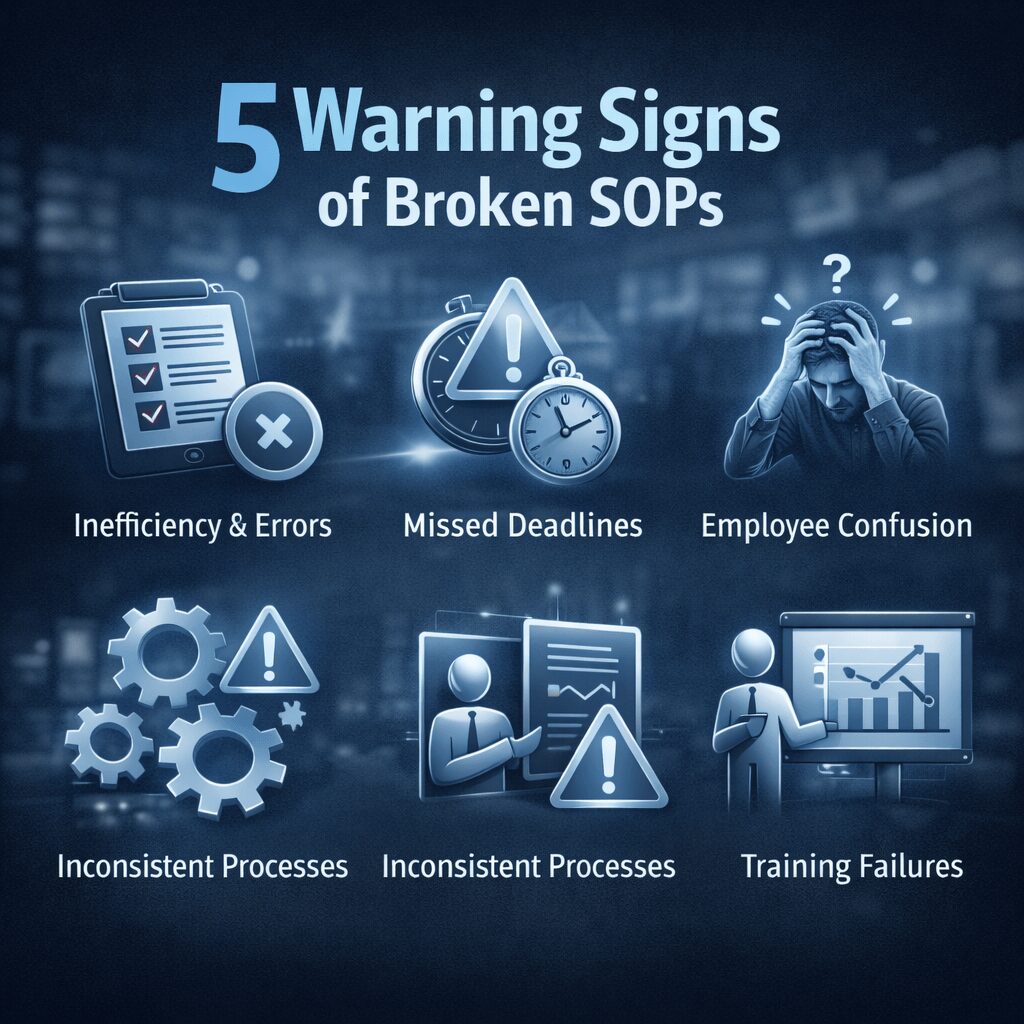
Pain signals in your operations don’t always announce themselves loudly. Sometimes they’re small friction points that pile up over time. Here’s what to watch for.
Frequent Errors and Inconsistent Outcomes
When the same task produces different results each time, your SOP isn’t doing its job. Inconsistency at scale is expensive.
Think about a client-facing process, like generating proposals or invoices. If each team member follows a slightly different path, errors multiply. Rework piles up. Client trust takes a hit.
According to research, facilities deploying integrated SOP management systems see reductions in procedural non-compliance rates of 32% to 48%. That gap exists because most teams are still running on informal habits, not documented standards.
If your error rate is climbing or your quality checks are catching the same issues repeatedly, that’s a root-cause analysis moment. The problem likely sits at the process level, not with individual employees.
Repetitive Tasks and Process Delays
Are you or your managers constantly repeating the same instructions? That’s a workflow bottleneck masquerading as a people problem.
When teams lack clear written guidance, they default to asking questions, waiting for approvals, or guessing what comes next. Each pause slows output. Over a week, those pauses add up to hours of lost productivity.
A well-structured SOP eliminates the need to ask. The answer is already there. That’s the point of documenting once and referencing often.
SOPs Are Outdated or Rarely Updated
If your SOPs still reference software you stopped using two years ago, that’s a problem. Outdated documentation creates confusion. Worse, it signals to employees that the documentation can’t be trusted.
That said, outdated SOPs don’t just waste time. In regulated industries, they expose your business to compliance risk. An internal audit finding linked to an obsolete procedure can trigger penalties, remediation costs, and reputational damage.
A strong SOP review process catches these gaps before they become liabilities.
Overdependence on Key Employees
When one person holds all the knowledge for a process, and nobody else can run it without them, that’s an operational bottleneck. It’s also a serious risk.
If that person leaves, takes time off, or gets pulled into another project, the whole workflow stalls. You’ve essentially built a single point of failure into your operation.
SOPs solve this by transferring knowledge from people to paper, or to a system. Processes become repeatable by anyone trained to follow them, not just the person who invented them.
Poor Team Communication and Collaboration
When teams work from different versions of the same process, misunderstandings happen. Tasks get duplicated. Handoffs break down. Accountability disappears.
You might see this as silos, where one department doesn’t know what another is doing. Or as friction during cross-team projects. Either way, the root cause is often unclear or inaccessible process documentation.
Good SOPs create shared language. Everyone knows the sequence, the owner, and the expected output. That shared clarity reduces friction significantly.
Common SOP Mistakes That Signal Improvement Needs
Poor outcomes often trace back to how SOPs were built in the first place. Here are the mistakes that show up most often, and what they cost you.
Overcomplicated and Hard-to-Follow Processes
Long, jargon-heavy instructions frustrate employees. When people find an SOP overwhelming, they skip it. Then they do the task from memory, which brings back inconsistency.
Good SOP design is about simplicity. Break steps down. Use plain language. If a step can be shown with a screenshot or diagram, use one. The goal is clarity, not thoroughness for its own sake.
Vague or Ambiguous Instructions
Instructions like ‘review the document carefully’ or ‘follow up with the client as needed’ tell employees nothing actionable. Vague SOPs produce vague results.
Each step in an SOP should state who does what, when, and to what standard. ‘Email the client within 24 hours of contract signing with the onboarding link’ is an SOP step. ‘Follow up promptly’ is not.
Lack of Version Control and Documentation
If employees aren’t sure which version of a document is current, trust in the system collapses. You’ll see this when teams print out old copies, save personal versions, or just stop referencing documentation altogether.
Version control is non-negotiable. Every SOP needs a clear version number, a review date, and a named owner. Without those three things, your documentation ages into noise.
This is one area where structured SOP review services make a real difference. External review catches version gaps that internal teams often miss.
No Employee Training or Engagement
Writing an SOP and expecting employees to follow it without training is wishful thinking. SOPs need to be introduced, explained, and practiced.
When training is skipped, adoption suffers. Employees develop workarounds. Over time, the official process and the actual process diverge. That gap is where errors live.
According to Sowflow, companies using SOPs can reduce training time by an average of 30%. But that benefit only kicks in when training is built around the SOP, not bolted on as an afterthought.
Ignoring Feedback and Continuous Improvement
Frontline employees often spot the most obvious process flaws. If your SOP system doesn’t include a feedback loop, you’re missing your best source of improvement data.
When feedback is ignored, employees stop reporting issues and start working around them. The SOP stays static while the actual work evolves. That’s a recipe for growing performance gaps.
Building a simple channel for staff to flag outdated steps or missing details keeps your documentation alive. It also signals that their input matters, which drives engagement.
The 7-Step Framework to Improve Standard Operating Procedures
Spotting the signs is one thing. Fixing them in a repeatable order is another. This is the sequence Prima uses when we rebuild an SOP set from the ground up, and it holds whether you’re fixing one procedure or forty.
Skip the audit or the monitoring step, and the whole thing falls apart later. Ask me how I know.

Step 1: Audit What You Already Have
Start by mapping every current SOP against the task it covers. Check when it was last updated, who wrote it, and whether it matches how the work actually gets done today.
Then ask your team which procedures they skip or ignore. Their answers point straight to the biggest problems. This is the foundation of any serious review, and most teams rush past it.
Step 2: Identify Gaps and Bottlenecks
Once the audit’s done, look for patterns. Are there steps that slow everyone down? Are tasks duplicated across departments?
Value stream mapping shows you where time and effort leak out. Root-cause methods like the 5 Whys get you past the surface symptom to the actual source. A slow handoff is rarely a slow person. It’s usually a missing instruction.
Step 3: Standardize and Simplify
Cut what’s redundant. Rewrite what’s confusing. Write everything at a level your whole team can follow without a dictionary.
Simpler procedures get used more. If an SOP takes 15 minutes to read before someone can act on it, they won’t read it consistently. Use a shared template across every document so the format stops being a variable.
Step 4: Apply a Process Improvement Framework
This is where structured methods earn their keep. Three matter most.
Lean targets waste: waiting, overproduction, unnecessary motion, defects. Applied to SOPs, it strips out steps that add time but no value. According to Flowgenius, pairing Lean principles with SOPs can cut costs by 20% to 40%.
Six Sigma attacks variation. Its DMAIC cycle (Define, Measure, Analyze, Improve, Control) gives you a repeatable way to find defects, fix root causes, and hold the gains. It shines in finance, manufacturing, and healthcare where precision isn’t optional.
BPM (Business Process Management) hands you end-to-end visibility across the whole organization, plus automation and compliance tracking in one place. Pair it with Lean or Six Sigma and the results compound. You get the macro view and the micro fixes working together.
The framework matters less than the discipline you apply it with. A consistently followed Lean cycle beats a one-off Six Sigma project every time.
Step 5: Digitize and Automate Workflows
Paper-based or PDF-locked SOPs create friction. Digital tools remove it.
According to F7i, digital SOPs in manufacturing deliver a 70% reduction in unplanned downtime and a 25% drop in maintenance costs. Those numbers carry over to other sectors. Moving procedures to a digital system means your team pulls the right version, every time, from any device. Automated notifications and approval workflows cut the manual effort of keeping everyone in sync.
Step 6: Train Teams and Drive Adoption
Writing a better SOP is half the job. Getting people to use it is the other half.
Bring frontline staff into the writing and review. When people help build a procedure, they actually follow it. Support the rollout with short checklists and quick video walkthroughs. Breaking a complex procedure into smaller, digestible chunks makes adoption far easier than a 12-page PDF ever will.
Step 7: Monitor, Measure, and Optimize
Improvement doesn’t stop at launch. You need feedback loops to know whether the change actually worked.
Set up regular audits. Track error rates, task completion times, and compliance scores. A 2023 study of postal operators in Australia found that adherence to data-collection SOPs climbed from around 69% to 88% after a management reinforcement push. That’s a 19-point jump from consistent monitoring alone. So the follow-through isn’t optional. It’s where the gains actually stick.
Tools That Support SOP Improvement
The framework tells you what to do. The right tools make it stick without adding overhead. You don’t need all of these, and you shouldn’t buy them all at once. Pick based on where your biggest gap sits right now.

Process Mapping and Workflow Tools
These help you see a procedure before you formalize it.
- Lucidchart and Miro handle flowcharts and process diagrams, both with real-time collaboration built in for teams that map together
- Microsoft Visio suits enterprise environments with complex workflows
Value stream mapping ships inside some of these platforms, which speeds up bottleneck spotting.
Document Management Systems
A solid document management system handles version control, access permissions, and audit trails.
- Confluence works well for teams already on Jira
- Notion fits smaller teams that need flexibility
- SharePoint suits larger organizations already inside Microsoft 365
When you pick one, look for automated version history, role-based access, and approval workflows. Skip anything that can’t tell you which copy is current.
Collaboration and Version Control
These keep your team aligned during and after the review cycle.
- Google Workspace is accessible and free for basic needs
- Tettra is purpose-built for internal knowledge management, including SOP storage and updates
- Process Street layers checklist automation on top of storage, which helps with execution
Most offer free tiers. They’re fine for small teams but usually skip compliance tracking and advanced permissions that larger organizations need.
Performance Tracking and Analytics
Knowing whether your SOPs work requires data.
- Power BI and Tableau build visual dashboards tied to operational metrics
- Smartsheet combines project management with reporting, useful for tracking SOP task completion
If you already run a BPM platform, most come with process analytics built in. So check what you own before you buy something new.
How to Measure SOP Effectiveness
You can’t improve what you don’t track. And “it feels better” isn’t a metric.
The KPIs That Actually Matter
Four numbers tell you whether an SOP is pulling its weight.
- Error rate: how often the task gets done wrong under the current procedure
- Cycle time: how long a standard process takes start to finish
- Compliance rate: the share of tasks completed the way the SOP says
- Onboarding time: how fast a new hire works independently from the documented procedure
Track each one before and after any change. The delta is your answer. If the number didn’t move, the SOP or the training did.
Continuous Feedback and Audits
Set a review schedule. Quarterly for high-volume or regulated processes, annually for lower-risk ones. Beyond the calendar, give your team a fast way to flag issues in real time. A simple form linked to each procedure surfaces problems before they become patterns.
This kind of documented review also supports your broader process documentation services by leaving a clear trail of when and why each change was made.
How Often Should You Review and Update SOPs?
Why Regular SOP Reviews Matter
A review isn’t just a maintenance task. It’s a performance check. Regular reviews catch outdated steps, missing controls, and compliance gaps before they cause real damage.
Businesses with documented SOPs pass audits 40% faster and receive 60% fewer compliance violations, according to Make SOP data. That performance advantage is tied directly to keeping documentation current. Structured SOP review and update services keep that cadence disciplined, so procedures stay aligned as your operations grow.
Signs Your Review Process Is Ineffective
If your reviews only happen after something goes wrong, that’s reactive, not strategic. Other signs of a broken review cycle include:
- SOPs that haven’t been touched in over a year
- No named owner responsible for each document
- Reviews that are scheduled but consistently skipped
- Staff still asking questions that the SOP should answer
- Compliance audit findings that trace back to outdated procedures
You might also want to weigh whether you’d benefit more from outsourced vs in-house SOP review depending on the size and complexity of your operations.
Simple SOP Review Framework That Works
Here’s a practical cadence you can start with:
- Quarterly: High-risk processes, regulated activities, and customer-facing workflows
- Bi-annually: Operational processes that change with tools or team structure
- Annually: Stable back-office processes with low error rates
- Trigger-based: Any time a major system change, regulatory update, or audit finding occurs
If that cadence is hard to hold internally, SOP review and update services run it on schedule and flag drift before it becomes an audit finding.
Prima Consulting
Not sure which SOPs to review first? Our advisory team can pressure-test your process set in a free initial call.
No obligation · Responds within 1 business day · GCC, Europe & APAC
What Happens If You Don’t Improve SOPs?
Impact on Efficiency and Productivity
Stale SOPs are a productivity drain. When people can’t trust the documentation, they ask more questions, wait longer for answers, and take more time verifying their own work.
The financial impact adds up. Rework alone costs time and materials. When errors reach clients, you’re adding customer service time and potential refunds on top of that. These aren’t abstract costs. They show up in your margins.
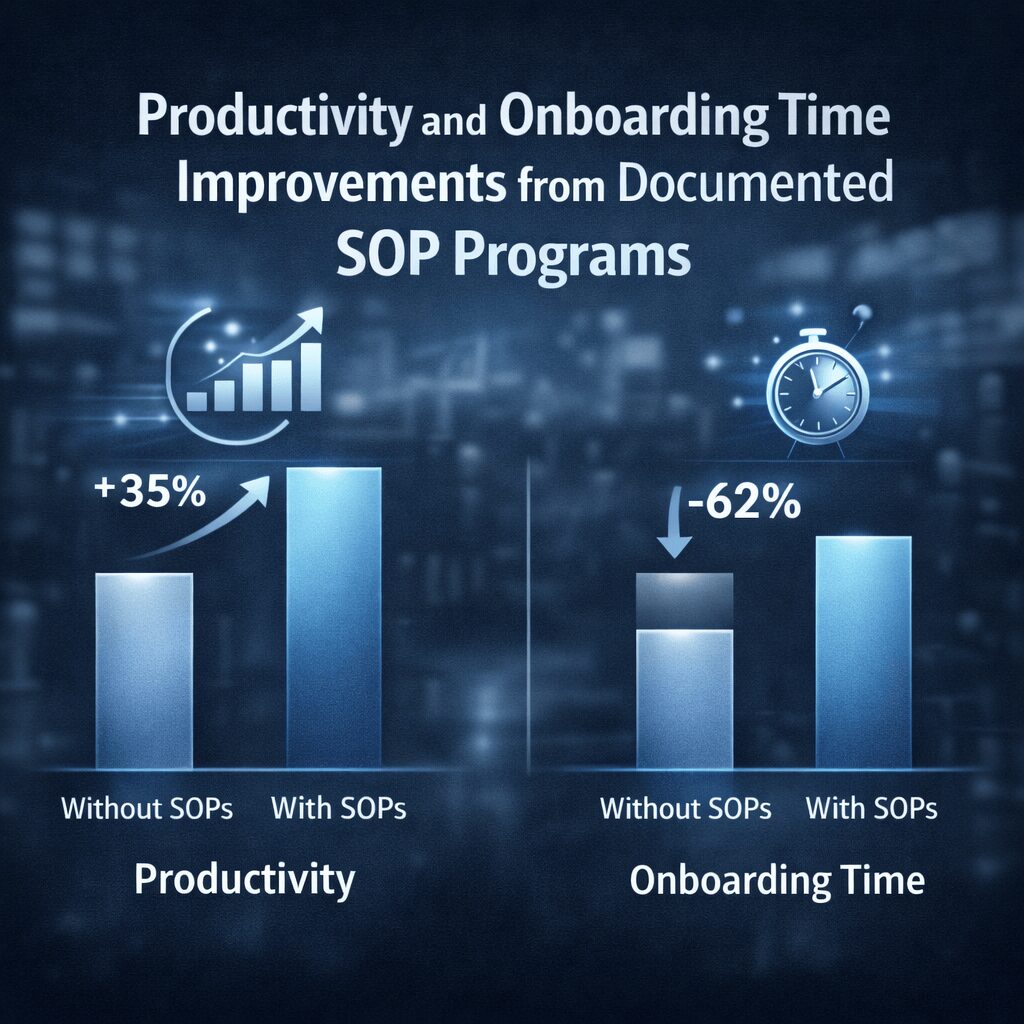
Organizations with mature SOP programs report 20-25% improvements in productivity and 30-40% reductions in training time for new employees, according to Dewstack. That’s the cost of inaction, measured in performance you’re leaving on the table.
Compliance and Operational Risks
In finance, healthcare, manufacturing, and any regulated industry, an outdated SOP isn’t just inefficient. It’s a liability. Regulators expect current, accessible, and followed procedures.
Audit findings tied to procedural gaps can lead to remediation requirements, fines, or in serious cases, suspension of operations. The cost of fixing problems after an audit almost always outweighs the cost of preventing them.
That’s exactly why working with specialists in SOP optimization consulting gives regulated businesses a measurable risk reduction advantage.
Challenges in Scaling Your Business
Scaling without updated SOPs is like adding more traffic to a road that’s already congested. The bottlenecks get worse, not better.
Companies with documented SOPs onboard new employees 50% faster, per MakeSOP. When you’re growing and need to bring people up to speed quickly, that speed advantage is the difference between growth that works and growth that strains the team.
Informal methods fail at scale. The business owner can’t personally train every new hire. The SOP has to do it instead. But only if it’s current, clear, and accessible.
How to Improve Standard Operating Procedures Effectively
Knowing what’s broken is only half the work. Here’s how to fix it.
Simplify and Standardize Processes
Start with your highest-volume, highest-risk processes. Map out each step as it actually happens, not as you wish it happened. Then identify where steps are unclear, redundant, or missing entirely.
Apply lean process thinking: remove steps that don’t add value, and simplify steps that create confusion. The goal is the clearest possible path from start to finish.
A structured SOP development process gives you a repeatable way to build this clarity into every document you create.
Align SOPs with Business Goals
SOPs don’t exist in isolation. They should connect to what your business is trying to achieve. A customer service SOP should reflect your quality standards. A finance process SOP should reflect your compliance requirements.
When SOPs are tied to goals, performance metrics make more sense. You can track whether the process is producing the outcomes it’s supposed to. That connection is what turns documentation from a compliance exercise into a performance tool.
Understanding the benefits of SOP consulting can help you see how goal-aligned documentation produces measurable business results.
Implement Training and Accountability
An SOP without training is a document nobody reads. Build short, task-specific training around each key procedure. Make it clear who is responsible for what, and what the expected outcome looks like.
Assign ownership to each SOP. The owner is responsible for keeping it current, answering questions about it, and flagging when it needs revision. Ownership creates accountability.
Track adherence through performance metrics. If errors on a particular task aren’t dropping after SOP training, that’s a signal to revisit either the document or the training approach.
Use Feedback for Continuous Improvement
Build in a formal way for employees to report SOP issues. It doesn’t need to be elaborate. A simple form, a shared channel, or a section in your regular team check-in works.
Act on what you hear. When frontline staff see their feedback reflected in updated procedures, they’re far more likely to follow and contribute to documentation going forward.
This loop between performance data, staff feedback, and SOP revision is what continuous improvement actually looks like in practice. It’s not a one-time project. It’s an ongoing discipline.
Whether you handle this internally or externally, knowing the difference between outsourced vs in-house SOP consulting helps you pick the right approach for your team size and resources.
Common Challenges When Improving SOPs
Even a solid framework runs into human friction. Three obstacles show up on nearly every project, and none of them are about the documents themselves.
Resistance to Change
People push back on procedures they didn’t help create. This is the single most common barrier, and it’s entirely predictable.
The fix is boring but reliable: involve the people who do the work before you finalize anything. Then tell them why the change happened and what problem it solves. Change management isn’t a soft skill you bolt on at the end. Build it into the update cycle from day one.
Outdated Documentation Nobody Owns
An SOP that hasn’t been touched in years is often worse than none at all. It gives people false confidence in a process that no longer matches reality.
Set an expiration date on every document. When an SOP hits its review date, it either gets updated or retired. Nothing stays in circulation without a named owner who’s accountable for its accuracy. No owner, no document.
Lack of Ownership and Accountability
If nobody owns an SOP, nobody maintains it. This hits fast-growing teams hardest, where roles shift every few months and responsibilities blur.
Assign one named owner to every procedure. That person answers for accuracy, updates, and training. Without that structure, even a well-written SOP drifts out of sync with how the work actually runs.
Quick Checklist to Identify SOP Gaps
Use this as a starting point for your next process review.
Process Clarity and Accessibility
- Are all steps written in plain language that any trained employee can follow?
- Is each SOP stored in one accessible, central location?
- Do SOPs include visuals or examples where the process is complex?
- Are roles and responsibilities clearly stated for each step?
Update Frequency and Ownership
- Does each SOP have a named owner and a last-reviewed date?
- Are high-risk SOPs reviewed at least quarterly?
- Is there a process for staff to flag outdated steps?
- Do reviews happen proactively, not just after an incident?
Performance Tracking and Metrics
- Are there KPIs tied to each key process?
- Do you track error rates, rework frequency, or audit findings by process?
- Is SOP adherence part of performance reviews or team check-ins?
- Are you measuring onboarding speed and time-to-competency for new hires?
If you answered no to several of these, your SOP improvement methods need a structured overhaul. The gaps you’re seeing have known fixes.

Frequently Asked Questions
How do you know when an SOP needs improving?
Watch for repeated errors, staff asking the same questions, one person holding all the process knowledge, and teams working from different document versions. Those are early warning signs, not random bad days. If your quality checks keep catching the same issue, the problem sits at the process level. A rising error rate or a failed audit means the SOP needs attention now, not at the next scheduled review.
What are the key elements of a good SOP?
A good SOP is clear, accurate, and written at a level your whole team can follow without confusion. It includes a defined purpose, step-by-step instructions, named roles and responsibilities, and measurable checkpoints. Keep the format consistent across every document so people spend less time reading and more time acting. Clarity and usability matter more than length.
What are the 7 steps to improve standard operating procedures?
Audit existing SOPs, identify gaps and bottlenecks, standardize and simplify, apply an improvement framework like Lean or Six Sigma, digitize and automate where you can, train teams for adoption, then monitor with ongoing metrics. Each step builds on the last. Skipping the audit or the monitoring phase is where most SOP overhauls quietly fall apart.
Which framework is best for SOP improvement?
Lean works best for cutting waste and simplifying steps. Six Sigma is strongest when you need to reduce variation and improve quality in measurable ways. BPM gives you the governance layer to manage processes at scale. Used together they cover both strategic and tactical gaps. The method matters less than the discipline you apply it with.
How often should SOPs be updated?
Update an SOP immediately after any process change, system update, or regulatory revision. For high-risk or regulated processes, quarterly reviews make sense. For standard procedures with low error rates, an annual review is usually enough. If your error rates are climbing or your team keeps skipping steps, that’s a sign the SOP needs attention now, not later.
Ready to Improve Standard Operating Procedures? Start Here.
Frequent errors, slow onboarding, compliance risks, and bottlenecks that won’t go away all point to the same root cause: SOPs that aren’t working hard enough.
The good news is that every one of these problems is fixable. Not with a single overhaul, but with a consistent approach to reviewing, updating, and aligning your documentation with how your business actually runs.
That means setting review cadences, assigning ownership, acting on staff feedback, and tracking whether your processes are actually producing the outcomes you need.
If you’re not sure where to start, or if your operations are complex enough that internal resources can’t cover it, professional SOP consulting services give you both the framework and the expertise to do this right.
Prima Consulting works with businesses across industries to assess, rebuild, and manage SOPs that actually hold up under real operational pressure. Get in touch to see where your processes stand and what it takes to fix them.
You can also start by exploring our SOPs Review service or reviewing whether outsourced vs in-house SOP development makes more sense for where your business is right now.
Your processes are the backbone of your business. Make sure they’re built to last.
Free Consultation
Ready to discuss your specific situation?
Prima’s advisors work with organisations across the GCC, Europe, and Asia-Pacific. First conversation is always free. No pitch, just expertise.