Ibrahim Ahmed Zahidie, FCA

IFRS 2 Advisory Services KSA | Financial Team Analyzing Grants

IFRS 2 Advisory Services KSA: Choose the Right Fit

Choosing the right IFRS 2 advisory services KSA partner is critical for companies managing complex share-based payment accounting. This guide shows why expert support matters, how to evaluate potential advisors, what services you actually need, and practical ways to reduce compliance risks. You’ll get actionable criteria for selecting partners who

Read More
Professional infographic for ERM consulting services showing four interconnected pillars: Integrated Frameworks, Data Governance, Technology Integration, and Scalability, designed in a GCC-inspired navy, gold, and white color palette.

Best ERM Consulting Services for GCC Businesses

ERM consulting services help GCC businesses identify, assess, and manage every material risk across their operations. With the GCC risk management market set to reach USD 14.9 billion by 2031, choosing the right partner is a strategic decision, not just a procurement one. This guide covers what these services include,

Read More
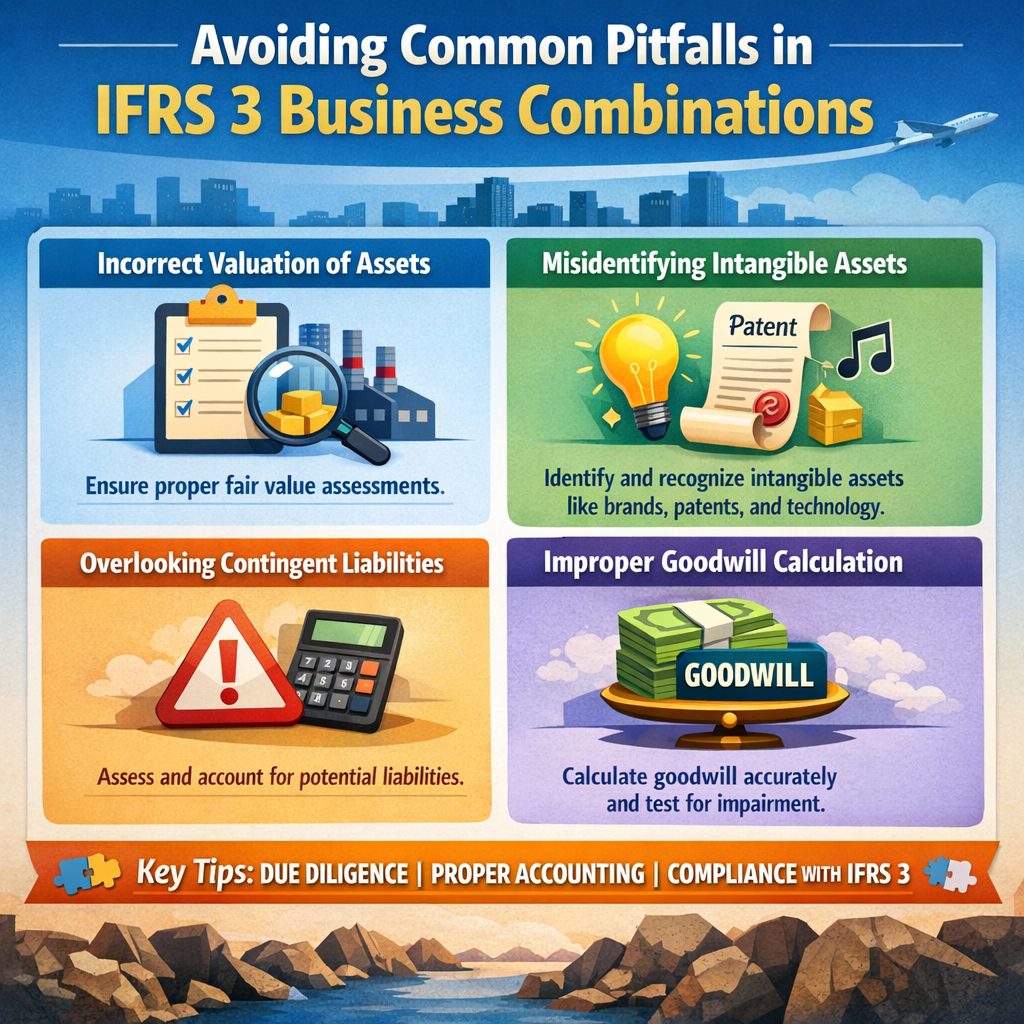
IFRS 3 Common Mistakes_ System Errors and Authentication Failures in Reporting

IFRS 3 Common Mistakes That Cost Millions

You’ll find the most critical IFRS 3 common mistakes that cost companies millions in restatements and penalties. This guide explains acquisition accounting errors like misidentifying the acquirer, purchase price allocation failures, and goodwill calculation mistakes. You’ll learn how to recognize intangible assets separately from goodwill, handle contingent consideration correctly, and

Read More
Business professional using a laptop with digital icons representing IFRS 15 automation, revenue recognition, and workflow optimization for professional services, branded with Prima Consulting logo.

Introduction to IFRS 15 automation for professional services companies

IFRS 15 automation for professional services helps firms manage complex contracts, improve compliance, and cut manual workload. This article explains how automation simplifies revenue recognition, reduces human error, and strengthens audit readiness. You’ll learn how automated tools handle multi-element contracts, streamline reporting across jurisdictions, and deliver real-time financial visibility. It

Read More
Aerial view of Dubai skyline with green sustainability icons overlay representing ESG initiatives by leading esg consulting firms in the Middle East

Choosing ESG Consulting Firms in the Gulf

Choosing the right ESG consulting firm in the Gulf decides whether your compliance holds up. This guide covers how to pick ESG consulting firms in the UAE and KSA: the criteria that matter, framework choices (GRI, SASB, TCFD, ISSB, IFRS S1/S2), what services cost, red flags to avoid, and the

Read More
IFRS 17 vs IFRS 4 infographic comparing the key differences between insurance accounting standards, highlighting new measurement models, the Contractual Service Margin (CSM), and the operational changes insurers must implement.

IFRS 17 vs IFRS 4: Key Differences Explained

IFRS 17 vs IFRS 4: IFRS 17 replaced IFRS 4 on 1 January 2023. IFRS 4 let insurers keep local accounting practices, so results were hard to compare. IFRS 17 forces one current-value method across three models (GMM, VFA, PAA), a Contractual Service Margin for profit release, explicit risk adjustment,

Read More
Professional infographic thumbnail titled “Choosing the Best IFRS 17 Consulting Firms for Insurers,” featuring financial visuals, analytics charts, and corporate imagery in a modern design.

Choosing the Best IFRS 17 Consulting Firms for Insurers

Picking IFRS 17 consulting firms comes down to three things: technical depth, proven experience with your insurance products, and a delivery model that fits your timeline. You need consultants who understand the standard’s nuances, can handle complex scenarios like onerous contract testing and reinsurance alignment, and bring real implementation track

Read More
Infographic thumbnail highlighting IFRS 17 implementation challenges with focus on regulatory complexity, actuarial modeling, data governance, and reporting readiness.

IFRS 17 Implementation Challenges Guide

IFRS 17 rarely stalls on the accounting. It stalls on five practical things: messy contract data, a CSM nobody can reconcile, assumptions that drift between actuarial and finance, testing that runs out of time, and governance that never named who owns the number. Sort those five and the standard falls

Read More
Expected Credit Loss IFRS 9 model showing ECL calculation using PD, LGD, and EAD with Stage 1, Stage 2, and Stage 3 credit risk categories.

Expected Credit Loss IFRS 9: ECL Model Explained with Calculation Examples

The expected credit loss IFRS 9 model replaces reactive accounting with forward-looking credit risk assessment across three stages. You’ll learn how Stage 1, 2, and 3 classifications trigger different provisioning requirements based on credit deterioration. This guide walks through ECL model examples using probability of default, loss given default, and

Read More
IFRS 9 Financial Instruments Explained infographic featuring financial reports, an IFRS 9 binder, calculator, charts, and key concepts including classification and measurement, expected credit loss model, risk management, and regulatory compliance.

IFRS 9 Explained: Classification, ECL & Hedging

IFRS 9 makes banks book credit losses before they happen, not after. This guide covers the two-gate classification test (business model + SPPI), the three impairment stages, and the ECL formula worked with real numbers: the same loan jumps from 8,000 to 48,000 in provisions once it slips from Stage

Read More