TL;DR
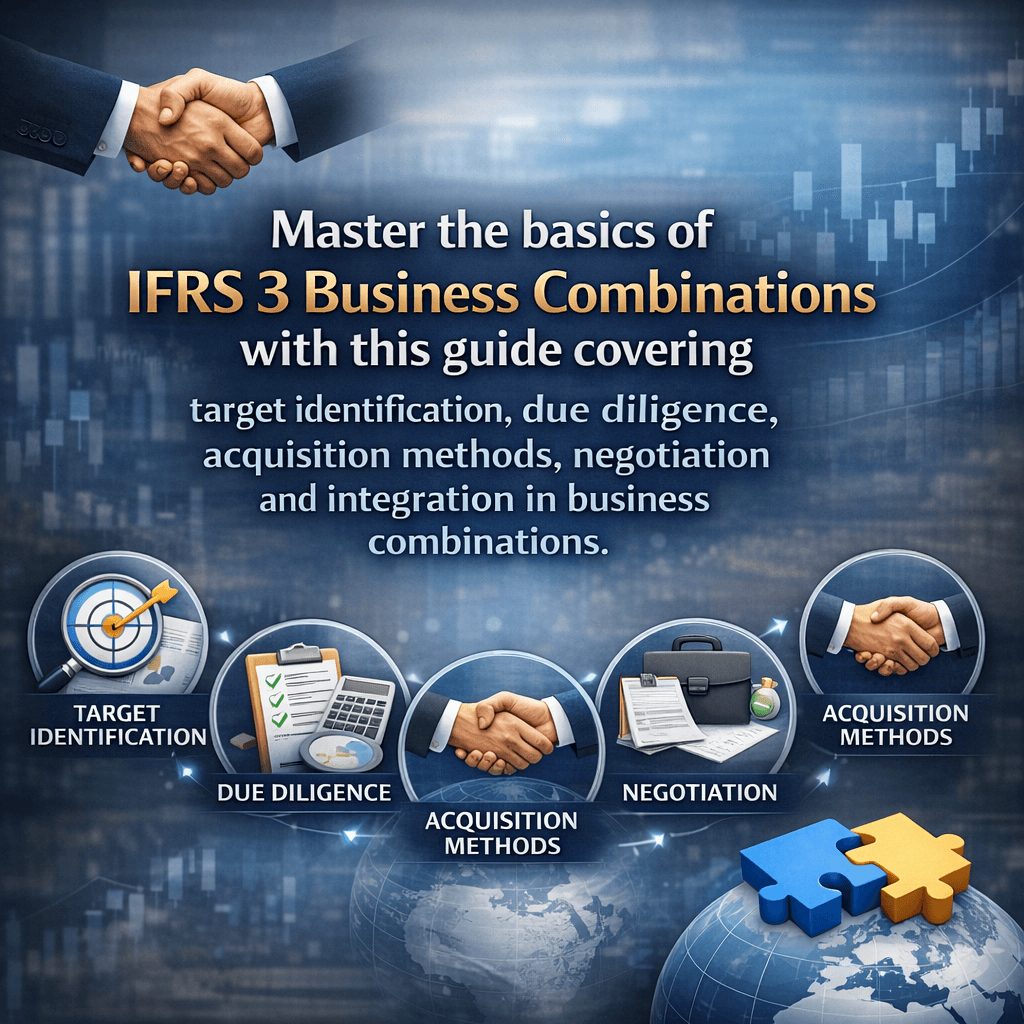
The basics of IFRS 3 business combinations are covered in this guide, showing you how to apply business combination accounting, the acquisition method IFRS 3 requires, and the key steps in practice. You’ll understand how to identify the acquirer, determine the acquisition date, measure the consideration transferred (including purchase consideration and contingent payments), and recognize and measure identifiable assets, liabilities and non-controlling interests. The post also explains how to calculate goodwill recognition and treat bargain purchases, and highlights disclosure requirements and implementation challenges in regional M&A contexts. Read on to help your team navigate IFRS 3 implementation with clarity.
Introduction to Basics of IFRS 3 and Business Combinations
The M&A market is booming. Global deal values hit $3.4 trillion in 2024, marking an 8% increase from the previous year.
But here’s what most finance professionals miss: closing the deal is just the beginning. The real challenge? Getting the accounting right.
That’s where understanding the basics of IFRS 3 business combinations becomes critical. Whether you’re a CFO handling a cross-border acquisition, an auditor reviewing goodwill calculations, or a financial controller preparing consolidated statements, you need to know IFRS 3 inside out.
This guide breaks down IFRS 3 into practical, actionable steps. You’ll learn the acquisition method, understand goodwill recognition, and see how companies apply these principles in real-world scenarios.
What is the Acquisition Method in IFRS 3?
The acquisition method is the only acceptable approach for business combination accounting under IFRS 3. It’s a systematic process that creates consistency across all transactions.
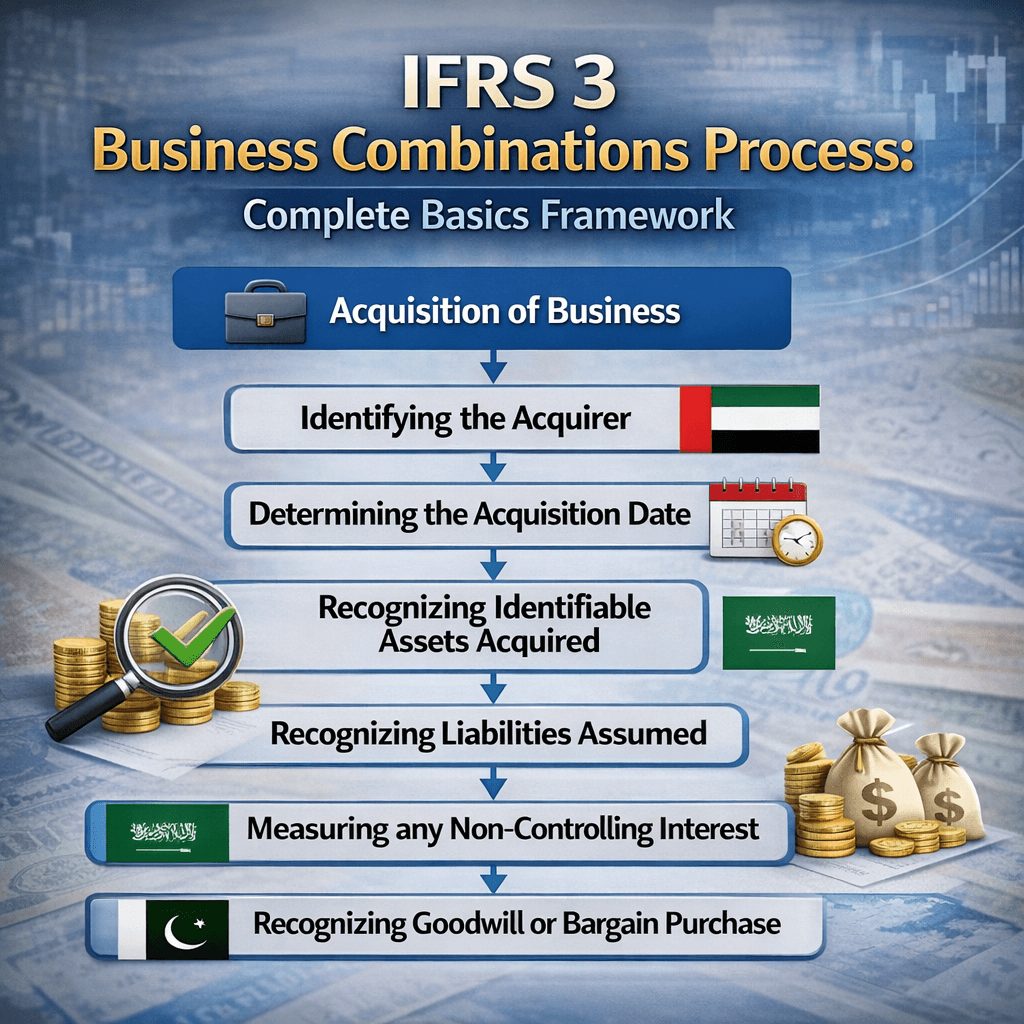
Here’s what the acquisition method IFRS 3 framework requires:
You identify the acquirer. One party always gets control.
You determine the acquisition date. This is when control transfers.
You measure the consideration transferred. This includes cash, shares, and contingent payments.
You recognize and measure identifiable assets and liabilities at fair value.
You calculate goodwill or a bargain purchase gain.
The acquisition method treats every business combination as a purchase transaction. The acquirer pays consideration and receives identifiable net assets plus goodwill in return.
Why this method? Because it provides relevant information to users of financial statements. They can see what was paid, what was received, and whether the acquirer paid a premium or got a bargain.
Regional context matters. When a private equity firm acquires a majority stake in a retail chain, they must apply the acquisition method regardless of the deal structure. Whether it’s a share purchase, asset acquisition, or merger, the principles remain the same.
Step-by-Step Process of Accounting for Business Combinations
The acquisition method breaks down into five clear steps. Let’s walk through each one with practical examples.
Step 1: Identifying the Acquirer
The acquirer is the entity that obtains control. In most cases, it’s obvious: the company paying cash to buy another business is the acquirer.
But some situations require judgment. In a stock-for-stock merger, you need to look at factors like relative voting rights, board composition, and management structure.
Consider this scenario: A holding company and a manufacturing firm merge. The first entity issues shares worth $100 million to the second firm’s shareholders.
Who’s the acquirer? You’d look at which shareholders can elect the board, which management team runs the combined entity, which entity transferred consideration, and what’s the relative size of each business.
Usually, the larger entity or the one issuing equity is the acquirer. But you must assess all facts and document your analysis carefully.
Step 2: Determining the Acquisition Date
The acquisition date is when you obtain control. This is typically the closing date, but not always.
Control can transfer before or after the legal closing. What matters is when you gain the power to direct the acquiree’s relevant activities.
Say a company signs an agreement on June 15 to buy a distributor. The legal transfer happens on July 31, but the agreement gives the buyer operational control from June 30.
The acquisition date? June 30. Because that’s when control transferred, even though legal formalities weren’t complete.
Why does this matter? Because you recognize assets and liabilities at their fair values on the acquisition date. Waiting even a few weeks can change valuations, especially for volatile assets like inventory or foreign currency accounts.
Step 3: Measuring Purchase Consideration and Transferred Amounts
Consideration includes everything you give up to obtain control. This typically includes cash paid to sellers, fair value of equity instruments issued, fair value of liabilities assumed, fair value of any previously held equity interest, and fair value of contingent consideration.
Let’s break down contingent consideration because it’s where many companies face IFRS 3 reporting challenges.
Imagine a company acquires a software firm for $50 million upfront plus an additional $20 million if revenue targets are met over three years. On the acquisition date, you estimate the contingent payment’s fair value at $15 million based on probability-weighted scenarios.
You record $65 million as total consideration ($50 million cash plus $15 million contingent).
The basics of IFRS 3 business combinations require you to remeasure this liability each reporting period. If the target looks more achievable six months later, you might increase the liability to $18 million. But this adjustment doesn’t change goodwill. It goes through profit or loss.
Step 4: Recognizing and Measuring Identifiable Assets and Liabilities
This is where IFRS 3 gets technical. You recognize all identifiable assets acquired and liabilities assumed at their acquisition-date fair values.
Identifiable means the asset is separable or it arises from contractual or legal rights.
You’ll often identify intangible assets that weren’t on the target’s books. Customer relationships, trade names, technology, and non-compete agreements are common examples.
Here’s a real-world scenario: An investment firm acquires a healthcare provider. The target’s balance sheet shows $80 million in net assets.
But when you do the purchase price allocation, you identify a brand name worth $15 million, patient database worth $10 million, and favorable lease contracts worth $5 million.
Total identifiable net assets? $110 million at fair value, not the $80 million book value.
This step requires valuation expertise. Companies often work with IFRS 3 consulting services for significant acquisitions. The quality of your valuation affects goodwill recognition and subsequent impairment testing.
Step 5: Calculating Goodwill Recognition or Bargain Purchase Gain
Goodwill is the excess of consideration transferred over the fair value of identifiable net assets acquired.
The formula: Goodwill = Consideration Transferred + Fair Value of Non-Controlling Interest – Fair Value of Identifiable Net Assets Acquired.
Using our healthcare example: The firm paid $150 million, there’s no non-controlling interest, and identifiable net assets are worth $110 million.
Goodwill = $150 million – $110 million = $40 million.
This represents the premium paid for synergies, assembled workforce, market position, and future growth potential.
But what if the math goes the other way? If you acquire net assets worth more than you paid, you’ve got a bargain purchase. IFRS 3 requires you to reassess your measurements first. If everything checks out, you recognize the gain immediately in profit or loss.
Bargain purchases are rare. In 2023, 353 U.S. public companies reported $82.9 billion in goodwill impairments, showing that overpaying is more common than underpaying.
Goodwill recognition under business combination accounting affects your balance sheet permanently. You don’t amortize it, but you test it for impairment annually.
Acquisition Costs and Their Treatment under IFRS 3
Acquisition costs are the fees you pay to complete business combinations. Legal fees, due diligence costs, valuation fees, and finder’s fees all qualify.
Here’s the rule: You expense these costs as incurred. They don’t get added to the purchase price or capitalized as part of goodwill.
This differs from how you treat costs in other contexts. When you issue equity, you reduce equity for issuance costs. But acquisition-related costs hit your income statement immediately.
Example: A company pays $100 million for a target. They also pay $2 million in legal fees, $1 million for due diligence, and $500,000 in finder’s fees.
The consideration transferred is $100 million. The $3.5 million in fees goes straight to expenses.
Why does IFRS require this treatment? Because acquisition costs don’t add future economic benefits. They’re necessary to complete the transaction, but they don’t create value.
This can hurt your reported earnings in the acquisition year. Companies closing large deals might see significant expense spikes. But it provides transparency.
Contingent Consideration Explained
Contingent consideration is a promise to pay additional amounts if certain conditions are met. It’s common in acquisitions where future performance is uncertain.
The basics of IFRS 3 business combinations require you to recognize contingent consideration at fair value on the acquisition date, even though you haven’t paid it yet.
Let’s look at a detailed example. A technology investor acquires an AI startup. The deal structure includes $30 million upfront in cash, additional $15 million if the startup achieves $50 million revenue in Year 1, and another $10 million if it achieves $75 million revenue in Year 2.
On acquisition date, you estimate 70% probability of hitting Year 1 target and 40% probability of hitting Year 2 target.
You calculate fair value using probability-weighted scenarios: Year 1 contingent payment is $15 million x 70% = $10.5 million. Year 2 contingent payment is $10 million x 40% = $4 million.
Total contingent consideration fair value: $14.5 million.
Each reporting period, you reassess the fair value. If the startup exceeds expectations and you now estimate 90% probability for Year 1 and 60% for Year 2, the new fair value becomes $19.5 million. The $5 million increase goes to profit or loss, not goodwill.
When you eventually pay, you settle the liability. If you pay exactly what you estimated, there’s no additional gain or loss.
Contingent consideration tied to employment is different. If the payment requires the seller to remain as an employee, it’s compensation expense, not part of the purchase consideration.
Goodwill and Non-Controlling Interests: Key Concepts
Goodwill represents future economic benefits that don’t qualify as identifiable assets. It includes synergies, assembled workforce, and market position.
You have two options for measuring goodwill when there’s a non-controlling interest: the full goodwill method and the partial goodwill method.
Full goodwill method: You recognize goodwill attributable to both the parent and non-controlling interest.
Partial goodwill method: You recognize goodwill only for the parent’s share.
Here’s how it works. A company acquires 80% of a manufacturer for $100 million. Fair value of identifiable net assets is $90 million. Fair value of 20% non-controlling interest is $22 million.
Using the full goodwill method, total consideration is $122 million ($100 million parent plus $22 million NCI). Less fair value of identifiable net assets of $90 million equals $32 million goodwill.
Using the partial goodwill method, parent’s consideration is $100 million. Parent’s share of net assets is 80% x $90 million = $72 million. Goodwill equals $28 million.
The choice affects your balance sheet and future impairment testing. Most companies use the partial goodwill method because it’s simpler and results in lower goodwill balances.
Nearly 40,000 M&A deals closed worldwide in 2023, and many involved partial acquisitions. Understanding how to account for non-controlling interests is essential for consolidated financial statements.
Differences Between Asset Acquisitions and Business Combinations
Not every acquisition triggers IFRS 3. You need to distinguish between buying a business and buying a group of assets.
A business requires three elements: inputs, processes, and outputs.
If you acquire something without all three elements, it’s an asset acquisition, not a business combination. Different accounting rules apply.
IFRS 3 provides a concentration test as an optional shortcut. If substantially all the fair value is concentrated in a single identifiable asset or group of similar assets, you can conclude it’s not a business without further analysis.
Example: A developer buys a plot of land with a building under construction. The building represents 95% of the total fair value. You can use the concentration test to conclude this is an asset acquisition.
Why does this matter? The accounting differs significantly.
Business combinations recognize assets and liabilities at fair value, recognize goodwill or bargain purchase gain, and expense transaction costs.
Asset acquisitions allocate purchase price based on relative fair values, don’t recognize goodwill, and capitalize transaction costs.
Here’s a scenario: A company buys a small distribution operation. The business has a warehouse, three trucks, and no employees. The seller’s customer contracts are all expiring.
Is this a business? Probably not. Without employees and with expiring contracts, there’s no process to convert inputs to outputs. It’s an asset acquisition.
You’d allocate the purchase price to the warehouse and trucks based on their relative fair values. Transaction costs get capitalized as part of the asset cost.
Getting this classification wrong creates IFRS 3 implementation challenges.
The Measurement Period and Its Impact on Accounting
The measurement period is the time after acquisition when you can adjust provisional amounts. It can’t exceed one year from the acquisition date.
Why do you need a measurement period? Because you might not have all the information to finalize your purchase price allocation when you first account for the acquisition.
During the measurement period, you can adjust provisional fair values of assets and liabilities, consideration transferred if contingent consideration estimates change, and recognition of previously unidentified assets or liabilities.
Any adjustments get recorded retrospectively as if they were known on the acquisition date. This means you restate comparative periods.
Example: A company acquires a manufacturer on April 1, 2024. Initial allocation shows goodwill of $50 million. In December 2024, the buyer completes a detailed valuation and identifies an unrecorded patent worth $8 million.
You adjust by recognizing the patent at $8 million, reducing goodwill by $8 million, and restating the April 1, 2024 balance sheet.
After the measurement period ends, you can only adjust for errors under IAS 8. You can’t claim you got new information about acquisition-date facts.
Best practice? Set internal deadlines well before the one-year mark. Aim to finalize your allocation within six to nine months to avoid year-end restatements.
Practical Examples of IFRS 3 Application in Business Combinations
Let’s work through a complete example.
Scenario: Logistics Corp acquires 100% of Distribution Ltd on July 1, 2024.
Deal terms include cash payment of $180 million, contingent payment of $20 million if revenue growth targets are met (estimated fair value $12 million), and transaction costs of $3 million.
Distribution Ltd’s book values show cash $5 million, receivables $15 million, inventory $25 million, property $40 million, equipment $20 million, payables $10 million, and loans $30 million.
Fair value adjustments identified include inventory fair value $28 million, property fair value $55 million, equipment fair value $17 million, brand name $10 million, customer relationships $8 million, and deferred tax liability $5 million.
Fair value of identifiable net assets totals $93 million.
Consideration transferred equals $192 million ($180 million cash plus $12 million contingent consideration).
Goodwill calculation: $192 million consideration less $93 million fair value of net assets equals $99 million goodwill.
This example shows the acquisition method IFRS 3 in action. The acquirer recognizes all identifiable assets and liabilities at fair value, calculates goodwill, and expenses transaction costs immediately.
Common Challenges and Best Practices for IFRS 3 Compliance
Companies face similar challenges when applying the basics of IFRS 3 business combinations.
Challenge 1: Identifying all intangible assets. Many acquirers overlook intangibles like customer relationships, trade names, and technology. This overstates goodwill and understates amortizable assets.
Best practice: Work with valuation specialists early. They can help identify and value intangibles that your accounting team might miss.
Challenge 2: Determining fair values in illiquid markets. Markets sometimes lack comparable transactions for specialized assets.
Best practice: Use multiple valuation approaches. If market comparables don’t exist, apply income or cost approaches. Document your assumptions carefully.
Challenge 3: Managing the measurement period. Companies start strong but lose momentum. Provisional allocations become permanent by default.
Best practice: Create a detailed project plan with milestones. Assign responsibility for each component of the purchase price allocation. Set internal deadlines three months before the measurement period ends.
Challenge 4: Cross-border complexities. Cross-border M&A reached nearly 8,500 deals in 2023. These transactions involve currency translation, different legal systems, and varying tax regimes.
Best practice: Involve specialists in international tax, foreign exchange, and local regulations. Understand how transfer pricing affects fair values.
Professional support helps. Whether you need IFRS advisory services or broader guidance, experienced advisors can guide you through complex transactions.
They bring technical knowledge of the acquisition method IFRS 3, experience with goodwill recognition and measurement, understanding of regulatory expectations, and practical implementation guidance.
In 2024, deal volumes reached $1.1 trillion in the second half alone, the highest since early 2022. As M&A activity rebounds, getting business combinations right becomes more critical than ever.
Your Next Steps in Mastering Business Combination Accounting Under IFRS 3
You now understand the core principles of business combination accounting under IFRS 3 and you know the acquisition method, how to calculate goodwill, and how to handle contingent consideration.
You can distinguish business combinations from asset acquisitions and apply these concepts in regional contexts.
But knowledge alone isn’t enough. Implementation requires judgment, experience, and often specialized expertise.
Start by reviewing your company’s recent acquisitions. Did you identify all intangible assets? Are your goodwill calculations properly documented? Have you tested goodwill for impairment as required?
If you’re planning an acquisition, involve your accounting team early. Structure the deal with accounting implications in mind. Budget for valuation specialists and legal advisors who understand IFRS 3 disclosure requirements.
For complex transactions, especially cross-border deals, consider professional support. The basics of IFRS 3 business combinations provide the framework, but applying them to sophisticated transactions requires expertise.
Prima Consulting offers specialized IFRS 3 Business Combination services to help companies handle everything from straightforward acquisitions to complex restructurings. Our team brings regional experience and technical depth to support your financial reporting requirements.
Don’t let IFRS 3 complexities derail your M&A strategy. Get the accounting right from day one, and you’ll build a foundation for accurate financial reporting and informed decision-making.
Ready to improve your business combinations accounting? Let’s talk about how we can help.