TL;DR
Selecting IFRS 3 consulting services means your business handles mergers and acquisitions smoothly, especially with global compliance demands ramping up. You’ll find how expert business combination advisors deliver precise goodwill valuations, synergy assessments, and audit-ready reporting to cut risks and boost deal value. This guide breaks down choosing top firms, weighing M&A advisory consultants against pricing models. Pick the right partner now to secure your next transaction without delays.
Business combinations aren’t simple transactions you can handle with basic accounting knowledge.
When your company acquires another business or merges with a competitor, you’re stepping into complex financial territory. Getting IFRS 3 accounting wrong leads to financial restatements, regulatory penalties, and damaged investor confidence.
In 2024, 140 public companies issued financial restatements in the first 10 months. This shows how many organizations struggle with accurate reporting. That’s where IFRS 3 consulting services become necessary.
You need advisors who understand acquisition accounting inside and out. Consultants who can guide your business through purchase price allocation, goodwill recognition, and disclosure requirements.
This guide shows you exactly how to select the right business combination advisors for your organization.
What IFRS 3 Consulting Services Are and Why They Matter
IFRS 3 consulting services help businesses account for mergers and acquisitions correctly.
These specialized advisors guide companies through the acquisition method. They handle purchase price allocation, identify intangible assets, calculate goodwill, and prepare required disclosures.
Think about what happens when you acquire another company. You’re not just buying assets and liabilities at book value.
You need to measure everything at fair value on the acquisition date. You must identify previously unrecognized intangible assets.
Get any of these steps wrong, and you’ll face problems down the line.
Expertise in Acquisition Accounting
Financial reporting consultants specializing in IFRS 3 bring technical knowledge that most internal accounting teams don’t possess. They’ve handled dozens or hundreds of business combinations.
Global M&A deal value rose 8% to $3.4 trillion in 2024. More companies need expert guidance than ever before.
The complexity of IFRS advisory services goes beyond basic accounting. Your consultants must understand valuation techniques, tax implications, and industry-specific considerations.
Regional and Industry-Specific Needs
They need to work with your legal team, tax advisors, and operational leaders to get the complete picture.
In markets worldwide, you face additional layers of complexity. Regional business practices, local regulations, and cross-border transactions require advisors with specific geographic expertise.
Your business can’t afford to be part of that restatement statistic.
Key Criteria for Choosing IFRS 3 Consulting Firms
Selecting the right IFRS 3 consulting firms requires a structured approach.
Start with technical qualifications. Your advisors must have recognized accounting certifications and specialized training in business combinations.
Look for CPAs, CAs, or ACCAs with demonstrated IFRS expertise.
But credentials alone won’t cut it.
You need consultants with hands-on experience in your industry. A retail merger involves different considerations than a technology acquisition.
Assessing Experience and Track Record
Ask potential firms about their track record. How many business combinations have they advised on?
What was the average deal size? Which industries do they serve most frequently?
Geographic expertise matters tremendously. IFRS 3 consulting firms must understand local markets and regulatory requirements across regions where you operate.
Cross-border transactions require advisors familiar with multiple jurisdictions.
Team Structure and Technology
Check their team structure. Will you work with senior partners or junior staff?
What’s their availability during critical deal phases? Can they scale support if your transaction accelerates?
Technology capabilities shouldn’t be overlooked. Modern IFRS 3 compliance experts use sophisticated modeling tools for purchase price allocation.
They employ data analytics for identifying intangible assets. They maintain secure platforms for sharing sensitive deal information.
Communication and Cost Transparency
Communication style reveals a lot about working relationships. During your initial meetings, notice how consultants explain complex concepts.
Do they use plain language or hide behind jargon? Can they translate technical requirements into business implications?
References provide invaluable insights. Speak with three to five past clients.
Ask about responsiveness, accuracy, and ability to meet deadlines under pressure.
Cost structure needs transparency upfront. Some firms charge fixed fees, others use hourly rates.
Understand what’s included and what triggers additional charges. IFRS 3 advisory pricing varies significantly based on deal complexity and firm reputation.
Comprehensive Support and Cultural Fit
Don’t fall for the lowest bid. Deals valued at $2 billion or more increased by 20% year-over-year in 2024.
The growing complexity of transactions means you need quality advice, not budget consultants.
Look for firms offering support beyond basic compliance. The best advisors help with due diligence, integration planning, and post-acquisition reviews.
Cultural fit matters more than you might think. You’ll work closely with these consultants during stressful deal periods.
Choose advisors who align with your company’s values and working style.
Understanding Business Combinations Under IFRS 3
A business combination occurs when one entity obtains control over another business.
Control is the key concept. You achieve control when you have power over the acquired entity, exposure to variable returns from your involvement, and the ability to use your power to affect those returns.
Most people think control means owning more than 50% of voting rights. That’s usually true but not always.
You can have control with less than 50% if other shareholders are widely dispersed. You might lack control despite owning 60% if another party has veto rights over key decisions.
Defining Control and Acquisition Method
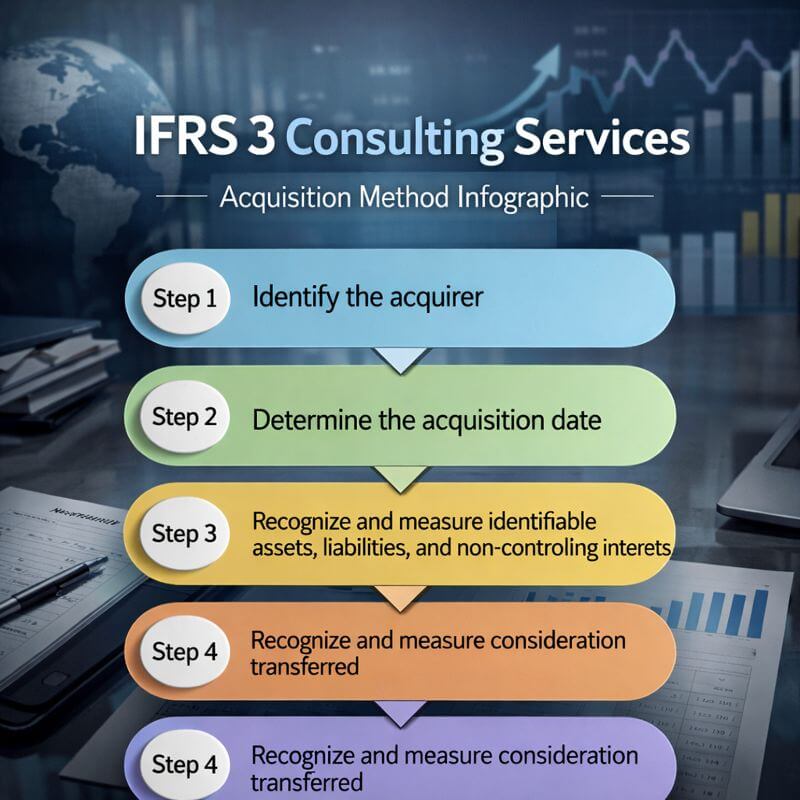
IFRS 3 requires you to use the acquisition method for all business combinations. This means identifying the acquirer, determining the acquisition date, recognizing and measuring identifiable assets acquired and liabilities assumed, and recognizing and measuring goodwill or a gain from a bargain purchase.
The acquisition date is when you obtain control. It’s usually the closing date, but not always.
Sometimes control transfers before legal closing based on contractual arrangements.
Fair Value Measurement
You must measure everything at fair value on the acquisition date. Book values from the acquired company’s financial statements are irrelevant.
This creates work. You need valuations for property, plant, and equipment.
Intangible assets like customer relationships, technology, and trade names must be identified and valued. Liabilities have to be measured at fair value, which might differ significantly from carrying amounts.
Contingent Consideration and Asset vs. Business
The basics of IFRS 3 business combinations include specific rules for contingent consideration. If you agree to pay additional amounts based on future events, you must recognize that obligation at fair value on acquisition date.
You’ll remeasure it each reporting period with changes flowing through profit or loss.
Not every asset purchase qualifies as a business combination. IFRS 3 applies only when you acquire a business, not just a group of assets.
This distinction carries significant accounting consequences.
Applying the Concentration Test
A business combines inputs and processes applied to those inputs that can create outputs. If you’re buying a manufacturing facility with employees and processes, that’s likely a business.
If you’re buying an empty warehouse, that’s an asset acquisition.
IFRS 3 includes a concentration test to simplify this assessment. If substantially all the fair value is concentrated in a single identifiable asset or group of similar assets, you’ve acquired assets, not a business.
Business combination advisors help you go through these definitions. They assess whether your transaction qualifies as a business combination or an asset acquisition.
The concentration test is applied correctly. Analysis supporting your conclusion is documented.
The accounting differs dramatically between the two. Asset acquisitions don’t generate goodwill.
Transaction costs are capitalized rather than expensed. Contingent consideration isn’t remeasured after initial recognition.
Get the classification wrong, and you’ll face material errors in your financial statements.
How IFRS 3 Consulting Helps with Complex Financial Transactions
Complex transactions create complex accounting challenges.
Your business might acquire a company with operations in multiple countries. You’re buying assets in different currencies, subject to different tax regimes, facing different regulatory requirements.
IFRS 3 consulting services simplify these complications. Consultants coordinate with local advisors in each jurisdiction.
They consolidate information into a coherent acquisition accounting memo. They identify interdependencies between different parts of the transaction.
Handling Multi-Jurisdictional Deals
Deals under $1 billion accounted for 95% of all M&A activity in 2024. Even smaller transactions involve substantial complexity.
You can’t treat a $50 million acquisition as a simple bookkeeping entry.
Step-ups in asset values create deferred tax liabilities. Your consultants calculate these implications and incorporate them into purchase price allocation.
They work with your tax advisors to identify planning opportunities.
Managing Contingent Consideration
Contingent consideration arrangements come in countless forms. You might agree to pay sellers based on revenue targets, earnings thresholds, or regulatory approvals.
Each structure requires different accounting treatment.
Financial reporting consultants model these arrangements. They determine appropriate discount rates for present value calculations.
Processes for ongoing remeasurement are established. Required disclosures explaining the arrangements to financial statement users are drafted.
Valuing Intangible Assets
Intangible asset identification demands specialized expertise. Most companies underestimate the intangibles they’re acquiring.
Customer relationships, technology, trade names, and non-compete agreements all might exist.
M&A advisory consultants bring valuation specialists to the table. These experts use relief-from-royalty methods, excess earnings approaches, and cost methods to value intangibles.
They document assumptions and calculations to withstand audit scrutiny.
Addressing Pre-Existing Relationships and Bargain Purchases
Pre-existing relationships between buyer and acquirer create measurement challenges. If you already owned 20% of the target company, you must remeasure that investment to fair value on acquisition date.
The resulting gain or loss flows through profit or loss.
Consultants identify these pre-existing relationships. They determine appropriate accounting treatment.
They calculate the financial statement impact.
Bargain purchases happen when you acquire a business for less than the fair value of net assets. IFRS 3 requires you to recognize a gain immediately.
But first, you must reassess whether you’ve identified all assets and liabilities and measured everything correctly.
IFRS 3 compliance experts guide this reassessment. They challenge your valuations.
Unrecognized liabilities are searched for. Documentation explains why the bargain purchase is genuine and not a measurement error.
Classifying Transaction Costs
Transaction costs must be expensed as incurred. But what counts as a transaction cost?
Legal fees clearly qualify. But what about executive time spent on the deal?
What about integration planning costs? What about financing arrangement fees?
Your advisors help classify costs correctly. They review invoices and time records.
They prepare schedules supporting your expense recognition.
Key Qualifications and Skills of IFRS 3 Consultants
Technical accounting knowledge forms the foundation.
Your IFRS 3 audit support firms need deep expertise in IFRS 3 itself. They must know the standard inside and out, including all amendments and interpretations.
They should track IASB discussions about future changes.
But IFRS 3 doesn’t exist in isolation. Consultants need strong command of related standards.
IAS 36 governs subsequent impairment testing of goodwill. IAS 38 provides additional guidance on intangible assets.
IFRS 9 affects measurement of contingent consideration.
Certifications and Experience
Professional certifications matter. Look for CPA, CA, ACCA, or CFA designations.
Additional credentials like ASA or CVA indicate valuation expertise.
Real-world transaction experience trumps classroom learning. The best consultants have advised on dozens of business combinations.
They’ve seen what works and what doesn’t. They can anticipate problems before they arise.
Industry and Geographic Expertise
Industry knowledge adds tremendous value. Consultants specializing in your sector understand typical intangibles, common deal structures, and regulatory considerations specific to your industry.
For businesses operating globally, geographic expertise is non-negotiable. Your advisors must understand regional business practices, local regulatory requirements, and cross-border considerations.
They should have relationships with local valuation firms, tax advisors, and legal counsel. They need familiarity with regional audit firm expectations and practices.
Communication and Project Management
Communication skills separate good consultants from great ones. Technical accuracy means nothing if you can’t understand the advice.
Your advisors must translate complex accounting into clear business language.
They should explain alternatives, outline implications, and help you make informed decisions. They must document their advice clearly for future reference and audit support.
Project management capabilities keep deals on track. Business combinations involve tight timelines, multiple workstreams, and numerous stakeholders.
Your consultants need to coordinate activities, manage deadlines, and escalate issues promptly.
Analytical and Technological Proficiency
Analytical thinking helps consultants spot problems early. They should question assumptions, challenge conclusions, and dig into details.
Surface-level analysis won’t cut it in complex transactions.
Technology proficiency improves efficiency and accuracy. Modern consultants use sophisticated modeling tools, data analytics platforms, and secure collaboration systems.
They should automate routine calculations while focusing judgment on complex areas.
Ethical Standards and Continuous Learning
Professional skepticism protects you from errors. Your consultants should push back when something doesn’t make sense.
They should verify information rather than accepting it at face value.
Ethical standards guide all actions. You’re sharing confidential deal information with these advisors.
They must maintain strict confidentiality and avoid conflicts of interest.
Continuing education keeps knowledge current. IFRS changes constantly.
Your consultants must invest in ongoing learning to stay current with standard changes, emerging practices, and regulatory developments.

Common Challenges in IFRS 3 Implementation and How Consultants Address Them
IFRS 3 reporting challenges start with tight timelines.
You need acquisition accounting completed quickly to issue timely financial statements. But fair value measurements take time.
Valuations require data collection, analysis, and documentation.
Consultants manage this time pressure. They set clear project plans with milestones.
What can be done concurrently versus sequentially is identified. Realistic timelines are communicated to management.
Managing Tight Timelines
They prioritize efforts based on materiality. Major asset categories get detailed analysis.
Minor items receive streamlined treatment.
Data availability creates headaches. The target company might have poor records.
Systems might be incompatible with yours. Key information might be missing or unreliable.
Your advisors develop workarounds. They use proxy data when direct information isn’t available.
Target company personnel are interviewed. Reasonable estimates supported by available evidence are applied.
Limitations are documented and impact on measurement accuracy is assessed.
Handling Judgment Areas
Judgment areas abound in business combinations. What’s the appropriate discount rate for contingent consideration?
How long should customer relationships be amortized? Is a particular intangible separately identifiable?
Financial reporting consultants bring experience to these judgments. They research market data to support discount rate selection.
They analyze customer retention patterns to estimate useful lives. They apply identification criteria systematically.
They document the basis for each significant judgment. This documentation supports audit reviews and future reference.
Reducing Goodwill Impairment Risks
Goodwill impairment looms as a future risk. During economic expansion periods, the frequency of goodwill impairment ranges between 7.3% and 12.4%.
During contraction periods, goodwill impairment percentages rise to between 17.9% and 21.3%.
Starting with accurate acquisition accounting reduces impairment risk. If you overvalue acquired assets initially, you’ll face impairments later.
If you fail to identify intangibles, goodwill will be overstated.
Consultants help you get it right from the start. They challenge optimistic assumptions.
They verify that valuations reflect realistic expectations, while also identifying all separately recognizable intangibles to minimize residual goodwill.
Handling Integration and Disclosures
Integration accounting complicates matters. After acquisition, you need to consolidate operations, align accounting policies, and remove intercompany transactions.
Your advisors help plan for integration. Accounting policy differences requiring alignment are identified.
Processes for consolidation are established. Coordination with your internal team on system integration happens throughout.
Disclosure requirements feel overwhelming. IFRS 3 demands detailed disclosures about each business combination.
You must describe the acquisition, explain how you obtained control, disclose fair values of assets acquired and liabilities assumed, explain goodwill recognition, and provide pro forma information.
Consultants draft these disclosures. They gather required information throughout the transaction.
Disclosure schedules meeting standard requirements are prepared. Your complete note is reviewed for compliance.
Supporting Audits and Regulatory Inquiries
Audit challenges arise during financial statement audits. Auditors scrutinize business combination accounting closely.
They question valuations, challenge judgments, and request detailed documentation.
Having experienced consultants on your team strengthens your position. They prepare audit-ready documentation.
Discussions with auditors are supported. Technical references for accounting conclusions are provided.
Regulatory inquiries occasionally occur. Securities regulators might question your accounting treatment.
They might require additional disclosures or restatements.
Your advisors help you respond. They explain the technical basis for your accounting.
Supplemental information regulators request is prepared. Appropriate responses to concerns raised are recommended.
The Role of IFRS 3 Consultants in Acquisition Accounting and Purchase Price Allocation
Purchase price allocation forms the core of acquisition accounting.
You start with the total consideration transferred. This includes cash paid, fair value of equity issued, fair value of pre-existing interests, and contingent consideration.
Your consultants verify the consideration calculation. They review purchase agreements.
Market quotes for any equity issued are obtained. Contingent consideration arrangements are modeled.
All forms of consideration that might be overlooked are identified. Replacement awards granted to target company employees?
Those might be part of consideration. Payments to selling shareholders for future services?
Those aren’t consideration at all.
Identifying Assets and Liabilities
Next comes the challenging part: allocating that consideration to assets acquired and liabilities assumed.
You must identify all assets and liabilities, even those not previously recognized by the target company. This means looking beyond their balance sheet.
Business combination advisors lead this identification process. They review target company operations systematically.
Management is interviewed about products, customers, technology, and processes. They look at contracts, customer lists, and intellectual property.
Often overlooked categories are considered. Customer relationships exist in most businesses but rarely appear on balance sheets.
Technology might be valuable even if developed internally. Non-compete agreements have value if enforceable.
Valuing Assets and Liabilities
Once identified, everything gets measured at fair value. This requires valuation expertise most companies lack internally.
Your consultants work with valuation specialists. These experts select appropriate valuation methods for each asset category.
They gather market data to support assumptions. Detailed valuation reports are prepared.
Property, plant, and equipment are valued next. Market values often differ from depreciated book values.
Equipment might be worth more or less than carrying amounts depending on market conditions and technological obsolescence.
They value intangible assets using recognized methods. Customer relationships typically use excess earnings approaches.
Technology might use relief-from-royalty or cost methods. Trade names often use relief-from-royalty approaches.
They value assumed liabilities at fair value. Debt is measured at present value of future payments.
Contingent liabilities are recognized at fair value even if target company didn’t record them.
Handling Working Capital and Deferred Taxes
Working capital is measured at existing carrying amounts, which usually approximate fair value. But consultants verify this assumption.
They review receivables for collectability. They assess inventory for obsolescence.
Deferred taxes require special attention. Fair value adjustments to assets and liabilities create temporary differences.
These generate deferred tax assets or liabilities.
Your advisors calculate these deferred taxes. They work with tax specialists to identify all temporary differences.
Appropriate tax rates are applied. Deferred taxes are incorporated into the overall allocation.
Calculating Goodwill
After allocating consideration to all identifiable assets and liabilities, what remains is goodwill. Goodwill represents the excess of consideration transferred over the fair value of net identifiable assets.
Consultants prepare detailed purchase price allocation schedules. These show consideration transferred, fair values of assets acquired and liabilities assumed, and resulting goodwill.
They document the allocation thoroughly. Audit reviewers will scrutinize these calculations.
Regulators might question them. Future management will need to understand the basis for recorded amounts.
Post-Allocation Tasks
They set amortization schedules for acquired intangibles. Useful lives are assigned based on expected use periods.
Amortization methods are selected, typically straight-line.
They calculate the impact on future financial statements. Higher asset values mean higher depreciation and amortization.
This affects future earnings. Management needs these projections for planning.
They coordinate with your tax team on purchase price allocation for tax purposes. Tax allocation might differ from book allocation based on local tax rules.
These differences create planning opportunities and compliance requirements.
Disclosure Requirements and Reporting Best Practices Under IFRS 3
IFRS 3 demands detailed disclosures for each material business combination.
You must describe the acquisition. This includes the name and description of the acquiree, the acquisition date, the percentage of voting equity interests acquired, and the primary reasons for the acquisition.
Your consultants draft these descriptions. They work with management to explain strategic rationale.
They gather factual details from transaction documents.
Explaining Control and Acquisition Date
You must disclose how you obtained control. This is straightforward when you buy 100% of voting shares.
It’s complex when you achieve control with less than 50% through contractual arrangements or other means.
Your advisors explain the control assessment. They reference specific contractual provisions.
They describe governance rights that convey control.
You must disclose the acquisition date if it differs from the transaction’s legal closing date. You must explain why control transferred on a different date.
Financial reporting consultants identify these situations. They document the reasons for using a different acquisition date.
They prepare clear explanations for financial statement users.
Detailing Fair Values and Intangibles
You must disclose fair values of assets acquired and liabilities assumed by major class. This means detailed schedules showing acquired cash, receivables, inventory, property and equipment, intangibles by type, goodwill, payables, debt, and other liabilities.
Your consultants prepare these schedules. They organize information clearly.
They provide subtotals that aid understanding.
For intangible assets, you must disclose amounts assigned to major classes and their weighted-average useful lives. You must explain which intangibles are amortized and which have indefinite lives.
Your advisors categorize intangibles appropriately. They calculate weighted-average lives correctly.
They document the basis for indefinite life conclusions.
Goodwill and Contingent Consideration Disclosures
You must explain goodwill recognition. What factors make up the goodwill?
How much is tax-deductible?
Consultants draft these explanations. They identify the components of goodwill: expected synergies, assembled workforce, other factors.
They work with tax advisors on deductibility.
For companies with goodwill, the proportion of goodwill to total assets hovers between 14.5% to 15.4%. This disclosure carries significance for financial statement users.
You must disclose amounts recognized for contingent consideration and the range of outcomes. You must describe arrangements and explain how amounts will be determined.
Your advisors describe these arrangements clearly. They present ranges when outcomes are uncertain.
They explain key terms affecting final amounts.
Pro Forma and Measurement Period Adjustments
You must provide pro forma revenue and profit information. What would consolidated revenue and profit have been if the acquisition occurred at the beginning of the annual period?
Consultants prepare these pro forma calculations. They gather target company pre-acquisition results.
Any measurement period changes are adjusted. Clear presentations are prepared.
For acquisitions occurring in prior periods within the measurement period, you must disclose adjustments to provisional amounts. You must explain why adjustments were made.
Your advisors track measurement period adjustments. They compare provisional to final amounts.
Reasons for changes are documented. Required disclosures are prepared.
Best Practices for Enhanced Disclosures
Best practices go beyond minimum requirements. Strong disclosure sets provide context for financial statement users.
It helps them understand the transaction’s strategic rationale and financial impact.
Consider including information about integration plans, expected synergies, and anticipated challenges. Explain significant judgments and key assumptions.
Your consultants advise on best practice disclosures. They review peer company disclosures for comparison.
Opportunities to provide helpful additional information are identified.
Draft financial statements are reviewed holistically. Do the disclosures tell a coherent story?
Is information consistent across different notes? Are terms used consistently?
They coordinate disclosure review with your auditors. Early discussion prevents late-stage disclosure issues.
It helps your financial statements meet professional standards.
Difference Between Asset Acquisition and Business Combination Accounting
The distinction between asset acquisitions and business combinations drives dramatically different accounting.
IFRS 3 applies only to business combinations. Asset acquisitions follow general recognition principles in other IFRS standards.
A business consists of inputs and processes applied to those inputs that can create outputs. Inputs are economic resources, like non-current assets, intellectual property, or access to materials.
Processes are systems, standards, protocols, or rules that convert inputs to outputs.
Defining a Business vs. Assets
If you’re acquiring inputs and processes that can generate outputs, you’re buying a business. If you’re buying only inputs without processes, you’re acquiring assets.
The concentration test simplifies this assessment. If substantially all the fair value of gross assets acquired is concentrated in a single identifiable asset or group of similar assets, the acquired set isn’t a business.
What counts as “substantially all”? IFRS doesn’t specify a percentage.
In practice, 90% is commonly used. But judgment is required based on facts and circumstances.
Business combination advisors apply this test carefully. They identify all acquired assets and calculate fair values.
Whether concentration exists is determined next. The analysis is documented thoroughly.
Accounting for Asset Acquisitions
When you account for an asset acquisition, you measure cost as the sum of consideration paid. You allocate that cost to individual assets acquired and liabilities assumed based on their relative fair values.
There’s no goodwill in asset acquisitions. If your cost exceeds the fair value of net assets, you allocate the excess proportionally to non-monetary assets.
If fair value exceeds cost, you reduce the allocated amounts proportionally.
Transaction costs are capitalized in asset acquisitions. Legal fees, due diligence costs, and advisory fees increase the cost of assets acquired.
Contingent consideration in asset acquisitions isn’t recognized until contingency is resolved. If you agree to pay additional amounts based on future events, you don’t record a liability initially.
Accounting for Business Combinations
Business combinations work completely differently.
You measure assets and liabilities at fair value regardless of consideration paid. Each item gets its own fair value measurement.
Any excess of consideration over fair value of net identifiable assets becomes goodwill. Goodwill is recognized as an asset and tested for impairment annually.
If fair value exceeds consideration, you recognize a bargain purchase gain immediately in profit or loss.
Transaction costs are expensed as incurred in business combinations. They don’t affect asset or goodwill measurements.
Contingent consideration is recognized at fair value on acquisition date. You record a liability even though amounts haven’t been paid and might never be paid.
You remeasure this liability each reporting period.
Practical Example and Consultant Role
These differences create material financial statement impacts.
Imagine buying a rental property with tenants for $10 million. The building’s fair value is $8 million.
The land’s fair value is $1.5 million. In-place leases have fair value of $500,000.
If it’s an asset acquisition, you allocate the $10 million based on relative fair values. Building gets $8 million, land gets $1.5 million, leases get $500,000.
No goodwill.
If it’s a business combination, you record building at $8 million, land at $1.5 million, leases at $500,000, and goodwill of $0 since total consideration equals total fair value.
Now assume you paid $11 million instead.
As an asset acquisition, you’d allocate the extra $1 million proportionally to non-monetary assets. Building and leases would increase proportionally.
As a business combination, you’d record $1 million of goodwill.
Your consultants review each transaction individually. They don’t assume all acquisitions are business combinations.
The definition is applied carefully.
Assessing Transaction Nature
Your consultants consider the acquired set’s ability to generate returns. Can it operate as an independent business?
Does it have the necessary inputs and processes?
They look at what you plan to do with the acquisition. Will you integrate it with existing operations?
Will you shut down processes and just use the assets?
They check what the seller had in place. Was it operating as a business before acquisition?
Had processes been dismantled?
The accounting classification isn’t a choice. You must apply the definitions correctly.
Your consultants help you reach the right conclusion based on facts and circumstances.
Frequently Asked Questions About IFRS 3 Consulting Services
What Is a Business Combination Under IFRS 3?
A business combination is a transaction where an acquirer obtains control of one or more businesses.
Control means power over the investee, exposure to variable returns, and ability to use power to affect returns. You typically have control when you own more than 50% of voting rights, but other factors can create or prevent control.
The acquired entity must be a business, meaning inputs and processes that can create outputs. Simply buying assets doesn’t qualify as a business combination.
How to Assess Control in Business Combinations
Assessing control requires analyzing three elements.
First, do you have power over the investee? Power comes from rights that give you current ability to direct relevant activities.
Relevant activities significantly affect returns.
Voting rights usually convey power. But look at shareholder agreements, board composition, and contractual arrangements.
Special approval rights might limit your power even with majority ownership.
Second, are you exposed to variable returns? Returns vary with the investee’s performance.
They include dividends, fees, economies of scale, cost savings, and synergies.
Third, can you use your power to affect returns? The link between power and returns must exist.
You must be acting as principal, not agent.
M&A advisory consultants assess these factors systematically. They review governance documents, analyze shareholder rights, and review economic exposure.
The Concentration Test in IFRS 3: What Consultants Need to Know
The concentration test provides an optional shortcut for assessing whether an acquired set is a business.
If substantially all the fair value of gross assets acquired is concentrated in a single identifiable asset or group of similar assets, the acquired set isn’t a business. You can conclude it’s an asset acquisition without further analysis.
“Substantially all” means approximately 90% or more in practice. “Gross assets” excludes cash and deferred tax assets.
Similar assets have similar nature and risks. Multiple buildings are similar.
Buildings and equipment aren’t.
IFRS 3 compliance experts apply this test early in transaction analysis. It simplifies assessment when concentration clearly exists.
If the test isn’t met, you must complete the full business assessment looking at inputs, processes, and outputs.
Steps to Comply With IFRS 3 Acquisition Method
Compliance requires systematic application of the acquisition method.
Step one: Identify the acquirer. This is the entity obtaining control.
Usually it’s whoever pays cash or issues equity, but not always. Consider which entity’s management dominates combined entity, which entity is larger, which initiated the transaction.
Step two: Determine the acquisition date. This is when you obtain control.
Usually it’s the closing date, but contractual terms might transfer control earlier or later.
Step three: Measure consideration transferred. Include cash paid, fair value of equity issued, fair value of pre-existing interests, and fair value of contingent consideration.
Step four: Recognize and measure identifiable assets acquired and liabilities assumed at fair value. This is where purchase price allocation occurs.
Step five: Recognize goodwill or bargain purchase gain. Goodwill equals excess of consideration over fair value of net identifiable assets.
Your IFRS 3 consulting services guide each step. They document decisions, support judgments with analysis, and prepare required calculations.
How IFRS 3 Consultants Manage Risk and Improve Financial Transparency
Risk management starts during transaction planning.
Consultants identify accounting complexities early. This allows time to address issues before closing.
You can negotiate deal terms to simplify accounting. You can plan for additional due diligence in problem areas.
They help you understand earnings impact. Purchase accounting affects future depreciation, amortization, and potential impairments.
You need these projections for deal assessment.
They identify technical accounting risks. Unusual transaction structures might raise audit or regulatory questions.
Early identification allows you to address concerns proactively.
They improve transparency through clear documentation. Well-documented analysis supports your accounting positions.
It helps audit reviews. It provides continuity if personnel change.
79% of M&A advisors surveyed anticipate 2025 deal flow to increase. More companies will face these risks.
Professional guidance protects your financial statements’ integrity.
Practical Examples of IFRS 3 Advisory in Mergers and Acquisitions
Consider a technology company acquiring a software business.
The buyer needs consultants familiar with both markets. They must coordinate with valuation experts who understand technology market conditions.
Currency translation needs to be addressed. Different tax regimes must be considered in calculating deferred taxes.
The consultants identify intangible assets including developed technology, customer relationships, and trade names. Valuation specialists are brought in to measure fair values.
Purchase price allocation happens. Disclosures meeting IFRS requirements are prepared.
Cross-Border Retail Acquisition
Another example: A retail company acquires a competitor in another region.
Cross-border considerations include currency translation, differences in accounting policies, and varying regulatory environments. The consultants align accounting policies before preparing combined financial statements.
They address local regulatory requirements in both jurisdictions. They coordinate with local advisors for on-the-ground support.
These real transactions show why regional expertise matters. Generic IFRS 3 consulting services aren’t sufficient for complex deals.
How to Review an IFRS 3 Consulting Firm’s Track Record
Start by requesting a client list focused on your industry and geography.
Ask about specific transaction experience. How many business combinations have they advised on in the past three years?
What was the range of deal sizes? Which industries were involved?
Request case studies or examples of complex issues they’ve resolved. Look for situations similar to challenges you anticipate.
Speak with references. Ask former clients about responsiveness, technical quality, ability to meet deadlines, and overall satisfaction.
Assessing Team and Technology
Check their team’s credentials. How many professionals have relevant certifications?
What’s their average experience level in business combinations?
Review thought leadership. Do they publish articles, speak at conferences, or contribute to professional discussions on IFRS 3 topics?
Assess technology capabilities. What tools do they use for valuations, modeling, and documentation?
Consider their relationships with audit firms. Do they have strong working relationships with major accounting firms?
This helps smoother audit reviews.
Reviewing Engagement Approach
Check their approach during initial meetings. Do they ask insightful questions?
Can they identify issues you hadn’t considered? Are concepts explained clearly?
Benefits of Expert IFRS 3 Consulting for Your Business
Businesses face unique challenges requiring specialized expertise.
Cross-border transactions are common. Companies acquire businesses across different regions and jurisdictions.
Each jurisdiction brings distinct considerations.
Expert consultants understand these complexities. They’ve handled transactions across multiple markets.
They know local practices, regulatory requirements, and market conditions.
Avoiding Restatements and Improving Economics
They help you avoid costly restatements. Getting acquisition accounting wrong leads to financial restatements that damage credibility and potentially violate regulatory requirements.
They improve deal economics. Accurate fair value measurements affect earn-out calculations, warranty claims, and tax planning.
Errors cost money.
Accelerating Completion and Audit Support
They accelerate time to completion. Experienced consultants work efficiently.
They know what information to gather, which analyses to perform, and how to document conclusions. This speeds up the process without sacrificing quality.
They provide audit support. When your auditors review business combination accounting, having expert consultants on your team strengthens your position.
Understanding Goodwill and Non-Controlling Interests in IFRS 3
Goodwill represents the excess of consideration transferred over the fair value of net identifiable assets acquired.
It’s not an intangible asset under IAS 38. It’s a residual.
Whatever you can’t allocate to specific identifiable assets becomes goodwill.
What makes up goodwill? Several components contribute.
Expected synergies from combining operations. The assembled workforce you’re acquiring.
Going concern value. The premium you paid to obtain control.
None of these items meet the criteria for separate recognition. So they’re captured collectively as goodwill.
Goodwill Impairment Testing
You don’t amortize goodwill under IFRS. Instead, you test it for impairment annually.
This means comparing the carrying amount of your cash-generating unit (including goodwill) to its recoverable amount.
If carrying amount exceeds recoverable amount, you recognize an impairment loss. Goodwill gets written down first, then other assets of the unit proportionally.
During economic contraction periods, goodwill impairment percentages rise to between 17.9% and 21.3%. Impairment testing carries real consequences.
Your IFRS 3 consulting services help you get initial goodwill measurement right. Accurate fair values of acquired assets reduce goodwill.
Lower goodwill means lower future impairment risk.
Measuring Non-Controlling Interests
Non-controlling interests represent equity in a subsidiary not attributable to the parent. They arise when you acquire less than 100% of a business.
IFRS 3 gives you a choice for measuring non-controlling interests. You can measure at fair value (full goodwill method) or at the proportionate share of the acquiree’s identifiable net assets (partial goodwill method).
This choice affects goodwill recognized. The fair value method recognizes goodwill attributable to non-controlling interests.
The proportionate share method doesn’t.
The choice is made separately for each business combination. Once made, it can’t be changed.
Business combination advisors help you review this choice. They consider the impact on goodwill, future impairment testing, and financial ratios.
Peer company practices are analyzed.
Non-controlling interests are calculated. Under the fair value method, this requires valuing the non-controlling ownership position.
Under the proportionate share method, it’s simply the NCI percentage times net assets acquired.
They present non-controlling interests properly in financial statements. NCI appears in equity, separately from parent shareholders’ equity.
In profit or loss, you show profit attributable to parent and profit attributable to NCI.
IFRS 3 Measurement and Recognition Principles Explained
Recognition principles determine what you include in acquisition accounting.
The general principle: recognize identifiable assets acquired and liabilities assumed that meet definitions at acquisition date. This includes items the acquiree didn’t recognize in its financial statements.
You must recognize contingent liabilities at fair value, even if outflow of resources isn’t probable. This differs from IAS 37, which recognizes provisions only when outflow is probable.
You recognize indemnification assets when the seller agrees to indemnify you for specific contingencies. These are measured on the same basis as the indemnified item.
Exceptions to Recognition
You don’t recognize future losses or restructuring costs you expect to incur post-acquisition. These don’t meet liability definitions at acquisition date.
Exceptions to the recognition principle exist. You don’t recognize contingent assets.
Assets or liabilities from transactions separate from the business combination aren’t recognized.
New assets or liabilities that didn’t exist at acquisition date remain unrecognized. Future plans aren’t recognized.
Fair Value Measurement Principles
Measurement principles require fair value for nearly everything.
Fair value is the price you’d receive to sell an asset or pay to transfer a liability in an orderly transaction between market participants at measurement date.
This requires market participant assumptions, not your specific plans. You might plan to close a facility, but fair value assumes a market participant would operate it.
Fair value measurements follow the fair value hierarchy in IFRS 13. Level 1 uses quoted prices in active markets.
Observable inputs other than quoted prices fall under Level 2. Level 3 uses unobservable inputs.
Most acquisition accounting measurements fall into Level 3. Quoted market prices rarely exist for most acquired assets.
Financial reporting consultants apply valuation techniques consistently with IFRS 13. They select appropriate methods for each asset category.
Valuations rely on market participant assumptions.
Specific Measurement Requirements
Your consultants document fair value measurements thoroughly. This documentation supports audit reviews and future impairment testing.
Certain items have specific measurement requirements. Employee benefits are measured per IAS 19.
Income taxes follow IAS 12. Share-based payments follow IFRS 2.
Your consultants apply these specific requirements correctly. They coordinate with specialists in each area when needed.
Transitioning to IFRS 3: Consultant Support and Best Practices
Transitioning to IFRS 3 occurs in several scenarios.
Companies adopting IFRS for the first time must apply IFRS 3 to business combinations occurring after their transition date. Prior combinations receive exemptions under IFRS 1.
Companies in jurisdictions implementing IFRS recently need transition support. Your consultants help you understand how IFRS 3 differs from previous local standards.
The differences can be substantial. Local standards might not require fair value measurement.
They might allow different goodwill treatments. They might have less strict disclosure requirements.
Preparing for IFRS 3 Adoption
Changes to IFRS 3 itself create transition issues. When the IASB amends the standard, you must understand effective dates and transition provisions.
Scale deals accounted for 59% of the largest strategic deals in 2024, the highest proportion in over a decade. Transition support becomes increasingly important as more companies enter the M&A market.
Best practices for transition start with education. Your team needs to understand IFRS 3 requirements thoroughly.
Consultants provide training tailored to your industry and typical transactions.
Developing Internal Processes
They help you develop internal processes. What information will you need for future business combinations?
Who will collect it? How will you document analyses and conclusions?
They review your historical business combinations. Gaining insight into how prior periods would be treated under IFRS 3 can be highly instructive, even without restating them.
They prepare template documentation. Having standard forms for purchase price allocation, goodwill calculations, and required disclosures improves consistency and efficiency.
Building Advisor Relationships
They set relationships with valuation specialists before you need them. When a transaction arises, you’ll already have trusted advisors ready to work quickly.
They connect you with legal and tax advisors familiar with IFRS 3 implications. Deal structuring affects accounting treatment.
Early coordination optimizes both business and accounting outcomes.
They help you understand audit firm expectations. Different audit firms focus on different aspects of business combination reviews.
Knowing these preferences helps you prepare appropriately.
Your M&A advisory consultants create a roadmap for IFRS 3 readiness. This includes timing, responsibilities, and key milestones.
Preparation is key before your next acquisition.
Selecting the Right IFRS 3 Consulting Services Partner
Finding the right advisor requires careful review of multiple factors.
Define Your Specific Needs
Start with your specific needs. Are you preparing for a single large acquisition?
Do you complete several smaller transactions annually? Are you expanding internationally for the first time?
Your needs determine the type of firm you require. Large transactions demand firms with extensive resources and specialized expertise.
Regional firms with strong technical skills can effectively handle routine smaller deals.
Consider Geographic Expertise
Geography matters tremendously for businesses operating globally. You need firms with actual presence and experience in your markets, not just theoretical knowledge.
Firms with local presence understand regional business practices differently than international firms serving regions remotely. Local presence means relationships with regional valuation experts, familiarity with local audit firm practices, and understanding of regulatory expectations.
Review Cross-Border Capabilities
For cross-border transactions, you need firms with international networks. Your company acquiring a business in another region requires coordination between advisors in different markets.
Assess Service Offerings
Look at the complete service offering. Do they provide only technical IFRS 3 advice, or do they offer integrated support including valuation, tax planning, and integration consulting?
Integrated services improve efficiency. When your IFRS advisor, valuation specialist, and tax consultant work for the same firm, communication improves and coordination problems decrease.
But integrated services aren’t always best. Sometimes best-in-class specialists from different firms produce superior results.
Your consultants should be willing to work with specialists you select.
Understand Their Consulting Approach
Check their approach to consulting relationships. Do they want to be strategic advisors or technical specialists?
Do they push for long-term work or project-based support?
Neither approach is inherently better. Choose what fits your organization.
Some companies prefer ongoing advisory relationships. Others want specific project support.
Prioritize Communication and Accessibility
Consider communication and accessibility. During critical deal phases, you need responsive advisors.
Will you work with senior partners or junior staff? How quickly do they respond to urgent questions?
Review Technology and Tools
Review their technology and tools. Modern IFRS 3 consulting firms use sophisticated platforms for modeling, documentation, and collaboration.
These tools improve accuracy and efficiency.
Value Knowledge Sharing
Check their commitment to knowledge sharing. The best consultants teach while they advise.
They help your team develop internal capabilities, not create dependency.
Pricing Transparency
Pricing transparency is needed. Understand fee structures upfront.
Fixed fees provide cost certainty but might not accommodate scope changes. Hourly rates offer flexibility but can escalate unexpectedly.
When reviewing IFRS 3 advisory pricing, compare total project costs, not just hourly rates. A firm with higher rates but greater efficiency might cost less overall.
Ask about payment terms. Some firms require retainers.
Others bill monthly. Understand expectations before starting.
Assess Cultural Alignment
Many organizations overlook cultural alignment, yet it plays a crucial role in success. You’ll work closely with consultants during stressful periods.
Choose advisors whose working style fits your organization.
Request and Compare Proposals
Request detailed proposals from finalist firms. Proposals should show understanding of your specific situation, outline proposed approach, identify team members, and provide clear pricing.
Compare proposals carefully. Don’t simply choose the lowest price.
Consider value, expertise, approach, and fit.
Trust Your Instincts
Trust your instincts. If something feels wrong during initial meetings, listen to that intuition.
Strong advisory relationships require trust and confidence.

Choosing Expert IFRS 3 Consulting Services for Your Business Success
Professional IFRS 3 consulting services deliver value far exceeding their cost. They prevent expensive restatements. Your advisors identify tax planning opportunities. Accurate fair value measurements improve deal economics.
The complexity of business combination accounting continues to grow. With total deal value increased by 12%, reaching $3.4 trillion in 2024, more companies than ever face these challenges.
Regional expertise matters for businesses operating globally. Your advisors must understand local markets, regulatory requirements, and business practices across regions.
You can’t afford to treat IFRS 3 as a compliance checkbox. It requires strategic thinking, technical expertise, and practical experience that specialized consultants provide.
The right time to work with consultants is before you need them. Build relationships with trusted advisors now.
Understand their capabilities and approach. Prepare your organization for future transactions.
When your next acquisition opportunity arises, you’ll be ready to move quickly with confidence.
Prima Consulting brings deep expertise in IFRS 3 business combinations across regions. Our team combines technical accounting knowledge with practical transaction experience and market understanding.
We help businesses complete accurate, compliant acquisition accounting that stands up to audit scrutiny and regulatory review.
Contact Prima Consulting to discuss your IFRS 3 consulting services requirements and learn how our specialized advisory services support your M&A success.