TL;DR
IFRS 3 reporting challenges in M&A demand precision in fair value measurements and compliance. This guide walks through the acquisition method, control assessment, and acquisition date determination. You’ll tackle business combination accounting adjustments like intangible assets valuation and contingent liabilities. Get practical solutions for purchase price allocation, measurement period adjustments, and solid disclosures. Apply these strategies to handle your next merger with confidence.
You’ve just closed a major acquisition deal. The excitement is real. But now comes the part that keeps CFOs up at night: getting the IFRS 3 reporting challenges sorted out.
Global M&A activity hit $3.4 trillion in 2024, an 8% jump from 2023. With 710 deals over $100 million completed globally in 2024, you’re not alone in facing these complexities. Finance teams worldwide are dealing with the same headaches when it comes to business combination accounting.
IFRS 3 reporting challenges can make or break your M&A accounting accuracy. You’re looking at fair value measurements that need precision. Purchase price allocation that demands attention. Disclosure requirements that can’t be overlooked.
This guide walks you through each challenge step by step. You’ll get practical solutions that work in real-world scenarios. No fluff, just what you need to handle IFRS 3 requirements with confidence.
Understanding the Acquisition Method Under IFRS 3 Reporting Challenges
The acquisition method forms the core of business combination accounting. You need to get four critical elements right from day one.
First, you’ll identify the acquirer. This is the entity gaining control. Control means you can direct relevant activities and affect returns. Sometimes it’s obvious. Other times, you’ll need to dig deeper.
Second, you’ll set the acquisition date. This is when control transfers. Not when you sign the agreement. Not when you pay. It’s when you actually gain control over the target’s operations through acquisition date determination.
Third, you’ll recognize identifiable assets and liabilities at fair value. This step trips up many finance teams. You can’t just use book values. You need market participant perspectives for IFRS 3 fair value measurements.
Fourth, you’ll calculate goodwill. It’s the difference between what you paid and what you got. On average, 47% of purchase consideration went to goodwill in 2024, with intangible assets taking 41%.
Understanding the basics of IFRS 3 business combinations requires you to apply acquisition accounting consistently. You’re not choosing between methods. IFRS 3 mandates one approach for all business combinations.
Here’s what makes the acquisition method different. You measure everything at fair value on the acquisition date. You don’t carry forward the acquiree’s historical cost basis. It’s a fresh start.
Your finance team needs to document each step. Why? IFRS 3 reporting challenges increase when documentation is weak. Auditors will ask questions. Regulators will review. You need clear support for your judgments.
The measurement period gives you up to 12 months to finalize your accounting. You’re not locked into preliminary figures. You can adjust as you get better information about facts that existed at the acquisition date.
Key Accounting Effects of Deal Terms in Business Combinations
Deal terms shape your entire accounting treatment. You need to read the purchase agreement carefully. Every clause matters for IFRS 3 fair value measurements.
Contingent consideration creates immediate accounting implications. You recognize it at fair value on day one. In 2023, contingent consideration made up 18% of total purchase consideration across analyzed transactions.
Payment timing affects your calculations. Deferred payments need present value adjustments. You’re discounting future payments to reflect the time value of money. Use market rates, not the rate in your agreement if it’s below market.
Earn-out structures tied to future performance require careful analysis. You’ll estimate probable outcomes. Weight them by likelihood. Update your estimates at each reporting date.
But here’s a critical distinction. Payments tied to continued employment aren’t part of consideration. They’re compensation expense. You’ll recognize them when earned, not at acquisition.
Working capital adjustments specified in your deal need separate treatment. They’re not contingent consideration if they settle amounts existing at closing. They adjust the final purchase price.
Your deal might include indemnifications. These create complexities in recognizing contingent liabilities. You’ll need to assess whether they meet recognition criteria separately.
Non-compete agreements from sellers have dual purposes. Part is consideration for the business. Part might be for future services. You need to split them appropriately.
Share-based payments issued to acquire the target get measured at fair value. Use the acquisition date value, not the agreement date. Markets move. Your accounting needs to reflect acquisition date conditions.
The deal terms affect your IFRS 3 accounting policy choices. You need consistency across deals. Document your approach for similar situations.
Recognizing and Measuring Identifiable Intangible Assets
Intangible assets represent one of the biggest IFRS 3 reporting challenges. You’ll find them in every acquisition. Missing them means overstating goodwill.
Identifiable intangible assets took 39% of total purchase consideration in 2023 based on 606 analyzed transactions. That’s significant value you can’t afford to miss.
Criteria for Recognition
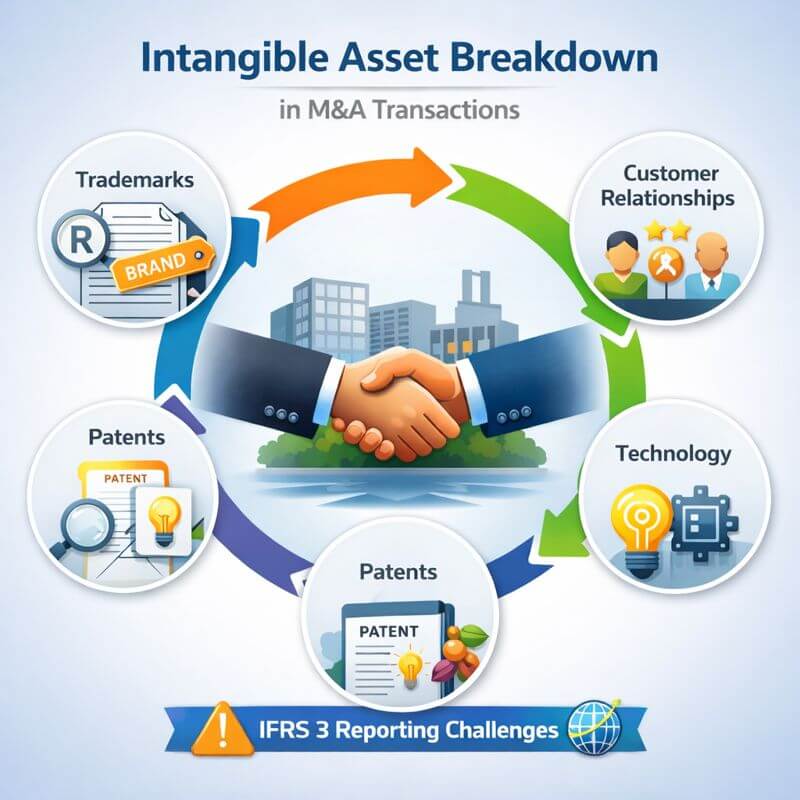
You need to separate intangibles that meet two criteria. First, they must be identifiable through separability or contractual rights. Second, they must be measurable reliably at fair value.
Customer relationships frequently get overlooked. If customers have a history of repeat purchases, you’ve got an intangible. If contracts exist, you’ve got legal rights. Either way, you recognize them separately.
Technology and Intellectual Property
Technology and intellectual property need careful assessment. Patents are obvious. But what about unpatented technology? Trade secrets? Proprietary processes? They all qualify if separable.
Brand names and trademarks carry value beyond their legal registration. You measure them based on market participant perspectives. What would others pay for the brand?
Valuation Methods
Your valuation methods depend on the asset type. Relief-from-royalty works well for brands and patents. Excess earnings method fits customer relationships. Cost approach applies when others don’t work.
IFRS 3 intangible assets assessment requires specialized skills. You’ll likely need valuation experts. Their input becomes critical for defending your IFRS 3 fair value measurements and conclusions.
Special Considerations
Defensive intangibles create confusion. You’re buying a competitor’s brand to shut it down. You still recognize it at fair value. Your intention to use it doesn’t change its market value.
In-process research and development gets recognized separately. Even if incomplete. Even if uncertain. You measure it at fair value based on probability-weighted outcomes addressing IFRS 3 reporting challenges.
Non-compete agreements from key employees might qualify. But test whether they’re really intangibles or disguised compensation. The distinction matters for your accounting treatment.
Identifying and Accounting for Contingent Liabilities in M&A
Contingent liabilities IFRS 3 treatment differs from normal accounting. You recognize them even when you wouldn’t outside a business combination.
The recognition threshold is lower. You don’t need to prove they’re probable. You only need them to be present obligations. If there’s a possible outflow, you recognize them at IFRS 3 fair value measurements.
Legal disputes from the acquired business are prime examples. Lawsuits pending at acquisition date get recognized. You measure them at fair value, not your best estimate of the settlement.
Environmental obligations follow similar logic. If contamination existed at acquisition, you’ve got a liability. Fair value reflects what market participants would demand for assuming it.
Warranty obligations on products sold before acquisition need recognition. You’re taking on that responsibility. Fair value captures the expected costs plus a margin.
Restructuring plans announced before acquisition create complications. Are they the acquiree’s obligations or yours? If announced before you gained control, they’re recognized. If after, they’re yours post-acquisition.
Tax contingencies require special attention. Uncertain tax positions from past periods get recognized at fair value. Don’t confuse them with deferred tax, which has different rules.
Onerous contracts assumed in the acquisition get recognized at fair value. You’re measuring the unfavorable terms compared to current market conditions. The liability reflects that disadvantage.
Your fair value measurements for contingencies need documentation. Identify what facts existed at acquisition date. Determine the amount market participants would pay. Establish which discount rates apply.
Changes after acquisition don’t adjust your original recognition. If a lawsuit settles differently than expected, that’s your gain or loss. It doesn’t change goodwill.
The disclosure requirements for contingent liabilities are extensive. You’ll explain their nature, timing, and measurement basis. Users need to understand the risks you’ve assumed.
Steps to Determine the Acquisition Date and Acquirer
Getting the acquisition date determination right isn’t optional. It affects everything in your IFRS 3 reporting challenges.
Understanding the Acquisition Date
The acquisition date is when you obtain control. Not when you sign the purchase agreement. Not when regulatory approval comes through. It’s when control actually transfers.
Control means three things work together. You’ve got power over relevant activities. You’re exposed to variable returns. You can use your power to affect those returns.
When Closing Date Differs from Acquisition Date
Closing date usually equals acquisition date. But not always. Sometimes control transfers before closing. Sometimes after. You need to look at the facts.
Regulatory approvals can delay the acquisition date. If you need approval to control operations, control doesn’t transfer until you get it. Even if you’ve paid the purchase price.
Staged acquisitions create complexity. You might already own 20%, then buy another 40% to reach control. The acquisition date is when you cross the control threshold through IFRS 3 step acquisition examples.
Assessing Control and Voting Rights
Your control assessment considers voting rights first. Over 50%? You’ve probably got control. But look deeper. Potential voting rights from options or convertibles might matter.
Sometimes control exists with less than 50%. Large dispersed shareholder bases can mean control with 30% or 40%. You’ll need to assess the practical ability to direct activities.
Identifying the Acquirer
The acquirer is the entity obtaining control. Usually the one paying consideration. But in reverse acquisitions, the legal acquirer isn’t the accounting acquirer. You need substance over form.
Determining control in acquisitions without clear ownership is tricky. Joint ventures restructured as subsidiaries. Multiple parties contributing different assets. You’ll analyze decision-making rights carefully.
Documentation Requirements
Documentation of your acquisition date decision matters. Record what changed on that date. What powers you gained. What activities you can now direct. Build your support file now.
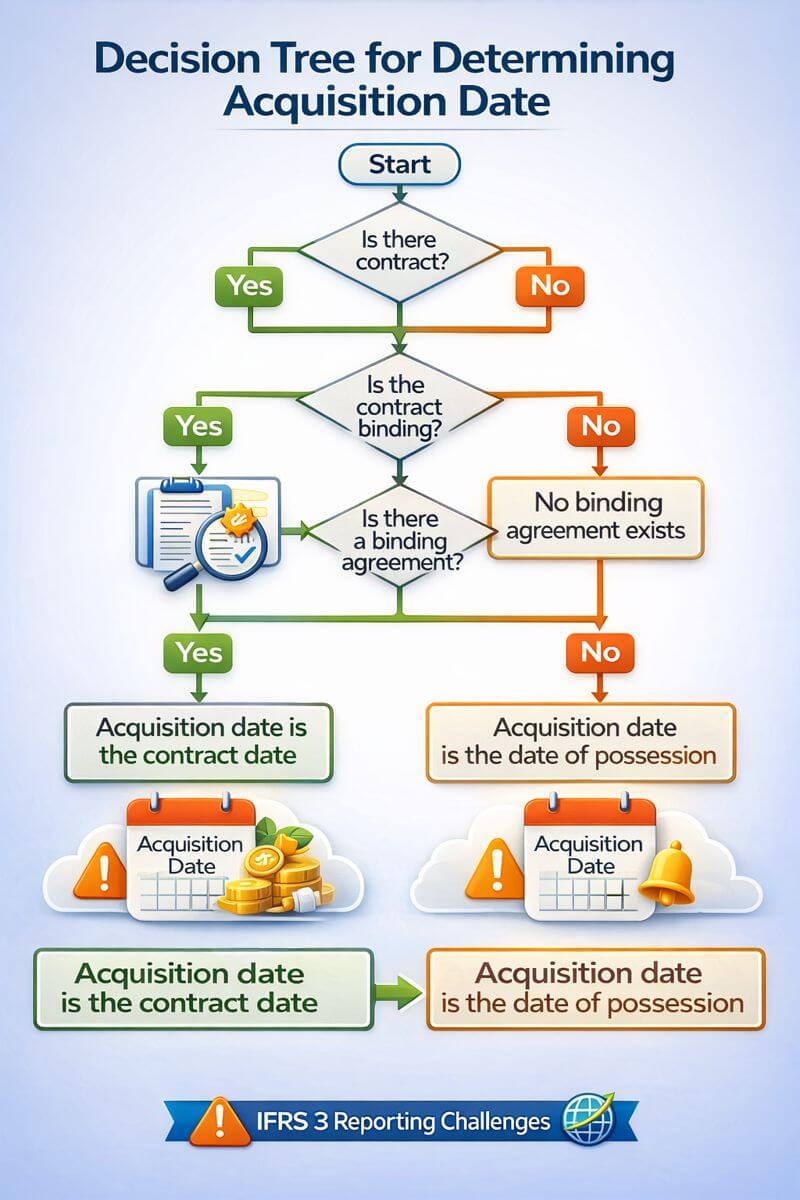
Navigate complex scenarios with a decision tree for determining the acquisition date under IFRS 3. Overcome IFRS 3 reporting challenges with this structured approach.
Common Challenges in Fair Value Measurement and Purchase Price Allocation
Fair value measurement sits at the heart of business combination accounting adjustments. You’re translating deal terms into balance sheet numbers that make sense.
A typical purchase price allocation takes 1-4 weeks to complete. That timeline depends on complexity, data quality, and how fast you can get information.
Missing information creates your first headache. You need details about assets you didn’t own yesterday. Sellers might not have the data you need. Operations are in flux.
Valuation requires market participant assumptions. Your synergies don’t get included. Cost savings specific to your company get excluded. Think like an independent buyer would think.
Level 3 inputs dominate your valuations. You’re using unobservable inputs. Discount rates. Growth rates. Customer attrition. Each requires judgment and support.
Specialized assets lack comparable transactions. How do you value proprietary manufacturing equipment? Unique technology? You’re building from first principles using cost or income approaches.
Multiple valuation methods might give different answers. You need to reconcile them. Weight them appropriately. Explain your final conclusion.
Working capital can be tricky to pin down. Day-to-day fluctuations happen. You need acquisition date balances. Not last month. Not next month. That specific date.
The interaction between intangibles creates complications. Customer relationships and technology often work together. You can’t easily separate their values. But you need to for amortization purposes.
Tax implications flow from your fair value measurements. Higher intangible values mean larger temporary differences. Larger deferred tax liabilities. That reduces net assets acquired.
Goodwill becomes a residual. Everything you get wrong in your fair value measurements flows into goodwill. In 2023, 353 U.S. public companies reported $82.9 billion in goodwill impairments. Get your initial measurement right to avoid impairments later.
Handling Measurement Period Adjustments
The measurement period gives you breathing room. You’ve got up to 12 months from acquisition. Use this time to refine your estimates.
New information about facts existing at acquisition triggers adjustments. You found out the customer list was smaller than you thought? That’s a measurement period adjustment. It changes your original accounting retroactively.
But post-acquisition events don’t qualify. A customer that leaves three months after closing? That’s your operating result. Not a measurement period adjustment.
You’ll need to distinguish between the two carefully. What facts existed at acquisition but you learned about later? Those adjust the opening balance sheet. What changed after acquisition? Those hit current earnings.
Provisional amounts are your friend initially. You can’t always get final valuations by your first reporting date. Record your best estimates. Disclose that they’re provisional. Update them as you learn more.
The adjustment mechanics matter. The opening balance sheet gets restated. Goodwill requires adjustment. Corrections shouldn’t run through current period earnings.
Documentation requirements increase during the measurement period. Record what you knew when. What information came to light. Why it changes your original estimates.
Some finance teams rush to close the measurement period. Don’t. Use the full time if you need it. Getting the accounting right matters more than speed.
Your auditors will scrutinize measurement period adjustments closely. They’ll want to know facts existed at acquisition. They’ll challenge post-acquisition items dressed as adjustments.
Practical Tips for Managing the IFRS 3 Reporting Process
Managing IFRS 3 reporting challenges needs organization. You’re dealing with multiple workstreams. Tight deadlines. External experts. Your own team’s learning curve.
Start planning before you close the deal. Your due diligence phase should identify reporting issues. Which intangibles exist? Are there hidden liabilities? What information gaps need filling for accurate IFRS 3 fair value measurements?
Get your valuation specialists involved early. Don’t wait until after closing. They need access to target management. They need to understand the business. Early engagement means better valuations.
Create a project plan with clear milestones. Determine when you need preliminary allocations. Identify the financial statement closing dates. Establish when valuations need completion. Work backwards from these deadlines.
Document everything as you go. Don’t rely on memory. Record decisions. Save emails. Keep meeting notes. You’ll need this documentation for audits and future reviews.
Build templates for recurring processes. IFRS 3 consulting services can help here. Standard formats for intangible asset identification. Checklist for recognition criteria. Templates save time and reduce errors.
Establish clear roles and responsibilities. Who owns the purchase price allocation? Assign someone to coordinate with valuation experts. Designate a reviewer for specialist reports. Confusion wastes time.
Set up regular status meetings with all parties. Your accounting team. Valuation specialists. Tax advisors. Legal counsel. Operations teams from the acquired business. Keep everyone aligned.
Quality control matters more than speed. Review specialist reports critically. Challenge assumptions. Test sensitivity to key inputs. Don’t accept numbers at face value.
Your first reporting deadline won’t be your last. You’ll file provisional numbers. Update them. Maybe adjust again. Plan for multiple cycles of refinement.
Consider IFRS advisory services for complex deals. You don’t need to be an IFRS 3 expert on every deal. Sometimes external help is worth the investment.
Disclosure Requirements and Avoiding Reporting Surprises
IFRS 3 disclosures tell your acquisition story. Users need to understand what you bought. What you paid. How you accounted for it.
You’ll disclose the acquiree’s name and acquisition date. Seems basic. But getting the date right matters. Remember, it’s the date control transferred, not signing date.
Describe what you acquired and why. What business activities? What products or services? Why did you buy it? Users want context for your strategic rationale.
Quantify the consideration transferred. Break it down by type. Cash paid. Shares issued. Contingent amounts. Fair value of each component. Show how you measured share-based consideration.
Your purchase price allocation needs disclosure. Major classes of assets acquired. Liabilities assumed. Fair values for each. Goodwill amount and what it represents.
Contingent consideration gets special attention. Describe the arrangement. The potential range of outcomes. How and when it gets settled. Your basis for fair value measurement.
Changes during the measurement period need explanation. What changed? Why? How much? Users track how your estimates develop over time.
If you acquired less than 100%, disclose non-controlling interest. How you measured it. Fair value or proportionate share of net assets? What amount you recognized?
Revenue and earnings of the acquired business matter. Show results since acquisition. Give pro forma numbers if the acquisition occurred during your reporting period. What would combined results have been from the start of the year?
Related party transactions assumed in the acquisition need disclosure. Especially if you’ll continue or modify them post-acquisition.
Enhancing Disclosure Quality for Business Combinations
Good disclosures go beyond minimum requirements. You’re telling a clear story. Helping users understand your acquisition accounting.
Use plain language. Accounting jargon doesn’t help anyone. Explain technical terms. Make your disclosures readable.
Break complex topics into digestible pieces. Don’t pile everything into one massive note. Use subheadings. Tables. Clear formatting.
Explain your significant judgments. How did you determine fair value for customer relationships? What discount rates did you use and why? What assumptions drove intangible asset useful lives?
Quantify sensitivity to key assumptions. If your discount rate changed by 1%, how would intangible values change? Give users tools to assess your judgments.
Compare your approach to industry norms. If your goodwill percentage differs materially from peers, explain why. If your intangible allocation is unusual, provide context.
Update your disclosures as the measurement period progresses. Don’t just meet minimum requirements at each reporting date. Show how your understanding developed.
Your disclosure quality affects investor confidence. Poor disclosures raise questions. Good ones build trust. You’re showing you’ve got the accounting under control.
Post-Merger Integration: Accounting and Reporting Implications
Your IFRS 3 work doesn’t end at closing. Integration creates ongoing accounting challenges. Systems merge. Policies align. New issues surface.
Revenue recognition policies might differ. IFRS 15 requires consistent application. You need to align the acquired business to your policies. This might trigger transition accounting.
Inventory valuation methods need harmonization. FIFO in your business, weighted average in theirs? Pick one. The change has earnings implications.
Fixed asset depreciation policies require consistency. Useful lives. Residual values. Depreciation methods. Align them for comparable reporting.
Financial instrument classifications under IFRS 9 need review. The acquired business might have classified items differently. Reclassify to match your approach.
Lease accounting under IFRS 16 applies consistently across the combined group. Identify any leases you inherited. Apply proper recognition and measurement.
Your chart of accounts expands to accommodate new operations. Design it thoughtfully. You need consolidated reporting and separate tracking of acquired operations.
Goodwill gets allocated to cash-generating units for impairment testing. Decide how the acquired business fits your CGU structure. Your allocation affects future impairment risk.
Intangible asset amortization starts immediately. Set up your systems to track it. Different useful lives for different assets. Different amortization methods if appropriate.
Deferred tax assets and liabilities need monitoring. As temporary differences reverse, your tax expense gets affected. Plan for these impacts in your forecasts.
Aligning Accounting Policies and Systems
Policy alignment prevents future headaches. You’re building one accounting framework for the combined group.
Document your accounting policies before integration starts. Where do you differ from the acquired business? Make deliberate choices about which policies to keep.
Some policy changes are mandatory. IFRS 3 requires certain treatments. Others are choices. Consider operational impacts, not just accounting preferences.
System integration takes time. You might run parallel systems initially. Plan your integration roadmap. What gets combined when? What stays separate temporarily?
Data migration carries risks. Test thoroughly. Validate completeness. Check that nothing gets lost in translation between systems.
Training your expanded team is critical. The acquired business’s accounting staff need to learn your policies. Your team needs to understand acquired operations.
Internal controls need updating. You’ll implement new processes. Different risks surface. Additional control activities become necessary. Don’t assume old controls cover new operations.
Your close process gets more complex. You’re managing more entities. Transaction volumes increase. Consolidation entries multiply. Build extra time into your close calendar.
Financial reporting requirements might expand. You’ll report new segments. Different geographies need coverage. Additional product lines require tracking. Your reports need to accommodate the changes from business combination activities.
Working with IFRS advisory services during integration helps. They’ve seen these challenges before. They can help you avoid IFRS 3 common mistakes in handling IFRS 3 reporting challenges.
Mastering IFRS 3 Reporting Challenges for M&A Success
IFRS 3 reporting challenges don’t have to derail your M&A success. You’ve got a clear framework. The acquisition method provides structure. Fair value measurement, while complex, follows defined principles.
Your key success factors are preparation, documentation, and expert involvement. Start planning during due diligence. Document your decisions thoroughly. Bring in specialists when needed.
The technical requirements won’t get easier. But your experience handling them will grow. Each acquisition teaches lessons. Each challenge solved builds your capabilities.
Markets worldwide are seeing increased M&A activity. Regulatory scrutiny is intensifying. Getting IFRS 3 right isn’t just about compliance. It’s about credibility in capital markets.
Your financial statements tell your acquisition story. Make sure they tell it accurately. Fair value measurements that reflect economic reality. Disclosures that provide transparency. Integration that maintains control quality.
Don’t face these IFRS 3 reporting challenges alone. Prima Consulting specializes in business combination accounting. Our IFRS consulting services help finance teams handle complex acquisitions with confidence. Contact us to discuss how we can support your next M&A transaction.
Frequently Asked Questions About IFRS 3 Reporting Challenges
What are the main IFRS 3 reporting challenges in M&A transactions?
The main IFRS 3 reporting challenges include fair value measurement of acquired assets and liabilities, identifying and valuing intangible assets, determining the acquisition date and acquirer, accounting for contingent consideration, allocating purchase price accurately, and meeting extensive disclosure requirements. Each challenge requires significant judgment and specialist expertise.
How long do I have to complete the purchase price allocation under IFRS 3?
You have a measurement period of up to 12 months from the acquisition date to finalize your purchase price allocation. During this time, you can adjust provisional amounts based on new information about facts existing at the acquisition date. This gives you time to obtain final valuations and complete your accounting.
What’s the difference between goodwill and identifiable intangible assets?
Identifiable intangible assets meet specific recognition criteria under IFRS 3. They’re either separable or arise from contractual rights. Examples include customer relationships, brands, and technology. Goodwill is the residual amount after allocating fair value to all identifiable assets and liabilities. It represents items that don’t meet separate recognition criteria.
How do I account for contingent consideration in a business combination?
You recognize contingent consideration at fair value on the acquisition date as part of the consideration transferred. Subsequently, you remeasure it at each reporting date. Changes in fair value from post-acquisition events go through profit or loss for financial liabilities or other comprehensive income depending on the instrument classification. Contingent consideration classified as equity isn’t remeasured.
What are IFRS 3 step acquisition examples?
IFRS 3 step acquisition examples include situations where you first acquire 30% of a business, then later purchase additional shares to reach 51% and gain control. The acquisition date is when you cross the control threshold. You remeasure your previously held interest at fair value on that date, with any gain or loss recognized in profit or loss.
How do I determine the acquisition date if regulatory approval is required?
The acquisition date is when you obtain control, not when you sign the purchase agreement. If regulatory approval is required for control to transfer, the acquisition date is when you receive that approval and control actually passes. Even if you’ve paid consideration earlier, control hasn’t transferred until approval comes through.
What disclosure requirements apply to IFRS 3 business combinations?
IFRS 3 disclosure requirements include the acquiree’s name, acquisition date, business description, consideration transferred and its fair value, amounts recognized for major asset and liability classes, goodwill amount and its components, contingent consideration arrangements, and the acquired business’s revenue and earnings since acquisition. You also provide pro forma information for the reporting period.
How do I identify intangible assets in an acquisition?
You identify intangible assets by analyzing the business for items meeting the separability criterion or arising from contractual-legal rights. Common categories include customer relationships, technology, brands, patents, licenses, non-compete agreements, and in-process R&D. IFRS 3 intangible assets assessment typically requires valuation specialists to support fair value measurements.
What are the common fair value measurement challenges in purchase price allocation?
Common fair value measurement challenges include limited market data for specialized assets, using Level 3 inputs requiring significant judgment, distinguishing between intangible assets and goodwill, determining appropriate discount rates, estimating cash flows for income-based valuations, and allocating value when multiple intangible assets work together. These challenges make business combination accounting adjustments complex.
When should I adjust my initial accounting for a business combination?
You should adjust your initial accounting during the measurement period when you obtain new information about facts existing at the acquisition date. These measurement period adjustments change the opening balance sheet and goodwill retroactively. You shouldn’t adjust for events occurring after the acquisition date. Those affect current period earnings.