TL;DR
IFRS 16 lease modification accounting changes how your business records and measures lease agreements after the original contract terms are altered. Whether you’re dealing with extended lease terms, scope reductions, or combined changes, getting the accounting right is a compliance requirement you can’t overlook. This guide breaks down the exact steps to classify, measure, and report modifications correctly, covering both finance leases and operating leases. You’ll also find practical guidance on IFRS 16 lease measurement, common pitfalls to avoid, and transition options. Read on to protect your financial reporting accuracy.
BPM Optimization for Compliance in UAE and KSA
Most businesses in the Gulf don’t struggle with ambition. They struggle with execution.
Between rapid regulatory changes, Vision 2030 mandates, ZATCA e-invoicing rollouts, and a growing demand for operational transparency, organizations across the UAE and KSA are being pushed to build tighter, faster, and more accountable processes.
That’s exactly where BPM optimization comes in. It’s not just a technology project. It’s a structured discipline that helps you map, automate, and continuously improve how your business actually works. And in 2026, it’s one of the most practical tools available for meeting compliance obligations without slowing down growth.
This guide walks you through the key principles, regional compliance pressures, practical implementation steps, and industry-specific use cases for BPM optimization across the UAE and KSA, so you can make informed decisions that actually move the needle.
What Is BPM Optimization and Why It Matters in UAE and KSA
BPM optimization refers to the ongoing practice of analyzing, redesigning, and improving your business processes to run more accurately, more quickly, and in full alignment with regulatory and strategic goals.
In the UAE and KSA, where compliance requirements shift frequently and the cost of non-conformance can be steep, that kind of structured control is not optional. It’s a core operational requirement.
Key Principles of Business Process Management
Business process management rests on four core activities: modeling, execution, monitoring, and continuous improvement. Each one feeds the next.
- Process modeling: You map out how work currently flows, from input to output, including approvals, handoffs, and decision points.
- Execution: Standardized workflows replace informal routines, cutting variation and human error.
- Monitoring: Real-time dashboards track KPIs, flag bottlenecks, and generate audit trails.
- Optimization: Data from monitoring feeds back into redesign cycles, so processes improve over time.
What’s interesting is that most organizations in the GCC already perform these activities in some form. BPM gives them structure, visibility, and measurability across all four.
How BPM Supports Regulatory Compliance
Compliance requires proof. BPM systems generate that proof automatically.
From automated audit trails to standardized approval workflows, BPM makes it easier for your teams to follow procedures correctly the first time. It also makes it easier to demonstrate that you did, when regulators ask.
According to the 2025 BPM Study by BOC Group, process documentation using BPM has its strongest impact on compliance, rated by 57% of respondents as the top area of value. That’s a number worth paying attention to.
Regulatory and Compliance Challenges in UAE and KSA
If your business operates across both the UAE and KSA, you’re dealing with two distinct regulatory environments, and several overlapping ones. That layering creates real complexity for any growing organization.
Regulatory Complexity Across GCC Markets
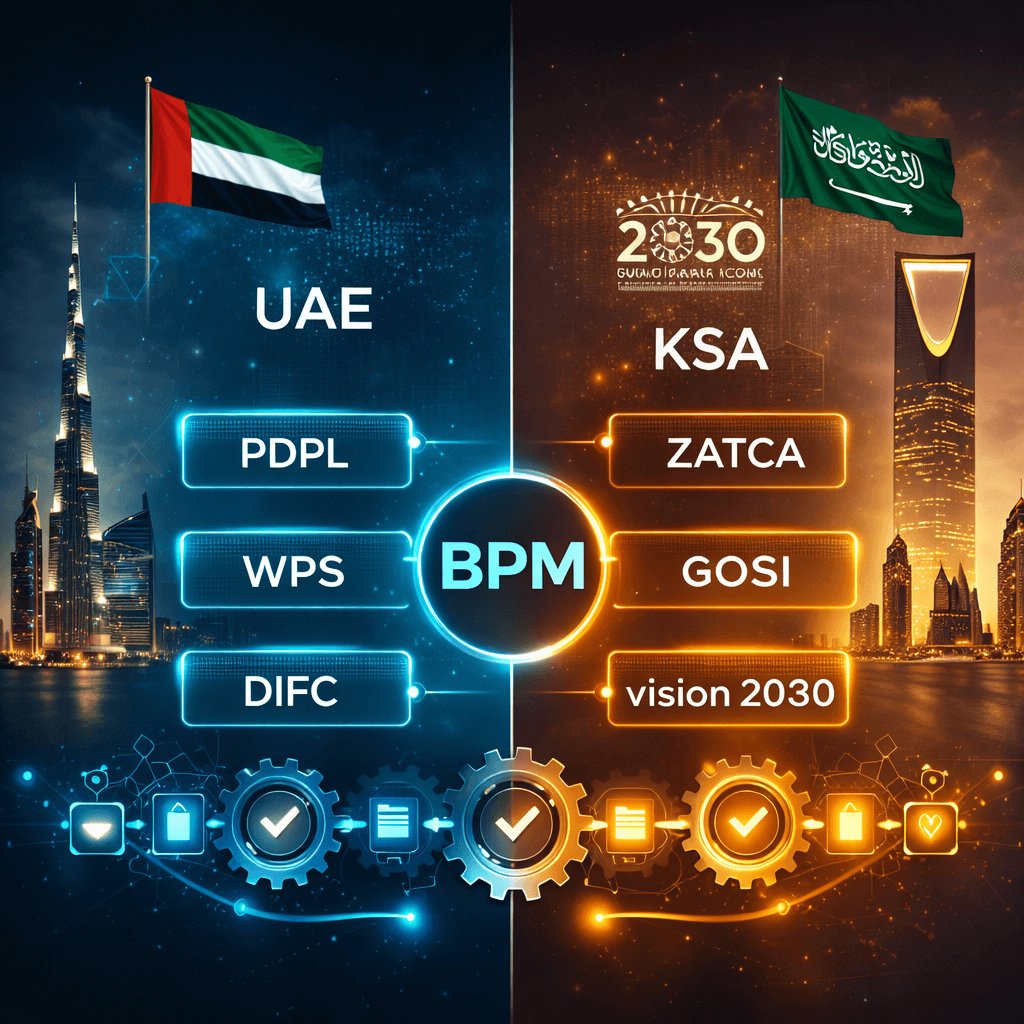
In Saudi Arabia, the ZATCA e-invoicing mandate (FATOORAH) is a clear example of how quickly compliance requirements can scale. Wave 23 of Phase 2 integration, which covered businesses with taxable turnover above SAR 750,000, required compliance between January and March 2026. Wave 24 targets businesses above SAR 375,000, with ZATCA notifying affected taxpayers directly.
Phase 2 requires real-time integration with ZATCA’s FATOORAH platform. B2B invoices must be sent in XML format and cleared before delivery. B2C invoices must be submitted within 24 hours, including a QR code. Non-compliance can result in fines ranging from SAR 5,000 to SAR 50,000 per violation, with potential suspension of VAT registration for repeat offenders.
In the UAE, the Personal Data Protection Law (PDPL) and DIFC data regulations add further layers of compliance obligations, especially for financial services and multi-site enterprises handling sensitive client data.
Compliance Risks in Rapidly Growing Organizations
Growth creates gaps. When teams expand quickly, informal processes get repeated as habits, not standards.
Without structured BPM, those habits introduce inconsistency. Inconsistency produces errors. Errors attract penalties. It’s a chain reaction that BPM is specifically designed to interrupt.
The RegTech market in the Middle East is forecasted to grow at 20% CAGR from 2023 to 2027, reaching USD 1.2 billion. That growth is a signal that businesses across the GCC are actively investing in compliance infrastructure, and BPM is central to that stack.
Managing Multinational Workforces and Operations
GOSI contributions in Saudi Arabia, Wage Protection System (WPS) obligations in the UAE, multi-currency payroll, and cross-border employee transfers all generate compliance exposure.
BPM addresses this by standardizing how HR, finance, and operations teams handle these processes, regardless of location. You get consistent execution, documented audit trails, and far less reliance on individual knowledge retention.
Key Benefits of BPM Optimization for GCC Businesses
Improve Operational Efficiency and Workflow Speed
Structured BPM removes redundant steps, cuts approval delays, and replaces paper-based handoffs with automated digital workflows.
Organizations fusing process mining, machine learning, and RPA report up to 85% efficiency improvements and a 30% rise in operational performance. In healthcare, for example, BPM-driven patient onboarding processes have cut processing time by up to 40% in GCC pilots.
Reduce Operational Costs and Process Errors
Manual processes cost more than they appear to on paper. Every rework cycle, every missed deadline, every compliance breach has a financial cost attached.
RegTech solutions integrated with BPM for compliance processes can cut compliance costs by 30% to 50%, according to Strategy& (PwC’s strategy consulting arm). That range alone justifies a serious conversation about BPM investment.
Strengthen Compliance and Risk Management
BPM platforms generate audit trails automatically, making it easier to prove compliance during a regulatory review.
You’re not scrambling to reconstruct records. They’re already documented, timestamped, and searchable. That’s a structural advantage in environments like the UAE and KSA where documentation requirements are non-negotiable.
Enable Data-Driven Decision Making
BPM dashboards surface real-time process data that most businesses currently can’t access or aggregate.
With that visibility, you can identify which processes are creating delays, which team members are handling the heaviest workloads, and where compliance gaps are forming before they become incidents.
Support Scalable Business Growth
When processes are documented and standardized, they scale cleanly. You don’t have to rebuild workflows every time you open a new office or bring on a new business unit.
That’s particularly relevant in the KSA market where Vision 2030 is pushing rapid expansion across non-oil sectors. The Saudi Arabia RegTech market is expected to grow from USD 173.1 million in 2025 to USD 718.7 million by 2034 at a CAGR of 17.14%. Growing alongside that curve requires scalable infrastructure, and BPM is part of it.
Step-by-Step BPM Optimization Framework
Here’s the thing: BPM optimization doesn’t have to start big. The most successful implementations in the GCC started with a focused pilot, then expanded from there.
Map and Analyze Existing Business Processes
Start with your highest-volume, highest-risk processes. Finance, HR, procurement, and client onboarding are typical starting points.
Use process discovery tools or structured interviews to document what actually happens, not what the process map says should happen. You’ll almost always find a gap between the two.
Identify Bottlenecks and Compliance Gaps
Once you have your process map, compare it against your compliance obligations. In KSA, that includes ZATCA invoice handling, GOSI payroll cycles, and Zakat reporting workflows. In the UAE, that includes WPS payroll submissions, PDPL data handling requirements, and trade license renewal schedules.
Flag every point where a manual step creates delay, error risk, or documentation failure. Those are your priority targets.
Redesign and Standardize Workflows
For each priority process, design a standardized workflow that removes unnecessary steps, clarifies ownership, and builds in compliance checkpoints.
Arabic language UI and localized field requirements are not optional in GCC deployments. Any BPM platform you select should support these natively.
Implement Automation and Digital Tools
Automation should follow redesign, not the other way around. Many businesses make the mistake of automating a broken process. That just produces broken results faster.
Once workflows are clean, introduce RPA for repetitive tasks like data entry and report generation. Connect your BPM platform with ERP, CRM, and compliance systems to reduce manual data transfers.
Monitor KPIs and Continuously Improve
Set up dashboards that track the KPIs that matter most for your specific compliance environment. Processing time, error rates, SLA adherence, and audit completion rates are a solid starting point.
Run monthly or quarterly review cycles. What your data reveals in Month 3 will be different from what it reveals in Month 1. That’s not a problem. It’s the point of continuous improvement.
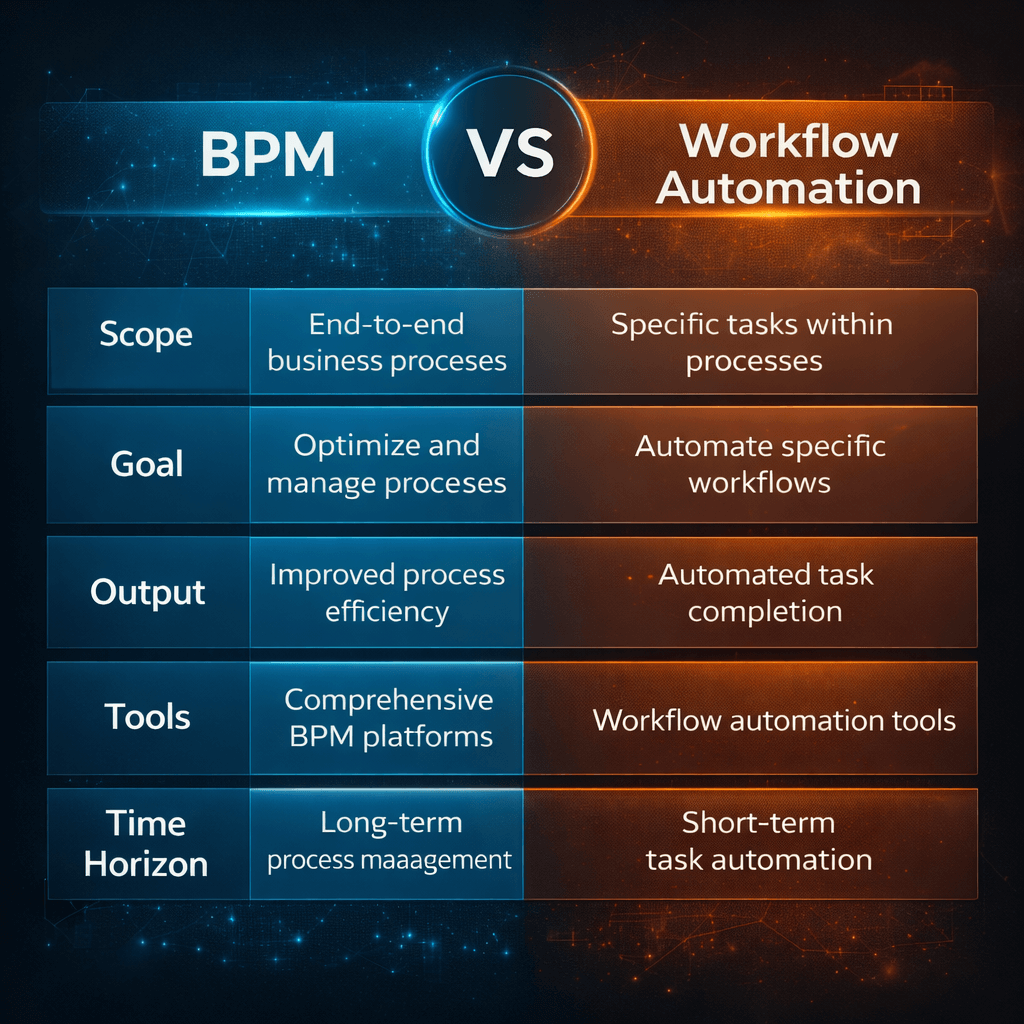
BPM Optimization vs Workflow Automation: Key Differences
These two terms get used interchangeably, but they’re not the same thing. Knowing the difference helps you set better expectations and make better investments.
- Workflow automation focuses on executing a specific, defined sequence of tasks without human intervention. It’s transactional.
- BPM optimization is broader. It includes strategy, process design, governance, technology, and continuous improvement. It’s structural.
To put it simply: workflow automation is a tool. BPM optimization is the discipline that tells you which tools to use, where, and why.
In the GCC compliance context, you need both. But you need BPM thinking to make sure your automation investments actually solve the right problems.
How BPM Integrates With ERP and Enterprise Systems
BPM and ERP Integration in UAE and KSA Businesses
ERP systems like SAP, Oracle, and Odoo manage your core transactional data. BPM sits on top of that foundation, coordinating how processes flow across departments and systems.
In the KSA context, your ERP needs to generate ZATCA-compliant XML invoices. Your BPM layer is what governs the approval workflow, exception handling, and audit documentation around that process.
For expert guidance on how to structure that integration effectively, working with experienced business process management consulting professionals makes a measurable difference in implementation outcomes.
Aligning BPM With CRM and Compliance Systems
CRM platforms manage your client-facing processes. When those processes touch compliance obligations, such as KYC documentation, contract renewals, or service delivery tracking, BPM creates the governance layer that keeps everything aligned.
That alignment matters most in financial services, real estate, and government contracting, where a single documentation gap can halt an entire transaction.
Industry Use Cases for BPM Optimization in UAE and KSA
Financial Services and Banking Compliance
Banking institutions across the GCC use BPM to automate loan approval workflows, KYC verification chains, and AML monitoring processes.
The results are concrete. BPM-optimized loan approval processes in KSA pilots have cut approval timelines significantly compared to manual workflows. Financial institutions must also interpret more than 200 daily regulatory changes, and BPM-centric compliance hubs automate that regulatory mapping, cutting investigatory workloads by up to 80%.
Government and Public Sector Processes
Government agencies in both countries are under pressure to deliver digital services faster and with greater transparency.
BPM optimization supports citizen onboarding workflows, permit processing, and inter-agency data sharing, all with built-in audit trails and performance monitoring. In Saudi Arabia, this directly supports the digital government goals embedded in Vision 2030.
Retail and E-Commerce Operations
In retail and e-commerce, BPM manages the end-to-end flow from order intake through inventory, fulfillment, invoicing, and returns handling.
For businesses operating across both markets, BPM handles the differences in VAT treatment, consumer protection obligations, and logistics documentation automatically within a single workflow framework.
Construction and Real Estate Project Management
Construction projects in the GCC involve multiple contractors, regulatory approvals, and milestone-based payment schedules. Each one is a compliance event.
BPM brings all of that into a single governed workflow. Approvals are tracked, subcontractor documentation is managed, and payment releases are tied to verified milestones rather than informal sign-offs.
Best BPM Tools and Technologies for 2026
Key Features to Look for in BPM Software
Not all BPM platforms are built for the GCC compliance environment. Here’s what actually matters when evaluating them:
- Arabic language support and right-to-left interface options
- On-premise or private cloud deployment options for data sovereignty compliance
- Native integration with ZATCA FATOORAH and UAE tax authorities
- Role-based access controls and audit trail generation
- Low-code or no-code workflow design for business users
- Process mining and analytics capabilities
- RPA and AI integration readiness
The BPM market is projected to grow from USD 18.67 billion in 2026 to USD 32.34 billion by 2031 at a CAGR of 11.62%. That growth is being driven by cloud-native delivery, process mining tools, and AI-enhanced workflow intelligence, all features worth prioritizing in your evaluation.
Choosing the Right BPM Platform for GCC Businesses
Your platform selection should be driven by your specific industry, compliance obligations, and IT environment. There’s no one-size-fits-all answer, and any vendor who claims otherwise is oversimplifying.
Start with a clear process inventory, define your top three compliance pain points, and evaluate platforms against those specific requirements. Engaging qualified bpm consulting firms during the selection process helps you avoid costly mismatches between platform capabilities and your actual operational needs.
Best Practices for Successful BPM Optimization
- Executive sponsorship matters most. BPM without leadership commitment stalls at the pilot stage.
- Start with a pilot. Pick a high-impact, bounded process, prove the model, then scale.
- Involve the people doing the work. Process owners who designed the new workflow are far more likely to follow it.
- Document everything. In compliance-heavy environments, your documentation is your defense.
- Don’t automate before you optimize. A broken process automated is still broken.
- Use local expertise. Regional compliance knowledge, particularly around ZATCA, GOSI, WPS, and PDPL, is non-negotiable for accurate process design.
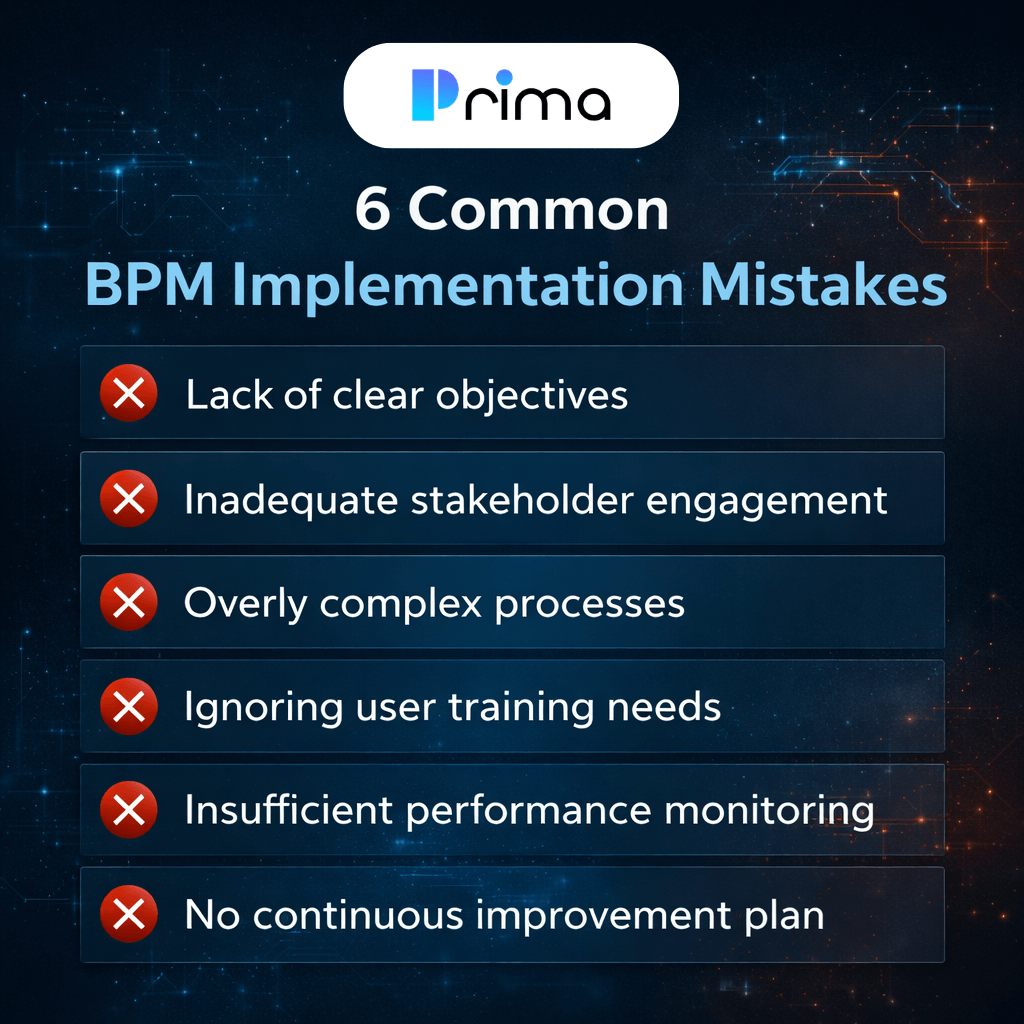
Common BPM Implementation Mistakes to Avoid
- Skipping the discovery phase. Going straight to automation without mapping current-state processes creates blind spots.
- Treating BPM as a one-time project. It’s a continuous discipline. Set up review cycles from day one.
- Choosing a platform before defining your requirements. The platform should fit your compliance context, not the other way around.
- Ignoring change management. Technology changes rarely fail technically. They fail because people don’t adopt them.
- Underestimating integration complexity. Multi-layered ecosystems blending legacy ERPs, cloud SaaS, and niche applications can double implementation costs if not scoped properly.
- No ROI tracking. Without metrics, you can’t justify continued investment or identify which parts of the program are working.
Frequently Asked Questions About BPM Optimization
What is BPM optimization in business operations?
BPM optimization is the practice of systematically analyzing, redesigning, automating, and monitoring your business processes to make them faster, more accurate, and fully aligned with compliance and strategic goals. In the UAE and KSA, it’s especially valuable for managing ZATCA, GOSI, WPS, and PDPL obligations within a single governed framework.
How long does BPM implementation take in UAE and KSA?
A focused pilot, covering a single high-impact process, typically takes 8 to 12 weeks. A full enterprise rollout across multiple departments and systems can take 6 to 18 months depending on organizational complexity, existing IT infrastructure, and the number of compliance systems being integrated.
Can small and mid-size businesses adopt BPM successfully?
Yes. Cloud-based BPM platforms and low-code workflow tools have made BPM accessible to businesses of all sizes. SMEs in the GCC can start with a narrowly scoped implementation targeting their highest-risk compliance processes, typically payroll, invoicing, or client onboarding, and expand from there as they build operational maturity.
What KPIs measure BPM optimization success?
Key performance indicators worth tracking include: process cycle time reduction, error and rework rates, SLA adherence, number of compliance incidents, audit trail completeness, cost per process transaction, and employee time saved through automation. Start with three to five metrics that directly reflect your biggest compliance pain points.
How does BPM help with regulatory compliance?
BPM helps with regulatory compliance by standardizing how regulated activities are performed, automatically generating audit documentation, flagging exceptions in real time, and integrating directly with systems like ZATCA FATOORAH. It turns compliance from a reactive scramble into a built-in feature of how your business operates day to day.
Make BPM Optimization Your Competitive Advantage in 2026
The regulatory landscape in the UAE and KSA is only getting more precise. Compliance requirements will keep expanding, deadlines will keep moving, and the cost of getting it wrong will keep rising.
BPM optimization gives your organization a structured way to stay ahead of all of it. It’s not just about passing audits. It’s about building operations that work better every single day, with less rework, less risk, and a clearer view of what’s actually happening across your business.
That starts with knowing where your processes stand right now, and having the right expertise to improve them.
Prima Consulting works with organizations across the GCC to design, implement, and continuously improve BPM frameworks built for the regional compliance environment. If you’re ready to build processes that perform as well as your ambitions, let’s talk.