TL;DR
Understanding IFRS 17 vs IFRS 9 is critical for insurers managing the biggest accounting transformation in decades. This comparison guide explains how IFRS 17 handles insurance contracts through CSM while IFRS 9 measures financial instruments using expected credit loss models. You’ll discover key differences in measurement approaches, volatility impacts, and how these standards interact on your balance sheet. Learn strategic implementation tips, disclosure requirements, and how to coordinate asset-liability matching for better financial reporting.
The insurance industry faced its biggest accounting transformation in decades when IFRS 17 vs IFRS 9 standards became effective in 2023. For insurers across UAE, Saudi Arabia, Pakistan, and Germany, understanding these standards isn’t just about compliance—it’s about strategic positioning in a competitive market.
Recent implementation data shows Middle Eastern insurers struggled with establishing proper governance structures during their IFRS 17 rollouts. The global insurance industry spent an estimated US$21-27 billion on IFRS 17 implementation alone, with large multinationals averaging US$240 million in program costs.
You’re navigating uncharted territory where traditional accounting methods no longer apply. This comprehensive guide breaks down the critical differences between IFRS 17 and IFRS 9, helping you make informed decisions that protect your bottom line and satisfy stakeholders.
IFRS 17 vs IFRS 9: A High-Level Overview
Think of IFRS 17 vs IFRS 9 as two sides of the same coin—both essential for complete financial reporting but serving different purposes.
IFRS 17 revolutionizes how you account for insurance contracts. It replaces the outdated IFRS 4 standard that allowed inconsistent practices across insurers. Refer to our blog, IFRS 17 vs IFRS 4, for clarity
IFRS 9 transforms financial instrument classification and measurement. For many insurers, understanding IFRS 9 vs IAS 39 is critical, as it introduces the Expected Credit Loss (ECL) model that fundamentally changes how you recognize impairments.
Global implementation data reveals the insurance industry spent US$21-27 billion on IFRS 17 implementation, with large multinationals averaging US$240 million in program costs.
The standards work together to create balance sheet symmetry. EFRAG research indicates this alignment reduces accounting mismatches significantly, particularly for insurers with complex investment portfolios.
Moreover, the connection between IFRS 17 and IFRS 9 alignment creates unique challenges when managing insurance assets and liabilities together.
Purpose and Scope of IFRS 17 and IFRS 9
IFRS 17 covers all insurance and reinsurance contracts you issue or hold. It doesn’t matter if you call them insurance—what matters is the contract substance.
IFRS 9 applies to all financial instruments including bonds, equities, derivatives, and loans. For insurers, this means virtually your entire investment portfolio falls under IFRS 9.
The scope differences create natural interaction points. Your insurance liabilities (IFRS 17) are funded by financial assets (IFRS 9), making coordination essential for meaningful financial reporting.

Key Differences Between IFRS 17 vs IFRS 9 for Insurers
Balance Sheet Treatment: Liabilities vs Assets
IFRS 17 focuses exclusively on insurance contract liabilities. You’ll measure these using three possible approaches:
- General Measurement Model (GMM) for most contracts
- Premium Allocation Approach (PAA) for short-term contracts
- Variable Fee Approach (VFA) for participation contracts
IFRS 9 classifies your financial assets into three categories based on business model and cash flow characteristics:
- Amortized Cost (AC) for hold-to-collect strategies
- Fair Value through Other Comprehensive Income (FVOCI) for hold-to-collect-and-sell
- Fair Value through Profit or Loss (FVTPL) for trading or failed SPPI test
Recognition and Measurement Differences
The measurement philosophies differ fundamentally. IFRS 17 introduces the Contractual Service Margin (CSM)—your unearned profit that releases over the coverage period.
IFRS 9 eliminates the incurred loss model. You now recognize Expected Credit Losses upfront, even for performing assets.
This represents the biggest accounting change in decades for insurers who previously relied on different measurement bases for assets and liabilities.
Why the IFRS 17 and IFRS 9 Transition Matters for UAE Insurers
UAE insurers among others face unique challenges during this transition. Many are navigating complex requirements under IFRS 17 GCC implementation, where the regulatory environment requires full compliance without compromising solvency ratios or dividend capacity
Proper adherence to accounting standards prevents disorganized financial statements that undermine investor confidence in the competitive UAE insurance market.
The transition affects three critical areas:
- Regulatory Compliance: UAE Central Bank expects timely implementation with robust disclosures.
- Investor Relations: Stakeholders need education on new KPIs and performance metrics.
- Operational Efficiency: Systems and processes require fundamental redesign.
Volatility in Earnings: What Insurers Should Expect
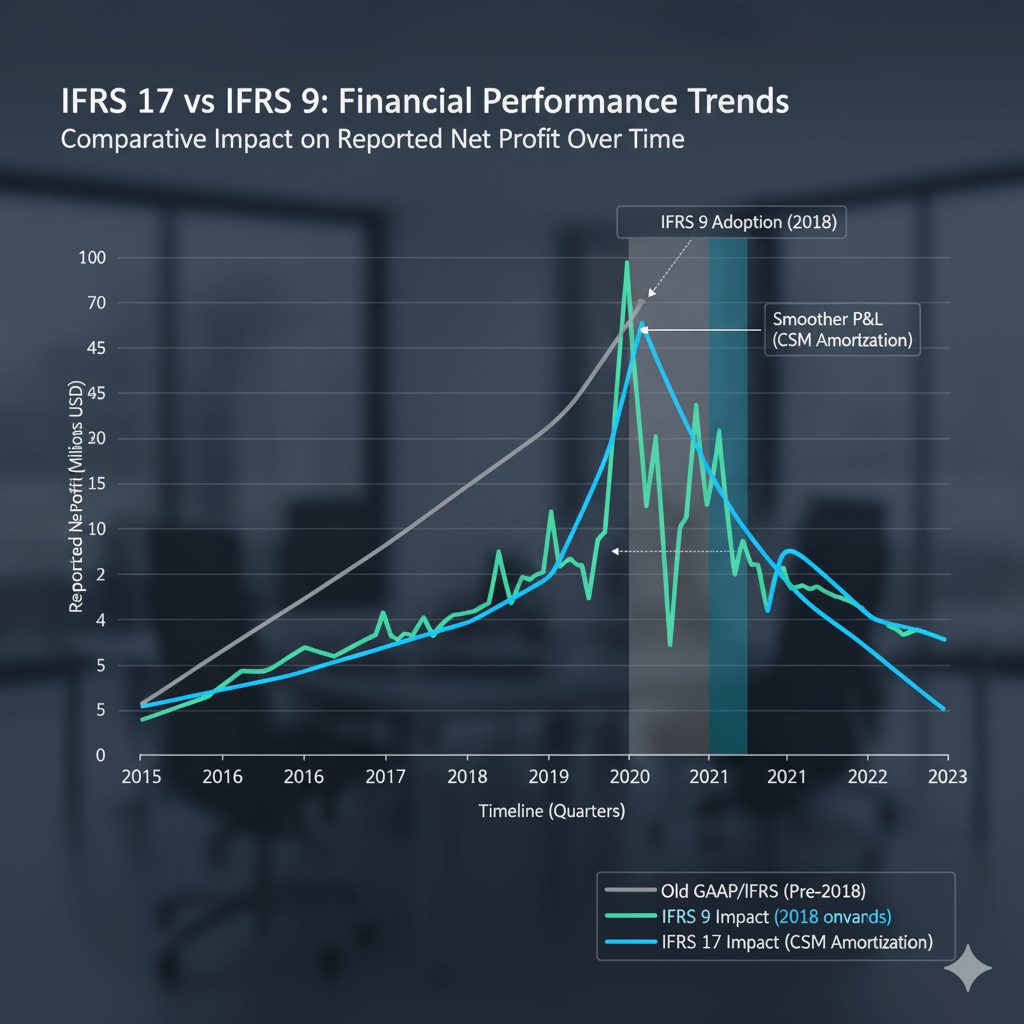
You’ll see different volatility patterns under the new standards. IFRS 17 smooths profit recognition through CSM releases, while IFRS 9 can introduce earnings volatility through fair value movements.
Survey data from 235 insurers across 37 countries reveals concerning readiness levels:
- Only 55% felt confident explaining simple IFRS 17 results to senior management
- Confidence drops to 18% for complex scenarios
- Just 9% felt prepared for extreme scenarios
These results highlight how common IFRS 17 myths still confuse senior leadership teams, even after years of preparation.
Among 60 insurers studied, 70% implemented IFRS 9 in 2023, with 63% applying the classification overlay. The remaining 30%, mainly bancassurers, had implemented IFRS 9 in 2018.
Strategic Considerations When Adopting IFRS 17 vs IFRS 9
Your strategic approach must balance technical compliance with business objectives. The standards don’t change your underlying business economics, but they transform how you present results.
Consider these strategic elements:
- Asset-Liability Matching: Coordinate your discount rate approaches between IFRS 17 and IFRS 9 to minimize accounting mismatches.
- OCI Elections: Make deliberate choices about using Other Comprehensive Income to smooth earnings volatility.
- System Integration: Invest in technology that handles both standards seamlessly rather than treating them separately.
- Stakeholder Communication: Develop clear narratives explaining new metrics like insurance revenue and CSM movements.
Implications for KPIs, Disclosures, and Investor Perception
Traditional metrics like gross written premiums become less relevant. Instead, you’ll focus on:
- Insurance Revenue (IFRS 17 metric replacing premiums)
- Insurance Service Result (profit from underwriting)
- CSM Release Ratios (measuring profit emergence)
- Net Finance Income/Expenses (investment performance)
The final IFRS 17 standard was released in May 2017 and applies separately to all insurance and reinsurance contracts, requiring comprehensive disclosure changes.
Based on 2024 industry data from 53 insurers across 17 EU states:
- 86% of life contracts use Variable Fee Approach
- 90% of non-life contracts use Premium Allocation Approach
- Insurance liabilities averaged 9.5% higher than Solvency II values
How IFRS 17 and IFRS 9 Affect Financial Statements Differently
Measurement Models: GMM, VFA, and ECL Explained
General Measurement Model (GMM) applies to most insurance contracts. You’ll calculate:
- Best Estimate Liabilities (BEL)
- Risk Adjustment for non-financial risk
- Contractual Service Margin (CSM)
Variable Fee Approach (VFA) suits contracts where policyholders participate in investment returns. The CSM adjusts for changes in underlying financial assets.
Expected Credit Loss (ECL) Model under IFRS 9 operates differently:
- Stage 1: 12-month ECL for performing assets
- Stage 2: Lifetime ECL for significant credit deterioration
- Stage 3: Lifetime ECL for credit-impaired assets
Credit Risk Assessment and Expected Credit Loss (ECL)
The ECL model requires forward-looking assessments. You can’t wait for actual losses—you must anticipate them based on reasonable scenarios.
For insurers, this creates interesting dynamics with IFRS 17 risk adjustments. Both address uncertainty, but through different mechanisms:
- ECL addresses credit risk on financial assets
- Risk adjustment addresses non-financial risk on insurance liabilities
Impacts on Profitability, Volatility, and Capital Management
Profitability patterns change significantly under both standards. IFRS 17’s CSM creates smoother profit emergence, while IFRS 9 can introduce volatility through fair value changes and ECL movements.
Capital management requires new approaches. You’ll need to understand how regulatory capital ratios interact with new accounting measurements.
The interaction between IFRS 9’s expected credit loss model and IFRS 17’s insurance contract measurements creates complex scenarios. When your investment assets backing insurance liabilities experience credit deterioration, both standards activate simultaneously.
Comparability Across Reporting Periods and Entities
Achieving comparability challenged many insurers during transition. Countries like Georgia and Ukraine implemented IFRS 17 in 2023, while Western Balkan countries delayed implementation, creating regional disparities.
The December 2021 IFRS 17 amendments introduced a classification overlay option, helping align financial asset presentation in comparative periods. This eased transitional difficulties significantly.
Transition Challenges and Operational Readiness
Impact on Data, Systems, and Reporting Infrastructure
Your data requirements expand dramatically under both standards. IFRS 17 demands granular contract-level information spanning decades, while IFRS 9 requires sophisticated credit modeling capabilities.
System integration becomes critical. You need platforms that handle:
- CSM calculations with monthly precision
- ECL computations across multiple scenarios
- Asset-liability matching analytics
- Regulatory reporting across multiple frameworks
Establishing clear governance structures with defined roles, responsibilities and workstreams proves essential for successful implementation.
Common Pitfalls in Implementing IFRS 17 and IFRS 9
Based on global implementation experience, avoid these common mistakes:
- Underestimating Data Requirements: Both standards need more granular data than most insurers initially expect.
- Treating Standards Separately: The standards interact significantly. Coordinate your implementation approach.
- Inadequate Testing: Complex calculations require extensive testing across multiple scenarios.
- Poor Change Management: Staff need comprehensive training on new concepts and metrics.
Internal Capability Gaps and Resource Requirements
Survey results show significant capability gaps:
- Over 50% of insurers weren’t ready for business planning under IFRS 17/9
- Most struggled with complex scenario explanations
- Few felt prepared for extreme market conditions
For expert IFRS advisory and accounting services, insurers need specialized support spanning technical accounting, systems implementation, and change management.

Investor Communication and Market Expectations
Market expectations differ across regions. UAE and Middle Eastern investors show increasing sophistication in understanding complex accounting standards, but still require education on new metrics.
Rating agencies indicated minimal expected credit rating changes due to these accounting updates. The focus remains on underlying business performance rather than accounting presentations.
For practical guidance on IFRS 9 for financial instruments, insurers should prioritize stakeholder education alongside technical implementation.
Strategic Implementation Recommendations
Start with governance structure establishment. You need clear project ownership spanning finance, actuarial, IT, and business units.
Develop your data strategy early. Both standards require historical information that might not exist in current formats. Begin data collection and cleansing immediately.
Plan your system architecture carefully. Choose solutions that integrate IFRS 17 and IFRS 9 calculations rather than treating them separately.
For comprehensive support on insurance contracts and IFRS 9 Expected Credit Loss, consider partnering with experienced advisors who understand regional requirements.
IFRS 17 vs IFRS 9: Making Informed Decisions for Your Insurance Business
Success requires understanding that these aren’t just accounting changes—they’re business transformation initiatives. Your approach should balance technical compliance with strategic positioning for future growth.
The standards create unprecedented transparency in insurance financial reporting. This transparency benefits stakeholders but requires careful preparation and communication. While implementation costs average US$240 million for large insurers globally, the long-term benefits include modernized finance functions, faster reporting, and improved commercial insights.
Ready to transform your insurance accounting practices? Contact our expert IFRS advisory team to develop a comprehensive implementation strategy that positions your organization for success in the new regulatory environment.
Moreover, our experts in IFRS 17 consulting Middle East help clarify the distinct accounting scopes of IFRS 17 for insurance contracts and IFRS 9 for financial instruments. This distinction is critical for accurate reporting and risk assessment.