
TL;DR
IFRS 17 actuarial assumptions directly determine how insurers recognize profits through five critical variables: discount rates, mortality rates, expense projections, policyholder behavior, and claims development patterns. This analysis explains how these assumptions affect the contract service margin, risk adjustment calculations, and profit emergence timing under different IFRS17 methodology approaches. You’ll discover why 85% of actuaries revised their reserving methods, how discount rate changes shift liability valuations by 10-15%, and what drives insurance profit IFRS17 volatility. Compare the General Measurement Model and Premium Allocation Approach to understand which assumptions create the biggest IFRS17 CSM impact for your contracts.
Insurance companies worldwide face a fundamental shift in how they recognize and report profits under IFRS 17.
The standard’s actuarial assumptions don’t just change numbers on financial statements – they reshape how insurers measure success, attract investors, and plan for the future.
Research shows that 85% of actuaries expect changes to their reserving methodologies and assumptions due to IFRS 17, directly influencing insurer profits.
This transformation affects everything from premium pricing to shareholder returns, making actuarial precision more critical than ever.
The shift from IFRS 4 to IFRS 17 fundamentally alters when and how profits appear on income statements, creating both opportunities and challenges for insurance executives navigating this new landscape.
Introduction to IFRS 17 Actuarial Assumptions
IFRS 17 actuarial assumptions form the backbone of modern insurance accounting. These assumptions determine how insurers measure contract liabilities, recognize profits, and present financial performance to stakeholders.
Under the new standard, actuarial assumptions encompass financial variables like discount rates, demographic factors including mortality rates, and operational elements such as expense projections. Each assumption directly impacts the Contractual Service Margin and risk adjustment calculations.
World Bank analysis reveals that 79% of net profit before tax for insurers derives from insurance service results under IFRS 17. This statistic highlights how actuarial assumptions now drive the majority of reported profitability.
The precision required for these assumptions has increased dramatically. Small changes in key variables can create significant fluctuations in reported profits and balance sheet strength.
Five Types of IFRS 17 Actuarial Assumptions
1. Discount Rates and Interest Yield
Discount rates represent the most volatile component of IFRS 17 actuarial assumptions. Most insurers adopt a bottom-up approach, building rates from risk-free government bonds plus specific adjustments for illiquidity and credit risk.
Interest rate changes create immediate impacts on both insurance contract liabilities and the contractual service margin. When rates rise, present values of future cash flows decrease, potentially releasing profits earlier than expected.
Long-term life insurance contracts show particular sensitivity to discount rate movements. A 100 basis point change can shift liability valuations by 10-15% for products with durations exceeding 20 years.
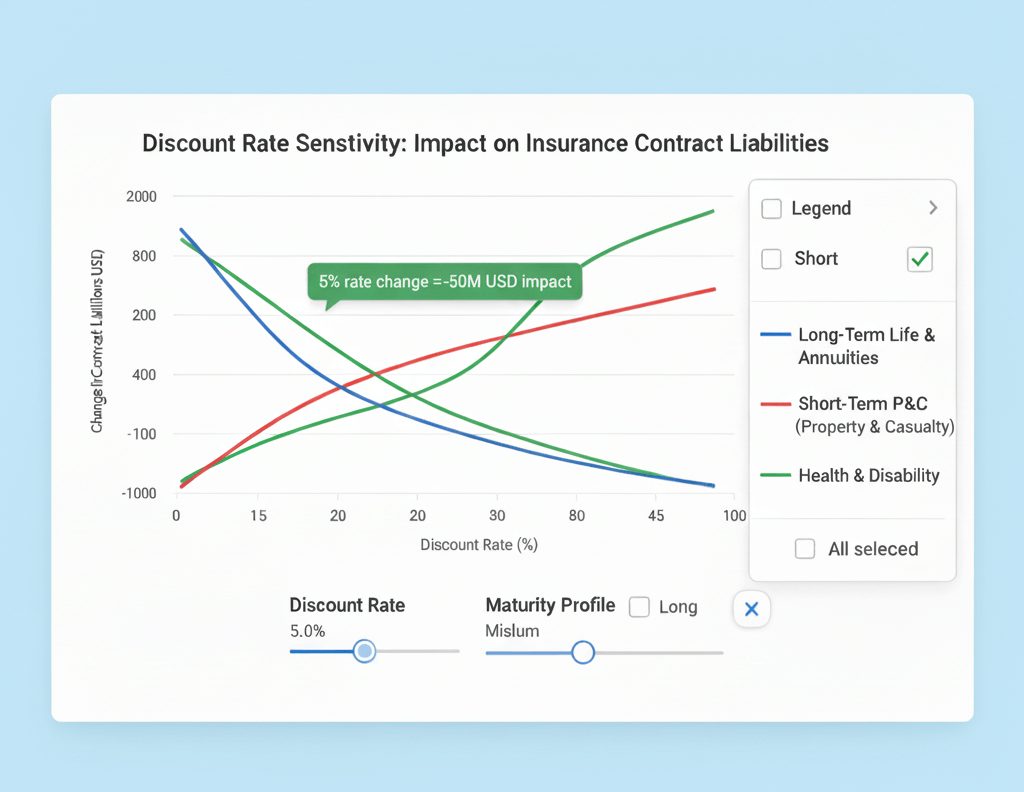
The choice between top-down and bottom-up approaches affects profit volatility. Top-down methods using observable market rates create more fluctuation but better reflect economic reality.
2. Mortality and Morbidity Assumptions
Mortality assumptions directly influence life insurance liability calculations and profit emergence patterns. Insurers must balance historical experience with emerging trends like longevity improvements and pandemic impacts.
Morbidity assumptions prove especially challenging for health and disability insurers. Medical cost inflation, changes in treatment protocols, and population health trends all affect these critical variables.
Best-estimate mortality rates require regular updates to reflect current population data. Outdated assumptions can lead to significant profit distortions, particularly for annuity writers facing longevity risk.
Regional variations in mortality experience demand localized assumption setting. What works in developed markets may not apply to emerging insurance jurisdictions.
3. Expense Assumptions
Expense assumptions under IFRS 17 include both direct contract costs and allocated overhead expenses. These projections must reflect realistic operational efficiency improvements and inflation expectations.
Many insurers revised expense assumptions after IFRS 17 implementation, recognizing the impact of digital transformation and changing cost structures. Technology investments often create short-term expense increases followed by long-term savings.
Maintenance expenses require particular attention as they affect ongoing contract servicing costs. Underestimating these expenses can lead to onerous contract recognition and immediate loss recognition.
Unit cost trends must align with business strategy. Aggressive cost reduction targets may create unrealistic expense assumptions that distort profit recognition.
4. Policyholder Behavior Assumptions
Lapse rate assumptions significantly influence cash flow timing and contractual service margin release patterns. Economic conditions, product competitiveness, and regulatory changes all affect policyholder behavior.
Dynamic lapse models that reflect market conditions provide more accurate projections than static historical rates. Interest rate environments particularly influence surrender patterns in life insurance products.
Partial withdrawal assumptions affect cash flows in flexible premium products. These behaviors often correlate with market performance and policyholder financial stress levels.
Customer retention programs can influence future lapse rates. Assumption setting must consider both current experience and planned retention initiatives.
5. Claims Development Assumptions
Claims development patterns form the foundation of non-life insurance reserving under IFRS 17. These assumptions predict both the timing and ultimate cost of reported claims.
Inflation assumptions within claims development require careful calibration. Social inflation, medical cost trends, and legal settlement patterns all influence ultimate claim costs.
Large loss development patterns may differ significantly from attritional claims. Catastrophe claims often settle faster but with greater uncertainty around ultimate costs.
Emerging risks like cyber liability or climate change require new assumption development methodologies. Historical data may not adequately predict future claim patterns for these evolving exposures.
How Do IFRS 17 Actuarial Assumptions Impact Profitability?
Effects on Insurance Margins and Volatility
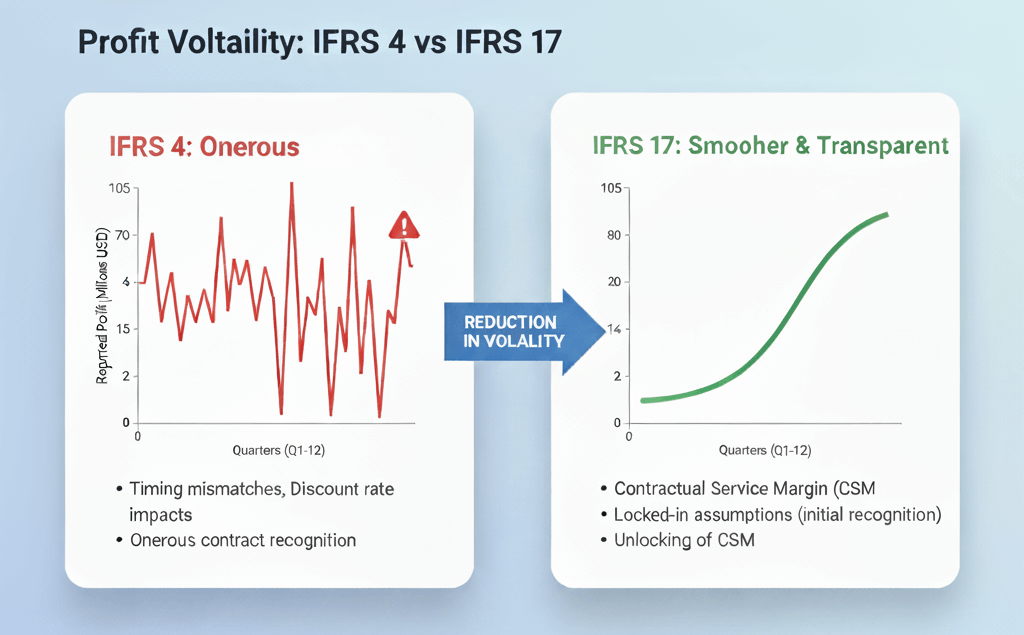
IFRS 17 creates new profit volatility patterns through its measurement approach. KPMG research shows that many insurers report higher Return on Equity under IFRS 17 compared to previous standards, driven by decreased equity levels.
Balance sheet volatility increases significantly under the new standard. Market-value-based liability measurements create earnings fluctuations that don’t necessarily reflect underlying business performance.
Profit emergence patterns shift from premium collection timing to service delivery periods. This change smooths some traditional volatility while introducing new sources of fluctuation through assumption updates.
The contractual service margin acts as a profit buffer, absorbing some assumption changes while releasing profits over contract periods. This mechanism creates more predictable profit recognition for profitable contracts.
We have discussed it in detail in our IFRS 17 vs IFRS 4 blog, so do check it out!
Investor Perception and Market Confidence
Investor understanding of IFRS 17 metrics continues evolving. Enhanced disclosure requirements provide more transparency but also create complexity in financial analysis.
Earnings per share impacts vary significantly across insurers. KPMG data indicates that over half of sampled insurers show EPS decreases under IFRS 17 reporting, despite higher ROE metrics.
Market confidence depends heavily on management’s ability to explain assumption changes and their profit impacts. Clear communication about actuarial judgment becomes crucial for maintaining investor relationships.
Rating agency assessments now focus more heavily on IFRS 17 metrics. Capital adequacy calculations and solvency ratios require new interpretation frameworks under the standard.
Contractual Service Margin (CSM) and Profit Recognition
What Is the CSM in IFRS 17?
The contractual service margin represents unearned profits from insurance contracts, calculated as the difference between expected inflows and outflows adjusted for risk. This mechanism fundamentally changes how insurers recognize profits over time.
CSM calculations require robust actuarial modeling capabilities. Initial CSM amounts depend heavily on the accuracy of locked-in assumptions at contract inception.
World Bank research shows most insurers expect to recognize around 43% of remaining contractual service margin over more than ten years, pointing toward long-term deferred profitability.
The CSM release pattern directly affects reported profit timing. Accelerated release increases current period profits while extending release periods defers profit recognition.
How Actuarial Assumptions Influence the CSM
Locked-in assumptions determine initial CSM calculations and remain fixed for contract duration unless financial assumptions require updating. This creates stability in profit recognition patterns.
Financial assumption updates flow directly through CSM adjustments. Interest rate changes can increase or decrease the CSM, affecting future profit release patterns.
Non-financial assumption changes impact CSM differently depending on whether they create gains or losses. Favorable experience increases CSM, while adverse experience may reduce it or create immediate losses.
Coverage unit calculations determine CSM release timing. The choice of coverage units significantly influences profit emergence patterns across contract periods.
Reassessment and Experience Adjustments
Experience adjustments occur quarterly when actual results differ from assumptions. These adjustments can either increase CSM for a favorable experience or decrease it for adverse results.
Onerous contract testing requires immediate loss recognition when contracts become loss-making. This mechanism prevents profit deferral on unprofitable businesses.
Assumption updates trigger reassessment of future cash flows. The timing and magnitude of these updates significantly influence reported profits.
Model validation becomes crucial for CSM calculations. Errors in actuarial models can create significant profit misstatements that require correction in subsequent periods.
Risk Adjustment and Uncertainty in IFRS 17
Risk adjustment quantifies uncertainty in insurance contract cash flows, typically set at the 75th percentile confidence level. New Zealand FMA data shows risk adjustment ratios between 3% and 6% of the present value of future cash flows.
The confidence level choice affects both liability levels and profit emergence. Higher confidence levels increase liabilities and defer profits, while lower levels have opposite effects.
Risk adjustment release patterns influence profit timing. As uncertainty decreases over time, risk adjustments are released to profit, creating additional earnings beyond the CSM release.
Diversification benefits within risk adjustment calculations can significantly impact reported results. Insurers with diverse portfolios may report lower risk adjustments than specialized writers.
Locked-in vs Updated Assumptions under IFRS 17
Financial assumptions receive regular updates to reflect current market conditions. These updates flow through both liability measurements and CSM adjustments, creating profit volatility.
Non-financial assumptions remain locked in at contract inception. Changes to these assumptions only affect CSM through experience adjustments, providing some profit stability.
The boundary between financial and non-financial assumptions affects profit volatility patterns. Classification decisions can significantly impact earnings fluctuations.
Assumption governance processes become critical for consistent application. Clear policies around assumption updates help manage profit volatility and regulatory compliance.
Measurement Models and Their Profit Implications
General Measurement Model (GMM)
The General Measurement Model applies to most long-term insurance contracts. This approach requires full actuarial modeling with CSM calculations and risk adjustments.
GMM creates complex profit recognition patterns through its building block approach. Each component – fulfillment cash flows, risk adjustment, and CSM – contributes to overall profit timing.
Quarterly remeasurement under GMM increases operational complexity but provides more current liability values. This approach better reflects economic substance but creates earnings volatility.
Contract modification accounting under GMM can trigger significant profit impacts. Changes to contract terms may require CSM adjustments or derecognition and recognition.
Premium Allocation Approach (PAA)
The Premium Allocation Approach simplifies accounting for short-duration contracts. PAA resembles the previous IFRS 4 treatment but includes enhanced disclosure requirements.
PAA reduces operational complexity for eligible contracts but may not be suitable for all short-term business. Contracts with significant financing components typically require GMM treatment.
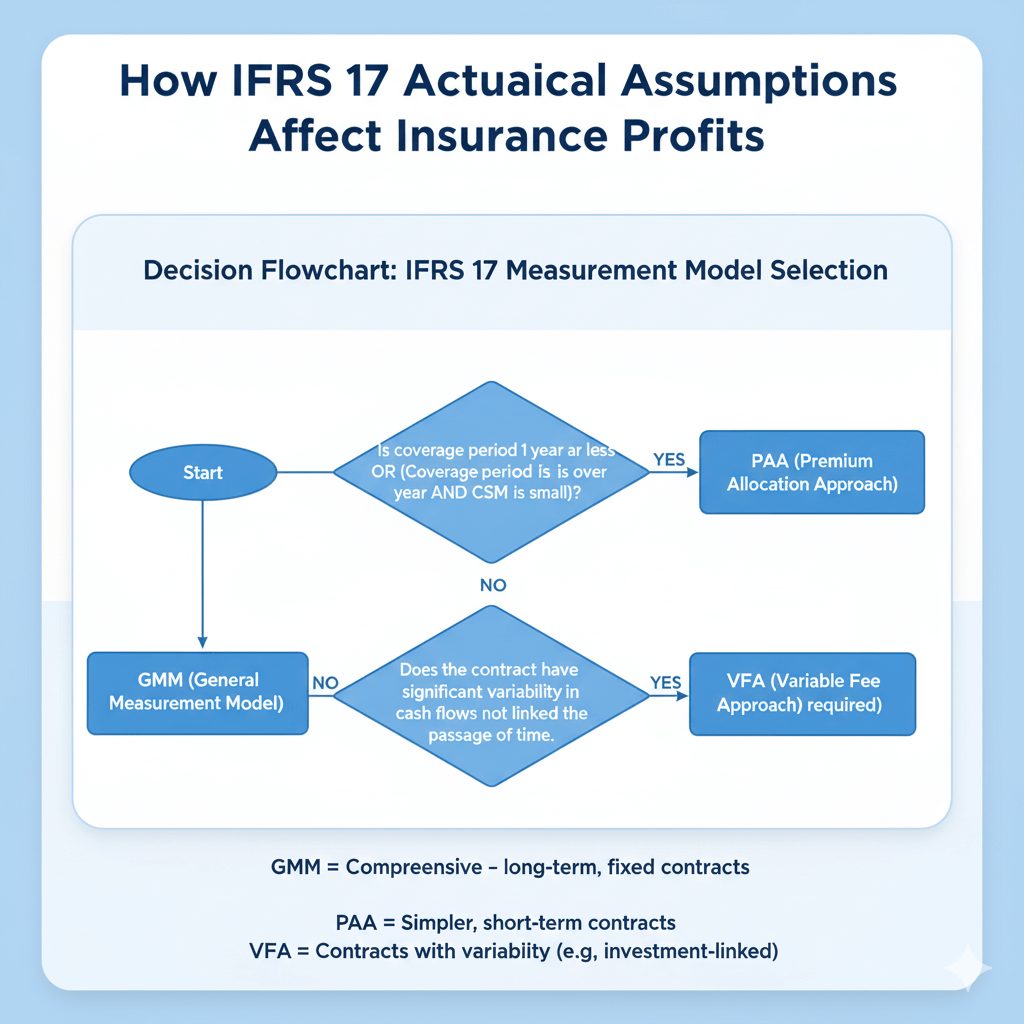
Profit recognition under PAA occurs as coverage provides, creating more predictable earnings patterns. This approach reduces the impact of actuarial assumption changes on reported profits.
Combined ratio calculations under PAA align more closely with traditional insurance metrics. This familiarity helps investors understand performance while meeting IFRS 17 requirements.
What Are the Biggest Risks in Setting IFRS 17 Assumptions?
Data Quality and Availability
Data quality represents the foundation of reliable IFRS 17 actuarial assumptions. Poor data quality can lead to significant profit misstatements and regulatory compliance issues.
Legacy system limitations often constrain data availability for historical assumption setting. Many insurers struggle with incomplete or inconsistent data across different product lines.
Granular data requirements under IFRS 17 exceed traditional reserving needs. Contract-level tracking demands sophisticated data management capabilities that many insurers are still developing.
External data validation becomes crucial for assumption credibility. Independent data sources help verify internal experience and support assumption reasonableness.
Model Complexity and Judgment Calls
Model complexity increases significantly under IFRS 17. The interaction between multiple assumption sets creates validation challenges and increases operational risk.
Professional judgment plays a larger role in IFRS 17 assumptions. Actuaries must balance mathematical precision with practical business considerations when setting key variables.
Model governance frameworks must address both technical accuracy and business reasonableness. Regular model validation helps identify potential issues before they affect reported results.
Documentation requirements expand substantially under IFRS 17. Clear assumption rationale becomes essential for audit support and regulatory examination.
IFRS 17 Actuarial Assumptions in the GCC Insurance Market
Regulatory Expectations in KSA and UAE
Gulf Cooperation Council regulators have established specific guidance for IFRS 17 GCC implementation. These requirements often exceed international standards to address local market conditions.
Saudi Arabian Monetary Authority (SAMA) emphasizes robust assumption governance and regular validation processes. Local insurers must demonstrate assumption reasonableness through comprehensive documentation.
UAE Insurance Authority requires detailed assumption disclosure and sensitivity analysis. These requirements help regulators assess insurer financial stability under various economic scenarios.
Regional mortality and morbidity data limitations create challenges for local assumption setting. Many GCC insurers rely on international experience adjusted for local conditions.
Market-Specific Challenges for GCC Insurers
Currency exposure affects assumption setting for insurers operating across multiple GCC markets. Exchange rate volatility can significantly impact contract valuations and profit recognition.
Regulatory capital requirements interact with IFRS 17 assumptions in complex ways. Assumption changes can trigger capital adequacy issues that require careful management.
Local reinsurance arrangements affect assumption setting, particularly for catastrophe and medical coverages. Regional reinsurance capacity constraints influence risk transfer assumptions.
Sharia-compliant products require specialized assumption development methodologies. Traditional actuarial models may need modification to reflect Islamic insurance principles.
How Insurers Can Manage IFRS 17 Assumptions Effectively
Cross-Functional Collaboration between Actuaries and Finance
IFRS 17 breaks down traditional silos between actuarial and finance functions. Success requires integrated teams working toward common objectives rather than separate departmental goals.
Monthly assumption reviews bring actuaries and finance teams together to assess profit impacts and validate model outputs. This collaboration improves both technical accuracy and business insight.
Joint training programs help both functions understand IFRS 17 implications. Actuaries gain financial reporting perspective while finance teams develop actuarial appreciation.
Shared performance metrics align incentives across functions. When both teams share responsibility for IFRS 17 results, collaboration improves naturally.
Technology and Data Needs for Assumption Management
Integrated actuarial and accounting systems provide the foundation for effective IFRS 17 management. These platforms must handle complex calculations while maintaining audit trails.
Real-time data feeds enable more frequent assumption updates and impact analysis. Automated processes reduce manual errors while improving response times to market changes.
Cloud-based solutions offer scalability and accessibility for distributed IFRS 17 teams. These platforms support collaboration while providing robust security and compliance features.
Data governance frameworks become essential for maintaining assumption integrity. Clear data lineage and validation processes support both operational efficiency and regulatory compliance.
Best Practices for Insurers in 2025 and Beyond
Regular assumption benchmarking against market practices helps validate internal approaches. Industry surveys and peer discussions provide valuable perspective on assumption reasonableness.
Scenario analysis capabilities enable proactive assumption management. Understanding profit sensitivity to key variables helps management anticipate and plan for assumption changes.
Clear communication strategies help stakeholders understand assumption impacts. Regular updates to boards, investors, and regulators build confidence in IFRS 17 results.
Continuous improvement processes identify opportunities for assumption refinement. Regular reviews of prediction accuracy help enhance future assumption setting.
Besides, to clarify further what best practices to hold on to, we have also debunked some of the most popular IFRS 17 myths in a detailed piece.
IFRS 17 Software Tools for Assumption Management and Profit Tracking
Modern IFRS 17 systems integrate actuarial calculations with financial reporting requirements. Leading platforms include Delta IFRS 17 Software by Prima Consulting/FRSTech, Prophet from FIS, AXIS from GGY, and Moses from Moody’s Analytics.
These systems automate CSM calculations, risk adjustment computations, and assumption impact analysis. Automation reduces manual effort while improving calculation consistency and accuracy.
Assumption libraries within these platforms maintain historical assumption sets and support impact analysis. Version control capabilities track assumption changes and their profit effects over time.
Reporting capabilities generate both regulatory filings and management reports. Standardized templates ensure consistency while customizable dashboards support decision-making needs.
Transparency and Disclosure Requirements under IFRS 17
Enhanced disclosure requirements provide unprecedented insight into insurer operations. Stakeholders now receive detailed information about assumption impacts and profit sources.
Quarterly assumption change disclosures help investors understand profit volatility drivers. Clear explanation of assumption updates builds confidence in management judgment.
Sensitivity analysis disclosure requirements quantify profit exposure to key assumption changes. These disclosures help stakeholders assess earnings stability and capital adequacy.
Reconciliation tables track changes in contract liabilities and CSM from period to period. These detailed breakdowns provide transparency into profit emergence patterns.
IFRS 17 Actuarial Assumptions Drive Insurance Success
IFRS 17 actuarial assumptions fundamentally reshape insurance profitability measurement and reporting. The standard’s sophisticated approach provides better economic insight while creating new operational challenges for insurers worldwide.
Keep in mind, your actuarial assumptions impact directly shapes how you recognize profitability and what stakeholders see in your financial results.
New Zealand regulatory data shows 41% of insurers experienced negative equity impacts from IFRS 17 transition, highlighting the standard’s material effect on financial position. Success requires robust assumption governance, integrated technology platforms, and strong collaboration between actuarial and finance functions.
Looking ahead, insurers that master IFRS 17 actuarial assumptions will gain competitive advantages through better risk management, clearer stakeholder communication, and more informed strategic decision-making. The investment in assumption capabilities pays dividends through improved financial stability and investor confidence.
The transformation continues as markets mature in their IFRS 17 application. Early adopters who built strong assumption frameworks are now leveraging these capabilities for competitive advantage, while others continue catching up to market leaders.
Ready to optimize your IFRS 17 actuarial assumptions and improve profit recognition? Prima Consulting provides expert guidance to help insurers navigate complex assumption setting and achieve sustainable profitability under the new standard.