TL;DR
IFRS 2 implementation is the key to managing share-based payments like stock options and cash-settled awards. This guide walks you through practical steps from gap analysis and valuation methods to governance, system upgrades, and disclosure requirements, using real examples to highlight common challenges such as data gaps and jurisdictional complexities. You’ll learn how to handle modifications, meet regional regulatory demands, and maintain compliance with IFRS 2 disclosure standards. Master these essentials to streamline your IFRS 2 implementation, reduce errors, and confidently comply with reporting obligations.
If you’re in finance leadership, you’ve probably felt the pressure mounting around IFRS 2 implementation. The board is asking questions. Meanwhile, your auditors are reviewing your processes. At the same time, your team is juggling spreadsheets that don’t quite fit together.
The thing is, IFRS 2 implementation doesn’t have to feel overwhelming. Share-based payment arrangements are becoming standard practice across companies worldwide. Yet many organizations still treat them as an afterthought rather than a critical accounting function. That’s where gaps appear. That’s where costly mistakes happen.
This guide walks you through IFRS 2 implementation step by step. You’ll see exactly how to handle equity and cash-settled payments, manage modifications, meet disclosure requirements, and avoid the pitfalls that trip up even experienced finance teams. We’re talking real examples, practical checklists, and specific solutions you can apply right away.
Understanding IFRS 2 Implementation and Its Scope
IFRS 2 Share-Based Payments sets the rules for accounting when your company gives employees, suppliers, or other parties something of value as compensation. That could be stock options, restricted stock units, cash bonuses tied to stock performance, or shares themselves.
Here’s what matters for IFRS 2 implementation: this standard applies to virtually every company offering long-term incentive plans or equity compensation. Research shows that 35.5% of companies are projected to offer Long-Term Incentive Plans in 2025, which means a significant portion of your peers are dealing with this standard right now.
Organizations are increasingly implementing Long-Term Incentive Plans, with adoption rates reaching 45% in certain sectors as of 2024. If you’re operating in these environments, you’re competing for talent where equity compensation is increasingly expected.
IFRS 2 implementation covers share options, restricted stock awards, performance shares, phantom stock plans, and cash-settled appreciation rights. If your company uses any of these tools to attract or retain talent, IFRS 2 implementation requirements apply to you.
Key Principles of Share-Based Payment Arrangements Under IFRS 2 Implementation
Before diving into mechanics, understand what IFRS 2 implementation fundamentally requires. The standard operates on three core principles.
First: Measurement at Fair Value. You measure the award’s value on the grant date using market prices and valuation models. This isn’t optional. You don’t get to use book value or some internal estimate. Fair value is the starting point for everything in your IFRS 2 implementation.
Second: Recognition Over the Vesting Period. You don’t expense the entire award on day one. Instead, you spread the expense across the time employees work to earn the award. This matches the benefit received to the period when it’s truly earned.
Third: Accounting for Both Equity and Cash Components. Some awards settle in shares (equity-settled). Others settle in cash (cash-settled). Some do both. IFRS 2 implementation requires different accounting for each type, and they’re treated quite differently on your financial statements.
These principles sound straightforward. In practice, they create real complexity, especially when modifications occur or when you’re operating across multiple jurisdictions with different regulatory overlays.
Step-by-Step IFRS 2 Implementation Process
Getting IFRS 2 implementation right requires a structured approach. Here’s the path successful companies follow.
Step 1: Conduct a Complete Gap Analysis
Start by identifying every share-based payment arrangement you have. Don’t miss anything. Many companies find hidden plans during this phase. Look for old arrangements that never quite got terminated, informal arrangements nobody documented, and restricted stock still vesting from years ago.
List each arrangement with details: grant date, vesting conditions, settlement method, number of participants, and current status. This becomes your master inventory for IFRS 2 implementation.
Step 2: Gather Historical Data
You’ll need historical information for comparative periods. If you’re starting IFRS 2 implementation for the first time in 2026, you need accurate data going back through any prior year presented comparatively. This includes grant dates, vesting schedules, forfeiture rates, and exercise prices if applicable.
Step 3: Select Valuation Methods
For equity-settled awards, you typically use the Black-Scholes model or binomial model. For cash-settled awards, you remeasure at each reporting date. Determine which method fits each of your arrangements and document your choice during IFRS 2 implementation.
Step 4: Establish Governance and Controls
Assign clear ownership. Who maintains the share-based payment register? Authorization of new grants is typically handled by a designated team. Valuations are calculated by the finance or accounting department. As for reviewing the financial statement disclosures, that responsibility usually falls to the auditors or senior management. Document these responsibilities as part of your IFRS 2 implementation.
Step 5: Build or Upgrade Systems
Most companies can’t manage IFRS 2 implementation in Excel. You’ll need systems that track award details, calculate expirations, monitor vesting conditions, and generate compliance reports. Many finance teams work with specialist advisors to assess whether existing systems need upgrades or whether specialized IFRS 2 software solutions work better for their scale.
Step 6: Develop Accounting Policies
Write clear, detailed policies for each type of arrangement you offer during IFRS 2 implementation. Document how you’ll treat modifications, cancellations, forfeiture estimates, and settlement processes. These policies become part of your financial statement notes.
Step 7: Train Your Team
Over 600 accounting and finance professionals in various regions received training on IFRS Standards, including IFRS 2, as of November 2023. Your team needs this knowledge too. They’ll be calculating, reviewing, and explaining these numbers to auditors and leadership throughout your IFRS 2 implementation.
Accounting for Equity-Settled and Cash-Settled Share-Based Payments
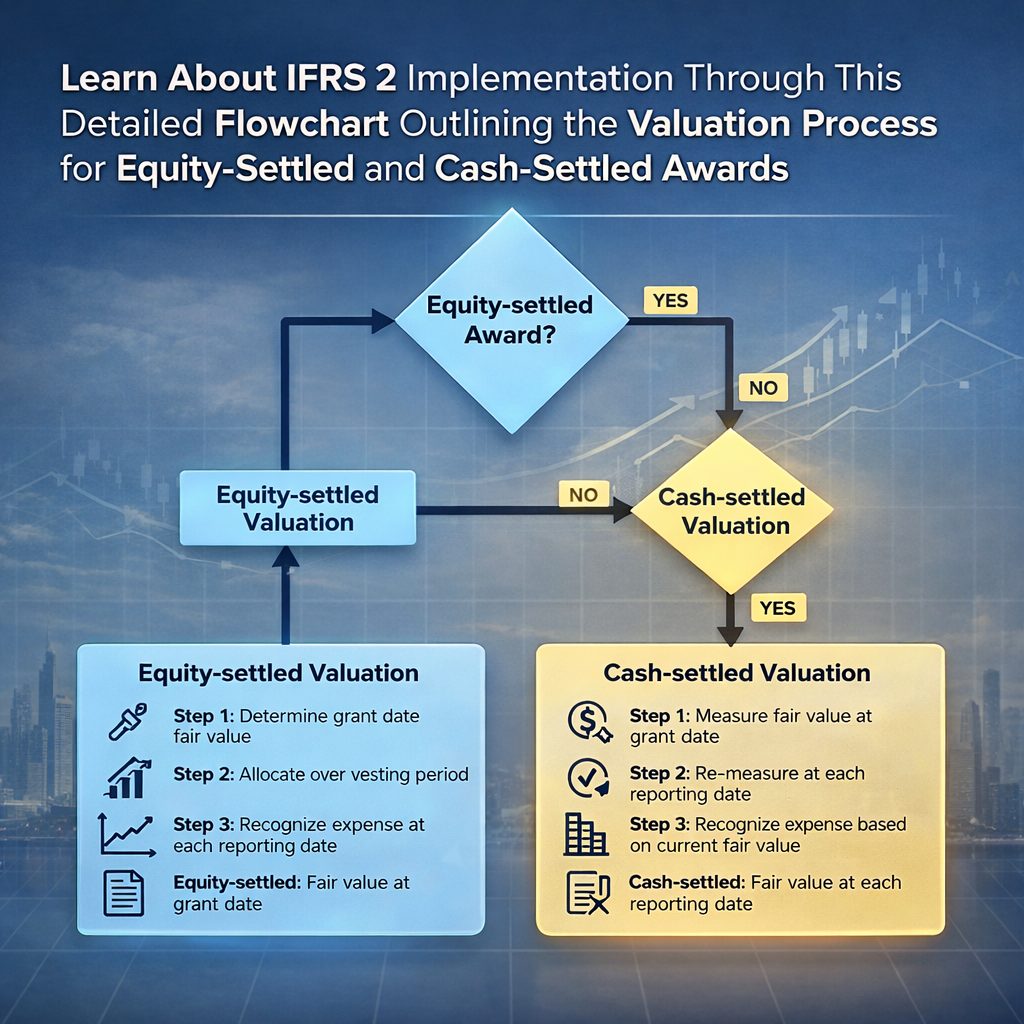
Here’s where IFRS 2 implementation gets specific. Your accounting treatment depends on the settlement method.
Equity-Settled Awards
When employees receive company shares or the company settles the obligation by issuing shares, you have an equity-settled award. Your journal entry recognizes an equity increase that won’t be adjusted later during IFRS 2 implementation.
On the grant date, calculate fair value using an appropriate model. Recognize compensation expense over the vesting period. The total expense is locked in on day one. No remeasurement happens afterward.
Example: Your company grants 10,000 stock options on January 1, 2026, with a fair value of $3 per option and a 3-year vesting period. Your annual expense is $10,000 (10,000 options × $3 ÷ 3 years). This amount stays constant even if the stock price changes.
Cash-Settled Awards
Cash-settled awards create phantom stock or cash appreciation rights. The company pays cash on settlement, not shares. Here’s the difference in IFRS 2 implementation: you remeasure the liability at each reporting date.
On the grant date, calculate fair value using the current stock price. At each quarter-end and year-end, remeasure at current fair value. The change in value flows through your profit and loss statement immediately.
Example: Your company grants 5,000 cash appreciation rights on January 1, 2026, when the stock price is $20 per share. Fair value is $100,000. By March 31, the stock price is $22 per share. You remeasure to $110,000 and recognize a $10,000 expense adjustment. If it drops to $19 by June 30, you recognize a $5,000 gain.
This remeasurement creates profit and loss volatility that equity-settled awards don’t have. That’s a critical consideration when you’re planning which structure to use during IFRS 2 implementation.
Measurement and Valuation of Share-Based Payments Under IFRS 2 Implementation
Measurement is where technical skill meets real-world complexity during IFRS 2 implementation. Get this wrong, and your entire IFRS 2 disclosure fails.
Fair Value Determination Methods
IFRS 2 implementation provides options for how you calculate fair value. Choice matters.
- Market Price Method: If the award trades actively, use the market price. This is simple and defensible. If your company has listed shares traded on major exchanges or international markets, use the closing price on the grant date.
- Black-Scholes Model: For stock options, Black-Scholes is standard practice. It requires five inputs: current stock price, exercise price, risk-free rate, expected volatility, and expected life. Expected volatility is where judgment enters during IFRS 2 implementation. You typically use historical volatility over a period equal to the expected option life.
- Binomial Model: More complex than Black-Scholes, binomial models allow for variable volatility and exercise patterns over time. They’re useful when your company has dividend history or when early exercise patterns differ from the Black-Scholes assumption.
- Monte Carlo Simulation: For performance conditions tied to market indexes or multi-variable scenarios, Monte Carlo provides the most accurate approach. It’s computationally intensive but produces robust results during IFRS 2 implementation.
Your auditors will scrutinize your methodology choice. Document why you selected your method and why alternatives weren’t suitable. This isn’t just technical accuracy. It’s about defending your position when compliance questions arise.
Handling Modifications, Cancellations, and Settlements of Awards
IFRS 2 modifications are where many companies struggle during implementation. Let’s make this clear.
Accounting for Award Modifications and Impact on Expenses
A modification occurs when your company changes the terms of an existing award. Common modifications include repricing options, extending vesting periods, adding performance conditions, or increasing the number of shares granted.
IFRS 2’s modification rule is straightforward conceptually but demanding in practice: account for the award at the greater of the original fair value or the modified fair value. Calculate the expense based on this higher amount over the new vesting period.
Example: Your company granted 10,000 stock options on January 1, 2024, with a $10 exercise price and original fair value of $3 per option. Three months later, the stock price drops to $5. Your company reprices the options to $5 to keep them valuable to employees.
The modified fair value is now $2 per option. Your original expense was $10,000 (10,000 × $3). Your company must use the higher amount. You can’t reduce the expense even though the award is now less valuable.
This rule prevents companies from gaming their expense recognition during IFRS 2 implementation. It matters most when companies modify awards to offset market declines. Companies in competitive sectors like technology and energy do this regularly to retain talent. Your accounting needs to reflect this accurately.
Cancellations work differently. If your company cancels an award before vesting, you immediately expense any portion not yet recognized. This creates a one-time charge. Many companies don’t anticipate these impacts during budget planning, causing uncomfortable quarter-end surprises.
IFRS 2 Disclosure Requirements in Financial Statements
IFRS 2 disclosure requirements are substantial. Your financial statement notes on share-based payments often span multiple pages. This isn’t bureaucracy. These disclosures tell readers the real economics of your compensation structure.
Meeting IFRS 2 Disclosure Requirements
Your notes must include these elements:
- Quantitative Details: Number of options outstanding at period-end, weighted average exercise prices, number of shares issued during the period, and number forfeited. Break this down by grant year and vesting status to meet IFRS 2 disclosure requirements.
- Valuation Methodology: Describe your Black-Scholes inputs: average expected life, expected volatility, risk-free rate, dividend yield. Explain why you chose these inputs. Readers need to understand market assumptions in your IFRS 2 disclosure requirements.
- Expense Impact: Show how much compensation expense flowed through your profit and loss statement. Separate equity-settled from cash-settled amounts. Show the tax effect of each to satisfy IFRS 2 disclosure requirements.
- Fair Value Summary: Present a reconciliation showing beginning balances, grants, exercises, forfeitures, and ending balances for each award category as part of your IFRS 2 disclosure requirements.
Here’s what a simplified disclosure looks like:
“During 2024, the Company granted 50,000 share options with a weighted average fair value of $8.50 per option. These were valued using the Black-Scholes model with the following assumptions: expected life of 4 years, expected volatility of 28%, risk-free rate of 3.8%, and dividend yield of 2.1%. Total share-based compensation expense recognized for the year was $2.1 million.”
Different regions have slightly different disclosure preferences. Regulatory authorities in various jurisdictions expect certain emphases. Document your choices and maintain consistency year to year to meet IFRS 2 disclosure requirements.
Common IFRS 2 Challenges During Implementation
Your company will likely face several recurring issues during IFRS 2 implementation.
Challenge 1: Missing or Inaccurate Historical Data
Many companies don’t maintain detailed records of older awards. You can’t complete IFRS 2 implementation without knowing grant dates, original terms, and participant details. Some companies find award agreements exist that nobody documented properly.
Solution: Conduct a comprehensive audit of all HR systems, award agreements, and historical communications. Work backward from current participants and reconstruct missing details where possible. Some gaps may require reasonable estimates or conservative assumptions that you document clearly during IFRS 2 implementation.
Challenge 2: Choosing Appropriate Volatility Assumptions
Volatility is the single biggest driver of option valuations during IFRS 2 implementation. It’s also the most subjective input. Should you use historical volatility? Implied volatility from market prices? How far back should your period look?
Some markets are less liquid than developed markets. This can make implied volatility unreliable during IFRS 2 implementation. Historical volatility may not reflect current market conditions, especially for newer companies with limited operating history.
Solution: Use historical volatility over a period matching the expected option life. For newer companies, consider peer company volatility if your own history is limited. Document your approach and explain deviations during IFRS 2 implementation. This defensibility matters when auditors question your assumptions.
Challenge 3: Tracking Forfeiture Rates Accurately
IFRS 2 implementation requires you to estimate forfeiture rates. These are the percentage of awards employees will lose through termination or failure to meet conditions before vesting. Too high an estimate reduces expense. Too low an estimate requires catch-up adjustments.
Many companies don’t have mature historical data on forfeitures. Rapid growth, high turnover in certain sectors, and changing employment patterns make prediction difficult during IFRS 2 implementation.
Solution: Track actual forfeitures granularly by employee category and grant year. As your history builds, rely more on actual data and less on estimates. Early years may require conservative estimates with documented reassessment annually.
Managing Regulatory and Reporting Differences
Your company’s IFRS 2 implementation needs to work across multiple jurisdictions. That’s not trivial when regulations differ.
Different regions have varying considerations. Some jurisdictions require disclosure of executive compensation in specific formats. Your IFRS 2 implementation expense must reconcile to these statutory disclosures. Many companies operate under employment incentive programs with specific terms that affect vesting calculations.
Other regulatory environments emphasize governance disclosures. Your IFRS 2 implementation notes need to clearly show board-approved parameters for awards. Free zone companies sometimes have different tax treatment of equity compensation that flows through to accounting.
Various jurisdictions have specific regulatory guidance on compensation structures. Some jurisdictions have implicit restrictions on foreigner participation in certain awards. Your policies need to reflect these constraints during IFRS 2 implementation.
Solution: Create a master policy that covers the broadest requirements across all jurisdictions where you operate. Add jurisdiction-specific procedures for local requirements. Have your external auditors validate that your consolidated approach meets all local requirements.
Practical Examples of IFRS 2 Implementation Application
Theory matters less than seeing how this works in practice. Let’s walk through realistic examples of IFRS 2 implementation.
Example 1: Technology Company – Equity-Settled Options
Your company grants stock options to retain technology talent. On January 1, 2026, you grant 100,000 options to employees across levels. Exercise price is $15 (current stock price). Fair value using Black-Scholes is $4.50 per option. Vesting is 25% after year one, then 25% annually for three more years.
Your calculation for IFRS 2 implementation: 100,000 options × $4.50 = $450,000 total expense over 4 years = $112,500 annual expense.
On December 31, 2026: You record compensation expense of $112,500. You record an increase to equity reserve of $112,500.
Actual forfeitures during 2026 are 2% (2,000 options). You adjust your estimate and reduce the January 1 estimate by 2%, making the revised annual expense $110,250 going forward. The adjustment is made in 2026 when you identify the actual forfeitures.
By year four, if all remaining awards vest during IFRS 2 implementation, you’ll have expensed $442,500 (100,000 × $4.50 × [100% – 2% forfeiture estimate]).
Example 2: Company – Cash-Settled Awards
Your company implements a phantom stock plan for senior management. On January 1, 2026, you commit to pay cash based on share appreciation for 20 executives holding notional amounts of 50,000 shares each (1,000,000 total shares notionally).
Actual share price on January 1: $50 per share. Fair value of the obligation: $50,000,000.
Your journal entry on January 1 during IFRS 2 implementation: Debit Compensation Expense $50,000,000; Credit Cash Flow Hedge Liability $50,000,000.
By March 31, share price is $52 per share. You remeasure the liability to $52,000,000. Debit Compensation Expense $2,000,000; Credit Cash Flow Hedge Liability $2,000,000.
By December 31, share price is $48 per share. You remeasure to $48,000,000. Debit Cash Flow Hedge Liability $4,000,000; Credit Compensation Expense (or income) $4,000,000.
Your 2026 profit and loss statement shows net compensation expense of $48,000,000 for this phantom stock arrangement during IFRS 2 implementation. This volatility is inherent to cash-settled awards. That’s why many CFOs prefer equity-settled structures.
Example 3: Modified Award
Your company granted 50,000 stock options on January 1, 2024, with $20 exercise price and $5 original fair value. By July 1, 2026, the stock price has declined to $12. Management decides to reprice to $12 to maintain retention value during IFRS 2 implementation.
Original total expense: 50,000 × $5 = $250,000 over original 4-year vesting ($62,500 per year).
Modified fair value on July 1: $4 per option (50,000 × $4 = $200,000 total).
Use the higher amount during IFRS 2 implementation: $250,000. Remaining vesting from July 1, 2026 through end of original 4-year period is 2.5 years. New annual expense: $250,000 ÷ 2.5 = $100,000 per year.
You’ll recognize increased expense going forward to reach the $250,000 total. This prevents the company from economically reducing expense through a repricing.
Transitioning to IFRS 2 Implementation: Key Steps
If you’re starting IFRS 2 implementation for the first time, the transition requires specific handling.
Determine Your Transition Date
Most companies adopt IFRS 2 implementation for periods beginning January 1, 2026 or January 1, 2027. You’ll need comparative 2026 data if you transition during 2026. This means 2026 needs to be prepared on an IFRS 2 basis even if not publicly reported under IFRS 2 yet.
Identify Awards Outstanding at Transition
Create a complete list of every award that was outstanding before your transition date but hasn’t fully vested or settled. These are “pre-transition awards.” IFRS 2 implementation applies modified rules to these.
Calculate Catch-Up Expense
For pre-transition awards during IFRS 2 implementation, calculate what you should have expensed from grant date through transition date had IFRS 2 been in effect. Recognize this as an adjustment at transition. This isn’t retroactive adjustment. It’s a one-time recognition of the share-based payment obligation that now appears on your balance sheet.
Establish Opening Balances
Your transition balance sheet shows additional equity (for vested equity-settled awards) and liabilities (for outstanding cash-settled awards). These create the opening position for post-transition accounting during IFRS 2 implementation.
Document Transition Accounting
Auditors will scrutinize transition accounting carefully during IFRS 2 implementation. Document your calculation of catch-up expenses, the awards included, and the assumptions applied. This documentation becomes part of your IFRS 2 transition audit package.
IFRS 2 Implementation Checklist and Best Practices
Use this checklist to validate your IFRS 2 implementation readiness:
Planning and Governance
Identify all share-based payment arrangements. Appoint accounting owner and governance structure. Document all decision-making authority. Define escalation procedures for complex situations during IFRS 2 implementation.
Data and Systems
Compile complete historical award data. Establish centralized award register. Put tracking systems in place for modifications and cancellations. Validate data integrity against HR records during IFRS 2 implementation.
Valuation and Measurement
Select appropriate valuation models for each award type. Document volatility assumptions and supporting data. Calculate fair values for all outstanding awards. Establish forfeiture rate estimation process during IFRS 2 implementation.
Accounting and Recording
Create detailed accounting policies. Build journal entry templates for standard transactions. Test accounting system configuration. Validate calculations independently during IFRS 2 implementation.
Disclosure and Reporting
Draft comprehensive financial statement notes. Prepare disclosure tables with quantitative details. Reconcile expense amounts to general ledger. Have auditors review draft disclosures during IFRS 2 implementation.
Training and Communication
Train finance team on IFRS 2 requirements. Brief operational teams on their roles. Prepare management summaries explaining impacts. Create FAQ document for frequently asked questions about IFRS 2 implementation.
Post-Implementation
Establish quarterly review procedures. Document actual forfeitures for future estimates. Track any modifications and retest accounting. Update policies annually based on experience with IFRS 2 implementation.
Best Practices for Companies Managing IFRS 2 Implementation
Stay current with regulatory updates. Each jurisdiction updates guidance periodically. Regulatory expectations continue changing between 2023 and 2025. Various regions have shifted guidance as well during IFRS 2 implementation.
Maintain detailed documentation for every significant judgment. Valuation assumptions, forfeiture estimates, modification decisions. All should be documented during IFRS 2 implementation. This isn’t just for auditors. Your successors in the finance function will need to understand your logic.
Reconcile to source data regularly. Don’t just rely on system reports during IFRS 2 implementation. Pull participant data from HR systems, cross-check against award agreements, and verify calculations manually for a sample of awards quarterly. This catches errors before they create financial statement adjustments.
Frequently Asked Questions About IFRS 2 Implementation
Can I complete IFRS 2 implementation without external advisors?
It depends on your organization’s sophistication. Smaller companies or those with straightforward equity plans may manage with internal resources. Larger companies with complex arrangements typically benefit from external guidance. IFRS 2 advisory services KSA and regional consulting are available to support implementation. Many companies find that specialized advisory support accelerates the process and reduces compliance risk during IFRS 2 implementation.
What’s the difference between IFRS 2 implementation and local tax accounting for share-based payments?
IFRS 2 implementation is a financial reporting standard. Tax accounting follows local tax law, which differs by country. Your financial statement shows IFRS 2 treatment. Your tax return shows tax treatment. They won’t reconcile perfectly. Deferred tax accounting bridges the gap. Document differences clearly so auditors and tax advisors both understand your positions.
How does IFRS 2 implementation connect to sustainability reporting?
IFRS 2 implementation (the accounting standard) is separate from broader sustainability disclosures. Some companies confuse them. IFRS 2 implementation tells you how to expense compensation. Sustainability reporting requires disclosure of executive compensation equity. For companies, share-based payment accounting feeds into sustainability disclosures but the standards serve different purposes.
Can I use different assumptions for different employee groups during IFRS 2 implementation?
Yes, but only if there’s a business reason. You can’t use higher volatility for executives and lower for staff to reduce executive expense during IFRS 2 implementation. You can use different vesting periods if terms genuinely differ. The key is consistency and clear documentation of why assumptions differ.
How do I handle awards when employees transfer between countries?
The award terms remain unchanged during IFRS 2 implementation. An employee’s transfer doesn’t typically modify the award. Tax withholding and local requirements may change. The country where the employee works may have specific regulations on foreign nationals holding equity. Your HR and tax advisors should address these. IFRS 2 implementation accounting usually remains unchanged. An advisory services team familiar with cross-border compensation can help navigate these complexities.
What happens if my valuation assumptions prove materially wrong later during IFRS 2 implementation?
IFRS 2 implementation uses fair value at grant date. Later changes in fair value for equity-settled awards don’t trigger revaluation. For cash-settled awards, remeasurement is required quarterly. If your original volatility assumption was significantly wrong, you’ll see this reflected in future expense adjustments for cash-settled awards. For equity-settled awards, the damage is done at grant date. This is why volatility assumptions receive so much scrutiny during valuation in IFRS 2 implementation.
Who should approve my IFRS 2 implementation accounting policies?
Your audit committee should review and approve share-based payment policies during IFRS 2 implementation. These policies are significant judgments affecting financial statements. Management develops the policies, the audit committee reviews them, and the external auditors validate compliance with standards. Get all three groups aligned early. Change control procedures should govern modifications to these policies going forward.
What transition issues should I expect when first starting IFRS 2 implementation?
Expect to recognize a one-time catch-up adjustment for all pre-transition awards. This increases equity or liabilities on your opening balance sheet during IFRS 2 implementation. You’ll need comparative prior-period data. Auditors will scrutinize transition calculations carefully. Systems may need reconfiguration. Team training takes time. Budget for these items explicitly rather than treating transition as a quick implementation.
Your Path Forward with Successful IFRS 2 Implementation
IFRS 2 implementation is complex, but it’s entirely manageable when you follow a structured approach and understand the real-world dynamics of business. Your company isn’t just checking a compliance box. You’re establishing the financial reporting foundation that auditors, investors, and regulators rely on to understand your real compensation obligations.
Advisory services from Prima Consulting helps companies navigate IFRS 2 implementation with confidence. Our team brings practical experience implementing across multiple regions. We’ve built systems, trained teams, and guided companies through first-time adoptions.
Start your IFRS 2 implementation journey today. Contact our team to discuss your specific situation, validate your approach, or get answers to the complex questions your finance team is asking. Your successful IFRS 2 implementation is just a conversation away.