TL;DR
Finding the right IFRS 9 advisory firms can determine whether your bank achieves full compliance or faces costly setbacks. This guide explains how to assess consultancies based on industry experience, technical depth, and IFRS 9 consultancy pricing. You’ll learn how financial instrument advisors develop ECL models, maintain data quality, and manage regulatory reporting for both conventional and Islamic banks. Use the included checklist to compare partners, avoid implementation pitfalls, and choose the best firm for your compliance journey. Read now to make an informed, confident decision.
Managing a financial institution means IFRS 9 compliance isn’t optional. It’s the difference between accurate financial reporting and regulatory penalties. Banks and financial organizations worldwide face mounting pressure to implement this standard correctly.
The challenge? Finding IFRS 9 advisory firms that truly understand both technical requirements and industry nuances. You need advisors who’ve worked with global banks. Who know regulators. Who can guide you through expected credit loss modeling without overwhelming your team.
This guide walks you through everything. From understanding what IFRS 9 means for your business to selecting the right consultancy partner. You’ll learn how to assess firms, avoid common mistakes, and implement this standard successfully.
Understanding IFRS 9 Advisory Firms and Their Importance for Financial Institutions
IFRS 9 advisory firms represent a fundamental shift in how financial institutions account for credit risk. Unlike its predecessor IAS 39, this standard requires forward-looking impairment models. You can’t wait for losses to occur. You must predict them.
For banks worldwide, this matters tremendously. In 2024, 70 banks collectively held $5.3 trillion in total assets. That’s massive exposure requiring accurate risk assessment.
The standard affects three core areas:
- Classification and measurement of financial assets
- Impairment through expected credit loss calculations
- Hedge accounting with more flexible effectiveness testing
Financial institutions face unique challenges. The Islamic finance market held significant global market share in 2024. This means advisory firms must understand both conventional and Islamic banking principles.
What Is IFRS 9 and Why Is It Critical for Financial Institutions?
IFRS 9 stands for International Financial Reporting Standard 9. It governs how you recognize, measure, and report financial instruments.
The standard became mandatory in January 2018. Many institutions still struggle with full implementation.
Why does this matter for your bank? Three reasons:
- Regulatory compliance. Regulators enforce strict adherence. Non-compliance means fines and reputational damage.
- Investor confidence. Accurate financial reporting attracts capital. A 2019 study of 55 listed banks examined IFRS 9 adoption impacts on firm value, showing direct effects on market perception.
- Risk management. The expected credit loss model forces better credit decisions. You identify problem loans earlier.
Key Services Offered by IFRS 9 Advisory Firms
When you work with IFRS 9 advisory firms, you’re buying expertise across multiple domains. Top consultancies provide comprehensive support. Not just theoretical guidance.
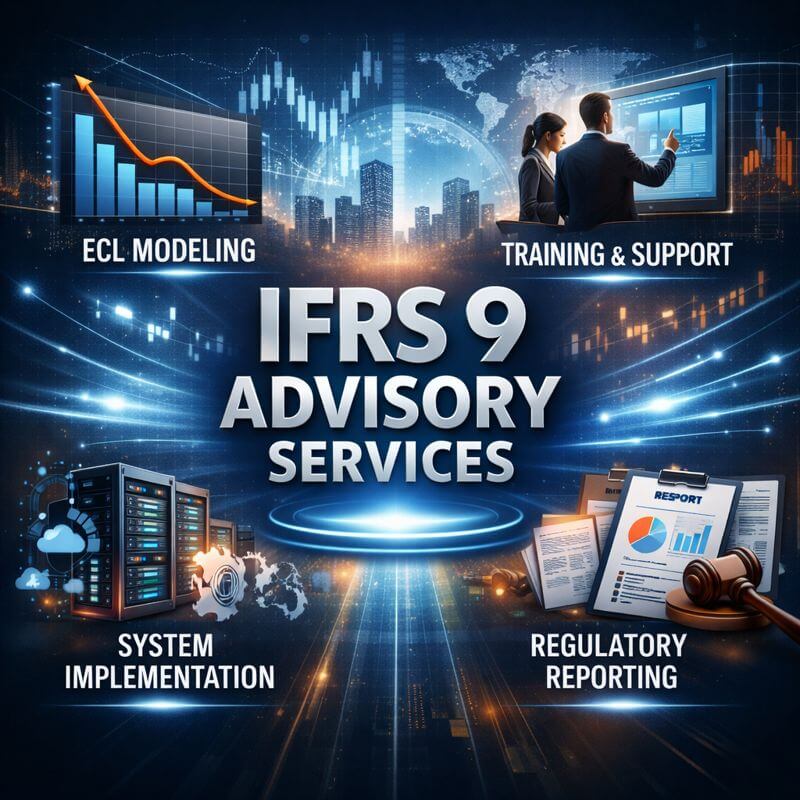
Core Advisory Services
Gap Analysis and Readiness Assessment
Before implementation, you need to know where you stand. Advisors compare your current practices against IFRS 9 requirements. They identify missing processes. Data gaps. System limitations.
Expected Credit Loss Model Development
This is where technical expertise matters most. IFRS 9 consultancy pricing often reflects the complexity of ECL model development. Financial instrument advisors build models using:
- Probability of Default (PD) calculations
- Exposure at Default (EAD) estimates
- Loss Given Default (LGD) projections
How Do IFRS 9 Advisory Firms Develop ECL Models?
Model development isn’t one-size-fits-all. Advisors start with your data. Historical loss rates. Customer segments. Macroeconomic factors.
They choose between simplified and general approaches. Smaller institutions might use simplified models. Larger banks need sophisticated multi-stage frameworks.
The process includes:
- Data collection and cleansing
- Parameter estimation
- Model validation
- Regulatory approval preparation
For more details on calculation methodology, check out our guide on IFRS 9 impairment calculation.
Implementation Support
Building the model is half the battle. Implementation requires:
- System configuration
- Process documentation
- Policy updates
- Control framework design
Regulatory Reporting Assistance
Regulators demand specific disclosures. Credit risk advisors help you get ready for compliant reports. They know what central banks expect. What formats work. How to present complex data clearly.
Steps to Choose the Right IFRS 9 Advisory Firm
Selecting the wrong consultancy wastes time and money. You need a systematic approach.
Step 1: Assess Industry Experience
Does the firm understand your market? Have they worked with regulators? Experience matters. A firm that’s implemented IFRS 9 for banks knows the specific challenges you face.
Step 2: Consider Technical Capabilities
Ask about their modeling approach. What software do they use? How do they validate results? Technical depth separates good advisors from great ones.
Step 3: Check Reference Cases
Request examples of previous implementations. Speak with their clients. Success stories show their actual capabilities. Not just marketing promises.
Step 4: Understand Pricing Structure
IFRS 9 consultancy pricing varies widely. Some firms charge fixed fees. Others work on time and materials. Get detailed proposals. Compare like-for-like services.
How to Assess the Cost and Value of IFRS 9 Consultancy Services
Price shouldn’t be your only consideration. Cheap advisors often create more problems than they solve. You’ll spend more fixing their mistakes.
Think about total value:
- Time to implementation
- Quality of deliverables
- Knowledge transfer
- Post-implementation support
A 2024 study of 19 banks showed IFRS 9 adoption led to a substantial increase in loan loss provisions with a mean increase of 0.25. Poor implementation magnifies these impacts.
Ask about their fee structure:
- Upfront assessment costs
- Model development fees
- Training expenses
- Ongoing support rates
Checklist for Assessing IFRS 9 Advisory Firms
Use this practical checklist when comparing firms:
Industry Expertise
- Experience with similar institutions
- Knowledge of regulatory requirements
- Understanding of Islamic finance (if applicable)
Technical Capabilities
- ECL modeling expertise
- IFRS 9 data analytics tools
- System integration experience
Service Quality
- Reference clients
- Implementation timeline
- Training programs
Post-Implementation Support
- Model validation services
- Regulatory compliance IFRS 9 assistance
- Continuous improvement programs
Overview of Expected Credit Loss (ECL) Models Under IFRS 9
The ECL model represents IFRS 9’s biggest departure from IAS 39. You must recognize losses before they occur. This requires sophisticated modeling.
What Are the Differences Between IFRS 9 and IAS 39?
The shift from IAS 39 to IFRS 9 changes everything. Under IAS 39, you recognized losses when they happened. Incurred loss model.
IFRS 9 requires expected loss recognition. You estimate future losses based on current information.
Key differences include:
| Feature | IAS 39 | IFRS 9 |
|---|---|---|
| Impairment Recognition | Incurred losses only | Expected losses from day one |
| Measurement | Historical loss experience | Forward-looking estimates |
| Staging | No staging concept | Three-stage approach |
For a complete comparison, read our article on IFRS 9 vs IAS 39.
How Does IFRS 9 Affect Credit Risk and Impairment Calculations?
Credit risk assessment becomes more complex under IFRS 9. You must calculate 12-month expected credit losses for performing loans. Lifetime losses for impaired assets.
The three-stage model works like this:
- Stage 1: Performing Assets – Calculate 12-month ECL. Loans with no significant increase in credit risk.
- Stage 2: Underperforming Assets – Calculate lifetime ECL. Credit risk has increased significantly.
- Stage 3: Credit-Impaired Assets – Calculate lifetime ECL with interest recognition changes.
Research on 13 banks from 2012 to 2021 found significant impact of IFRS 9 implementation on bank performance. Proper staging is critical.
Learn more about this in our guide on IFRS 9 expected credit loss.
Implementation Challenges and Solutions for Financial Institutions
Implementation isn’t straightforward. Financial institutions face specific hurdles.
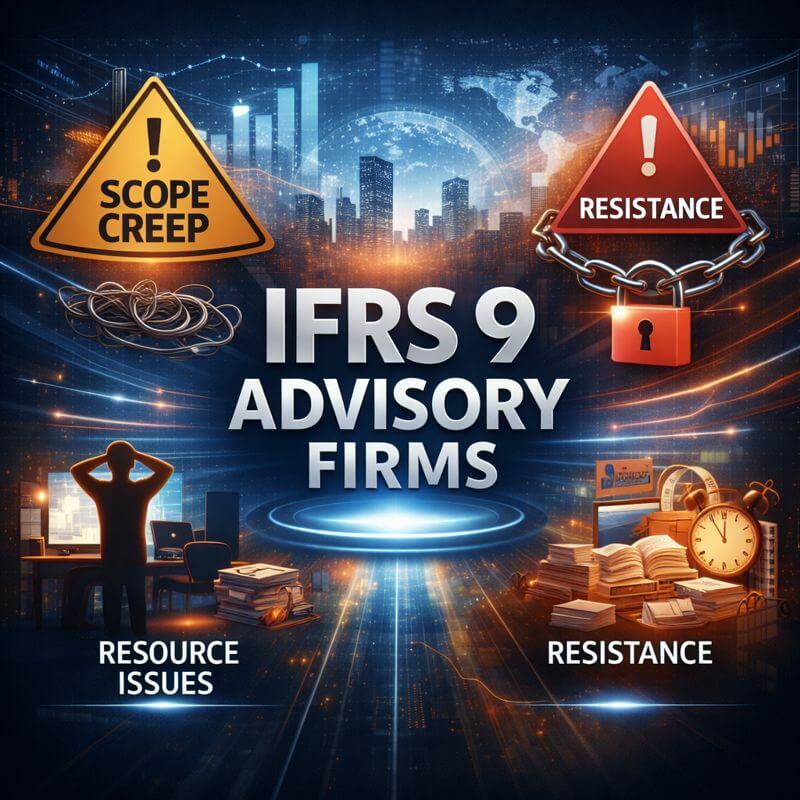
Challenge 1: Data Availability
Many banks lack historical loss data. Especially newer institutions. Solution: Use proxy data from similar markets. Adjust for industry factors.
Challenge 2: System Limitations
Legacy systems can’t handle complex ECL calculations. Solution: Invest in IFRS 9 software solutions. Integrate with existing platforms. Check our recommendations for IFRS 9 software.
Challenge 3: Resource Constraints
You need specialists in credit risk, modeling, and accounting. Solution: Partner with experienced advisory firms. They fill knowledge gaps.
Examples of Successful IFRS 9 Advisory Implementations
Success stories provide valuable lessons. One major bank partnered with specialists for full implementation. They started with comprehensive data quality improvement. The result? Smooth transition with minimal disruption.
Another institution focused on training. They invested heavily in capacity building. Their team now manages ECL models independently.
Data Management and Quality for IFRS 9 Compliance
Data quality makes or breaks your IFRS 9 implementation. Garbage in, garbage out.
What Are the Key Data Challenges in IFRS 9 Compliance?
You need extensive data for accurate ECL modeling.
- Historical Loss Experience: At least 5-7 years of default data by customer segment and product type.
- Macroeconomic Variables: GDP growth, unemployment rates, interest rates drive forward-looking adjustments.
- Customer Information: Payment histories, financial statements, collateral valuations.
Common problems include missing data fields, inconsistent definitions, poor data governance, and system fragmentation.
IFRS 9 data analytics tools can help. You must first clean your underlying data.
Data Quality Framework
Build a robust framework covering:
- Data collection processes
- Validation rules
- Reconciliation procedures
- Quality monitoring
Financial reporting consultants can design these frameworks. They’ve seen what works.
Regulatory Compliance Requirements for IFRS 9
Regulators take IFRS 9 seriously. You must meet specific requirements.
How Can Advisory Firms Help With Regulatory Reporting Under IFRS 9?
Regulators demand detailed disclosures. Central banks want to see:
- ECL methodology documentation
- Model validation reports
- Sensitivity analyses
- Stage migration details
Advisory firms get ready for these submissions. They know regulatory expectations.
Financial institutions worldwide must follow IFRS 9 requirements. Islamic banking assets totaled USD 120 billion as of 2023. Each must follow both IFRS 9 and Shariah requirements. This adds complexity. Advisors with Islamic finance expertise become essential.
For broader context on standards, see our article on IFRS 9: Financial Instruments.
Audit Preparation
External auditors scrutinize IFRS 9 implementation.
IFRS 9 audit preparation requires:
- Complete documentation
- Model validation evidence
- Control testing results
- Disclosure accuracy verification
Advisors help you get ready. They conduct pre-audit reviews.
Training and Capacity Building for IFRS 9 Adoption
Implementation shouldn’t create permanent dependence on consultants. You need internal expertise.
What Training Programs Are Essential for IFRS 9 Compliance?
Effective training covers multiple levels:
- Executive Level: Board and senior management need conceptual understanding. Focus on impacts to financial statements and strategic implications.
- Technical Teams: Credit risk, finance, and IT staff need deep training. Model mechanics, system operation, process execution.
- Business Units: Relationship managers must understand how IFRS 9 affects lending decisions.
Training should include:
- IFRS 9 principles overview
- ECL calculation methodology
- System navigation
- Regulatory requirements
Want a simplified explanation? Read our IFRS 9 simplified guide.
Knowledge Transfer
Good advisors don’t just do the work. They teach your team.
Look for firms offering:
- Hands-on workshops
- Documentation in plain language
- Ongoing coaching
- Train-the-trainer programs
Post-Implementation Support and Continuous Improvement
Implementation isn’t the end. IFRS 9 requires ongoing management.
Key Metrics to Monitor Post IFRS 9 Implementation
Track these metrics quarterly:
- Model Performance: Actual vs. predicted default rates, coverage ratio trends, stage migration patterns
- Operational Efficiency: Calculation time, data quality scores, exception rates
- Regulatory Compliance: Disclosure completeness, submission timeliness, audit findings
Continuous improvement means:
- Regular model recalibration
- Process optimization
- Technology upgrades
- Staff training refreshers
Tips for Integrating IFRS 9 Software Solutions
Software selection matters.
Choose platforms that:
- Integrate with core banking systems
- Handle complex calculations efficiently
- Provide audit trails
- Support regulatory reporting
Implementation tips:
- Start with pilot testing
- Run parallel calculations initially
- Document all configuration choices
- Train users thoroughly
Regulatory compliance IFRS 9 becomes easier with the right tools.
Common Mistakes to Avoid in IFRS 9 Implementation
Learn from others’ errors:
- Mistake 1: Rushing Implementation – Taking shortcuts creates problems. Allow adequate time.
- Mistake 2: Ignoring Data Quality – Models are only as good as underlying data. Fix data issues first.
- Mistake 3: Insufficient Testing – Test extensively before going live. Use multiple scenarios.
- Mistake 4: Poor Documentation – Auditors and regulators demand complete documentation. Don’t skip this.
- Mistake 5: Neglecting Training – Your team must understand the new processes. Invest in education.
Common FAQs About IFRS 9 Advisory Services
How long does IFRS 9 implementation typically take?
Timelines vary. Small institutions might need 6-9 months. Larger banks often require 12-18 months. Factors include data readiness, system complexity, and resource availability.
Can we implement IFRS 9 without external advisors?
Technically yes. It’s risky. Most institutions lack specialized expertise. IFRS 9 risk assessment requires specific skills. The cost of mistakes often exceeds advisory fees.
How often should ECL models be recalibrated?
At minimum, annually. Some banks recalibrate quarterly. Necessary when economic conditions change, portfolio shifts, model performance drops, or regulations update.
What’s the difference between IFRS 9 and IFRS 17?
IFRS 9 covers financial instruments. IFRS 17 governs insurance contracts. Both require complex calculations but apply to different industries. Learn more in our IFRS 17 vs IFRS 9 comparison.
Do advisory firms provide ongoing support?
Reputable firms offer post-implementation services, including model validation, regulatory compliance IFRS 9 assistance, and training updates. Clarify support terms upfront.
Impact of IFRS 9 on Financial Reporting and Risk Management

IFRS 9 fundamentally changes how banks operate. The impacts extend beyond accounting.
Financial Statement Effects
Provisions increase under IFRS 9, sometimes dramatically. Volatility in earnings becomes more common. ECL estimates fluctuate with economic conditions.
Risk Management Integration
IFRS 9 drives closer alignment between accounting and risk management. Credit decisions now consider accounting impacts upfront. This improves overall risk governance.
Strategic Implications
Banks adjust lending strategies. Pricing reflects expected credit losses more accurately. Portfolio management becomes more sophisticated.
For deeper insights, read our article on IFRS 9 Financial Instruments Explained.
Securing Your IFRS 9 Compliance Journey with the Right Advisory Firms
Finding the right IFRS 9 advisory firms makes all the difference. You need partners who understand your markets. Who combine technical excellence with practical implementation experience. Who transfer knowledge to your team.
Start by assessing your current state. Identify gaps in data, systems, and expertise. Then assess potential advisors against the criteria we’ve covered. Check their industry experience. Verify technical capabilities. Speak with references.
Don’t rush the decision. The wrong choice creates problems that persist for years.
Remember that implementation is just the beginning. IFRS 9 advisory firms support ongoing management and continuous improvement.
Prima Consulting specializes in IFRS advisory services for financial institutions worldwide. Our team combines deep technical expertise with extensive industry experience. We’ve helped banks successfully implement IFRS 9.
Contact us today to discuss your specific needs. Let’s build a compliance program that works for your institution.