TL;DR
ERM frameworks give your organization a structured way to identify, assess, and manage risk, while meeting IFRS reporting requirements with confidence. This guide covers the six core components every ERM framework needs, a six-step implementation sequence, and how to align your framework with IFRS 17 and IFRS 9 for insurance and financial services firms. You’ll also find practical solutions for common implementation challenges like data silos, inconsistent risk ownership, and legacy systems. Whether you’re building from scratch or strengthening existing compliance solutions, this article gives you the governance reviews, risk framework design steps, and audit strengthening tactics you need. Read the full guide to decide which ERM model fits your organization and how to start building one that holds up under regulatory scrutiny.
Build ERM Frameworks for IFRS Compliance
Risk doesn’t sit still. Regulations shift, markets move, and reporting requirements get tighter every year. For finance and risk teams operating under IFRS standards, the gap between theory and practice can cost your organization real money and credibility. ERM frameworks give you a structured path through that complexity.
They tie risk identification to financial reporting, help boards make decisions with confidence, and put you in front of auditors rather than running from them. This guide walks you through every stage of building and aligning ERM frameworks for IFRS compliance, with practical steps, relevant stats, and examples built for teams in the Middle East and beyond.
What Are ERM Frameworks and Why They Matter for IFRS?
ERM frameworks are structured systems that organizations use to identify, assess, and manage risk across every function. They’re not just compliance tools. They connect strategy, operations, and financial reporting into one coherent picture.
For IFRS-reporting entities, that connection is critical. IFRS standards like IFRS 17 and IFRS 9 require precise risk disclosure, quantified estimates, and board-level oversight. Without a solid ERM framework, those requirements become guesswork.
Here’s a question worth asking: how many organizations actually have this in place? According to a 2025 IIA/Baker Tilly survey of 567 professionals, 60% of ERM programs connect with their organization’s strategic planning. That’s progress, but the other 40% are still missing the link.
ERM vs Traditional Risk Management
Traditional risk management is siloed. Finance handles credit risk, operations handles process risk, and IT handles cyber risk. Nobody talks to each other.
ERM frameworks break those silos. They create a single taxonomy, shared reporting lines, and a common language for risk across the entire organization. That’s why they’re better suited to IFRS compliance, where risks cut across contract liabilities, credit exposure, and sustainability disclosures all at once.
Linking ERM to Financial Reporting Controls
IFRS compliance isn’t just about filing accurate numbers. It requires documented evidence of how you identified and managed the risks behind those numbers.
ERM frameworks provide that documentation. Risk registers feed into disclosure notes. Control testing supports audit sign-off. Escalation workflows show regulators that your governance structure works.
Working with enterprise risk management consulting specialists helps firms build these connections correctly from the start.
6 Core Components of Effective ERM Frameworks
Strong ERM frameworks share six building blocks. Miss one, and the whole structure weakens.
Risk Identification and Categorization
You can’t manage what you haven’t named. Risk identification starts with structured workshops, data analytics reviews, and horizon scanning across strategic, operational, financial, and compliance risk categories.
A risk taxonomy aligned to COSO or ISO 31000 keeps definitions consistent so your teams don’t argue about whether a vendor failure is an operational or strategic risk.
Risk Assessment and Materiality Analysis
Once you’ve identified risks, you score them. Likelihood and impact matrices are the standard approach. But for IFRS compliance, materiality analysis adds another layer: you need to know which risks are large enough to affect your financial statements.
That threshold matters for what you disclose and how you set your reserves.
Risk Appetite and Tolerance Setting
Your risk appetite defines how much risk you’re willing to accept in pursuit of your objectives. Tolerance is the acceptable variance around that target.
For IFRS 17 insurers in the GCC, for example, your appetite for insurance contract volatility needs to map directly to your contract service margin assumptions. That’s where ERM and actuarial work intersect.
Control Design and Testing
Controls are the mechanisms you put in place to keep risk within your defined appetite. Design them for the specific risk. Test them regularly to confirm they’re working.
For IFRS compliance, controls around financial close processes, journal entry approvals, and model validation all need to be documented and demonstrably effective.
Monitoring, Reporting, and Disclosure
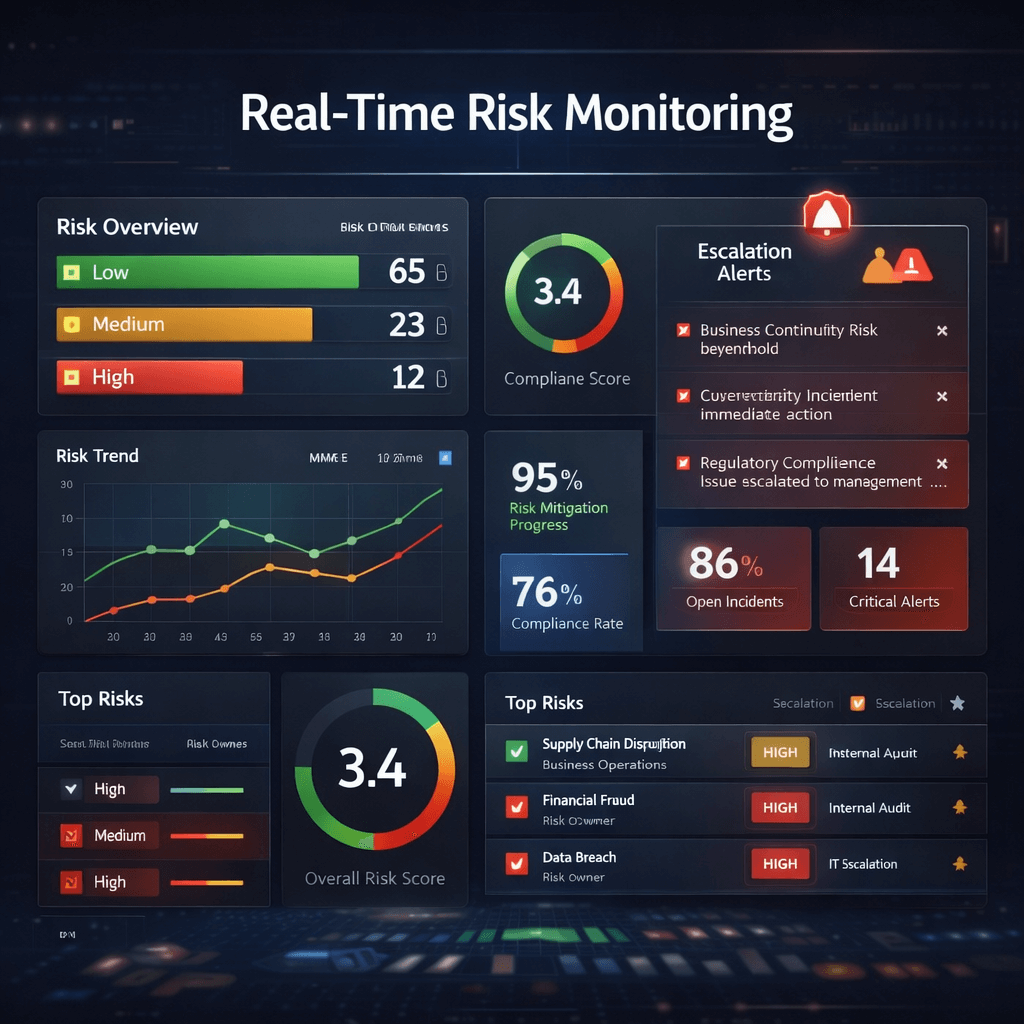
This is where ERM frameworks pay off visibly. Real-time dashboards, escalation workflows, and board-level risk reports show that your organization is on top of its exposure.
IFRS disclosures require specific narratives about your risk management approach. Your ERM reporting outputs feed directly into those notes.
Role of Technology and Automation
Manual spreadsheets can’t scale. Automation changes everything for ERM programs. You get faster data aggregation, real-time alerts, and audit-ready documentation without the manual effort.
GRC platforms, AI-based monitoring tools, and integrated reporting systems make it possible to run a compliant ERM framework without a team of 20 risk analysts doing it by hand.
Step-by-Step Guide to Building ERM Frameworks
Here’s the thing: most organizations don’t fail at ERM because they lack intention. They fail because they don’t follow a clear sequence. This is the one that works.
Step 1: Establish Governance and Board Oversight
Start at the top. Your board needs to own risk appetite. Without board-level buy-in, ERM frameworks become compliance theater rather than real management tools.
Establish a risk committee, define reporting lines, and document the board’s role in approving and reviewing the risk appetite statement.
Step 2: Define Risk Appetite and Policy Framework
Turn the board’s risk tolerance into written policy. Define quantitative thresholds for key risk types, and set the process for escalation when thresholds are breached.
For IFRS-reporting entities, make sure your policy explicitly addresses financial reporting risk, contract liability risk, and credit risk.
Step 3: Conduct Enterprise-Wide Risk Assessment
Run structured risk workshops with department heads. Use a consistent methodology: identify the risk, rate likelihood and impact, assign an owner, and document mitigating controls.
This produces your risk register, which becomes the foundation for both your ERM reporting and your IFRS disclosures.
Step 4: Integrate ERM with IFRS Reporting Processes
This step is where most organizations fall short. ERM data needs to flow into your financial reporting processes, not sit in a separate system.
Map each material risk to the relevant IFRS standard. For insurers, that means linking your risk register to IFRS 17 contract groupings, risk adjustments, and contract service margin calculations. ERM consulting services can help you build these mappings correctly.
Step 5: Implement Monitoring, KPIs, and Thresholds
Define key risk indicators for each material risk. Set thresholds that trigger escalation. Automate monitoring where possible.
Metrics to track include risk coverage ratio, control effectiveness rates, and the percentage of risks with documented owners and testing records.
Step 6: Continuous Review and Improvement
ERM frameworks aren’t static. Schedule quarterly reviews, run annual framework assessments, and update your risk taxonomy as new risks appear.
For IFRS compliance, make sure your review cycle aligns with your financial reporting calendar so there are no surprises at period close.
How to Align ERM Frameworks with IFRS 17 and IFRS 9
IFRS 17 and IFRS 9 are the two standards that most directly affect how insurance and financial services firms build their ERM frameworks. Let’s break down what each one demands.
Managing Insurance Risk and Contract Liabilities
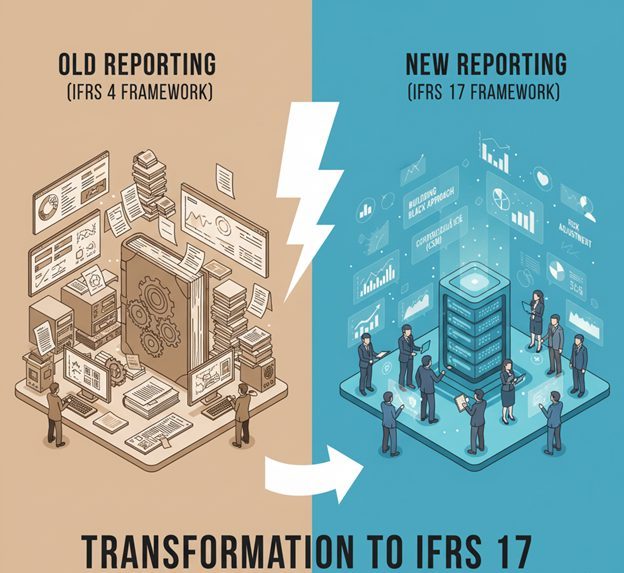
IFRS 17 fundamentally changes how insurers measure and report insurance contracts. It introduces current fulfillment value, the contract service margin, and risk adjustment for non-financial risk.
Your ERM framework needs to reflect these constructs. That means updating your risk taxonomy to include contract boundary risk, onerous contract risk, and CSM volatility as distinct risk categories. GCC insurers in particular have faced volatility in these areas due to pricing pressures and regulatory changes in the region.
Integrating Credit Risk and ECL Models
IFRS 9 requires expected credit loss models that forward-look at borrower risk. That’s an ERM input, not just a finance function.
Your credit risk identification process needs to feed your ECL model with scenario assumptions, macroeconomic overlays, and borrower-level data. Without that integration, your IFRS 9 provisioning is built on incomplete information.
Strengthening Disclosure and Audit Readiness
Both IFRS 17 and IFRS 9 require qualitative and quantitative disclosures about your risk management approach. Auditors will ask for evidence of the processes behind those disclosures.
ERM frameworks provide that evidence: risk registers, control testing records, board minutes, and monitoring reports all support your audit position.
Internal audit consulting teams working alongside ERM functions can close disclosure gaps before auditors find them.

Choosing the Right ERM Framework Model
There’s no single correct model. The right choice depends on your industry, regulatory environment, and organizational maturity.
COSO ERM Framework
COSO is the most widely adopted framework in the US and among multinationals. It covers five components: governance and culture, strategy and objective-setting, performance, review and revision, and information and communication.
A study of 100 US and European multinationals found that 63% adopted ERM processes during fiscal years 2021 to 2023. Researchers linked that growth partly to GAAP and SOX enforcement pushing organizations toward structured risk governance.
ISO 31000 Risk Management Standard
ISO 31000 takes a principles-based approach. It’s more flexible than COSO, which makes it a strong choice for organizations outside the US or those operating across multiple regulatory regimes.
It’s particularly relevant for Middle East firms operating under both IFRS and local regulatory frameworks, where flexibility in application is more practical than rigid compliance to a US-centric model.
Hybrid and Industry-Specific Models
Most mature organizations don’t use one framework in isolation. They combine elements of COSO’s structure with ISO 31000’s flexibility, then add industry-specific overlays for insurance, banking, or asset management.
For Saudi Arabia and GCC-based firms building ERM consulting programs, hybrid models let you meet SAMA, CBUAE, or IA-specific requirements without abandoning the global IFRS framework.
Common ERM Implementation Challenges and Solutions
You might be wondering: if ERM frameworks are this valuable, why do so many organizations struggle to implement them? Here are the four most common barriers, and what to do about each one.
Data Silos and System Integration Gaps
Challenge: Risk data lives in multiple systems with no clean way to consolidate it for reporting.
Solution: Map your data sources early in the implementation. Prioritize integration between your ERM platform and your financial reporting systems. Even a manual bridge is better than no connection at all.
Inconsistent Risk Ownership
Challenge: Risks are assigned owners on paper, but nobody actually takes responsibility for monitoring or mitigation.
Solution: Tie risk ownership to performance objectives. When a risk owner knows their rating depends on closing open action items, the engagement improves significantly.
Manual Processes and Scalability Issues
Challenge: Spreadsheet-based ERM programs can’t handle the volume and frequency of data that IFRS compliance requires.
Solution: Phase in automation. Start with risk register digitization, then add monitoring dashboards, then integrate with financial reporting systems. Don’t try to automate everything at once.
Compliance Gaps and Legacy Systems
Challenge: Legacy ERP or actuarial systems weren’t built with IFRS 17 or IFRS 9 in mind. Retrofitting them is expensive and error-prone.
Solution: Build the ERM framework around what your systems can currently produce, then create a roadmap to close technology gaps over 12 to 24 months. Document the gap itself as a known risk with mitigating controls.
Benefits of ERM Frameworks for IFRS Compliance
Let’s be clear about what you actually get when you build a well-designed ERM framework.
Improved Risk Transparency
IFRS disclosures are more credible when they’re backed by a documented ERM process. Investors, regulators, and auditors can see that your risk reporting reflects a real management discipline, not just a box-checking exercise.
The percentage of organizations claiming to have complete ERM processes jumped to 34% in 2023, up from just 9% in 2010, according to the IIA Foundation. Organizations that invest early build a disclosure advantage.
Stronger Governance and Accountability
Board-level risk oversight improves decision quality. When directors have real-time access to risk dashboards and escalation reports, they can challenge management assumptions and prevent overconfidence in projections.
That governance structure is also what IFRS auditors want to see as evidence of a controlled reporting environment.
Better Decision-Making and Capital Planning
ERM frameworks give CFOs and actuaries the data they need to make capital allocation decisions with risk-adjusted returns in mind.
For IFRS 17 insurers, that means CSM release decisions informed by real risk quantification, not just actuarial estimates made in isolation from the broader risk picture.
FAQs on ERM Frameworks for IFRS Compliance
What is the first step in building an ERM framework for IFRS compliance?
Start with governance. Define your board’s risk oversight role, establish a risk committee, and document who approves the risk appetite statement. Without executive ownership, the rest of the framework won’t hold.
How do ERM frameworks connect to IFRS 17 specifically?
IFRS 17 requires insurers to measure insurance contracts at current fulfillment value, including a risk adjustment for non-financial risk. Your ERM framework provides the risk identification and quantification processes that feed those calculations. The contract service margin, which represents unearned profit, needs to be monitored for volatility, and that’s a direct ERM function.
What’s the difference between COSO and ISO 31000 for IFRS compliance?
COSO provides a structured, component-based model aligned to US regulatory expectations. ISO 31000 offers a principles-based approach with more flexibility. For Middle East firms under IFRS with local regulatory overlays, ISO 31000 often fits better. Many organizations adopt a hybrid that combines the governance structure of COSO with the process flexibility of ISO 31000.
How long does it take to implement an ERM framework?
A basic framework covering risk identification, assessment, and reporting can be operational in three to six months. Full integration with IFRS financial reporting processes typically takes 12 to 18 months, depending on your system landscape and the complexity of your risk portfolio.
What are the common pitfalls in ERM implementation for IFRS firms?
The most common pitfalls are unclear risk ownership, data silos between risk and finance teams, and frameworks that don’t map to the specific IFRS standards that apply to your organization. Rushing past the governance design step is also a frequent mistake that creates accountability gaps later.
Do Middle East and GCC firms need a different ERM approach?
Not a completely different approach, but regional adaptations matter. GCC insurers implementing IFRS 17 face specific volatility in motor and medical lines. Saudi Arabia’s SAMA and the UAE’s CBUAE have their own capital and risk governance expectations. A hybrid ERM framework that addresses both IFRS requirements and local regulatory standards is the most practical model for the region.
ERM Frameworks That Work Start With the Right Foundation
Building ERM frameworks for IFRS compliance isn’t a one-time project. It’s an ongoing discipline that connects your risk culture to your financial reporting, your governance to your audit readiness, and your strategy to your capital decisions.
The organizations getting this right aren’t necessarily the largest. They’re the ones that started with a clear governance structure, mapped their risks to the specific IFRS standards that apply to them, and invested in continuous monitoring rather than annual reviews.
If your organization is ready to build or strengthen its ERM framework for IFRS compliance, Prima Consulting brings deep expertise in risk frameworks, actuarial integration, and IFRS-aligned governance for firms across the Middle East and globally.
Get in touch with our enterprise risk management consulting team today to start building a framework that holds up under scrutiny.